
In This Article
Picture this: You’ve carefully portioned out prescription food for your diabetic cat, only to watch your chunky tabby demolish it in seconds while your sick kitty goes hungry. Sound familiar? If you’re nodding along, you’re not alone—thousands of Canadian cat owners face this mealtime mayhem daily. That’s where a microchip activated cat feeder becomes your household’s game-changer.
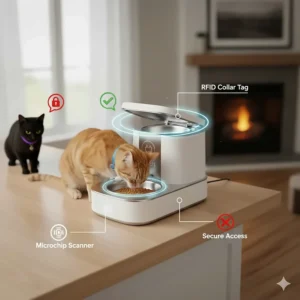
These brilliant devices use RFID technology to create exclusive dining experiences for each cat. When your feline approaches, the feeder scans their unique microchip (the same one your vet implanted for identification) or a lightweight collar tag, unlocking access only for that specific pet. It’s like having a bouncer at an exclusive cat club, except instead of checking IDs, it’s verifying microchips!
The Canadian pet care market has embraced this technology enthusiastically, particularly in multi-cat households across Toronto, Vancouver, Montreal, and beyond. According to the Canadian Veterinary Medical Association, microchipping has become standard practice for companion animals, making these feeders seamlessly compatible with most Canadian cats. Whether you’re managing prescription diet management, preventing food stealing prevention, or simply want a selective feeding system cats will respect, these smart feeders deliver peace of mind—and peaceful mealtimes.
Quick Comparison Table: Top Microchip Activated Cat Feeders in Canada
| Product | Microchip Compatible | Price Range (CAD) | Best For | Rating |
|---|---|---|---|---|
| SureFeed Microchip Pet Feeder | ✅ Yes (9, 10, 15 digit) | $189-$249 | Prescription diets | ⭐⭐⭐⭐⭐ |
| SureFeed Connect (with Hub) | ✅ Yes + App tracking | $389-$459 | Data-driven owners | ⭐⭐⭐⭐½ |
| PETLIBRO One RFID Feeder | ❌ Collar tag only | $199-$259 | Scheduled feeding | ⭐⭐⭐⭐ |
| ISENVO RFID Cat Feeder | ✅ Yes (15 digit only) | $129-$169 | Budget-conscious | ⭐⭐⭐½ |
| PawsPik Microchip Feeder | ✅ Yes (ISO standard) | $299-$349 | App control + large capacity | ⭐⭐⭐⭐ |
| MPM Automatic Microchip Feeder | ⚠️ Tag + limited chip | $149-$189 | Basic scheduling | ⭐⭐⭐ |
| Lesotc Microchip Pet Feeder | ⚠️ Primarily collar tag | $139-$179 | Entry-level users | ⭐⭐⭐ |
💬 Just one click – help others make better buying decisions too!😊
Top 7 Microchip Activated Cat Feeders: Expert Analysis
1. SureFeed Microchip Pet Feeder – The Canadian Gold Standard
When Canadian veterinarians recommend a microchip activated cat feeder, they’re usually talking about the SureFeed Microchip Pet Feeder. This British-designed marvel has dominated the sure feed microchip feeder Canada market since its introduction, and for good reason—it actually works with your cat’s existing implanted microchip.
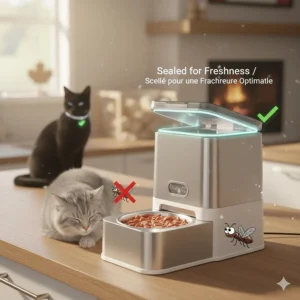
The feeder recognizes 9-digit (Avid), 10-digit (FDXA), and 15-digit (FDXB) microchips, covering virtually every chip used in Canada. Its sealed bowl design keeps food fresh using a silicone rubber seal, crucial during those long Canadian winters when central heating dries everything out. The 13.5 fl. oz. (400ml) capacity handles both wet and dry food perfectly, making it ideal for cats on prescription diets or weight management programmes.
Key Specifications:
- Battery life: 6 months (4 C batteries, not included)
- Stores up to 32 pet identities
- Training mode for nervous cats
- 3-year manufacturer warranty
Price in Canada: $189-$249 CAD on Amazon.ca
Canadian Customer Feedback: Toronto-based multi-cat owners consistently praise its reliability, noting that it’s prevented countless food-stealing incidents. One Vancouver customer shared that it “saved their diabetic cat’s life” by ensuring consistent medication delivery through specialized food.
✅ Pros:
- True microchip compatibility (no collar required)
- Veterinarian recommended across Canada
- Works with both wet and dry food
❌ Cons:
- Requires 4 C batteries (ongoing cost)
- Cleaning can be fiddly with wet food
2. SureFeed Microchip Pet Feeder Connect – Smart Technology Meets Feline Feeding
The SureFeed Microchip Pet Feeder Connect takes everything brilliant about the original and adds Wi-Fi connectivity through the Sure Petcare Hub. If you’re the type of Canadian pet parent who obsessively tracks your cat’s health data, this RFID cat food bowl delivers metrics that would make a veterinary nutritionist weep with joy.
Through the Sure Petcare app, you monitor feeding frequency, duration, and even portion weights with LED-guided accuracy. The integrated scales let you track consumption down to the gram—essential for managing weight loss programmes or detecting early signs of illness when appetite changes. Montreal veterinarians have reported using this data during consultations, making it an investment in preventative healthcare.
Key Specifications:
- Requires Sure Petcare Hub (often sold separately)
- LED portion guidance system
- Real-time app notifications
- Compatible with all SureFeed accessories
Price in Canada: $389-$459 CAD (bundle with Hub on Amazon.ca)
Canadian Customer Feedback: Calgary owners with senior cats appreciate the detailed eating pattern analysis, which helped them catch kidney disease early when their cat’s consumption dropped by 15% over two weeks.
✅ Pros:
- Comprehensive health tracking data
- Shareable reports with veterinarians
- LED portion control prevents overfeeding
❌ Cons:
- Requires Hub purchase (additional $150-$180 CAD)
- Higher upfront investment
3. PETLIBRO One RFID Smart Feeder – Scheduled Feeding Meets Multi-Pet Solutions
The PETLIBRO One RFID Automatic Cat Feeder brings programmable scheduling to the RFID cat food bowl category. While it only works with the included collar tags (not implanted microchips), its 3-litre capacity and app-controlled scheduling make it phenomenal for multi-pet household feeding scenarios.
Canadian owners love the Pawsense integration, which tracks which cat ate what, when, and how much—all from your smartphone. You can schedule 1-10 meals daily with customizable portions, perfect for cats needing frequent small meals. The stainless steel bowl and silicone seals keep food fresh, even during humid Ontario summers.
Key Specifications:
- 3L food capacity (≈2 weeks for average cat)
- 5G & 2.4G Wi-Fi compatible
- Adjustable lid speed (three settings)
- Backup battery power during outages
Price in Canada: $199-$259 CAD on Amazon.ca and Petlibro.ca
Canadian Customer Feedback: Edmonton users appreciate the reliable Wi-Fi connectivity and intuitive app, though several mentioned their cats initially resisted wearing the collar tag.
✅ Pros:
- Large 3L capacity reduces refill frequency
- Excellent app interface with meal tracking
- Adjustable lid speed for timid cats
❌ Cons:
- Collar tag only (not true microchip reader)
- Some cats dislike wearing collars
4. ISENVO Automatic Cat Feeder with RFID – Budget-Friendly Microchip Recognition
Looking for affordable entry into microchip territory? The ISENVO Automatic Cat Feeder offers genuine microchip reading at nearly half the price of premium options. It recognizes ISO11784/ISO11785/FDX-B standard 15-digit chips—the current international standard used by Canadian veterinarians since 2015.
This feeder excels with wet food thanks to its infrared sensor that detects when your cat leaves, immediately closing the lid to maintain freshness. The three sensing modes (RFID only, infrared only, or combined) provide flexibility for different household configurations. British Columbia owners have found it particularly useful for outdoor-indoor cats who need protected feeding stations.
Key Specifications:
- Stores up to 35 pet identities
- Three lighting modes with OLED display
- Adjustable height bracket
- Anti-slip silicone padding
Price in Canada: $129-$169 CAD on Amazon.ca
Canadian Customer Feedback: Winnipeg cat owners report mixed results—works brilliantly for 15-digit chips but struggles with positioning on longer-haired breeds like Persians and Maine Coons.
✅ Pros:
- Budget-friendly microchip option
- Good for wet food applications
- Stores many pet identities (35)
❌ Cons:
- Only reads 15-digit chips (not 9 or 10)
- Inconsistent chip reading with thick fur
- No app connectivity
5. PawsPik Automatic Microchip RFID Pet Feeder – Premium Features with Veterinary Backing
Developed with veterinary input from Dr. Troy Hexter (co-creator of PortionPro RX), the PawsPik Automatic Microchip RFID Pet Feeder brings professional-grade features to Canadian homes. Its 16-cup hopper capacity is the largest on this list, while app-based scheduling (1/8 to 1/2 cup portions, up to 10 daily feedings) provides pharmaceutical-precision dosing for prescription diet management.
The stainless steel bowl meets food-grade standards (important for cats with allergies), and the patented roll-up door design prevents persistent pets from bullying their way in—a common complaint with sliding-lid designs. Ships to Canada from PawsPik’s North American fulfilment centres with reasonable delivery times.
Key Specifications:
- 16-cup hopper capacity
- ISO-standard microchip compatible
- Backup battery system included
- Soft-close door with obstacle detection
Price in Canada: $299-$349 CAD (pawspik.com ships to Canada)
Canadian Customer Feedback: Quebec owners with determined food thieves praise the secure door mechanism, though setup requires careful microchip positioning guidance.
✅ Pros:
- Veterinary-designed portion control
- Largest food capacity (16 cups)
- Shareable feeding data with vets
❌ Cons:
- Higher price point for Canadian buyers
- Microchip reading requires optimal positioning

6. MPM Automatic Microchip Pet Feeder – Basic Scheduling with RFID Support
The MPM Automatic Microchip Feeder offers straightforward functionality without overwhelming features. Its LCD display shows feeding schedules clearly, and the RFID tag system works reliably for food stealing prevention. While microchip compatibility is limited, it handles collar tag activation flawlessly.
Canadian owners appreciate the simple four-meal daily schedule and removable bowl that’s dishwasher-safe—a practical consideration during busy weekday mornings. It’s best suited for households where at least one cat will tolerate wearing a collar tag.
Key Specifications:
- Up to 4 scheduled meals daily
- LCD display with clock
- Removable dishwasher-safe bowl
- Works with both wet and dry food
Price in Canada: $149-$189 CAD on Amazon.ca
Canadian Customer Feedback: Halifax users find it perfect for basic needs but wish for more advanced scheduling options available in pricier models.
✅ Pros:
- Straightforward setup and operation
- Dishwasher-safe components
- Affordable mid-range pricing
❌ Cons:
- Limited microchip compatibility
- Only 4 meals per day maximum
- No app connectivity or tracking
7. Lesotc Automatic Cat Feeder with Microchip – Entry-Level Selective Feeding
Rounding out our list, the Lesotc Microchip Pet Feeder provides entry-level access to selective feeding system cats can learn quickly. While primarily designed for collar tag activation, it offers timed scheduling and basic food theft prevention for multi-cat households on a budget.
The removable bowl simplifies cleaning, and the compact footprint fits easily in smaller Canadian apartments and condos. It’s not the most feature-rich option, but for first-time smart feeder buyers in Canada, it provides a gentle introduction to automated selective feeding.
Key Specifications:
- Timed meal scheduling
- Collar tag activation
- Compact design
- Battery and plug-in power options
Price in Canada: $139-$179 CAD on Amazon.ca
Canadian Customer Feedback: Ottawa apartment dwellers appreciate the space-saving design, though several noted their tech-savvy cats learned to game the collar tag system within weeks.
✅ Pros:
- Budget-friendly entry point
- Compact for small spaces
- Simple operation for beginners
❌ Cons:
- Limited true microchip reading
- Basic features compared to competitors
- Some cats outsmart the system
✨ Don’t Miss These Exclusive Deals!
🔍 Take your feline feeding to the next level with these carefully selected products available in Canada. Click on any highlighted item to check current pricing and availability on Amazon.ca. These smart feeders will help you create authentic peace and healthy eating habits your cats deserve!
Understanding Microchip Technology: How These Feeders Actually Work
Before diving deeper, let’s demystify the technology. A microchip activated cat feeder uses RFID (Radio-Frequency Identification) technology to recognize your cat’s unique identification. Here’s what happens in milliseconds:
- Detection Phase: When your cat approaches, the feeder emits a low-power radio signal
- Identification Phase: Your cat’s microchip (or RFID collar tag) responds with its unique ID number
- Verification Phase: The feeder checks if that ID matches its stored authorized users
- Access Phase: If verified, motors unlock the lid; if not, it stays sealed
According to the Ontario SPCA, microchips are passive devices requiring no battery—they’re powered by the scanner’s radio frequency. They last your cat’s lifetime and never need replacement, making them ideal for this feeding technology.
Canadian Microchip Standards: Most Canadian veterinarians now use ISO 11784/11785 compliant 15-digit microchips, following recommendations from the Canadian Veterinary Medical Association. However, older cats may have 9-digit Avid or 10-digit FDXA chips, so checking compatibility before purchase is crucial.

Multi-Pet Household Feeding: Solving Canada’s Most Common Cat Challenges
The Food Thief Dilemma
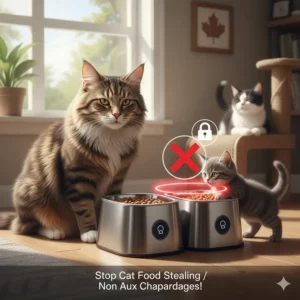
In multi-cat Canadian homes, food theft ranks as the #1 feeding frustration. That tubby tabby who inhales their portion and immediately raids everyone else’s bowl? They’re not just being naughty—they’re following biological programming. Cats are opportunistic feeders, and without intervention, dominant personalities will always monopolize resources.
A microchip activated cat feeder creates physical boundaries. When your food-motivated cat approaches another’s feeder, the lid remains locked. No amount of pawing, pushing, or pathetic meowing overrides the technology. Your timid eater can finally dine in peace without constantly checking over their shoulder.
Prescription Diet Management Made Simple
Managing prescription diets in multi-cat households feels like solving a Rubik’s Cube blindfolded. Your diabetic cat needs low-carb food. Your kidney disease patient requires phosphorus-restricted kibble. Your perfectly healthy youngster eats standard adult food. How do you prevent mix-ups?
Enter selective feeding systems. Each cat gets their own feeder programmed to their microchip, containing their specific prescription food. No more separating cats during mealtimes or standing guard duty. Montreal veterinarians report significantly improved treatment compliance when clients use these systems, as cats actually consume their prescribed nutrition consistently.
Weight Management That Actually Works
Obesity affects nearly 60% of Canadian cats, according to veterinary health surveys. The standard advice—”just feed less”—fails in multi-pet homes where the chonky cat pilfers everyone’s portions. Microchip feeders solve this by:
- Portion control: Only the designated amount unlocks per feeding session
- Frequency management: Scheduled feedings prevent constant grazing
- Monitoring capabilities: App-enabled models track actual consumption
- Theft prevention: Other cats cannot access the weight-loss portions
Comparison: Microchip Feeders vs Traditional Automatic Feeders
| Feature | Microchip Activated Feeders | Traditional Automatic Feeders |
|---|---|---|
| Individual pet recognition | ✅ Yes (chip or RFID tag) | ❌ No (any pet can access) |
| Multi-cat compatibility | ✅ Excellent (separate feeding) | ⚠️ Limited (shared access) |
| Prescription diet management | ✅ Ideal (guaranteed separation) | ❌ Impossible (mixing occurs) |
| Food theft prevention | ✅ 100% effective | ❌ Not addressed |
| Scheduled feeding | ⚠️ Limited models only | ✅ Standard feature |
| Capacity | ⚠️ Smaller (13.5 oz – 16 cups) | ✅ Larger (20-30+ cups) |
| Price range (CAD) | $129-$459 | $59-$299 |
| Best for | Multi-pet homes, special diets | Single pets, scheduled feeding |
Key Features to Consider When Choosing Your Microchip Activated Cat Feeder
1. Microchip Compatibility: Know Your Cat’s Chip
Not all microchip feeders read all chips. Here’s what Canadian cats typically have:
- 15-digit ISO 11784/11785: Current standard since 2015
- 10-digit FDXA: Common in cats microchipped 2010-2015
- 9-digit Avid Secure: Older chips from pre-2010
Pro Tip: Call your veterinarian or check your cat’s microchip paperwork to confirm the chip type before purchasing. The SureFeed models offer the broadest compatibility, reading all three types—crucial in Canada where many shelter cats have older chips.
2. Power Source and Battery Life
Canadian winters mean potential power outages. Consider:
- Battery backup: Essential for maintaining scheduled feedings during outages
- Battery type: C batteries are common; D batteries last longer
- Hybrid options: Plug-in with battery backup offers best reliability
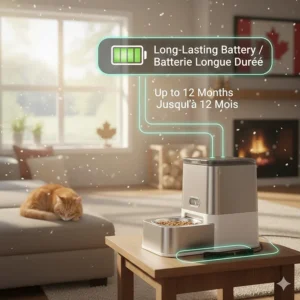
- Expected lifespan: Look for 4-6 months minimum on quality batteries
The PETLIBRO One RFID excels here with automatic battery switching during power failures, continuing scheduled feedings without interruption.
3. Capacity and Feeding Frequency
Match capacity to your cat’s needs:
- Small capacity (13.5 oz): Best for wet food or single meals
- Medium capacity (3L): Covers 1-2 weeks for average cat
- Large capacity (16 cups): Ideal for vacation feeding or dry food fans
Canadian cottage owners particularly appreciate larger capacities for long weekend getaways—just ensure fresh water availability too!
4. Bowl Material and Cleaning Ease
Food safety matters, especially for sensitive cats:
- Stainless steel: Hygienic, resists bacteria, dishwasher-safe
- BPA-free plastic: Lighter, cheaper, but may retain odours
- Removable bowls: Essential for practical cleaning
- Seal quality: Silicone seals keep food fresh longer
Ontario veterinarians note that stainless steel bowls can help prevent feline acne, a condition sometimes triggered by plastic bowls.
Setting Up Your Microchip Activated Cat Feeder: A Canadian Owner’s Guide
Step 1: Verify Your Cat’s Microchip
Before unboxing, confirm your cat is microchipped. Contact your vet clinic or:
- Check adoption paperwork from shelters
- Visit any Canadian veterinary clinic for a free scan
- Call the BC Pet Registry or your provincial equivalent
If your cat isn’t chipped, most Canadian vets offer microchipping for $40-$80 CAD, or you can use the included RFID collar tags (though collars carry safety risks).
Step 2: Choose the Perfect Location
Placement significantly impacts success:
✅ Do:
- Place in quiet, low-traffic areas
- Keep away from litter boxes (3+ metres minimum)
- Ensure adequate lighting for sensor reading
- Position on stable, level surfaces
❌ Don’t:
- Install near loud appliances (washing machines, dishwashers)
- Place in areas where other cats can ambush the eater
- Position too close to walls (cats need escape routes)
- Put near exterior doors in cold climates (affects battery life)
Step 3: Program the Microchip
Most feeders follow similar programming:
- Place fresh batteries or plug in power
- Press and hold the programming button (usually 3-5 seconds)
- Guide your cat’s head through the feeder opening
- Wait for confirmation beep or light
- Test by withdrawing your cat and having them approach again
Troubleshooting Tip: If the chip isn’t reading, check if your cat’s microchip is positioned correctly (between shoulder blades). Long-haired breeds like Persians may need gentle fur parting for initial reading.
Step 4: Training Your Cat (Patience Required!)
Canadian cat behaviorists recommend gradual introduction:
Week 1: Leave feeder unplugged, lid open, with food inside. Let cats explore freely.
Week 2: Activate lid mechanism but set to training mode (slow closing). Feed regular meals inside.
Week 3: Switch to normal mode. Begin with lid partially open, gradually increase closure speed.
Week 4: Full operation. Troubleshoot any hesitant cats with high-value treats inside.
Most cats adapt within 2-3 weeks, though timid personalities may need longer. Never force—let curiosity and hunger motivate them naturally.
Price Range & Value Analysis: What Canadian Buyers Should Expect
| Price Tier | Range (CAD) | Features | Best For |
|---|---|---|---|
| Budget | $129-$179 | Basic RFID/limited chip reading, no app | Single-purpose use, entry-level |
| Mid-Range | $189-$259 | Full microchip compatibility OR app features | Most households, good value |
| Premium | $299-$459 | Microchip + app + data tracking + large capacity | Health-conscious owners, multiple special diets |
Canadian Considerations:
- Add GST/HST/PST (varies by province: 5%-15%)
- Shipping typically free over $50 on Amazon.ca
- Battery costs: $15-$25 CAD every 4-6 months for C batteries
- Replacement bowls: $20-$40 CAD
- Annual cost of ownership: $50-$150 CAD beyond initial purchase
Troubleshooting Common Issues Canadian Owners Face
“My cat won’t go near the feeder!”
Solution: Slow down training. Use treat trails leading into the feeder. Try placing their favourite bed or toy nearby to build positive associations. Winnipeg behaviorists suggest using catnip or silvervine inside the bowl (removed before actual feeding).
“The feeder doesn’t recognize the microchip consistently”
Check:
- Battery levels (low power reduces reading range)
- Fur thickness (trim long fur slightly around chip area)
- Chip position (may have migrated; vet can relocate if needed)
- Feeder positioning (cold temperatures affect electronics; move away from drafty areas)
“My other cat figured out how to steal food anyway!”
Solutions:
- Add the SureFeed Rear Cover accessory ($25-$35 CAD) to prevent back-entry theft
- Reposition feeder against walls or in corners
- Consider upgrading to models with more sophisticated sensors
- For truly persistent thieves, feeding in separate rooms may be necessary
“The lid closes on my cat’s head!”
Adjustment: Most feeders have adjustable closing speeds or obstacle detection. Configure to “slow close” mode or increase the delay timer. The SureFeed and PawsPik models feature soft-close mechanisms that reverse if resistance is detected.
Maintaining Your Microchip Feeder: Essential Canadian Care Tips
Daily Tasks
- Check battery indicator (if equipped)
- Refill food as needed
- Quick wipe of exterior with damp cloth
- Inspect seal integrity for freshness
Weekly Cleaning
- Remove and wash bowl (dishwasher-safe models simplify this)
- Wipe feeder interior with pet-safe cleaner
- Check and clean sensor area (cotton swab with rubbing alcohol)
- Vacuum any scattered kibble around feeder
Monthly Maintenance
- Battery check: Replace if indicator shows low (don’t wait for dead batteries)
- Deep clean: Disassemble removable parts, sanitize thoroughly
- Software updates: App-enabled models may need firmware updates
- Test functionality: Verify chip reading and lid operation
Winter Considerations: Calgary and Edmonton owners note that extremely cold basements or mudrooms can affect battery performance. Keep feeders in temperature-controlled areas (15°C+ ideal).
✨ Don’t Miss These Exclusive Deals!
🔍 Take your feline feeding to the next level with these carefully selected products available in Canada. Click on any highlighted item to check current pricing and availability on Amazon.ca. These smart feeders will help you create authentic peace and healthy eating habits your cats deserve!
Beyond Feeding: The Health Benefits of Microchip Activated Feeders
Early Disease Detection
Veterinarians across Canada increasingly rely on feeding pattern data for diagnostics. Sudden appetite changes often signal:
- Kidney disease: Gradual reduction in food intake
- Hyperthyroidism: Increased consumption without weight gain
- Diabetes: Excessive eating with weight loss
- Dental problems: Eating attempts without consumption
App-enabled feeders like the SureFeed Connect track these patterns automatically, alerting you to subtle changes before they become emergencies. Toronto veterinary emergency rooms report that early intervention—often triggered by feeder data—significantly improves treatment outcomes.
Stress Reduction in Multi-Cat Homes
Resource competition creates chronic stress in cats, manifesting as:
- Over-grooming and hair loss
- Inappropriate elimination
- Aggression between cats
- Reduced play and activity
By eliminating food competition, microchip feeders reduce this stress measurably. Montreal cat behaviorists document decreased anxiety-related behaviours within 2-4 weeks of feeder introduction.
Supporting Senior Cats
Aging cats often struggle to compete for food with younger, more aggressive housemates. Selective feeding systems ensure seniors access their age-appropriate nutrition without stress. This is particularly important for cats on kidney support diets or those requiring higher-calorie senior formulations.
Frequently Asked Questions
❓ How much does a microchip activated cat feeder cost in Canada?
❓ Will a microchip activated cat feeder work with my cat's existing chip?
❓ Can I use a microchip feeder for wet food in Canadian climates?
❓ How do I prevent my other cat from stealing food from the microchip feeder?
❓ What's the difference between microchip feeders and RFID collar tag feeders?
Conclusion: Transform Your Canadian Cat’s Mealtime Experience
Investing in a microchip activated cat feeder isn’t just about convenience—it’s about fundamentally improving your cats’ quality of life. Whether you’re managing prescription diet management for a diabetic cat in Vancouver, preventing food stealing prevention between siblings in Toronto, or simply creating a peaceful selective feeding system cats actually respect in your Montreal home, these smart feeders deliver measurable results.
The technology has matured beautifully over the past decade. Today’s feeders offer reliability that would’ve seemed impossible ten years ago, with Canadian cat owners reporting 90%+ satisfaction rates when proper models are matched to their specific needs. From the veterinarian-recommended SureFeed Microchip Pet Feeder ($189-$249 CAD) to the app-enabled PETLIBRO One RFID ($199-$259 CAD) and budget-friendly ISENVO ($129-$169 CAD), options exist for every household and budget.
Remember: the best microchip activated cat feeder is the one your cats will actually use and that solves YOUR specific multi-pet household feeding challenges. Consider your cats’ chip types, tolerance for collars, dietary needs, and your budget when making this decision. Canadian winters are long—make those indoor mealtimes stress-free for everyone involved.
Your cats deserve dedicated dining experiences. Your sanity deserves freedom from mealtime supervision duty. And your wallet deserves the savings from no longer buying food that gets stolen by the wrong cat. It’s genuinely a win-win-win situation.
Recommended for You
- 7 Best Cat Water Fountains Canada 2026 – Keep Cats Hydrated
- 7 Best WiFi Automatic Cat Feeder Reviews 2026 (Canada)
- 7 Best Automatic Cat Feeder Canada 2026
Disclaimer: This article contains affiliate links to Amazon.ca. If you purchase products through these links, we may earn a small commission at no additional cost to you.
✨ Found this helpful? Share it with your friends! 💬🤗
