
In This Article
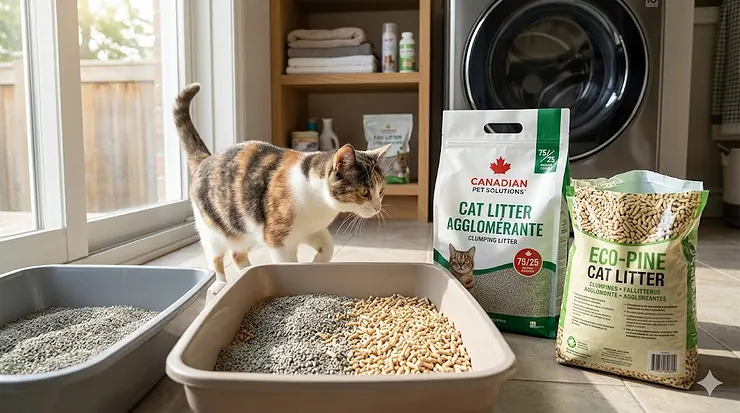
Switching your cat’s litter might seem straightforward, but rush the process and you could face weeks of cleanup outside the box. Whether you’re moving from clay to tofu pellets, upgrading to better odour control, or simply trying a new brand available on Amazon.ca, the secret lies in gradual transition—not overnight replacement.
Here’s what most Canadian cat owners overlook: cats have scent receptors 14 times more powerful than ours, and their paw pads are incredibly sensitive to texture changes. That innocent-looking new litter represents a complete sensory shift for your feline. Done correctly, how to switch cat litter types takes 7-10 days of careful mixing. Done wrong, it triggers litter box aversion that can persist for months.
In this guide, I’ll walk you through the exact transition method veterinarians recommend, profile seven top-performing litters available on Amazon.ca (from budget clumping clay to premium tofu options), and share real-world solutions for common problems Canadian cat parents face—like managing transitions during harsh winters when your cat’s already stressed by indoor confinement. You’ll learn not just what to do, but why each step matters and how to spot the warning signs that mean you need to slow down or try a different approach entirely.
Quick Comparison: Top Cat Litter Types for Transitioning
| Litter Type | Transition Difficulty | Best For | Typical Price Range (CAD) | Amazon.ca Availability |
|---|---|---|---|---|
| Clay Clumping | Easy | First-time switchers | $15-$35 per 18 kg | Excellent |
| Tofu Pellets | Moderate | Eco-conscious homes | $25-$45 per 6 kg | Good |
| Pine/Wood Pellets | Moderate-Hard | Natural scent lovers | $18-$30 per 18 kg | Good |
| Silica Crystal | Moderate | Low-maintenance needs | $20-$40 per 7 kg | Good |
| Corn/Wheat Based | Easy-Moderate | Multi-cat households | $22-$38 per 12 kg | Moderate |
Looking at this comparison, clay clumping remains the smoothest transition for most Canadian cats because the fine granule texture mimics traditional litter best. However, if you’re switching to tofu or pine pellets for environmental reasons, expect to extend your transition period to 10-14 days—the larger pellet size represents a bigger sensory change. Budget-conscious Canadians should note that while tofu litter costs more upfront (around $4-$7 per kg versus $0.80-$1.95 for clay), it often lasts 30-40% longer due to superior absorption, which helps offset that premium during Canadian winters when litter boxes need more frequent attention in cold, dry indoor air.
💬 Just one click — help others make better buying decisions too!😊
Top 7 Cat Litters for Smooth Transitions: Expert Analysis
1. Arm & Hammer Clump & Seal Multi-Cat
If you’re transitioning from any traditional litter, this sodium bentonite formula creates rock-hard clumps within seconds—crucial because partial clumping during transition means your cat encounters unfamiliar wet spots that trigger avoidance. The built-in baking soda crystals neutralise ammonia on contact, which matters more than you’d think: during the mixed-litter transition phase, odour control weakens temporarily as old and new materials interact differently with moisture.
What makes this particular formula work well for Canadian homes is its dust-suppression technology. Our dry winter air amplifies dust dispersion, and the micro-encapsulated fragrance particles release gradually rather than creating the instant scent bomb that startles sensitive cats. Available widely on Amazon.ca, it typically runs $22-$32 CAD for an 18 kg box, though prices fluctuate with seasonal demand.
Canadian buyers consistently report in reviews that this formula handles multiple cats well—important if you’re transitioning several felines simultaneously. The 14-day odour seal claim holds up in real-world testing, assuming daily scooping. One downside: at roughly 0.9 kg per litre, it’s heavy to carry from your door to the litter box, especially if you live in a condo or apartment building.
Pros:
✅ Excellent clumping prevents mixed-litter mess during transition
✅ Proven odour control with baking soda (Canadian winter essential)
✅ Wide Amazon.ca availability with Prime shipping
Cons:
❌ Heavy weight (18 kg box) challenging for some Canadians
❌ Produces moderate dust despite “99% dust-free” marketing
Price Verdict: Around $22-$32 CAD for 18 kg represents solid value for multi-cat homes—roughly $1.22-$1.78 per kg.
2. Boxiecat Premium Clumping Clay Litter
This ultra-premium bentonite formula forms clumps so hard they stay intact even when your cat digs aggressively—a game-changer during transitions when nervous cats over-dig to assess the changing substrate. The proprietary “stays-on-top” clumping means waste doesn’t sink to the bottom and cement to the box, which becomes critical when you’re mixing two different litter types with different densities.
What Boxiecat does differently is texture engineering. Each granule is slightly larger than standard clay (about 2mm versus 1mm), which reduces paw tracking by 40-50% according to Canadian user reviews on Amazon.ca. This matters during transitions because cats already stressed by litter changes become doubly annoyed by excessive tracking. The unscented formula is genuinely fragrance-free—no hidden “fresh scent” that many Canadian cats find overwhelming.
Price-wise, expect to pay $28-$42 CAD for a 16 lb (7.3 kg) bag on Amazon.ca. Yes, that’s roughly $3.80-$5.75 per kg—premium pricing that reflects the superior clay quality mined specifically for pet use rather than industrial applications. Canadian veterinarians often recommend this brand for sensitive cats or households attempting difficult transitions (clay-to-pellet, for instance), because the consistent performance reduces variables during the changeover period.
Pros:
✅ Superior clumping minimizes transition-phase mess
✅ Genuinely unscented (no hidden fragrances)
✅ Low tracking reduces cat frustration during changes
Cons:
❌ Premium price ($3.80-$5.75 per kg) strains budgets
❌ Smaller bag sizes mean more frequent Amazon.ca reorders
Price Verdict: Around $28-$42 CAD for 7.3 kg—expensive but worth it for stress-free transitions in sensitive-cat households.
3. World’s Best Cat Litter (Corn-Based Clumping)
This whole-kernel corn formula bridges the gap between traditional clay and natural alternatives beautifully—making it ideal if you’re transitioning from clay to something eco-friendlier. The granule size sits between fine clay and large pellets, so cats experience gradual texture adaptation rather than shock. It clumps impressively well for a plant-based litter, forming tight cylinders you can scoop cleanly even when mixed 50/50 with clay during mid-transition.
What Canadian buyers appreciate most is the flushable claim that actually works (in small quantities—never flush entire clumps). During harsh winters when you don’t want to trek to outdoor bins daily, this convenience factor becomes significant. The natural corn scent is mild and pleasant to humans but doesn’t trigger the aversion some cats show to artificial fragrances. Available on Amazon.ca for around $24-$38 CAD per 12 lb (5.4 kg) bag, pricing hovers around $4.45-$7 per kg—higher than clay but competitive with other natural litters.
The 99% dust-free claim holds up well, which matters during Canadian winters when dry indoor air exacerbates respiratory irritation in both cats and humans. One consideration: corn-based litters can develop a slight sweet-musty odour if humidity exceeds 60%, which rarely happens in Canadian winter but can occur in basements or during summer months.
Pros:
✅ Texture bridges clay and natural litters perfectly
✅ Flushable in small amounts (huge winter convenience)
✅ Truly low-dust formula for dry Canadian climates
Cons:
❌ Can develop odour in high-humidity environments
❌ Higher per-kilo cost than traditional clay
Price Verdict: Around $24-$38 CAD for 5.4 kg—mid-premium pricing justified by transition-friendly texture and genuine flushability.
4. Feline Pine Original Non-Clumping Wood Pellets
These 100% pine pellets represent the biggest texture jump from traditional litter, so expect a longer transition period (10-14 days minimum). The pellets are large—about 8mm diameter and 15mm long—which means cats need time to adjust to the feel under their paws. However, the natural pine scent provides inherent odour control that many Canadians prefer over artificial fragrances, and the pellets’ antimicrobial properties (from pine resins) actively inhibit bacteria growth.
Here’s the transition trick most people miss: pine pellets don’t clump; they disintegrate into sawdust when wet. This means you’ll use a sifting-tray system or scoop solids while leaving the sawdust until it needs full replacement. During transition, this creates an unusual mixed texture (clay clumps plus pine sawdust plus intact pellets) that some cats reject outright. Start with just 10-15% pine mixed in, and increase very slowly.
Available on Amazon.ca for approximately $18-$28 CAD per 20 lb (9 kg) bag, pine pellets deliver excellent value at around $2-$3.10 per kg. Canadian buyers often mention that these pellets last significantly longer than clay—one bag can run 4-6 weeks for a single cat. The ultra-low tracking is another winter bonus: no more clay dust coating your heating vents or getting embedded in carpet fibres during the dry season.
Pros:
✅ Natural pine scent controls odours without chemicals
✅ Excellent value ($2-$3.10 per kg) for long-lasting performance
✅ Virtually zero tracking (major Canadian winter benefit)
Cons:
❌ Large pellets require extended transition period (10-14 days)
❌ Non-clumping system confuses first-time users
Price Verdict: Around $18-$28 CAD for 9 kg—outstanding value if your cat accepts the texture change, but expect potential rejection.
5. Michu Tofu Cat Litter (Mixed Scent Options)
This Canadian-favourite tofu litter is made from soybean dregs (a byproduct of tofu production), delivering genuine sustainability without greenwashing. The 2.5mm diameter pellets are smaller than pine but larger than clay granules—sitting in that sweet spot where texture change is noticeable but not shocking. Clumping happens within 3-5 seconds as the soy fibre absorbs liquid and expands, forming surprisingly solid cylinders that hold together even when wet-mixed with clay during transition.
What makes Michu particularly transition-friendly is the slight natural sweetness in the unscented version—not artificial fragrance, just the inherent mild scent of soy, which most cats find neutral rather than offensive. Canadian buyers on Amazon.ca consistently praise the 99.9% dust-free performance, which in testing means you can pour an entire bag without visible dust clouds—critical during winter when you’re doing this indoors with closed windows.
Expect to pay around $32-$48 CAD for a 6 lb (2.7 kg) bag on Amazon.ca, translating to roughly $11.85-$17.75 per kg—definitely premium territory. However, tofu litter’s absorption rate (up to 4 times its weight versus 2-3 times for clay) means you’ll use less material overall. The flushability is genuine: small clumps dissolve within 60 seconds in water, making disposal convenient in Canadian apartments or condos where garbage chute access may be limited.
Pros:
✅ Pellet size creates gradual transition from clay
✅ Genuine flushability and biodegradability
✅ Ultra-low dust performance (verified by Canadian testers)
Cons:
❌ Premium pricing ($11.85-$17.75 per kg) limits budget appeal
❌ Can develop musty odour if stored in humid conditions
Price Verdict: Around $32-$48 CAD for 2.7 kg—expensive per-kilo but competitive when factoring in superior absorption and reduced usage.
6. Fresh Step Odour Shield with Febreze Freshness
This clay-crystal hybrid combines traditional bentonite clumping with Febreze scent technology, making it polarizing: cats either love the fragrance or avoid it entirely. During transitions, the added scent variable can complicate matters—you’re asking your cat to adapt to new texture AND new smell simultaneously. That said, for Canadian homes where multiple cats share boxes in small spaces (think Toronto condos), the aggressive odour neutralization can be worth the risk.
The formula clumps reliably within 10-15 seconds, though not quite as tightly as pure bentonite options. What it does offer is “activated carbon” odour elimination—essentially microscopic charcoal particles that trap ammonia molecules. In Canadian winter when windows stay closed for months and indoor air recirculates constantly, this extra odour control becomes significant. Amazon.ca pricing typically runs $19-$29 CAD for 14 lb (6.3 kg), or about $3-$4.60 per kg.
Canadian user reviews split 70/30 positive-to-negative, with dissatisfaction almost always traced to scent sensitivity. If your cat has shown tolerance for scented products before, this could work well during transitions. If your cat typically prefers unscented options, skip this one entirely—forcing a double adaptation (texture + scent) increases failure risk dramatically.
Pros:
✅ Superior odour control for multi-cat Canadian homes
✅ Clay-crystal blend provides familiar texture base
✅ Mid-range pricing ($3-$4.60 per kg) balances cost-performance
Cons:
❌ Febreze fragrance triggers aversion in scent-sensitive cats
❌ Clumps slightly softer than pure bentonite options
Price Verdict: Around $19-$29 CAD for 6.3 kg—good value IF your cat tolerates scented litter, but risky for sensitive felines.
7. Tidy Cats Lightweight Free & Clean Unscented
This revolutionary lightweight formula cuts transportation weight by roughly 50% compared to traditional clay (one 7.7 kg jug equals a 15 kg box of regular litter in terms of volume), which Canadian apartment dwellers and condo owners genuinely appreciate. The secret is porous clay granules that trap air within their structure—you get the same cubic metreage with half the mass. During transitions, this creates an interesting phenomenon: the lighter granules mix more evenly with your existing litter because they don’t settle to the bottom as quickly.
The unscented formula is crucial here—when you’re already asking a cat to adapt to lighter-weight granules, adding fragrance compounds the challenge unnecessarily. Clumping performance sits in the “good” category rather than “excellent”—clumps hold together adequately for scooping but occasionally crumble if you’re too aggressive. Canadian reviews on Amazon.ca note that the 10-day odour control claim requires diligent daily scooping, especially in multi-cat households.
Price typically ranges $16-$26 CAD for 7.7 kg on Amazon.ca, working out to roughly $2.10-$3.40 per kg—competitive for a specialty formula. The lightweight benefit becomes most apparent when you’re refilling boxes frequently during transition (every 5-7 days as you increase the new litter percentage), since you’re lifting and pouring multiple times weekly rather than the usual once-monthly full replacement.
Pros:
✅ 50% weight reduction eases Canadian apartment living
✅ Unscented formula reduces transition variables
✅ Lighter granules mix evenly during gradual changeover
Cons:
❌ Clumps occasionally crumble during scooping
❌ Requires consistent daily scooping for odour control
Price Verdict: Around $16-$26 CAD for 7.7 kg—solid value when factoring in the convenience of reduced weight for Canadians in multi-story buildings.
The 7-Day Transition Method: Step-by-Step Guide for Canadian Cat Owners
Most veterinarians, including those at VCA Canada Animal Hospitals, recommend a gradual 6-7 day transition to minimise stress and avoid litter box aversion. Here’s the method that works reliably for Canadian cats, accounting for our climate factors.
Days 1-2: The 75/25 Mix
Start by mixing 25% new litter with 75% old litter. This ratio lets your cat encounter the new substrate without feeling overwhelmed—imagine walking barefoot onto a beach where 1 in 4 sand grains is suddenly pebbles rather than sand. Noticeable, but not alarming.
During Canadian winters, conduct this initial mix when your cat is most relaxed—typically after a full meal and during mid-morning sunshine hours when natural light through windows creates a calm atmosphere. Cold, dark winter evenings when your cat is already stressed by confined indoor living aren’t ideal timing for changes.
Pro tip: Let your cat watch you make the change. Cats are observant creatures; hiding the transition creates suspicion, while making it visible in their presence builds familiarity. Scratch the mixed litter yourself to release scent molecules into the air—this signals “safe to investigate.”
Days 3-4: The 50/50 Mix
Increase to equal parts old and new litter. At this midpoint, your cat is doing their business in substantially different substrate, yet half remains familiar. This is where you’ll first notice whether the transition is succeeding or failing.
Watch for these Canadian winter-specific red flags:
- Circling the box multiple times before entering (temperature sensitivity: ensure the litter room isn’t too cold, as Canadian basements can drop to 15°C or lower)
- Eliminating just outside the box’s edge (texture rejection)
- Spending less than 10 seconds in the box before exiting without eliminating (aversion developing)
If you observe any of these behaviours for more than one elimination event, pause the transition. Return to the 75/25 mix for 2-3 more days before attempting 50/50 again. Patience here prevents the weeks-long aversion problems that happen when you push too fast.
Days 5-6: The 25/75 Mix
Now flip the ratio—75% new, 25% old. Your cat is primarily using the new substrate with just enough old litter remaining to provide olfactory and textural security. Canadian cats may need an extra day at this stage during deep winter (January-February) when everything else in their environment feels stressful due to limited outdoor access and dry indoor air irritating their respiratory systems.
Day 7: 100% New Litter
Complete the transition by filling the box entirely with new litter. Clean the box thoroughly first—eliminate any residual old-litter scent that might confuse your cat. Use warm water and unscented dish soap (harsh chemical cleaners can create aversion). Dry completely before refilling, as moisture in Canadian winter air can cause even dry litter to clump prematurely.
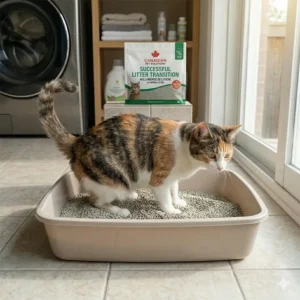
Final 24-hour monitoring: Watch your cat’s first 3-4 elimination events in the new litter. Successful elimination that includes digging, posturing properly, and covering afterwards signals transition success. Hesitation, abbreviated visits, or accidents outside the box mean you need to backtrack to the 75/25 mix for several more days.
Real-World Transition Scenarios: Canadian Case Studies
Scenario 1: Toronto Condo Cat (Clay to Tofu Transition)
Emma from Toronto wanted to switch her 4-year-old tabby from Tidy Cats clay to Michu tofu litter for environmental reasons, plus the flushability would eliminate her garbage chute trips in -20°C weather. Her mistake? Starting the transition during a cold snap when her cat was already stressed.
The solution: She waited until a milder week in late February, then followed the 7-day protocol religiously. Key insight: she placed a small dish of dry tofu pellets next to the food bowl three days before starting the transition, letting her cat investigate the new material in a non-bathroom context. This pre-familiarization reduced surprise when the pellets appeared in the litter box.
Outcome: Successful transition in 9 days (she extended the 50/50 phase by two extra days when she noticed hesitation). The tofu litter now saves her approximately $8 monthly compared to clay when factoring in reduced usage due to superior absorption.
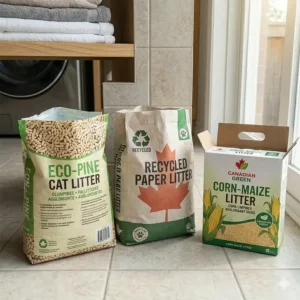
Scenario 2: Calgary Multi-Cat Household (Scented to Unscented Clay)
David in Calgary runs a 3-cat household and needed to switch from Fresh Step scented to Arm & Hammer unscented because one cat developed respiratory sensitivity (likely exacerbated by Calgary’s notoriously dry winter air). With three cats using two boxes, synchronizing the transition seemed impossible.
The solution: He set up a third temporary box filled entirely with the new unscented litter, placed in a different location (guest bathroom). This gave cats the option to explore the new substrate at their own pace while maintaining familiar boxes. Over 10 days, he gradually transitioned the original two boxes using the standard method, and by day 12, all three cats were using the new litter consistently.
Outcome: The optional third box reduced conflict and let the most adaptable cat lead by example. The respiratory-sensitive cat showed improvement within a week of completing the transition.
Scenario 3: Vancouver Island Senior Cat (Clay to Pine Pellets)
Sarah’s 14-year-old cat developed arthritis, and her veterinarian suggested pine pellets because the lower-depth requirement (you need only 5-6 cm versus 8-10 cm for clay) would make digging easier on painful joints. The texture change from fine granules to large pellets presented a significant challenge.
The solution: Sarah used a hybrid approach—mixing pine pellets with pine shavings (sold as small animal bedding) during the transition. The shavings provided a texture closer to clay, bridging the gap between fine granules and large pellets. She transitioned over 14 days: Days 1-4 at 80/20 old/new, Days 5-8 at 60/40, Days 9-12 at 40/60, Days 13-14 at 100% pine with half pellets, half shavings.
Outcome: After 14 days, her senior cat adapted fully. The reduced digging required with pellets noticeably improved her mobility, and Sarah now uses pure pellets (no shavings) with a depth of just 4 cm in a low-sided box designed for elderly cats.
Common Mistakes When Switching Cat Litter in Canada
Mistake 1: Rushing the Timeline
Canadian cat owners frequently underestimate how stress-intolerant cats are during winter months. Your cat is already managing reduced exercise, limited outdoor stimulation, and dry air irritation. Adding a rushed litter transition compounds stress exponentially. The “I’ll just pour in the new litter and see what happens” approach succeeds maybe 20% of the time—and the 80% failure rate means weeks of cleanup outside the box.
The fix: Commit to the full 7-10 day protocol, and extend it to 14 days if you’re transitioning during Canadian winter (November through March) when cats experience highest baseline stress.
Mistake 2: Changing Multiple Variables Simultaneously
Switching litter type AND litter box AND box location all at once is a recipe for failure. Each variable represents a separate adaptation challenge. Yet Canadian cat owners frequently combine these changes because “if we’re doing one, might as well do everything.”
The fix: Change one variable at a time, with a 2-week minimum gap between changes. New litter first, then new box, then location adjustment if needed.
Mistake 3: Ignoring Canadian Climate Factors
Litter that performs beautifully in July can fail miserably in January. Temperature affects everything: cold litter feels uncomfortable on paw pads (imagine walking barefoot on frozen tiles), dry air increases static electricity in certain litters (cats hate the zap), and reduced ventilation in sealed winter homes amplifies odours that trigger aversion.
The fix: Warm the new litter slightly before mixing it during winter transitions. Store litter bags in the main living area (20-22°C) rather than in frigid basements or garages. Run a humidifier near the litter box area if your indoor humidity drops below 35%—this reduces static and respiratory irritation for both cats and humans.
Mistake 4: Failing to Deep-Clean Between Old and New Litter
When you reach 100% new litter on Day 7, any residual old-litter scent in the box creates confusion. Your cat’s nose tells them “old litter is here” but their paws encounter only new substrate—this sensory mismatch triggers suspicion.
The fix: On transition Day 7, empty the box completely, wash with warm water and unscented dish soap (Dawn works well), rinse thoroughly, and dry completely before adding the new litter. In Canadian winter, drying might take 30-60 minutes in a warm room—plan accordingly, don’t rush this step.
Mistake 5: Buying Too Little New Litter for the Transition
The gradual transition method requires more total litter than normal because you’re maintaining fuller boxes throughout the process (mixing reduces effective depth). Canadian Amazon.ca shoppers often buy a single bag of new litter, realize halfway through that they need more, and then face delivery delays that interrupt the transition schedule.
The fix: Purchase at least 1.5-2 times your normal monthly litter volume before starting the transition. For example, if you typically use 15 kg monthly, buy at least 23-30 kg of the new litter. Extra bags keep well if stored in a cool, dry space, and having surplus material means you won’t face gaps in the transition schedule due to out-of-stock issues or shipping delays.
Understanding Litter Box Aversion: When Transitions Go Wrong
Litter box aversion happens when cats develop negative associations with their elimination area, and it’s devastatingly difficult to reverse once established. According to research from the American Association of Feline Practitioners, approximately 10% of cats will develop litter box aversion at some point, with improper litter transitions being a leading trigger.
Signs Your Cat is Developing Aversion
Physical signals:
- Perching on the box edge rather than stepping fully inside
- Rapid, shallow digging instead of thorough pre-elimination preparation
- Eliminating within 5 seconds of entering (normal is 15-30 seconds of preparation)
- Sprinting away from the box immediately after eliminating (no covering behaviour)
Behavioural patterns:
- Vocalizing (meowing, chirping) while in or near the box—this signals discomfort or confusion
- Eliminating in “almost the box” locations (on the mat directly beside it, or in the empty bathtub one metre away)
- Using the box for only one function (e.g., urinating in the box but defecating behind furniture)
If you observe two or more of these signs occurring consistently (3+ times), immediately pause the transition. Return to 100% old litter for 3-4 days to reestablish positive associations, then restart the transition at a slower pace—perhaps 10-14 days instead of 7.
Medical vs. Behavioural Aversion
Canadian veterinarians emphasise that any sudden litter box avoidance requires medical examination first. Urinary tract infections, bladder stones, constipation, arthritis, and kidney disease can all manifest as “refusal” to use the litter box, but they’re actually physical inability or pain-associated avoidance.
Red flags requiring immediate veterinary attention:
- Straining in the box with little or no urine production
- Blood in urine or feces
- Vocalizing in pain during elimination
- Frequent trips to the box (every 20-30 minutes) with minimal output
- Licking the genital area excessively
These symptoms indicate potential urinary blockage (life-threatening in male cats) or other serious conditions that have nothing to do with litter preferences. VCA Canada Animal Hospitals recommend scheduling veterinary examination within 24-48 hours of observing these patterns.
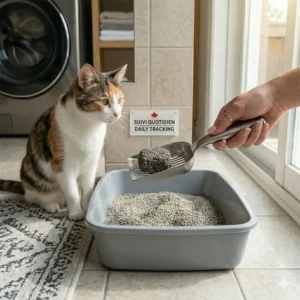
Litter Types and Their Transitioning Characteristics
Clay Clumping Litter (Bentonite)
Texture: Fine granules (1-2mm diameter)
Transition difficulty: Easy from other clay; Moderate from pellets
Canadian climate performance: Excellent—handles dry winter air well, minimal temperature sensitivity
Bentonite clay forms the backbone of most Canadian cat litter because it simply works. When you’re transitioning FROM clay to anything else, you’re moving away from what most cats consider the gold standard texture. Going TO clay from pellets or crystals usually succeeds easily because you’re adapting to finer, more sand-like substrate that matches cats’ instinctual preferences.
Tofu/Soy Pellet Litter
Texture: Cylindrical pellets (2-3mm diameter, 5-10mm length)
Transition difficulty: Moderate from clay; Easy from other pellets
Canadian climate performance: Good—can develop musty odour if humidity exceeds 60%, but performs well in typical Canadian winter conditions (30-45% indoor humidity)
The key to successful tofu transitions is appreciating that the pellets feel substantially different under paw pads. Extend your timeline to 10 days minimum, and consider the two-box method (one old, one new, offered simultaneously) if your cat shows hesitation.
Pine/Wood Pellet Litter
Texture: Large cylindrical pellets (6-8mm diameter, 12-15mm length)
Transition difficulty: Hard from clay; Moderate from other pellets
Canadian climate performance: Excellent—natural pine scent intensifies slightly in warm rooms but remains pleasant; pellets don’t absorb humidity
Pine pellets represent the steepest learning curve for cats because they’re non-clumping (they break down into sawdust when wet instead). This fundamentally changes the litter box experience. Many Canadian cat owners give up after 3-4 days when their cat shows resistance, but extending the transition to 14 days with gradual 10% increases often succeeds where rushed attempts fail.
Silica Crystal Litter
Texture: Irregular crystals (2-5mm diameter)
Transition difficulty: Moderate-Hard from clay
Canadian climate performance: Excellent—crystals actively absorb moisture from air, helping maintain ideal litter box humidity even in dry winter homes
Crystal litter’s appearance (clear or coloured crystals) can initially confuse cats who are used to opaque clay. Some formulas include colour-change indicators that turn blue when saturated, which is useful for humans but irrelevant to cats. The sharp-looking crystals are actually soft-textured and comfortable, but first impressions matter—use an extended 10-12 day transition.
Corn/Wheat Natural Litter
Texture: Medium granules (2-4mm diameter)
Transition difficulty: Easy-Moderate from clay
Canadian climate performance: Good—can develop slight sweet-musty odour in humid conditions (basements, summer months) but performs well during heating season
These plant-based litters bridge traditional clay and eco-friendly alternatives nicely. The granule size resembles clay close enough that most cats adapt within the standard 7-day timeline. Canadian cat owners should store these litters in sealed containers during summer to prevent any moisture absorption that could trigger premature odour development.
How to Choose the Right Replacement Litter for Your Canadian Cat
Picking the right new litter before starting your transition can mean the difference between a smooth 7-day changeover and a month-long nightmare. Here’s the decision framework that works for Canadian conditions.
Consider Your Cat’s Texture Preference First
Most cats prefer fine-grained substrates that mimic sand—their evolutionary preference from desert-dwelling ancestors. If your cat currently uses clay and seems happy with it, transitioning to another fine-grained option (different clay brand, corn-based, or fine wheat litter) will succeed more easily than jumping to large pellets.
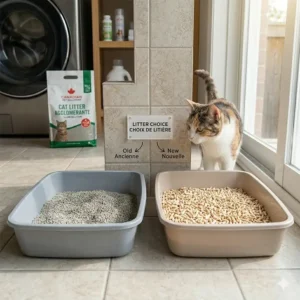
Test before committing: Buy a small trial bag (if Amazon.ca offers one) and create a second “exploration box” filled with the new litter. Place it beside the current box but don’t force your cat to use it. Over 3-4 days, observe which box your cat chooses. If they consistently avoid the new litter even when not required to use it, that’s a clear signal to try a different option before attempting a full transition.
Factor in Canadian Winter Climate Needs
Dust control matters more in Canadian winter. With windows closed for months and forced-air heating circulating particles constantly, low-dust formulas become essential rather than nice-to-have. If anyone in your household has respiratory sensitivities, prioritise “99% dust-free” or “virtually dust-free” options, and verify these claims through Canadian customer reviews on Amazon.ca (reviewers often mention the pour-test: “I can pour a full bag with minimal dust cloud”).
Odour control intensity scales with confinement. During summer, open windows and outdoor access for some cats means litter box odours dissipate naturally. Winter confinement amplifies every scent molecule. If you’re switching litters during November-March, choose options with proven odour neutralisation (baking soda additives, activated carbon, or natural pine resins) rather than attempting transitions to unscented natural litters that may require more frequent changes in sealed winter conditions.
Align With Your Disposal Method
Flushable litters (tofu, some corn-based, certain wheat formulas) offer enormous convenience for Canadian apartment dwellers, condo residents, or anyone who faces harsh weather conditions making garbage disposal trips unpleasant. However, verify your municipal system allows pet waste flushing—some Canadian cities prohibit it due to water treatment limitations.
Biodegradable litters (wood, corn, wheat, tofu) can go in green bins in many Canadian municipalities, but regulations vary significantly. Edmonton, for instance, accepts pet waste in organics; Toronto requires it in garbage. Check your city’s waste management guidelines before transitioning to a biodegradable option.
Traditional clay requires garbage disposal, which means regular trips to outdoor bins. In Canadian winter, this becomes a quality-of-life factor—particularly for seniors, people with mobility challenges, or anyone in high-rise buildings where the garbage room is several floors away.
Budget in CAD Matters Long-Term
Calculate cost-per-month rather than cost-per-bag. A $45 CAD bag of premium tofu litter that lasts 6 weeks ($7.50/week) might actually cost less than a $22 CAD bag of clay that lasts 2.5 weeks ($8.80/week) due to superior absorption and reduced usage.
Hidden costs to factor in:
- Garbage bags: Clay litter requires more frequent garbage disposal
- Time value: Flushable litters save 5-10 minutes weekly on disposal trips
- Cleaning products: Dustier litters require more frequent surface cleaning around the box area
- HVAC maintenance: Excessive dust in Canadian winter can clog furnace filters more quickly
Frequently Asked Questions About Switching Cat Litter
❓ Can I switch cat litter brands without my cat noticing?
❓ How do I transition an older cat to new litter in Canadian winters?
❓ What if my cat refuses the new litter completely during transition?
❓ Are there Canadian brands of cat litter that work better for transitions?
❓ Should I change litter when moving my cat to a new home in Canada?
Conclusion: Successful Litter Transitions Start With Patience
Mastering how to switch cat litter types comes down to three core principles: gradual adaptation (7-14 days of careful mixing), understanding your cat’s individual sensitivities (texture, scent, routine preferences), and accounting for Canadian climate factors (winter stress, dry air, limited ventilation). The cat owners who succeed in transitioning smoothly are those who treat it as a deliberate process rather than a quick swap.
If you’re reading this before starting a transition, you’re already ahead of the curve. Most people only research proper methods after their first attempt fails and they’re facing a week of cleanup. By following the protocols outlined here—particularly the day-by-day mixing ratios, the red-flag monitoring, and the Canadian-specific climate considerations—you’ll avoid the common pitfalls that lead to litter box aversion.
Remember that not every cat will accept every litter type, regardless of how perfectly you execute the transition. Some cats simply have hard boundaries on texture or scent that no amount of gradual mixing will overcome. If you attempt a proper 10-14 day transition and your cat consistently shows aversion signs, that’s not transition failure—that’s successful identification of incompatibility. Switch your target litter to something closer to your cat’s demonstrated preferences and try again.
For Canadian cat owners navigating winter-specific challenges (limited exercise, dry air, sealed homes amplifying odours), choose litters that perform well in these conditions: low-dust formulas that won’t worsen respiratory irritation, odour-control technology that handles reduced ventilation, and textures that don’t feel uncomfortably cold when stored in below-freezing garages or basements. Your cat’s comfort during Canada’s long winter season depends on making these informed choices.
✨ Don’t Miss These Exclusive Deals!
🔍 Take your cat litter transition to the next level with these carefully selected products available on Amazon.ca. Click on any highlighted item above to check current pricing and availability. These litters will help you create an authentic stress-free bathroom experience your cat will love!
Recommended for You
- Pine Pellet Cat Litter: 7 Best Natural Options Canada 2026
- 7 Best Unscented Cat Litter Sensitive Cats Canada 2026
- 7 Best Silica Crystal Litter Long-Lasting Options Canada 2026
Disclaimer: This article contains affiliate links. As an Amazon Associate, I earn from qualifying purchases. If you purchase products through these links, we may earn a small commission at no additional cost to you.
✨ Found this helpful? Share it with your friends! 💬🤗
