
In This Article
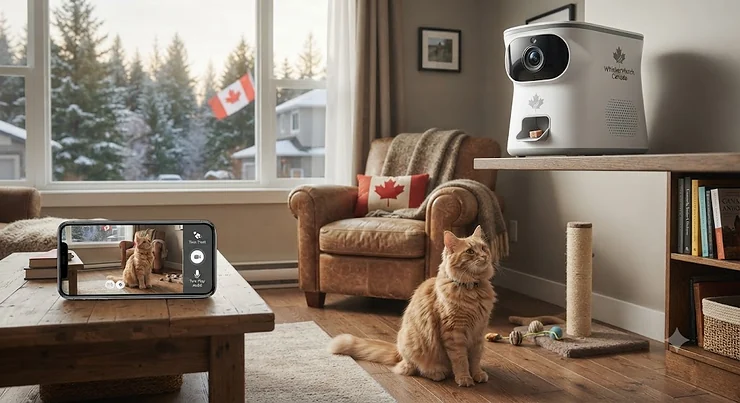
An interactive camera for anxious cats is a Wi-Fi-connected pet camera that adds two-way audio, gentle motion tracking, and sometimes scent or treat-based reassurance so a stressed cat has something calming to lean on while you’re away; the good ones are built to soothe, not to hype a cat up with lasers and buzzers. If your cat starts pacing the second you reach for your coat, or comes out from under the bed only after you’ve been home for twenty minutes, that’s not quirky behaviour — it’s a real physiological stress response, and it’s worth taking seriously rather than shrugging off as “just how she is.”
Cats are territorial animals wired for predictability, and a sudden absence — even a short one — can register as a genuine threat to a nervous cat’s sense of safety. The BC SPCA notes that pacing, excessive vocalizing, over-grooming, and hiding are among the clearest signs of anxiety in cats, and these signs often show up specifically around departures and arrivals rather than throughout the day. That’s exactly the window an interactive camera for anxious cats is built to cover: not endless entertainment, but a calmer bridge between the moment you leave and the moment you’re back. We compared seven real, currently available cameras — from a budget pick under C$60 to a purpose-built anxiety device north of C$500 — based on real specifications and aggregated review sentiment, so you can figure out which one actually calms your cat down instead of adding one more blinking gadget to the wall.
Quick Comparison: 7 Interactive Cameras for Anxious Cats at a Glance
| Product | Best For | Standout Calming Feature | Price Range (CAD) |
|---|---|---|---|
| Wyze Cam Pan v3 | Testing voice check-ins on a tight budget | Gentle pan/tilt tracking, no laser | C$45–C$60 |
| Ring Indoor Cam | Automated scheduled reassurance | Alexa Routines trigger recorded messages | C$70–C$90 |
| EZVIZ C6N | Following a pacing or hiding cat | Auto motion-tracking dome | C$55–C$75 |
| Petcube Cam | Natural-sounding voice check-ins | Full-duplex two-way audio | C$45–C$65 |
| PetLibro Scout Smart Camera | Multi-cat households | AI activity summaries flag anxiety changes | C$110–C$140 |
| Furbo 360° Cat Camera | Distress-specific alerts | Meowing-detection alerts | C$180–C$230 |
| PetChatz HDX | Cats with diagnosed separation anxiety | Aromatherapy plus DOGTV plus video | C$480–C$540 |
Looking across this table, the split isn’t budget-versus-premium so much as passive reassurance versus active intervention. The Wyze Cam Pan v3, Ring Indoor Cam, EZVIZ C6N, and Petcube Cam all lean on the same core idea — a calm voice on demand, without a laser or buzzer competing for attention — while the PetLibro Scout Smart Camera, Furbo 360° Cat Camera, and PetChatz HDX add layers of detection, alerting, or scent-based intervention on top. If your cat’s anxiety is mild and mostly tied to being alone, one of the four budget entries is a reasonable place to start; if a vet has already flagged genuine separation anxiety, the PetChatz HDX is the only device here engineered around that diagnosis specifically.
💬 Just one click — help others make better buying decisions too!😊
The Top 7 Interactive Cameras for Anxious Cats in 2026
1. Wyze Cam Pan v3 — gentle pan/tilt tracking without a laser
The standout here is what this camera doesn’t have: no laser, no treat launcher, nothing designed to hype an already-nervous cat into a chase. Instead, it offers 1080p video with colour night vision, 360-degree pan and 180-degree tilt, motion tracking that follows your cat around a room, and two-way audio, all with no subscription required for the core features. In practice, that means you can talk to a pacing cat as it moves between the couch and the hallway without the camera losing sight of it, which matters more for anxious cats than it does for confident ones who tend to stay put.
This is the pick for owners testing the waters before spending more: at this price, you’re really only committing to finding out whether your voice through a speaker actually settles your cat down at all. Reviewers consistently note the 2.4 GHz-only Wi-Fi requirement causes setup friction on mesh routers that hide that band, and the built-in night-vision spotlight has been flagged by some users as briefly startling in a fully dark room — worth testing before relying on it nightly for a jumpy cat.
Pros:
- ✅ No laser or treat launcher to overstimulate an anxious cat
- ✅ Pan/tilt motion tracking follows a pacing cat automatically
- ✅ Core two-way audio works with no subscription required
Cons:
- ❌ 2.4 GHz-only Wi-Fi struggles with some mesh router setups
- ❌ Night-vision spotlight can briefly startle cats in total darkness
At around C$45–C$60, the value verdict is simple: it’s the lowest-risk way to find out if voice reassurance works for your cat before spending three or four times as much.
2. Ring Indoor Cam — automated reassurance on a schedule
Ring Indoor Cam‘s standout feature isn’t the hardware, which is a straightforward 1080p plug-in unit — it’s that Alexa Routines let you schedule a recorded reassurance message to play automatically at set times, so your cat hears your voice at 9 a.m. and again at 1 p.m. without you needing to remember to open an app during back-to-back meetings. It has two-way talk, a manual privacy cover, and a compact design that mounts almost anywhere near an outlet, though it lacks pan or tilt, so placement relative to your cat’s usual hiding spot matters more than with rotating models.
Based on the spec comparison against pan/tilt rivals here, the fixed field of view is the real trade-off: you’re choosing reliability and Alexa scheduling over the ability to track a cat that changes rooms. Reviewers generally describe setup as fast and the app as stable, though several note that viewing recorded clips beyond the live feed requires a separate Ring Protect subscription, which isn’t obvious from the box.
Pros:
- ✅ Alexa Routines automate scheduled reassurance messages
- ✅ Compact plug-in design with reliably stable app performance
- ✅ Manual privacy cover respects household members’ comfort
Cons:
- ❌ Fixed field of view, no pan or tilt to follow movement
- ❌ Recorded video history requires a separate Ring Protect subscription
At roughly C$70–C$90, this suits a cat with one predictable hiding or pacing spot more than a cat that roams the whole apartment while you’re out.
3. EZVIZ C6N — auto-tracking dome that follows a pacing cat
The EZVIZ C6N packs a 1080p pan-and-tilt dome with genuine auto motion-tracking, meaning it swivels on its own to keep a moving cat in frame rather than requiring you to manually steer it. Two-way talk, night vision, and compatibility with Alexa and Google Assistant round out the package, and it stores footage locally to a microSD card rather than requiring a cloud plan for basic recording. What most buyers overlook about this model is that the auto-tracking specifically helps you locate where an anxious cat has retreated to, which matters when the whole point of checking in is knowing where to direct your voice.
The honest trade-off here is Wi-Fi: like several budget cameras in this comparison, it’s 2.4 GHz only, and reviewers researching this model consistently mention that two-way audio quality is serviceable but noticeably tinnier than the full-duplex systems on pricier units. If auto-tracking on a budget matters more to you than audio polish, it’s a reasonable trade.
Pros:
- ✅ Auto motion-tracking follows a cat between rooms or corners
- ✅ Local microSD recording avoids mandatory cloud subscription costs
- ✅ Broad smart-home compatibility with Alexa and Google Assistant
Cons:
- ❌ 2.4 GHz-only Wi-Fi limits mesh router flexibility
- ❌ Two-way audio quality reported as tinnier than premium rivals
At around C$55–C$75, this is the value pick specifically for locating and following a cat that moves around rather than staying in one visible spot.
4. Petcube Cam — full-duplex audio that sounds like a real conversation
Petcube deliberately left the laser off this model, and the standout feature instead is full-duplex two-way audio — both sides of the conversation can be heard at once, rather than the walkie-talkie-style cutoff common on cheaper cameras, which reviewers and Petcube’s own materials describe as sounding noticeably more natural. Specs-wise, it’s 1080p with a 110-degree wide-angle view, 8x digital zoom, clear night vision rated to roughly nine metres (30 feet) in the dark, and AI-powered alerts that distinguish pets from people. An optional Petcube Care subscription adds 24/7 access to a certified vet chat.
Here’s what the spec sheet won’t tell you directly: a half-duplex speaker that cuts out while your cat is “talking back” can feel jarring to a nervous cat mid-meow, while full-duplex audio lets a soft, continuous voice come through more like an actual presence in the room. That’s a genuinely underrated detail for anxiety specifically, separate from video quality entirely. The trade-off is a narrower 110-degree field of view than some pricier wide-angle competitors, so placement in a smaller room matters more.
Pros:
- ✅ Full-duplex audio sounds less robotic than half-duplex rivals
- ✅ No laser toy to overstimulate an already-anxious cat
- ✅ Optional 24/7 certified vet chat for behaviour questions
Cons:
- ❌ Petcube Care vet-chat access is an added monthly subscription
- ❌ 110-degree field of view narrower than some pricier competitors
At around C$45–C$65, this is the strongest budget pick if a calmer-sounding voice specifically, not extra gadgetry, is what your cat responds to.
5. PetLibro Scout Smart Camera — AI summaries that flag anxiety changes automatically
This is the newest entry on the list, and its standout feature is AI-driven multi-pet recognition that tracks up to five individual cats or dogs by identity, then generates daily activity summaries and short highlight reels so you don’t have to scrub through hours of footage to notice a behaviour change. It offers 1080p colour night vision, 360-degree pan-and-tilt with auto-tracking, and two-way audio, with free, standard, and premium Video Cloud AI subscription tiers layered on top of the hardware.
Based on the spec comparison against simpler monitoring cameras here, the meaningful upgrade is data, not gadgetry: instead of guessing whether your cat has been hiding more than usual this week, the AI summary can surface that pattern directly, which is genuinely useful for anxiety specifically, since reduced movement and increased hiding are two of the clearest behavioural signals owners tend to miss in real time. In a multi-cat household, identifying which specific cat is the anxious one — rather than assuming — is a real practical advantage over cameras that treat every motion event the same. As a newer product, it carries a smaller base of long-term review history than more established brands on this list.
Pros:
- ✅ AI activity summaries surface hiding and movement changes automatically
- ✅ Multi-pet recognition identifies which specific cat is stressed
- ✅ 360° auto-tracking follows movement without repositioning hardware
Cons:
- ❌ Full AI history features require an ongoing subscription tier
- ❌ Newer product with less long-term review data than rivals
At roughly C$110–C$140, this earns its premium mainly in multi-cat households where knowing which cat is anxious is half the battle.
6. Furbo 360° Cat Camera — meowing-detection alerts built for distress, not just noise
Unlike general security cameras adapted for pets, the Furbo 360° Cat Camera was designed around cat behaviour specifically, and its standout feature for anxious cats is meowing-detection alerts that flag vocalizations distinct from normal chatter, pushing a notification to your phone so you can respond with a calming voice message in something close to real time. It also offers 360-degree rotation that follows climbing or pacing cats, two-way audio, night vision, and a treat-toss mechanism, with the core see-talk-toss functions working without any subscription.
What the spec sheet won’t tell you is that a cat sleeping sixteen to twenty hours a day, which is typical, simply won’t trigger every alert type as often as an active dog would, so some of the AI features feel underused unless your cat’s anxiety specifically manifests as vocal distress rather than quiet hiding. Reviewers generally praise the meowing-alert accuracy and rotation design, while flagging that advanced distress-pattern alerts and extended video history sit behind an optional Furbo Nanny subscription running roughly C$9–C$13 per month on top of the hardware cost.
Pros:
- ✅ Meowing-detection alerts flag distress vocalizations in real time
- ✅ 360° rotation tracks a pacing or climbing anxious cat
- ✅ Core see-talk-toss reassurance features need no subscription
Cons:
- ❌ Advanced distress-alert features require an optional monthly subscription
- ❌ Best suited to vocal anxiety, less so to quiet hiding behaviour
At around C$180–C$230, this is worth the premium specifically if your cat’s stress shows up as crying out rather than silently disappearing under the bed.
7. PetChatz HDX — the only device engineered specifically for separation anxiety
Where every other camera on this list was adapted from general pet monitoring, the PetChatz HDX was built from the ground up around separation anxiety, and it shows: a “compassionate curve” screen shape designed to avoid appearing predatory or threatening to a nervous pet, an aromatherapy system with interchangeable scent pads including a Calm variant, DOGTV streaming for ambient visual and audio distraction, a treat dispenser tracking up to 150 treats, and two-way HD video and audio through a full-frequency sound system. It ships with a structured pet-training guide specifically for acclimating a nervous cat to the device, and pairs with the optional PawCall accessory, which lets your cat press a button to actively call you rather than just being passively observed.
Based on the spec comparison against every camera above, this is the only product combining scent, sound, video, and a documented training process into one system rather than repurposing a security camera for emotional support. The honest limitation is price and availability: at nearly double the next most expensive option here, and with a Canadian retail footprint smaller than Amazon-stocked rivals like Furbo or Petcube, it’s realistically ordered directly through the manufacturer or a marketplace seller rather than picked up as an impulse buy. Reviewers consistently praise the acclimation guide and aromatherapy combination as genuinely differentiated, while flagging the price and required accessories as real barriers.
Pros:
- ✅ Only device combining aromatherapy, DOGTV, and two-way video
- ✅ Included structured guide for gradually acclimating a nervous cat
- ✅ PawCall lets your cat proactively call you, not just be watched
Cons:
- ❌ Priced well above every other camera in this comparison
- ❌ Limited direct Canadian retail availability outside the manufacturer
At roughly C$480–C$540, this only makes sense once a vet or behaviourist has confirmed genuine separation anxiety rather than general shyness.
Full Spec Comparison: All 7 Cameras Side by Side
| Product | Resolution | Calming Mechanism | Wi-Fi | Price Range (CAD) |
|---|---|---|---|---|
| Wyze Cam Pan v3 | 1080p | Pan/tilt tracking, voice | 2.4 GHz | C$45–C$60 |
| Ring Indoor Cam | 1080p | Scheduled Alexa voice messages | 2.4 GHz | C$70–C$90 |
| EZVIZ C6N | 1080p | Auto-tracking, voice | 2.4 GHz | C$55–C$75 |
| Petcube Cam | 1080p | Full-duplex voice, vet chat | 2.4 GHz | C$45–C$65 |
| PetLibro Scout Smart Camera | 1080p | AI behaviour summaries | 2.4/5 GHz | C$110–C$140 |
| Furbo 360° Cat Camera | 1080p | Meowing-detection alerts | 2.4/5 GHz | C$180–C$230 |
| PetChatz HDX | 1080p | Aromatherapy, DOGTV, video | 2.4/5 GHz | C$480–C$540 |
Read side by side, resolution stops mattering almost entirely — every single one is 1080p, so the real decision comes down to which calming mechanism actually matches your cat’s specific trigger. Only the PetLibro Scout Smart Camera, Furbo 360° Cat Camera, and PetChatz HDX support 5 GHz Wi-Fi, which is worth checking if your router prioritizes that band. Notice, too, that price climbs almost in a straight line with the number of calming mechanisms stacked into one device, not with video quality — a useful thing to keep in mind before assuming a pricier camera automatically means a calmer cat.
Introducing a Calming Interactive Camera for Cats Canada Households Can Trust: A 30-Day Gradual Desensitization Plan
Mounting a camera and immediately expecting a nervous cat to relax into it backwards is one of the most common reasons these devices get abandoned within weeks. Gradual desensitization — introducing a new stimulus in small, non-threatening increments rather than all at once — is the same principle veterinary behaviourists use for noise phobias and vet-visit anxiety, and it applies just as directly here. Veterinary staff at the University of Calgary specifically recommend a gradual, structured approach when introducing new tools meant to ease separation anxiety, rather than expecting an immediate adjustment, and that guidance maps cleanly onto camera introduction.
Week one should involve zero voice interaction at all — let the camera sit powered on, silent, so your cat stops reacting to the mounting bracket or the faint motor whir some pan-tilt models make. Week two introduces short, ten-second voice check-ins at the same low-key time daily, ideally while you’re still physically home so the sound isn’t yet tied to your absence. By week three, start using the voice feature during brief, planned absences of ten to fifteen minutes, always returning calmly rather than making a big entrance. Week four extends this to your actual daily departure, with occasional check-ins rather than constant chatter, since continuous noise can become its own stressor. A common first-month mistake is mounting the camera at head height pointed at the room’s centre rather than toward your cat’s known hiding or resting spot, which misses exactly where a voice check-in is most needed.
✨ Don’t Miss These Exclusive Deals!
🔍 Take the guesswork out of calming your cat’s day alone with one of these seven cameras. Click through to check current Amazon.ca pricing and availability — a calmer routine for your cat could be one click away!
Real-World Scenarios: Matching the Right Camera to Your Anxious Cat’s Triggers
Picture three different Canadian households, each with a cat whose anxiety shows up differently. First, a young professional in a Vancouver rental with a cat who yowls loudly the moment the door clicks shut — for that cat, the Furbo 360° Cat Camera‘s meowing-detection alert is the strongest match, since it flags vocal distress specifically and lets the owner respond within minutes rather than discovering the pattern after the fact from a neighbour’s complaint.
Second, a family in suburban Winnipeg with two cats, one confident and one who’s clearly stressed by the other’s presence but hard to pin down — here, the PetLibro Scout Smart Camera‘s multi-pet recognition is the practical fit, since it separates each cat’s activity data rather than lumping every motion event together, making it possible to confirm which cat is actually struggling. Third, a retired couple in Halifax whose vet has already diagnosed their senior cat with clinical separation anxiety following a recent household move — for that specific, diagnosed situation, the PetChatz HDX‘s combination of aromatherapy, DOGTV, and structured acclimation guidance offers a level of intervention the budget monitoring cameras simply weren’t designed to provide.
Calming Voice Features Explained: What the Science Says About Your Voice and Feline Stress
Calming voice features work because cats are highly attuned to human vocal tone specifically, not just presence — a low, steady, unhurried voice reads as safety, while a high-pitched or urgent one can do the opposite, even when the words themselves mean nothing to the cat. This is why full-duplex audio, like the system on the Petcube Cam, tends to outperform half-duplex speakers for anxious cats specifically: a voice that cuts in and out unpredictably mimics exactly the kind of unpredictability that triggers stress in the first place, whereas a continuous, natural-sounding voice mimics real presence.
The broader science here isn’t limited to human speech. A study evaluating music-based sound therapy found measurable reductions in stress indicators among hospitalized cats exposed to calming audio compared to a silent control group, which supports the general principle behind every camera on this list that includes a voice or sound-based calming mechanism: consistent, gentle audio genuinely does something physiologically, not just anecdotally. What most owners overlook is tone consistency — using the same calm, unhurried voice every single check-in trains the association faster than varying your tone based on your own mood that day, which is easy to forget when you’re rushing out the door.
How to Choose an Interactive Camera With Soothing Features: 7 Criteria That Actually Matter
Picking among seven genuinely different devices gets easier with a short checklist rather than a gut decision. First, identify whether your cat’s anxiety is vocal, physical (pacing, hiding), or both, since a meowing-detection camera solves a different problem than an auto-tracking one. Second, prioritize full-duplex or otherwise natural-sounding audio over resolution, since a crisp video feed does nothing to calm a stressed cat if the speaker sounds robotic. Third, weigh subscription costs honestly against what you actually need — a C$60 camera with no fees can outperform a C$150 camera that quietly requires C$100 a year for the features that matter to you specifically.
Fourth, consider whether pan/tilt or auto-tracking is worth the premium over a fixed camera, which depends entirely on whether your cat has one consistent hiding spot or roams during stressful periods. Fifth, in multi-cat households, weigh whether multi-pet recognition like the PetLibro Scout Smart Camera‘s is worth the extra cost, since it solves a real problem — figuring out which cat is actually anxious — that single-pet cameras can’t. Sixth, check Wi-Fi band compatibility against your own router before buying a 5 GHz-capable model you can’t actually use. Seventh, and most commonly skipped, confirm Canadian shipping and support specifically, since a couple of brands in this comparison, including PetChatz, have a thinner Canadian retail footprint than Amazon-stocked staples like Furbo and Petcube.
A frequent mistake worth flagging on its own: buying the most feature-packed camera available and assuming more alerts automatically means a calmer cat. In practice, a barrage of push notifications and alert sounds from an over-sensitive motion detector can become its own low-grade stressor for an owner checking their phone anxiously all day, which somewhat defeats the purpose — tuning down alert sensitivity in the app settings, rather than leaving every default notification switched on, is a small step most buyers skip entirely.
Interactive Cameras vs Pheromone Diffusers and Anxiety Toys: What Actually Works Better
| Factor | Interactive Camera | Pheromone Diffuser | Anxiety Toys/Wraps |
|---|---|---|---|
| Addresses departure-specific stress | Yes, with voice/scent options | Partial, passive and continuous | No, general comfort only |
| Upfront cost | C$45–C$540 | C$25–C$40 | C$15–C$50 |
| Requires Wi-Fi/app | Yes | No | No |
| Lets you actively respond | Yes | No | No |
The clearest advantage a camera holds over a diffuser or a wrap is responsiveness: a pheromone diffuser works passively and continuously regardless of what’s actually happening in the room, while a camera lets you react to a specific moment of distress with your actual voice. That said, peer-reviewed survey research on separation-related problems in domestic cats found that a meaningful share of owners underestimate how common and how serious these behaviours are, which is exactly why combining approaches — a diffuser running continuously alongside scheduled camera check-ins — tends to outperform relying on any single tool alone. Anxiety wraps and diffusers still win on simplicity and zero ongoing subscription risk, which matters if Wi-Fi reliability is a concern in your home.
Signs Your Cat Is Anxious, Not Just Shy
Shyness and anxiety look similar on the surface but behave differently over time, and telling them apart matters before you invest in any device. A shy cat generally warms up within minutes of a predictable, calm interaction and doesn’t show physical stress signals once settled; an anxious cat may continue pacing, over-grooming to the point of thinning fur, or hiding for hours even after the “threat” — you leaving — has passed. Excessive vocalization specifically tied to departures and arrivals, rather than general chattiness throughout the day, is another strong differentiator worth tracking over a week or two before assuming a camera alone will fix things.
Appetite changes are commonly missed too: a cat that skips meals only on days you’re gone longer than usual, but eats normally otherwise, is showing a stress-linked pattern rather than a food preference issue. If you’re noticing two or more of these signs consistently rather than as one-off events, that’s the point where a vet consultation alongside any camera-based intervention becomes the responsible next step, since anxiety symptoms can sometimes overlap with underlying medical issues that a device alone can’t diagnose.
Calming Interactive Camera for Cats Canada Shoppers Should Actually Know About
Canadian winters change the calculus here more than most buying guides acknowledge. With several provinces seeing well under nine hours of daylight from November through March and outdoor stimulation essentially off the table for indoor cats, departure-related anxiety symptoms often spike seasonally in ways owners don’t connect to the calendar. Shoppers specifically looking for a calming interactive camera for cats Canada retailers actually stock and support should check listed shipping origin directly on Amazon.ca, since budget entries like Wyze Cam Pan v3 and EZVIZ C6N often ship from U.S. or overseas warehouses, which can extend replacement timelines compared to Canadian-fulfilled listings from Petcube or Furbo.
Currency swings between the U.S. dollar and Canadian dollar also mean the CAD price gap between similar-spec cameras can shift throughout the year in ways a rough USD conversion won’t capture, so checking current Amazon.ca pricing directly rather than assuming a fixed exchange rate holds is worth the extra minute. Apartment and condo dwellers, who make up a large share of the Canadian pet-camera market, should also weigh Alexa or Google Assistant compatibility on the Ring Indoor Cam or EZVIZ C6N if a smart-home routine is already part of the household setup, since voice-triggered check-ins add convenience that manual app control doesn’t offer on its own.
Long-Term Cost & Maintenance: What These Calming Cameras Really Cost Over Time
| Tier | Hardware Cost | Annual Subscription | 2-Year Total Cost |
|---|---|---|---|
| Budget (Wyze, Petcube Cam) | C$45–C$65 | C$0–C$60 (optional vet chat) | ~C$65–C$185 |
| Mid-range (Ring, EZVIZ, PetLibro) | C$55–C$140 | C$0–C$120 | C$55–C$380 |
| Premium (Furbo, PetChatz) | C$180–C$540 | C$0–C$156 | C$180–C$852 |
The two-year total cost column is where the premium tier’s appeal narrows considerably: a PetChatz HDX owner who never adds a subscription still pays the highest hardware cost outright, while a Furbo 360° Cat Camera owner who opts into the full Nanny subscription can add nearly C$300 over two years on top of the hardware. For most anxious-but-not-clinically-diagnosed cats, a mid-range camera with no mandatory subscription realistically delivers most of the calming benefit without the compounding annual cost, reserving the premium tier for cases where a vet has specifically recommended a more intensive intervention.
Camera Privacy, Safety & Canadian Regulations Every Anxious-Cat Owner Should Know
Any Wi-Fi camera running in your home is a data-privacy matter as well as a pet-comfort one, and companies operating in Canada are bound by federal privacy legislation governing how audio and video collected in your home can be stored and used, so it’s worth checking each brand’s stated data-retention and encryption practices before mounting anything permanently. On the physical side, aromatherapy-based devices like the PetChatz HDX deserve a specific caution: essential oils and scent pads should always be the pet-safe formulations the manufacturer supplies rather than substituted with household essential oils, since several common oils are documented as toxic to cats even in small, diffused quantities.
Treat-dispensing features on the Furbo 360° Cat Camera also warrant a basic safety check of their own: an anxious cat sometimes over-relies on food as self-soothing, so confirming dispensed portions align with daily caloric needs matters more here than it would for a confident, food-indifferent cat. And as a general rule with any camera positioned to actively engage a stressed cat, avoid stacking too many simultaneous stimuli — voice, treats, and alert sounds all firing during one session can overwhelm rather than reassure, which somewhat defeats the entire purpose of a calming device.
Features That Actually Matter (And Marketing Hype to Ignore)
Marketing copy across this category leans hard on resolution numbers and zoom ratios, but based on the full comparison above, the features that correlate most with genuine calming outcomes are audio duplex quality, alert specificity (distinguishing distress from routine motion), and consistent scheduling, not video sharpness. Every camera here is 1080p, so paying extra for marginally higher resolution buys you almost nothing for anxiety specifically. Features that sound impressive but rarely move the needle include extreme digital zoom ratios and generic “AI-powered” motion detection, which in most current implementations still just means a standard motion trigger with extra branding attached.
One feature that’s genuinely underrated in marketing materials is alert sensitivity tuning — the ability to set a camera to notify you only for genuinely unusual behaviour rather than every twitch, which matters enormously for owners prone to checking their phones anxiously throughout the day. If a listing spends more copy on camera resolution than on how its audio or alert system actually behaves, that’s usually a sign the device is a repurposed general security camera rather than one engineered around a genuinely anxious cat’s needs.
Frequently Asked Questions
❓ What is the best interactive camera for anxious cats overall?
❓ Do calming voice features on pet cameras actually reduce cat anxiety?
❓ How much does a good calming interactive camera cost in Canada?
❓ How long does gradual desensitization to a new camera usually take?
❓ Can a pet camera replace veterinary treatment for severe cat anxiety?
Conclusion: Matching the Camera to the Anxiety, Not the Other Way Around
Across all seven products, the honest takeaway is that no single camera works for every anxious cat, because anxiety itself doesn’t show up the same way twice. If your cat’s stress is mild and mostly tied to being alone, the Wyze Cam Pan v3 or Petcube Cam offer a low-risk way to test whether voice check-ins help at all, while the Ring Indoor Cam and EZVIZ C6N add scheduling and tracking respectively for a modest premium. If vocal distress or multi-cat dynamics are the specific trigger, the Furbo 360° Cat Camera and PetLibro Scout Smart Camera are built around exactly those patterns.
And if a vet has already confirmed genuine, diagnosed separation anxiety rather than general shyness, the PetChatz HDX remains the only device on this list engineered from the ground up around that specific problem, aromatherapy and structured acclimation guide included. Whichever you choose, remember what the research keeps confirming: the camera works best as one part of a gradual, patient introduction process, not an instant fix layered onto a cat who’s never had a chance to get used to it.
✨ Ready to help your cat feel safer while you’re away? Compare current prices on the models above and start with the slow, structured introduction that actually works.
Recommended for You
- Interactive Camera for Bored Indoor Cats: 7 Top Picks 2026
- Interactive Pet Camera vs Treat Dispensing Camera: 7 Picks (2026)
- Interactive Pet Camera Canada: 7 Top Picks Tested for 2026
Disclaimer: This article contains affiliate links. As an Amazon Associate, I earn from qualifying purchases. If you purchase products through these links, we may earn a small commission at no additional cost to you.
✨ Found this helpful? Share it with your friends! 💬🤗
