
In This Article
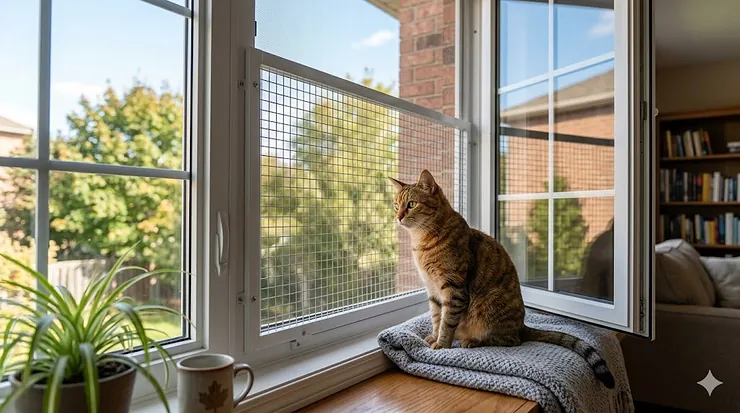
A cat window safety guard is a screen, net, or mesh barrier installed over an open window, balcony, or terrace railing to physically prevent a cat from squeezing through, falling, or jumping out. Unlike a standard bug screen, these products use reinforced mesh, steel wire, or heavy-duty nylon designed to resist claws and the full body weight of a cat — protecting against what veterinarians call “high-rise syndrome.”
If you’ve ever cracked a window open on a warm spring day in Toronto, Calgary, or Halifax and then spent the next ten minutes nervously watching your cat sniff the breeze, you already understand the appeal. A good guard lets you ventilate your home freely without that constant low hum of anxiety.
Quick Comparison Table
| Product | Type | Best For | Price Range (CAD) |
|---|---|---|---|
| NeatiEase Cat Proof Window Screen | Reinforced mesh window screen | Standard double-hung windows | $25–$40 |
| PAWISE Transparent Balcony Safety Net | Nylon balcony/window net | Balconies, terraces, condos | $30–$55 |
| MAGZO Pet Proof Screen Replacement Mesh | Vinyl-coated polyester mesh roll | Larger or custom-sized windows | $30–$50 |
| AnExer Cat Balcony Net | Lightweight transparent nylon net | Renters, temporary setups | $25–$45 |
| Morimoe Steel-Reinforced Balcony Net | Steel wire-reinforced net | Determined climbers, large dogs/cats | $40–$70 |
| TOYZFRIENDY Windowsill Scratch Guard | Adhesive film panels | Protecting sills/screen edges | $15–$25 |
| Sunjoy Castle Banister Guard Net | Thick fabric mesh balustrade net | Railings, stairwells, balconies | $35–$60 |
Looking at the lineup above, the NeatiEase screen is the strongest all-rounder for a typical apartment window, while the Morimoe net earns its higher price tag if you’ve got a particularly determined or heavier cat testing the limits of a thinner net. Renters who can’t drill into window frames will likely lean toward the AnExer or PAWISE nets, since both rely on hooks, rope, and tension rather than permanent hardware — a detail that matters a lot if your lease requires you to leave walls untouched.
💬 Just one click — help others make better buying decisions too! 😊
✨ Don’t Miss These Deals
Click any highlighted product below to check current pricing and availability on Amazon.ca. As prices and stock shift often (especially around shipping promotions), it’s worth bookmarking your favourites and checking back before move-in day or the first warm weekend of the year.
Top 7 Cat Window Safety Guards — Expert Analysis
1. NeatiEase Cat Proof Window Screen
The NeatiEase Cat Proof Window Screen is one of the most consistently well-reviewed pet screens sold to Canadian shoppers, and it’s easy to see why. The reinforced mesh is noticeably thicker than a standard fibreglass bug screen, so a cat pawing at it out of curiosity doesn’t immediately put a claw-sized hole through it. It’s designed to fit inside standard window tracks, which matters in older Canadian apartment buildings where window frames are rarely a “nice round number” in metric or imperial.
What most buyers overlook is that this screen still needs a secure frame to sit in — if your window track is warped or the frame doesn’t close flush, even a heavy-duty mesh can be nudged loose by a persistent cat leaning on it. In my experience, pairing it with a simple frame tension rod or a few small screws into the track turns a “pretty good” screen into one that actually holds.
Pros:
- Thicker, claw-resistant mesh than basic screens
- Fits into existing window tracks without major modification
- Good airflow and visibility retained
Cons:
- Best suited to standard-sized windows; large or oddly shaped windows may need the MAGZO roll instead
- Frame fit quality varies with older window tracks
Best for: Apartment dwellers with standard sliding or double-hung windows who want a drop-in upgrade over a stock screen. Price range: roughly $25–$40 CAD.
2. PAWISE Transparent Cat Safety Net for Balconies & Windows
The PAWISE Transparent Cat Safety Net comes in several sizes (commonly 4x3m, 6x3m, and 8x3m), made from hand-braided nylon rope with a roughly 3cm x 3cm mesh opening. The transparency is the real selling point here — from a few feet away it practically disappears, which condo boards in cities like Vancouver and Mississauga tend to appreciate far more than a bulky white grid bolted to a balcony rail.
The 6mm rope thickness is sturdy enough that most cats can’t chew through it quickly, though I’d note that the included nails and hooks are a basic starter kit — for a windy high-rise balcony, upgrading to stainless screws or eye bolts rated for outdoor use is worth the extra $10–15 CAD, especially given how exposed balcony hardware gets during a Canadian winter freeze-thaw cycle.
Pros:
- Nearly invisible, preserves the view and curb appeal
- Multiple size options for different balcony widths
- Foldable and easy to remove for winter storage
Cons:
- Stock hardware (nails) isn’t ideal for long-term outdoor exposure
- Needs periodic UV-damage checks after a full summer outside
Best for: Condo and apartment balconies where appearance matters as much as function. Price range: roughly $30–$55 CAD depending on size.
3. MAGZO Pet Proof Window & Door Screen Replacement Mesh
If your window doesn’t match any pre-made screen size — common in century homes in Montreal or older walk-ups in Halifax — the MAGZO Pet Proof Window & Door Screen Replacement Mesh is the practical answer. It’s sold as a roll of vinyl-coated polyester mesh that you cut to size, which means it works for windows, sliding patio doors, and even custom screened porches.
The vinyl coating is the key spec here: it’s noticeably stiffer and more scratch-resistant than the loosely woven fibreglass mesh that comes standard in most builder-grade screens. In practice, that means a cat repeatedly pawing at the screen wears it down far more slowly — useful if your cat treats the windowsill as a permanent perch from spring through fall.
Pros:
- Cut-to-size flexibility for non-standard windows
- Vinyl coating resists scratches better than fibreglass
- Doubles as a sliding-door screen replacement
Cons:
- Requires basic DIY tools (spline roller, frame) to install properly
- Not a finished product — more of a material/repair kit
Best for: Older Canadian homes with non-standard window or patio door sizes, and anyone comfortable with a short DIY project. Price range: roughly $30–$50 CAD.
4. AnExer Cat Balcony Net
The AnExer Cat Balcony Net is a lightweight, transparent nylon mesh net marketed specifically for balconies, windows, stairs, and patios. It’s a popular pick among renters because the installation kit relies on hooks and tension rather than permanent fasteners — meaning it can come down cleanly at the end of a lease without leaving marks.
What stands out in real-world use is how quickly it can be taken down and stored for winter. Given that most Canadian balconies see far less use from November through March, being able to fold this net into a small bag and toss it in a closet (rather than leaving hardware exposed to ice and salt) extends its lifespan considerably compared to a permanently mounted option.
Pros:
- Renter-friendly, removable installation
- Lightweight and easy to store seasonally
- Transparent design blends into most balcony styles
Cons:
- Lighter-gauge mesh than steel-reinforced options — not ideal for very large or strong cats
- Tension-based mounting may need periodic re-tightening
Best for: Renters and seasonal balcony users who want an easy on/off solution. Price range: roughly $25–$45 CAD.
5. Morimoe Steel Wire-Reinforced Cat Balcony Net
For households with a cat (or cats) that have already proven they can out-stubborn a basic nylon net, the Morimoe Steel Wire-Reinforced Balcony Net brings noticeably more reinforcement to the table. The steel wire woven through the netting adds rigidity and bite-resistance that a pure nylon net can’t match — useful for multi-cat homes, larger breeds, or households that also have a dog sharing balcony access.
The trade-off is weight and stiffness: this net is less “invisible” than the PAWISE or AnExer options, and it’s a bit more involved to mount evenly along a railing. But for anyone who has already replaced one net that got chewed through, the extra durability tends to pay for itself.
Pros:
- Steel wire reinforcement resists chewing and clawing
- Holds shape well along long balcony railings
- Suitable for multi-pet households
Cons:
- More visually noticeable than pure nylon nets
- Slightly trickier to install neatly around corners
Best for: Multi-cat or multi-pet households, or anyone replacing a net that didn’t survive a determined chewer. Price range: roughly $40–$70 CAD.
6. TOYZFRIENDY Windowsill Scratch Guard Film
The TOYZFRIENDY Windowsill Scratch Guard isn’t a standalone safety barrier — it’s a set of adhesive film panels designed to protect the windowsill and screen edges from claw damage. I’m including it because one of the most common ways a “good” screen fails is at the edges, where a cat repeatedly scratches the same spot until the frame seal weakens.
Applied along the bottom edge of a window screen or sill, this nano-adhesive film takes the brunt of daily scratching, meaning your actual safety screen (whether that’s the NeatiEase, MAGZO, or anything else) lasts longer before needing replacement.
Pros:
- Cheap, simple way to extend the life of your main screen
- Nano-adhesive removes cleanly without residue on most surfaces
- Pack of 4 covers multiple windows
Cons:
- Not a fall-prevention product on its own — it’s a supplement
- Adhesive performance can vary on textured or painted sills
Best for: Anyone who already has a window screen but wants to protect it from premature wear. Price range: roughly $15–$25 CAD.
7. Sunjoy Castle Banister Guard Balcony Safety Net
Originally designed as a child-safety product for stairs and balcony railings, the Sunjoy Castle Banister Guard has become a popular cross-over choice for cat owners with wide-gap balcony railings — a common feature in many Canadian condo buildings built in the 1990s and 2000s. The thicker fabric mesh covers wide vertical gaps that a slim cat could otherwise slip through.
Because it’s marketed for both kids and pets, it tends to come with sturdier zip-ties and mounting clips than pet-specific nets, which is a small but meaningful difference if your railing sees a lot of wind exposure.
Pros:
- Covers wide railing gaps effectively
- Sturdier mounting hardware than many pet-only nets
- Dual-purpose if you also have young children
Cons:
- Less transparent — more visually prominent on the balcony
- Sized for railings (10ft x 3ft), so very large balconies need multiples
Best for: Condo balconies with wide railing gaps, especially in households with both kids and cats. Price range: roughly $35–$60 CAD.
How to Choose a Cat Window Safety Guard in Canada
- Measure before you shop. Window tracks and balcony railings in Canadian homes vary widely by building era — a screen sized for a newer condo window often won’t fit a 1970s apartment frame. Measure width, height, and depth of the track or railing gap first.
- Match the barrier to your cat’s personality. A calm senior cat rarely tests a screen the way a young, athletic cat does. If your cat is a climber or a “door-dasher,” prioritize reinforced mesh (MAGZO, Morimoe) over lighter nylon nets.
- Consider your lease terms. Renters should favour tension-mounted or hook-based nets (PAWISE, AnExer) over screwed-in hardware, since most Canadian rental agreements require restoring walls and frames to original condition.
- Think about winter storage. Outdoor balcony nets left up through a Canadian winter face ice, salt spray (especially near coastal cities), and UV exposure. A foldable, easy-to-remove option saves you a replacement purchase each spring.
- Check condo board rules first. Many Canadian condo corporations have bylaws about what can be attached to exterior railings or window frames — a quick email to the property manager before you drill anything saves a headache later.
- Don’t skip the edges. A screen is only as strong as its weakest seam. Budget a few extra dollars for edge protection (like the TOYZFRIENDY film) if your cat is a known scratcher.
- Buy slightly larger than you think you need. Nets and mesh rolls are easy to trim down but impossible to stretch. When in doubt, size up.
Installation & Seasonal Usage Guide
Getting a window guard installed properly is mostly about patience, not tools. Start by cleaning the window track or railing thoroughly — old screen debris and grit are a common reason new screens don’t sit flush. For frame-fit screens like NeatiEase, press the mesh into the track corner-by-corner rather than starting at one edge and working across, which helps avoid bunching.
For balcony nets, work from a top corner outward, keeping moderate tension as you go rather than pulling everything taut at once — over-tightening nylon nets in warm weather can cause them to sag once temperatures drop, since most synthetic ropes contract slightly in the cold.
Canadian seasonal tip: Outdoor nets and balcony screens generally don’t need to survive a full winter outdoors. Taking them down once temperatures consistently drop below freezing — and giving them a quick rinse before storage — prevents the brittleness that comes from repeated freeze-thaw cycles, which is one of the most common reasons nylon netting fails after just one season.
Common first-30-day mistakes include: forgetting to check for small gaps at corners (a cat only needs a few centimetres), assuming a screen that “looks tight” is actually secured at every edge, and not testing the barrier with the window in its most-open position you actually plan to use.
Real-World Scenarios: Matching the Product to Your Situation
The Toronto high-rise condo cat. A one-bedroom unit on the 22nd floor with a Juliet balcony and a curious two-year-old cat. Here, the PAWISE transparent net combined with the NeatiEase window screen covers both the balcony door and the bedroom window — and the transparency keeps the condo board happy about exterior appearance.
The Vancouver rental with a chewer. A ground-floor rental with a small patio, shared with a dog and an adult cat that has already chewed through one cheap net. The Morimoe steel-reinforced net handles the extra durability needs, while the AnExer net (cheaper, easy to remove) covers a secondary window where pressure is lower.
The Ottawa family with kids and a kitten. A townhouse with a second-floor balcony with wide railing gaps — a known fall risk for both a new kitten and a toddler. The Sunjoy banister guard solves both problems at once, while the TOYZFRIENDY scratch film protects the kitchen window screen the kitten has already started testing.
Window Screens vs. Balcony Nets: Which Do You Actually Need?
These two product categories solve related but distinct problems, and a lot of buyers end up needing both rather than choosing one. Window screens (NeatiEase, MAGZO) are about preventing a cat from pushing through or squeezing past an open window — the failure mode is usually a gap at the edge or a torn mesh. Balcony nets (PAWISE, AnExer, Morimoe, Sunjoy) are about preventing a fall from an already-open space, like a balcony or terrace, where there’s no window to screen in the first place.
If your cat only has access to windows, a quality screen is likely sufficient. If your home has a balcony, terrace, or any railing your cat can reach, a net is the higher-priority purchase — open balcony doors during warm weather are one of the most common high-rise syndrome scenarios reported by veterinary clinics.
Canadian Climate & Building Considerations
Canadian housing stock varies enormously — from sealed, triple-glazed windows in newer Ontario builds to older sash windows in Maritime heritage homes — and that variation affects which screen actually fits. Older sash windows in particular often have shallower tracks, meaning a thicker reinforced mesh may need slight trimming to seat properly.
Humidity swings matter too: a screen installed during a humid August may fit more loosely once indoor heating dries out wooden window frames in January, so it’s worth re-checking the fit at the start of heating season. For balcony installations, remember that many Canadian municipalities and condo corporations have specific rules about what can be attached to common-element railings — checking with your building management before installing anything permanent is a simple step that avoids disputes later.
Long-Term Cost & Maintenance in Canada
Most products in this guide are inexpensive enough that “buy once, cry once” isn’t really the calculation — a $25 CAD screen and a $50 CAD net together cost less than a single emergency vet visit for a fall injury, which the BC SPCA and other animal welfare groups note can run into the hundreds or thousands of dollars depending on the injuries involved.
Where costs add up is replacement frequency. A cheap, unreinforced net left outdoors year-round in a coastal or high-humidity climate may need replacing annually, while a reinforced option (Morimoe, MAGZO) stored properly over winter can often last two to three seasons. Factoring in seasonal removal and storage — which costs nothing but a bit of time — is the single biggest lever for reducing long-term spend. If a fall does happen despite precautions, VCA Animal Hospitals notes that some injuries, like collapsed lungs or hernias, can develop hours after the event, which is why a vet check is recommended even when a cat seems fine immediately afterward.
Common Mistakes When Buying a Cat Window Safety Guard
Buyers most often go wrong by purchasing based on window dimensions alone without considering frame depth, which leaves the screen sitting loosely and easy to push out. Another frequent issue is choosing a purely decorative-looking net for a cat that’s already shown determined escape behaviour — appearance matters, but it shouldn’t outrank durability for a known climber. Finally, many Canadian renters skip checking their lease or condo bylaws first, only to discover that permanently mounted hardware isn’t allowed, after they’ve already drilled holes.
Features That Actually Matter (And Those That Don’t)
Mesh density and material (vinyl-coated polyester or steel-reinforced nylon vs. basic fibreglass) genuinely matters for longevity. So does ease of removal for seasonal storage. What matters less than marketing suggests: exact colour options (transparent vs. white rarely affects function), and “designer” patterns on balcony nets, which add cost without improving safety. Focus your budget on mesh quality and mounting hardware first.
FAQ
❓ Do cat window screens block airflow significantly?
❓ Can I install a balcony safety net in a rented apartment in Canada?
❓ How do I know what size net or screen to buy?
❓ Do these products ship across Canada, including rural areas?
❓ Will a window screen alone stop high-rise syndrome?
Conclusion
Protecting a curious cat from an open window or balcony doesn’t require an expensive renovation — it usually comes down to picking the right mesh or net for your specific window, railing, and cat’s personality, then taking the time to install it properly. Whether that’s a drop-in screen like the NeatiEase for a standard apartment window, a transparent PAWISE net for a condo balcony, or a steel-reinforced Morimoe net for a determined escape artist, the goal is the same: let in the fresh air without the worry.
If you’re outfitting a whole apartment, a reasonable starting combination is one window screen per accessible window plus one balcony net if applicable — together usually landing well under $150 CAD total, a small price for year-round peace of mind.
Recommended for You
- Best Cat Proof Cord Protector in Canada 2026: 7 Top Picks
- Complete Cat Proofing Home Guide: 7 Best Products for Canada (2026)
- Best Waterproof Cat Couch Cover Canada 2026: Top 7 Picks
Disclaimer: This article contains affiliate links. As an Amazon Associate, I earn from qualifying purchases. If you purchase products through these links, we may earn a small commission at no additional cost to you.
✨ Found this helpful? Share it with friends who have window-watching cats! 🐱
