
In This Article
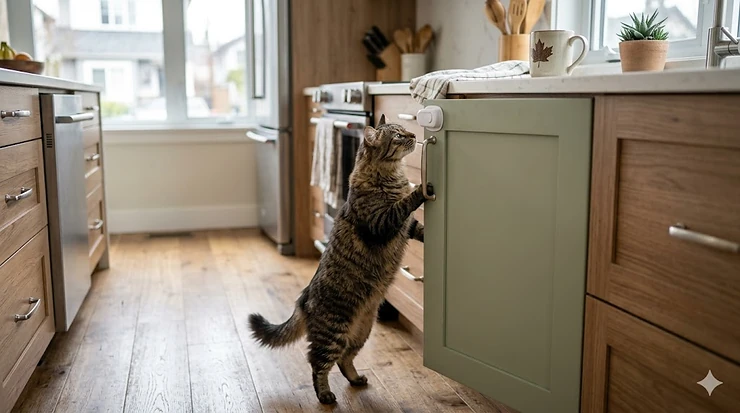
Childproof cabinet locks for cats are latch, strap, or magnetic mechanisms originally designed for baby-proofing that double as a barrier against paws clever enough to open cupboard doors. Unlike standard child locks, the best versions for cats resist hooking, clawing, and body-weight pulling — the three moves a determined cat will try before a toddler ever does.
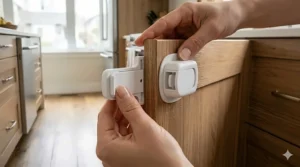
If you’ve ever found your cat halfway into the under-sink cabinet, you already know regular latches aren’t built with claws in mind. Below, we’ve rounded up real, Canadian-available options across magnetic, adhesive-strap, and lever-lock styles, plus the buying logic to pick the right one for your cabinets.
Quick Comparison Table
| Lock Style | Best For | Tools Needed | Price Range (CAD) |
|---|---|---|---|
| Magnetic (e.g., Tot-Lok, Vmaisi) | Strong, stubborn cats; permanent install | Drill or strong adhesive | $25–$60 |
| Adhesive strap (e.g., Door Buddy style) | Renters, doors (not just cabinets) | None | $15–$30 |
| Lever/U-shape latch | Cabinets with knobs or handles | None | $10–$20 |
| Spring-loaded elbow catch | Frameless or European-style cabinets | Screws | $15–$25 |
A quick read on the table: magnetic systems cost more up front but are nearly impossible for a cat to defeat because there’s no visible mechanism to claw at from outside the cabinet — the trade-off is a more involved install. Strap and lever styles install in minutes with zero tools, which suits renters, but a heavy or persistent cat can sometimes work a strap loose over months. If your cat is the type to literally throw their body weight against a door, magnetic is worth the extra cost; for milder curiosity, a lever latch is plenty.
💬 Just one click — help others make better buying decisions too! 😊
✨ Don’t Miss These Exclusive Deals!
🔍 Take your cat-proofing to the next level — check current pricing and availability for these locks on Amazon.ca.
How to Choose Cabinet Locks for Cats in Canada
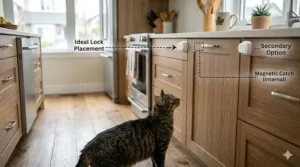
- Measure your cabinet gap and door type first. Magnetic and strap locks both need a small gap between door and frame to work — flush, frameless cabinets (common in newer Canadian condo builds) often need a spring-loaded elbow catch instead.
- Match strength to your cat’s persistence. A cat that paws once and gives up doesn’t need the same hardware as one that returns daily with a plan.
- Decide between drilled and adhesive. Renters and condo dwellers usually want adhesive or no-drill options; homeowners can drill for a more permanent magnetic system.
- Check the gap size range on the listing. Cabinet door gaps vary from under an inch to several inches — most adjustable strap locks list a workable range, so measure before you buy.
- Consider winter humidity swings. Many Canadian homes run drier in winter from forced-air heating, which can weaken adhesive bonding over a season; a drilled or screwed lock holds up better long-term in those conditions.
- Plan for multiple cabinets. Kitchens, bathrooms, and under-sink areas in laundry rooms all tend to be cat targets — buy in multi-packs rather than one at a time.
- Keep an “adult override” in mind. If you’ll be opening the cabinet often yourself, prioritize one-handed magnetic-key or push-button designs over fiddly double-strap systems.
Top Cabinet Lock Picks for Cat Owners
1. Tot-Lok Magnetic Cabinet Lock System (Rev-A-Shelf)
This is the lock people recommend when a determined cat or toddler has already destroyed everything else. The Tot-Lok mounts entirely inside the cabinet — there’s nothing visible or grabbable from outside the door — and releases only when a magnetic key is held against the correct spot.
What that means in practice: a cat can paw, lean, or sit on the door all day and never find a mechanism to work loose, because there isn’t one accessible. The trade-off is installation — it typically needs to be screwed to wood, glass, metal, or particleboard, so it’s a better fit for homeowners than renters. One frequent piece of feedback from pet-owning households is that it holds up where strap-style locks eventually get chewed or pulled apart.
✅ Pros: Nearly impossible for cats to defeat; works on multiple cabinet materials; key can be parked on the fridge for convenience
❌ Cons: Requires drilling/screws; pricier than strap alternatives
Price range: roughly $35–$60 CAD per kit, depending on lock count. Check current availability on Amazon.ca, as kit sizes vary.
2. Vmaisi Child Safety Magnetic Cabinet Locks
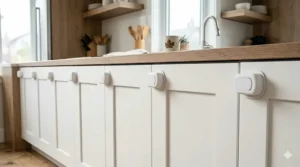
Vmaisi’s magnetic system is the budget-friendly cousin of the Tot-Lok concept — no-drill adhesive mounting, magnetic key release, and a stated strength rating aimed at both toddlers and a “house cat or 30-lb dog,” according to the manufacturer’s own listing.
For Canadian apartment and condo dwellers who can’t drill into cabinetry (a real restriction in many lease agreements), this is one of the few magnetic options that doesn’t require permanent mounting. The honest caveat: adhesive-mounted magnetic locks rely entirely on bond strength, so surface prep matters — clean and dry the cabinet interior thoroughly before sticking, especially in winter when indoor air is drier and adhesives can grip less reliably at first.
✅ Pros: No drilling; invisible from outside; reusable key system
❌ Cons: Adhesive bond can weaken over time on textured or painted surfaces; not rated for very heavy/large dogs
Price range: roughly $20–$30 CAD for a 4-pack with one key.
3. Safety 1st Adhesive Magnetic Lock System
A long-running, widely stocked option that uses a similar magnetic-release concept but at a lower price point than dedicated pet-marketed kits. It’s adhesive-only (no screws), which keeps installation to a few minutes per cabinet.
The honest read here: this is a solid mid-tier choice if your cat is curious but not especially strong — reviewers over the years have generally rated it well for ease of install, with occasional notes that very strong pulling can eventually work the adhesive loose, which lines up with what you’d expect from any adhesive-only magnetic system.
✅ Pros: Affordable for multi-cabinet kitchens; quick install; widely available
❌ Cons: Adhesive-dependent strength ceiling; replacement pads may be needed after a year or two
Price range: roughly $20–$25 CAD for a kit with multiple locks and a key.
4. Door Buddy-Style Adjustable Strap Latch
These aren’t cabinet locks in the strict sense — they’re adjustable door straps designed to let a cat squeeze through a gap while blocking a child (or a determined dog). For cat owners, the more useful application is the reverse: mounting one on a pantry, laundry, or under-sink cabinet door to limit how far it opens, so a cat can’t wedge themselves all the way in.
This is a smart pick for households managing a litter-box room boundary or a half-open cabinet rather than a fully sealed one. It’s adhesive-mounted and reusable, with a width range that typically adjusts from a few centimetres up to roughly 19 cm (about 7.5 inches).
✅ Pros: No tools; instantly adjustable; doubles as a door and cabinet solution
❌ Cons: Not a full lock — it limits opening rather than sealing the cabinet shut; adhesive needs a clean, smooth surface
Price range: roughly $15–$25 CAD per pack.
5. 4our Kiddies Magnetic or Strap Cabinet Lock Multi-Packs
Sold in larger multi-packs (commonly 8–12 units), these are a practical pick for households with several cabinets to cover at once — kitchen, bathroom, and a linen or laundry cupboard, for example. Both magnetic and adhesive-strap versions exist under this and similar budget multi-pack brands on Amazon.ca.
For a multi-cat or multi-cabinet household, the per-unit cost in a 10–12 pack is usually lower than buying premium locks one at a time, which matters if you’re cat-proofing an entire kitchen in one weekend.
✅ Pros: Cost-effective for whole-kitchen projects; no drilling; comes with spare adhesive pads in most kits
❌ Cons: Build quality varies pack to pack; not as heavy-duty as Tot-Lok style systems
Price range: roughly $20–$35 CAD for a 10–12 pack.
6. Lever-Style U-Shape Latches (for knob or handle cabinets)
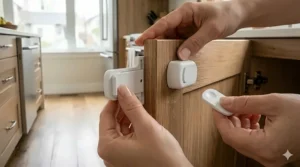
If your cabinets have actual knobs or handles rather than flush doors, a simple U-shaped or lever latch that loops over two adjacent handles is often all you need — cats can’t generate enough leverage on a basic plastic loop the way they can hook a claw under a door edge.
This is the cheapest, fastest option on this list and a reasonable first try before investing in a magnetic system, particularly for milder cabinet-curious cats rather than serial offenders.
✅ Pros: Very cheap; instant install; reusable across cabinets with handles
❌ Cons: Only works on cabinets with handles/knobs spaced correctly; lower-strength cats only
Price range: roughly $8–$15 CAD for a multi-pack.
7. Spring-Loaded Elbow Catch (for frameless cabinets)
Many newer Canadian kitchens use frameless, European-style cabinet construction, where most adhesive and magnetic locks designed around a traditional face frame won’t sit correctly. A spring-loaded elbow catch, screwed to the inside of the door and cabinet wall, is the more reliable fix for that cabinet style.
This is the one option on the list that explicitly is not for frameless cabinets in most cheaper designs — so it’s worth double-checking your cabinet construction before buying, since the wrong style simply won’t catch.
✅ Pros: Works on frameless cabinets where others fail; durable hardware
❌ Cons: Requires screws; not designed for drawers without a door lip
Price range: roughly $15–$25 CAD per pack of 4.
Magnetic vs. Strap vs. Lever Locks: Which Actually Stops a Cat?
| Factor | Magnetic | Adhesive Strap | Lever/U-Latch |
|---|---|---|---|
| Resistance to clawing | Highest | Medium | Medium-low |
| Install effort | Medium–high | Low | Low |
| Best cabinet type | Any flush door | Doors with a gap | Doors with handles |
| Renter-friendly | Some (adhesive versions) | Yes | Yes |
The pattern across pet-owner forums and product feedback is consistent: magnetic systems win on raw cat-proofing because there’s nothing exposed to grip or chew, while strap and lever styles win on convenience and renter-friendliness. If you’ve already tried a strap latch and your cat defeated it, that’s usually the signal to move up to magnetic rather than trying a second strap brand.
Real-World Scenarios
A Toronto condo owner with a counter-surfing cat and a no-drill lease clause: adhesive magnetic options like Vmaisi or Safety 1st make more sense than Tot-Lok, since drilling into cabinetry usually isn’t allowed in a rental or condo agreement.
An Ottawa household with three cats and an entire kitchen to secure: a 10–12 pack multi-brand kit is the more economical route than buying premium locks one cabinet at a time, even if individual build quality is a step down from Tot-Lok.
A Calgary homeowner with a persistent cat that’s already destroyed two strap locks: this is the case for going straight to a drilled magnetic system — the repeated-replacement cost of cheaper locks usually exceeds the price difference within a year.
Common Mistakes When Cat-Proofing Cabinets
- Skipping the gap measurement. Buying a strap lock with too short an adjustable range for your door gap is the single most common return reason.
- Using adhesive on a dirty or oily kitchen surface. Wipe down with isopropyl alcohol before sticking — grease residue is the main reason adhesive locks fail early.
- Assuming one lock style covers the whole house. Kitchens, bathrooms, and laundry cabinets often have different door styles; mixing lock types per room is normal and expected.
- Forgetting under-sink chemical cabinets specifically. These tend to hold the most genuinely dangerous items (cleaners, drain products) and deserve your strongest lock, even if other cabinets get a cheaper one.
- Not checking frameless cabinet compatibility before buying a standard adhesive or magnetic kit designed for face-frame doors.
Why This Matters: Cabinets, Cats, and Household Toxins
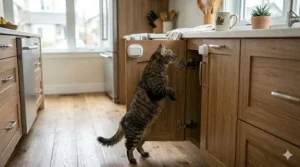
This isn’t only about a cat knocking over your spice rack. Cabinets — especially under the kitchen sink and in laundry rooms — are where most households store cleaning products, medications, and pest-control items, all of which are genuinely dangerous if a cat manages to get inside and chew through packaging. Health Canada’s guidance on household chemical products notes that these products should be kept out of sight and out of reach of children and pets, since they can cause poisoning, burns, fires, or explosions if mishandled.
Veterinary toxicology resources echo the same point specifically for cats: common at-home advice is to store hazardous substances out of reach and use childproof locks on cabinets, since everyday items like household cleaners and certain medications can be seriously harmful if a pet gets into them.
If you ever suspect your cat has gotten into something it shouldn’t have, contact your veterinarian or a poison control line immediately rather than waiting for symptoms — the Canadian Association for Poison Centres and Clinical Toxicology maintains a list of national resources, including animal-specific poison control contacts, and Health Canada’s household chemical safety page covers what hazard symbols on product labels actually mean.
FAQ
❓ Do cat-proof cabinet locks really work, or will a clever cat figure them out?
❓ Will cabinet locks damage my rental cabinets in Canada?
❓ Can I use the same lock on drawers and cabinets?
❓ Do these locks ship reliably across Canada, including rural areas?
❓ What's the cheapest way to cat-proof an entire kitchen?
Conclusion
There’s no single “best” cat-proof cabinet lock — the right pick depends on whether you’re renting or own, how determined your particular cat is, and whether your cabinets are frameless or traditional. For most Canadian households, a no-drill magnetic or adhesive strap lock covers everyday curiosity, while a drilled Tot-Lok-style system is worth the extra effort for cabinets holding genuinely hazardous items like cleaners or medication. Whichever you choose, the goal is the same: a barrier your cat can’t out-stubborn.
✨ Don’t Miss These Exclusive Deals!
🔍 Ready to cat-proof your kitchen? Compare current prices and availability on Amazon.ca before you buy — stock and pricing shift often.
Recommended for You
- Best Cat Scratch Carpet Protector for Stairs in Canada 2026 (Top 7 Picks)
- Cat Deterrent for Kitchen Counters: 7 Top Picks for Canada (2026)
- 7 Best Cat Proof Screen Door Protectors in Canada (2026 Guide)
Disclaimer: This article contains affiliate links. As an Amazon Associate, I earn from qualifying purchases. If you purchase products through these links, we may earn a small commission at no additional cost to you. Prices and availability are approximate at the time of writing and may change — always confirm current pricing and Canadian shipping details on Amazon.ca before purchasing.
✨ Found this helpful? Share it with your friends! 💬🤗
