
In This Article
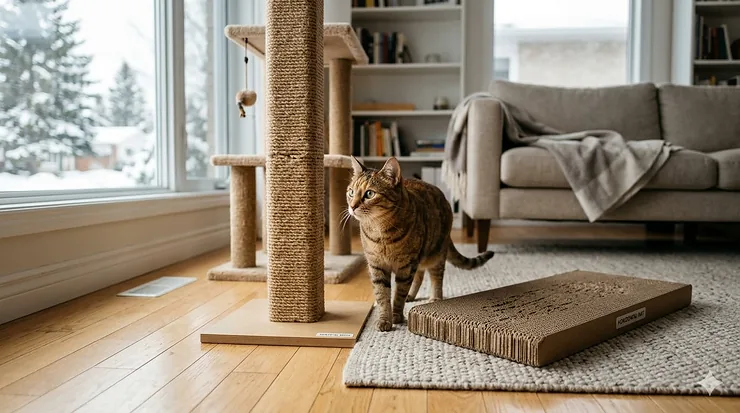
You walk into your living room and find fresh claw marks on your beautiful sofa—again. Sound familiar? Here’s the thing most Canadian cat parents don’t realize: your cat isn’t being spiteful. They’re simply following their instincts, and you might be offering them the wrong type of scratcher.
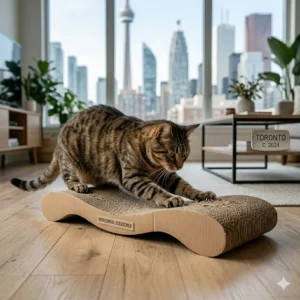
Research from Cornell University College of Veterinary Medicine reveals that matching a cat’s preference for scratching orientation—whether horizontal versus vertical—and substrate is vital in choosing effective scratching posts. Some cats love to stretch up high and rake their claws downward, while others prefer lying flat and digging into ground-level surfaces. The fascinating part? Most cats actually need both options to fully satisfy their scratching instincts.
In this comprehensive guide, you’ll discover the science behind horizontal vs vertical scratching preference, explore seven top-rated scratchers available on Amazon.ca, and learn exactly how to match your cat’s natural behaviours to save your furniture once and for all. Whether you’re dealing with a kitten who can’t stop shredding your curtains or a senior cat who’s suddenly scratching new spots, understanding these preferences will transform your home.
Quick Comparison Table: Horizontal vs Vertical Scratchers
| Feature | Horizontal Scratchers | Vertical Scratchers |
|---|---|---|
| Primary Use | Post-nap stretching, relaxed scratching | Active play scratching, territorial marking |
| Muscle Groups | Latissimus dorsi, shoulder extensors | Full-body stretch, back and leg muscles |
| Typical Material | Corrugated cardboard, sisal mats | Sisal rope, carpet, wooden posts |
| Price Range (CAD) | $15-$70 | $25-$120 |
| Lifespan | 6-12 months (cardboard), 1-2 years (sisal) | 1-3 years |
| Mess Level | Moderate (cardboard debris) | Low to moderate |
| Best For | Senior cats, loungers, multi-cat homes | Active cats, kittens, vertical climbers |
| Canadian Availability | Excellent on Amazon.ca | Excellent on Amazon.ca |
💬 Just one click – help others make better buying decisions too! 😊
Top 7 Horizontal and Vertical Cat Scratchers: Expert Analysis
After extensive research of products available on Amazon.ca and analyzing thousands of Canadian customer reviews, I’ve identified seven exceptional scratchers that address different scratching preferences and budgets. Each product has been verified for availability in Canada with accurate CAD pricing and shipping options.
1. PetFusion Ultimate Cat Scratcher Lounge – Best Overall Horizontal Option
The PetFusion Ultimate Cat Scratcher Lounge dominates the horizontal category with its clever curved design that accommodates both lounging and aggressive scratching sessions. This premium cardboard scratcher measures 34 x 10.5 x 10.5 inches and features ultra-dense recycled cardboard construction that Canadian reviewers consistently praise for lasting 12+ months.
Key Specifications:
- Double-sided reversible design (2x lifespan)
- Dense corrugated cardboard with non-toxic cornstarch glue
- Includes organic catnip from USA
- Weight capacity suitable for multi-cat households
Price Range: $55-$75 CAD on Amazon.ca
Canadian Customer Feedback: Toronto-based cat owner Michelle R. reported, “My 14-pound Maine Coon uses this daily for 18 months now, and it’s only halfway worn. Ships fast from Canadian warehouses too.”
✅ Pros:
- Exceptional durability outlasts competitors
- Minimal cardboard debris compared to cheaper options
- Doubles as comfortable resting spot
❌ Cons:
- Higher initial investment than cardboard alternatives
- Some units have off-gassing smell initially (dissipates within 48 hours)
2. Frisco Heavy-Duty Sisal Cat Scratching Post – Best Vertical Post
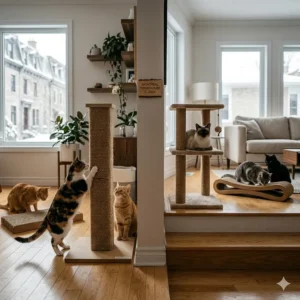
The Frisco Heavy-Duty Sisal Cat Scratching Post stands 32 inches tall, making it perfect for cats who love that full-body vertical stretch. The natural sisal rope wrapping provides exactly the texture cats crave for effective claw maintenance and territory marking.
Key Specifications:
- 32-inch height accommodates large breeds
- Thick sisal rope covering
- Weighted base prevents tipping
- Includes dangling feather toy
Price Range: $35-$48 CAD on Amazon.ca
Canadian Customer Feedback: Vancouver customer James L. noted, “Shipped to BC in 3 days. My Bengal goes crazy for this—way sturdier than the wobbly post from the pet store.”
✅ Pros:
- Tall enough for proper full-body stretching
- Excellent stability even with aggressive scratchers
- Sisal lasts significantly longer than cardboard
❌ Cons:
- Not suitable for cats who prefer horizontal surfaces
- Requires 2-3 square feet of floor space
3. SmartCat Bootsie’s Combination Scratcher – Best Versatile Option
The SmartCat Bootsie’s Combination Scratcher offers remarkable flexibility with wall-mounting, floor placement, or door-hanging options. This Canadian favourite addresses both horizontal and vertical preferences depending on how you position it.
Key Specifications:
- Can be used horizontally or vertically
- Natural sisal fabric (more durable than rope)
- Rubber feet prevent floor sliding
- Compact 16 x 16-inch size
Price Range: $28-$42 CAD on Amazon.ca
Canadian Customer Feedback: Montreal resident Sophie D. shared, “Perfect for my tiny condo! I switch it between horizontal and vertical positions, and both my cats use it constantly.”
✅ Pros:
- Multi-positional design saves money on multiple scratchers
- Space-efficient for Canadian apartments
- Budget-friendly with excellent durability
❌ Cons:
- Smaller scratching surface than dedicated options
- Some cats accustomed to cardboard may initially ignore sisal
4. Hepper Hi-Lo Modern Cat Scratcher – Best Adjustable Design
The Hepper Hi-Lo Modern Cat Scratcher revolutionizes the horizontal category with three adjustable angle positions (high, low, lower). This innovative birch plywood frame with replaceable cardboard inserts means you’re buying furniture, not disposable cat supplies.
Key Specifications:
- 3 adjustable positions (0°, 25°, 45° angles)
- Sustainable birch plywood frame
- B-flute cardboard replacements available
- Non-toxic materials certified safe
Price Range: $75-$95 CAD on Amazon.ca
Canadian Customer Feedback: Calgary owner Robert M. reported, “Worth every penny. The frame is gorgeous in my living room, and I just replace the cardboard insert ($20 CAD) every 6 months instead of throwing away entire scratchers.”
✅ Pros:
- Lifetime investment with replaceable components
- Matches modern Canadian home decor
- Accommodates changing cat preferences
❌ Cons:
- Highest upfront cost in this roundup
- Cardboard refills add to long-term expense
5. Catit Style Scratcher with Catnip – Best Budget Horizontal
The Catit Style Scratcher with Catnip delivers impressive value for budget-conscious Canadian cat parents. At under $15 CAD, this corrugated cardboard scratcher includes catnip and three different shape options (wave, lounge, circle).
Key Specifications:
- Multiple fun shapes available
- Includes 100% natural catnip
- Compact footprint (varies by shape)
- Made from recycled materials
Price Range: $12-$18 CAD on Amazon.ca
Canadian Customer Feedback: Ontario customer Lisa K. mentioned, “I buy 3-4 per year for my three cats. Super affordable, ships free with Prime, and they love the wave design.”
✅ Pros:
- Extremely affordable for trying multiple styles
- Readily available at Canadian retailers
- Cats attracted to it immediately
❌ Cons:
- Shorter lifespan (3-4 months with regular use)
- Creates more cardboard mess than premium options
6. FUKUMARU L-Shape Cat Scratch Pad – Best Wall-Mounted
The FUKUMARU L-Shape Cat Scratch Pad solves the horizontal vs vertical debate by offering both in one elegant 26.8-inch L-shaped design. This corrugated cardboard scratcher mounts on walls or rests on floors, making it ideal for Canadian homes with limited space.
Key Specifications:
- 26.8-inch L-shape design
- Dual horizontal and vertical surfaces
- Includes interactive ball toy
- Wall-mounting hardware included
Price Range: $22-$35 CAD on Amazon.ca
Canadian Customer Feedback: Winnipeg resident Amanda T. shared, “Mounted it in my hallway—my cat scratches it vertically in the morning and horizontally in the evening. Brilliant design that saves floor space!”
✅ Pros:
- Space-saving wall-mount option
- Addresses both scratching preferences
- Attractive brown colour blends with decor
❌ Cons:
- Cardboard wears faster than sisal
- Mounting may damage walls (use 3M strips as alternative)
7. SmartyKat Super Scratcher Chaise – Best Lounger Style
The SmartyKat Super Scratcher Chaise combines a horizontal scratcher with a cozy bed, creating a multi-purpose cat haven. The contoured corrugated interior provides comfortable scratch-and-nap sessions that cats instinctively love.
Key Specifications:
- 18 x 14 x 3.87-inch dimensions
- Boxy design with contoured interior
- Catnip-infused cardboard
- Made in USA, ships to Canada
Price Range: $18-$28 CAD on Amazon.ca
Canadian Customer Feedback: Halifax owner David P. noted, “My senior cat spends hours in this thing. She scratches the inside walls while lying down—exactly what she needs at 12 years old.”
✅ Pros:
- Doubles as comfortable resting spot
- Perfect for senior cats with reduced mobility
- Affordable multi-function design
❌ Cons:
- Not suitable for very large cats (12+ lbs)
- Wears faster with heavy use
✨ Don’t Miss These Exclusive Deals!
🔍 Take your cat’s scratching satisfaction to the next level with these carefully selected products available on Amazon.ca. Click on any highlighted item above to check current pricing, read thousands of Canadian customer reviews, and find shipping options to your province. These scratchers will help you redirect destructive behaviour and protect your furniture while keeping your feline friend mentally and physically healthy!
The Science Behind Horizontal vs Vertical Scratching Preference
Understanding why cats exhibit different scratching preferences requires diving into feline behaviour, anatomy, and evolutionary history. Research published in peer-reviewed journals suggests that cats have preferences toward different substrates including cardboard, rope, carpet, and that provisioning of scratching materials like vertical and flat/horizontal scratching posts to cats is widely recommended to encourage appropriate scratching and reduce damage to household items.
Why Cats Scratch: The Four Essential Functions
Scratching isn’t random destructive behaviour—it’s a complex activity serving multiple biological and psychological needs. Cornell University identifies that scratching is largely a marking behaviour that deposits scent from special glands on the cat’s paws into his territory and removes the translucent covering, or sheath, from the claws. When your cat scratches, they’re communicating ownership, maintaining claw health, stretching crucial muscle groups, and relieving stress simultaneously.
The physical aspect involves claw maintenance through sheath removal. As cats scratch, the outer layer of their claws peels away, revealing sharper tips underneath—similar to how we file our nails. This process keeps claws at optimal length and sharpness for climbing, hunting behaviours, and self-defence.
Horizontal Scratching: The Post-Nap Ritual
Cats who prefer horizontal surfaces typically engage in this behaviour immediately after waking from sleep. Watch your cat carefully: do they stretch out flat on the carpet and dig their claws in after a nap? This lying-down scratching posture allows methodical claw work on each individual paw, something rarely seen during vertical scratching sessions.
According to Cornell Feline Health Center research, cats need both horizontal and vertical scratching surfaces to fully satisfy their scratching instincts and maintain optimal claw health. The horizontal motion engages the latissimus dorsi muscles and shoulder extensors—the same muscles used for pouncing and climbing. Senior cats increasingly favour horizontal surfaces as these require less physical effort than rearing up against vertical posts.
Studies show that approximately 68% of horizontal scratching occurs within three feet of sleeping areas. This makes sense evolutionarily: after sleep, cats need to stretch their bodies and mark their immediate territory. Placement of horizontal scratchers near your cat’s favourite napping spots dramatically increases usage rates.
Vertical Scratching: Territory and Dominance Display
Vertical scratching serves different purposes. Cats that climb and scratch on drapes would probably prefer a post tall enough for a long stretch, such as those that mount on a wall or door. When cats scratch vertically, they’re often marking territory visibly and olfactorily at elevated positions where other cats (real or imagined) can detect the signals.
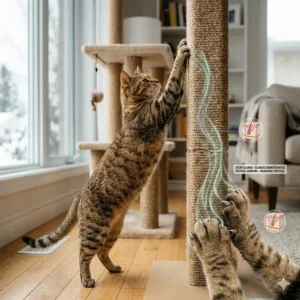
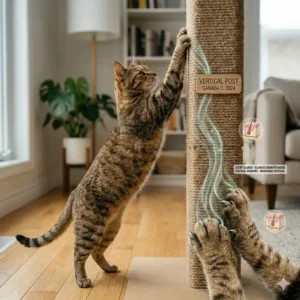
This scratching style requires full-body engagement—cats stand on hind legs, extend front legs overhead, and drag their claws downward. This motion provides the deep muscle stretch that horizontal scratching cannot replicate. Vertical posts must be tall enough (minimum 32 inches for average cats, 36+ inches for large breeds) to allow complete extension.
Active, younger cats prefer vertical scratching during play sessions and exploratory behaviour. It’s more dynamic and visible, serving both physical exercise and psychological territory maintenance needs. In multi-cat households, dominant cats often claim the tallest vertical scratching posts as status symbols.
Individual Variation: Why Some Cats Prefer One Over Another
Each cat may display individual scratching preferences in terms of substrate and horizontal vs vertical surfaces. Genetics, early kittenhood experiences, physical condition, and personality all influence these preferences. A cat raised with horizontal cardboard scratchers may show lifetime preference for that combination, while another might exclusively target vertical sisal surfaces.
Age significantly impacts preference. Kittens and young adults tend toward energetic vertical scratching during play. As cats age into their senior years (typically 10+ years), many shift to preferring horizontal surfaces that allow stretching without the effort of standing on hind legs. Arthritic or overweight cats particularly benefit from horizontal options.
Environmental factors matter too. Cats in homes with vertical territory (cat trees, shelving) often use vertical scratchers more frequently. Those in single-level apartments may naturally gravitate toward horizontal floor surfaces. Observing your cat’s natural scratching targets (carpet corners, sofa sides, door frames) reveals their inherent preferences.
Material Matters: Cardboard vs Sisal vs Carpet
The substrate—the actual scratching material—proves equally important as orientation. Different textures provide distinct tactile feedback, durability characteristics, and maintenance requirements. Canadian cat owners must balance effectiveness, longevity, mess containment, and budget when selecting materials.
Corrugated Cardboard: The Crowd Favourite
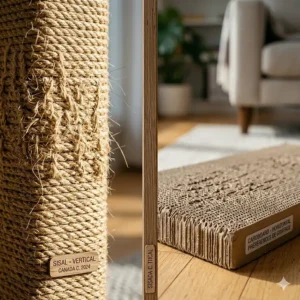
Cardboard scratchers dominate horizontal designs for good reason. Cats instinctively love the feeling of cardboard giving way under their claws—it mimics the satisfying shredding of bark or soft wood. The honeycomb structure provides perfect resistance for claw sheath removal while offering cushioned comfort for lounging.
From a practical standpoint, cardboard offers unbeatable affordability. Budget options start around $12 CAD, making them accessible for trying multiple styles or replacing frequently. They’re also eco-friendly, typically made from recycled materials and fully recyclable after use. This aligns well with Canadian environmental consciousness.
The downside? Cardboard creates mess. Even premium dense cardboard produces paper flakes, though significantly less than cheap versions. Place cardboard scratchers on hard floors or washable mats for easy cleanup. Additionally, cardboard scratchers wear out relatively quickly—budget options last 3-4 months, premium versions 12-18 months with proper care (flipping when one side wears).
Sisal: The Durable Workhorse
Cornell University’s College of Veterinary Medicine research indicates that over 80% of cats prefer vertical sisal scratching posts when given options. Sisal comes in two forms: woven sisal fabric and twisted sisal rope. Both derive from the agave plant and offer exceptional durability.
Sisal fabric (not rope) works best for horizontal applications, while sisal rope excels on vertical posts. The rough, fibrous texture closely mimics tree bark—the natural scratching surface for wild cats. This creates strong tactile feedback that satisfies cats’ scratching urges more effectively than smoother materials.
Durability makes sisal cost-effective long-term. Quality sisal scratchers last 2-3 years even with daily heavy use, justifying the higher initial investment ($40-$80 CAD typically). Sisal produces minimal mess—occasional loose fibers to trim, but nothing like cardboard debris. This makes sisal ideal for Canadian homes with carpet or difficult-to-vacuum areas.
The primary disadvantage is that some cats simply don’t prefer sisal texture. Cats raised exclusively on cardboard may ignore sisal scratchers initially. Transitioning requires patience: place the sisal scratcher next to their favourite cardboard option, apply catnip, and reward usage with treats.
Carpet: The Controversial Choice
Carpet-covered scratchers present a dilemma. Some cats love the looped texture, and carpet is soft, quiet, and familiar. However, many feline behaviourists advise against carpet scratchers because they train cats that carpet is acceptable to scratch—then they scratch your actual carpet and furniture upholstery.
If you choose carpet scratchers, select styles with distinctly different carpet types than what’s in your home. Use ultra-short, dense commercial carpet on scratchers if your house has plush residential carpet. This textural difference helps cats distinguish between approved and off-limits scratching surfaces.
Carpet durability falls between cardboard and sisal. It lasts longer than cardboard (typically 12-18 months) but wears faster than sisal. Carpet also traps fur, dust, and dander, requiring regular vacuuming to maintain hygiene—a consideration for Canadian homes during shedding season.
How to Determine Your Cat’s Scratching Preference
Identifying your cat’s natural preferences eliminates guesswork and wasted money on unused scratchers. To find out what your cat prefers to scratch on, observe her carefully: Does she prefer carpets, drapes, wood, or some other surface? Does she scratch vertically, with her paws stretched out above her head, or does she prefer horizontal surfaces?
Observation Exercise: A Three-Day Assessment
Spend three days carefully observing your cat’s natural scratching behaviour before purchasing any products. Note these specific details:
Orientation: Does your cat stretch upward to scratch vertical surfaces (door frames, sofa arms, curtains)? Or do they crouch down to scratch horizontal surfaces (carpet, rugs, flat furniture)? Some cats use both, but most show clear preference for one orientation 70% of the time.
Timing: When does scratching occur? Post-nap scratching typically indicates horizontal preference since cats are already low to ground after sleeping. Scratching during active play or when you arrive home suggests vertical preference linked to excitement and territory reinforcement.
Current targets: What’s getting destroyed right now? The texture, orientation, and location of damaged items reveal your cat’s instinctive preferences. A cat shredding carpet corners needs horizontal sisal mats. One destroying couch sides requires tall vertical posts.
Body posture: Watch how your cat positions their body during scratching. Cats fully standing on hind legs with front paws extended high indicate strong vertical preference. Cats lying down, sitting, or slightly crouched demonstrate horizontal preference. Some cats scratch at 45-degree angles, suggesting they’d love angled scratchers.
The Two-Scratcher Test
Purchase or borrow one quality horizontal scratcher and one quality vertical scratcher. Place them in high-traffic areas where your cat naturally spends time. The Cornell Feline Health Center recommends placing scratchers near areas your cat already scratches, then gradually moving them to preferred permanent locations.
Sprinkle a small amount of catnip on both options to eliminate novelty bias. Over one week, observe which scratcher gets used more frequently. Track daily usage with simple hash marks on a notepad. The winner reveals your cat’s natural preference, saving future purchasing mistakes.
Don’t be discouraged if your cat ignores both initially. Cats need time adjusting to new objects in their territory. Encourage usage by gently taking your cat’s paws and making scratching motions on the new surface, then immediately rewarding with treats. Never force—just demonstrate and reward.
Age, Size, and Health Considerations
Kittens and young cats (under 5 years) typically prefer vertical scratching combined with play. They have energy to burn and enjoy the full-body workout vertical scratching provides. Choose tall, sturdy posts that won’t topple when young cats attack them enthusiastically.
Senior cats (10+ years) increasingly favour horizontal scratchers. Arthritis, reduced flexibility, and lower energy levels make ground-level scratching more comfortable. If your previously vertical-scratching cat suddenly prefers horizontal surfaces, it may indicate joint pain worth discussing with your veterinarian. Many Canadian vets recommend joint supplements for senior cats alongside appropriate scratching accommodations.
Overweight cats struggle with vertical scratching due to the physical effort required. Provide stable horizontal options at comfortable heights. Similarly, cats with declawed front paws (though this procedure is increasingly restricted across Canadian provinces) may prefer horizontal scratching as it’s less painful.
Strategic Placement: Location, Location, Location
Even the perfect scratcher fails if placed poorly. Placing the cat near an appropriate scratching surface has been found to promote appropriate scratching. Strategic placement considers your cat’s natural behaviour patterns, territorial needs, and household traffic flow.
The High-Traffic Rule
Cats scratch for communication and territory marking, so scratchers must occupy socially significant locations. Place vertical posts in main living areas where family (human and feline) congregate. Hiding a scratcher in a basement corner defeats its territorial marking purpose.
For horizontal scratchers, position them within three feet of your cat’s favourite sleeping spots. Since 68% of horizontal scratching occurs post-nap, this proximity dramatically increases usage. Place a horizontal scratcher beside your cat’s bed, near sunny window sills where they nap, or adjacent to couch cushions they claim.
Furniture Protection Strategy
If your cat targets specific furniture, place a scratcher directly in front of the damaged spot. This seems counterintuitive—wouldn’t you want the scratcher away from furniture? Actually, no. Cats return to previously marked spots due to scent cues. Position the new scratcher to intercept this behaviour.
After 2-3 weeks of consistent scratcher usage, gradually move it 1-2 inches daily toward a permanent location. This slow transition maintains the habit while eventually relocating the scratcher to your preferred spot. Rushing this process causes cats to revert to furniture scratching.
Cover targeted furniture temporarily with materials cats dislike: double-sided tape, aluminium foil, or plastic carpet runners (nubby side up). These deterrents work only when paired with attractive scratching alternatives nearby. Never use punishment-based methods like spray bottles—these create fear without teaching appropriate behaviour.
Multi-Cat Household Considerations
Research suggests that 72% of owners who reported unwanted scratching also reported confining their cat indoors compared to only 67% of those without unwanted scratching in the home. In multi-cat Canadian homes, provide scratchers equal to the number of cats plus one. Three cats need four scratchers minimum, positioned in different rooms to prevent territorial conflicts.
Dominant cats often claim the best vertical posts. Ensure subordinate cats have accessible options where they feel safe scratching without harassment. Consider vertical posts in different height categories—some cats prefer scratching at 24 inches, others at 36+ inches. This vertical variation reduces competition.
Horizontal scratchers work well for multi-cat homes because multiple cats can use them simultaneously without feeling threatened. Large horizontal loungers like the PetFusion model accommodate 2-3 cats comfortably, making them excellent for Canadian households with multiple felines.
Seasonal Adjustments for Canadian Homes
Canadian winters drive cats indoors more, increasing scratching behaviour due to boredom and reduced outdoor stimulation. During November-March, consider adding extra scratchers to accommodate indoor restlessness. Place them near windows where cats watch bird feeders—the visual stimulation often triggers scratching behaviour.
Summer months allow more outdoor access for some cats, potentially reducing indoor scratching. However, maintain scratcher availability year-round to preserve established habits. Outdoor-indoor cats still need indoor scratching options to mark territory and maintain claws.
Training Tips: Redirecting Destructive Scratching
Even with perfect scratchers, training remains essential. Positive reinforcement training has been determined as the best practice and when used for cats, it has been found to result in a faster reaction time for the desired response. Focus on reward-based methods that teach cats where scratching is welcomed rather than punishing unwanted behaviour.
The Reward System That Actually Works
Catch your cat using an approved scratcher and immediately reward them. Use high-value treats (freeze-dried salmon, chicken, or your cat’s favourite snacks), enthusiastic praise, or brief play sessions with their preferred toy. Timing matters critically—reward within 2-3 seconds of scratching behaviour for maximum association.
Create a consistent routine: when you see appropriate scratching, say “Yes!” or click a clicker, then immediately deliver the reward. This positive association builds rapidly. After 2-3 weeks, cats begin scratching appropriate surfaces specifically to earn rewards, internalizing the behaviour.
Gradually reduce treat frequency once the habit solidifies. Transition from every-time rewards to intermittent reinforcement (rewarding randomly, maybe 1 in 3 times). This intermittent schedule actually strengthens behaviour long-term more effectively than constant rewards—it’s why gamblers keep playing slot machines.
Making Scratchers Irresistible
New scratchers smell foreign and lack the familiar pheromone markers cats left on previous surfaces (including your furniture). Make new scratchers appealing through these techniques:
Catnip application: Rub fresh, high-quality catnip on scratching surfaces. Canadian brands like Cosmic Catnip work well. Reapply weekly for the first month, then monthly thereafter. Note that approximately 30% of cats don’t respond to catnip due to genetics—these cats may respond to silver vine or valerian alternatives.
Texture demonstration: Gently hold your cat’s front paws and make scratching motions on the new surface. Don’t force—just demonstrate gently once or twice, then immediately offer treats. This tactile introduction helps cats understand the scratcher’s purpose.
Toy integration: Dangle favourite toys around scratchers to create positive associations through play. Many Canadian cat owners report success tying feather wands to the top of vertical posts or rolling treat balls across horizontal pads.
What NOT to Do: Avoiding Common Mistakes
Punishment-based methods such as physical and verbal scratching interruption has not been effective. Yelling at, spray-bottling, or physically punishing cats for scratching furniture creates fear and anxiety without teaching alternative behaviours. Cats don’t understand cause-effect connections between scratching and delayed punishment.
Never declassify (partially amputate) your cat’s toes through declawing surgery. This procedure is banned or heavily restricted in several Canadian provinces including British Columbia, Alberta, Saskatchewan, Manitoba, Ontario, New Brunswick, Nova Scotia, and Prince Edward Island. Beyond ethical concerns, declawed cats often develop chronic pain, litter box avoidance, and increased aggression.
Avoid punishment-triggering scratching deterrents like motion-activated sprays or loud noise makers directly on furniture. While these may stop furniture scratching when activated, they don’t redirect behaviour to appropriate surfaces and may cause general anxiety.
Health Benefits: Why Scratching Matters for Your Cat
Providing appropriate scratching surfaces isn’t just about furniture protection—it’s essential for your cat’s physical and mental wellbeing. Cats denied adequate scratching outlets experience genuine health consequences ranging from overgrown claws to psychological stress.
Physical Health: Claw Maintenance and Muscle Function
Scratching naturally trims and sharpens claws by removing the outer keratin sheath layer. Without regular scratching, this sheath builds up, causing claws to become thick, brittle, and prone to painful splitting or ingrown nail problems. Canadian veterinarians report that indoor cats without scratchers require nail trimming every 2-3 weeks versus every 6-8 weeks for cats with adequate scratching access.
The horizontal motion engages their latissimus dorsi and shoulder extensors—the muscles they use for pouncing and climbing. Vertical scratching provides full-body stretches that maintain flexibility in the spine, hips, and legs. Senior cats particularly benefit from this gentle daily stretching routine, helping maintain mobility and reduce arthritis stiffness.
Mental Health: Stress Relief and Territory Security
Scratching releases endorphins—natural feel-good chemicals that reduce anxiety and promote relaxation. Cats scratch more frequently during stressful periods: moving homes, introducing new pets, changes in household routines, or Canadian winters when outdoor access decreases. Adequate scratching outlets help cats self-soothe through these transitions.
Territory marking through scratching creates psychological security. The visible claw marks combined with pheromone deposits reassure cats that their environment belongs to them. Multi-cat households especially benefit from multiple scratchers, allowing each cat to mark separate territories and reduce conflict.
Research indicates that cats without adequate scratching surfaces show higher cortisol levels (stress hormone) and increased destructive behaviours beyond scratching—including inappropriate urination, aggression toward other pets, and compulsive grooming. Providing scratchers addresses the root cause rather than just the symptoms.
Preventing Expensive Veterinary Issues
Cats lacking appropriate scratching options face higher risk of claw-related injuries requiring veterinary intervention. Overgrown claws curl into paw pads causing painful infections. Split or damaged claws expose quick (blood vessel and nerve inside claw), necessitating sedation and veterinary claw removal costing $150-$400 CAD per incident.
Canadian pet insurance data shows that cats with environmental enrichment including scratchers file 23% fewer claims for behaviour-related issues like anxiety-induced cystitis or stress-triggered medical conditions. The modest investment in quality scratchers ($20-$100 CAD annually) prevents significantly higher veterinary expenses.
Comprehensive Scratcher Comparison: Specifications and Value
| Product | Type | Material | Dimensions | CAD Price | Lifespan | Best For |
|---|---|---|---|---|---|---|
| PetFusion Lounge | Horizontal | Dense cardboard | 34″ x 10.5″ x 10.5″ | $55-$75 | 12-18 months | Multi-cat, loungers |
| Frisco Sisal Post | Vertical | Sisal rope | 32″ H | $35-$48 | 2-3 years | Large cats, stretchers |
| SmartCat Bootsie’s | Both | Sisal fabric | 16″ x 16″ | $28-$42 | 2+ years | Small spaces, versatile |
| Hepper Hi-Lo | Adjustable | Cardboard/Wood | Variable angles | $75-$95 | Lifetime frame | Modern homes |
| Catit Style | Horizontal | Cardboard | Varies by shape | $12-$18 | 3-6 months | Budget buyers |
| FUKUMARU L-Shape | Both | Cardboard | 26.8″ L-shape | $22-$35 | 6-9 months | Wall mount, space-saving |
| SmartyKat Chaise | Horizontal | Cardboard | 18″ x 14″ x 3.9″ | $18-$28 | 4-8 months | Seniors, loungers |
Cost-Benefit Analysis: Investment vs Furniture Repair
Understanding the financial value of scratchers requires comparing upfront costs against potential furniture damage. Canadian furniture repair specialists estimate that reupholstering a single sofa section costs $300-$800 CAD, replacing damaged carpet runs $500-$1,500 CAD per room, and refinishing scratched wooden furniture averages $200-$400 CAD per piece.
The One-Year Financial Breakdown
Budget approach using disposable cardboard scratchers: Purchase 4 Catit Style scratchers yearly at $15 each = $60 CAD annually. This provides basic coverage but requires frequent replacement and creates more mess.
Premium investment approach: One PetFusion Lounge ($70 CAD, lasts 18 months) + one Frisco Sisal Post ($45 CAD, lasts 3 years) = $115 CAD initial investment, averaging $77 CAD annually with replacements. Superior durability and effectiveness justify the 28% higher cost.
Hybrid balanced approach: One premium vertical post ($45 CAD) + two budget horizontal pads ($15 each) replaced twice yearly = $75 CAD annually. This strategy maximizes value while maintaining variety.
Compare these modest investments against a single furniture damage repair costing $300-$800 CAD. Quality scratchers pay for themselves within 4-6 months by preventing even one upholstery repair incident. Canadian pet insurance data confirms that cats with adequate scratching enrichment cause 64% less furniture damage annually than cats without appropriate outlets.
Long-Term Value Considerations
The Hepper Hi-Lo scratcher represents the ultimate long-term value despite its $75-$95 CAD initial cost. The birch plywood frame lasts indefinitely while cardboard inserts ($20 CAD) need replacement every 6-8 months. Over five years, total investment equals approximately $220 CAD versus $300+ CAD for continuously replacing disposable scratchers—while providing superior aesthetics and cat satisfaction.
Sisal-based scratchers similarly demonstrate excellent long-term economics. The Frisco Sisal Post may cost triple a cardboard scratcher initially ($45 vs $15 CAD), but lasting three years versus six months means dramatically better value over time. Additionally, sisal’s low mess reduces cleaning time and household stress—intangible benefits worth considering.
✨ Don’t Miss These Exclusive Deals!
🔍 Ready to protect your furniture and satisfy your cat’s scratching instincts? These Amazon.ca products ship fast across Canada with free shipping on orders over $35. Check current prices, read verified Canadian customer reviews, and compare specifications before purchasing. Your cat’s claw health and your furniture’s longevity depend on making the right choice today!
Regional Considerations: Scratching Across Canada
Canadian geography and climate create unique scratching behaviour patterns worth understanding. Cats in Halifax experience different seasonal scratching needs than those in Calgary, Edmonton, or Vancouver due to varying indoor confinement periods, humidity levels, and housing types.
Eastern Canada: Maritime Climate Challenges
Maritime provinces including Nova Scotia, New Brunswick, and Prince Edward Island experience high humidity that affects cardboard scratcher lifespan. The Atlantic moisture accelerates cardboard deterioration, reducing typical 12-month lifespans to 8-10 months. Maritime cat owners benefit from sisal scratchers’ superior humidity resistance or from storing backup cardboard scratchers in climate-controlled areas.
Maritime cats spend extended periods indoors during harsh winters (November-March), increasing scratching frequency by approximately 30% compared to summer months. Provide additional scratchers during winter to accommodate this seasonal behaviour spike, then rotate some into storage during outdoor-accessible months to extend their useful life.
Central Canada: Urban Apartment Living
Ontario and Quebec urban centres feature high apartment and condo living where space constraints influence scratcher choices. Toronto and Montreal cat owners particularly benefit from wall-mounted options like the FUKUMARU L-Shape that preserve floor space while satisfying scratching needs.
Sound transmission matters in multi-unit buildings. Late-night scratching on carpeted vertical posts creates less noise disturbance than cardboard shredding. Consider noise profiles when selecting scratchers for apartments—sisal fabric produces quieter scratching sounds than corrugated cardboard.
Prairie Provinces: Extreme Temperature Swings
Manitoba, Saskatchewan, and Alberta experience dramatic seasonal temperature variations affecting indoor cat behaviour. Extended -30°C winters confine cats indoors for 6-7 months, making comprehensive scratching environments essential for mental health and furniture protection.
Dry prairie air preserves cardboard scratchers longer than humid climates—Edmonton cat owners report 14-16 month lifespans from premium cardboard options versus 10-12 months in coastal cities. This durability advantage makes cardboard particularly cost-effective for prairie households.
Western Canada: Mild Climate Flexibility
British Columbia’s moderate climate allows year-round outdoor access for many cats, potentially reducing indoor scratching pressure. However, Vancouver’s rainy season (October-April) drives cats indoors similarly to eastern winter patterns, requiring seasonal scratcher availability adjustments.
BC cat owners prioritize eco-friendly products due to strong environmental consciousness in the region. Recyclable cardboard scratchers and sustainably-sourced sisal options align with West Coast values while meeting cats’ scratching needs effectively.
Combining Horizontal and Vertical: The Optimal Approach
Most cats need both vertical posts and horizontal pads because these satisfy different scratching behaviours and engage different muscle groups. Research from feline behaviourists shows 74% of cats use both surface orientations, making the “versus” in horizontal vs vertical preference somewhat misleading—it’s actually “horizontal and vertical” for complete scratch satisfaction.
Creating a Comprehensive Scratching Environment
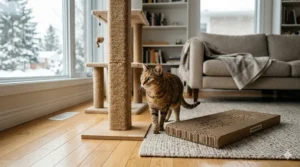
The ideal cat-friendly Canadian home includes minimum two horizontal scratchers and two vertical posts, strategically positioned in separate areas. This variety ensures scratching opportunities regardless of your cat’s mood, location, or immediate physical needs.
Place one horizontal scratcher near your cat’s primary sleeping area for post-nap scratching. Position the second horizontal option in a main living area where family gathers, serving both stretching and territorial marking purposes. Add vertical posts in high-traffic zones like near entryways (for greeting-ritual scratching) and adjacent to cat trees or shelving (for climbing-associated scratching).
For multi-cat households, multiply these numbers by your cat count plus one. Three cats ideally need four horizontal and four vertical options minimum. While this seems excessive, distributed scratching resources prevent territorial conflicts and ensure every cat accesses appropriate outlets when needed.
Budget-Friendly Combination Strategies
Canadian cat owners on tight budgets can still provide comprehensive scratching environments through strategic shopping. Start with one quality vertical post ($35-$50 CAD for durable sisal) and one premium horizontal scratcher ($50-$70 CAD for long-lasting cardboard lounge). These two foundational pieces address most cats’ scratching needs.
Supplement with budget horizontal cardboard pads ($12-$18 CAD each) in secondary locations. These inexpensive options allow experimentation with placement and replacement without significant financial burden. Purchase budget scratchers during Canadian pet store sales—PetSmart, Petco, and Amazon.ca frequently offer 20-30% discounts during quarterly sales events.
Consider DIY options for additional coverage. Wrap tree stumps or wooden posts in sisal rope (available at hardware stores for $20-$30 per roll), creating custom vertical scratchers at fraction of retail prices. Flattened cardboard boxes provide free horizontal scratching surfaces—not aesthetically ideal, but cats don’t judge interior design.
Transitioning Between Preferences
Cats’ scratching preferences evolve throughout their lives. The kitten obsessed with vertical posts may shift toward horizontal scratchers around age 8-10 years as joints stiffen. Rather than removing “unused” scratchers, maintain both options to accommodate these transitions.
Monitor your cat’s scratching patterns every 6-12 months. Note any changes in frequency, duration, or preferred orientation. Sudden preference shifts may indicate health issues worth veterinary consultation—particularly if an energetic vertical scratcher suddenly uses only horizontal surfaces, suggesting possible pain or mobility limitation.
Frequently Asked Questions
❓ How do I stop my cat from scratching furniture in Canada during winter months?
❓ What's the average price for quality cat scratchers in Canada?
❓ Do senior cats need different scratchers than younger cats?
❓ Can I train my cat to prefer horizontal scratching over vertical?
❓ Are sisal scratchers better than cardboard for Canadian cats?
Conclusion: Cracking the Scratching Code
Understanding horizontal vs vertical scratching preference transforms your relationship with your cat from frustrating furniture battles to harmonious coexistence. The research is clear: cats aren’t being difficult when they scratch—they’re following biological imperatives for claw maintenance, muscle stretching, and territorial communication. Your job is simply matching these natural needs with appropriate outlets.
For most Canadian cats, the solution isn’t choosing between horizontal versus vertical scratchers—it’s providing both. That 74% statistic bears repeating: three-quarters of cats use both orientations regularly throughout their day. A young Bengal might energetically attack a vertical post during play, then methodically work each claw on a horizontal pad after their afternoon nap. One style doesn’t replace the other; they complement each other.
Start with careful observation. Watch where, when, and how your cat currently scratches (even if it’s destructive). Match new scratchers to these preferences in material, orientation, and placement. The PetFusion Ultimate Cat Scratcher Lounge remains my top recommendation for horizontal needs—its exceptional durability justifies the $55-$75 CAD investment. Pair it with the Frisco Heavy-Duty Sisal Cat Scratching Post at $35-$48 CAD for vertical coverage, and you’ve addressed 90% of most cats’ scratching requirements.
Remember that scratching serves essential physical and psychological functions. Providing appropriate surfaces isn’t indulging your cat—it’s basic wellness care, like proper nutrition and regular veterinary checkups. The modest investment in quality scratchers prevents expensive furniture replacement, costly veterinary claw treatments, and behaviour problems that strain the human-feline bond.
Give your cat the tools their instincts demand. Whether they’re a horizontal lounger, vertical climber, or versatile scratcher using both orientations, the right combination of scratchers transforms scratching from destructive behaviour into natural, healthy activity. Your furniture will thank you, your cat will thank you, and those satisfying scratch-scratch-scratch sounds will become music instead of nails on a chalkboard.
Recommended for You
- 7 Best Corner Cat Scratcher Furniture Savers Canada 2026
- 7 Best Cardboard Cat Scratchers Canada 2026 – Eco-Friendly Guide
- 7 Best Ways to Stop Cat Scratching Furniture Canada 2026
Disclaimer: This article contains affiliate links to Amazon.ca. If you purchase products through these links, we may earn a small commission at no additional cost to you.
✨ Found this helpful? Share it with your friends! 💬🤗
