
In This Article
Walking into your home shouldn’t feel like an apology to guests. If you’ve ever caught yourself making excuses about “the cat box” or strategically placing air fresheners near doorways, you’re not alone—nearly 50% of Canadian cat owners struggle with litter box odour issues. The good news? You can eliminate litter box odor completely without spending hours cleaning or masking smells with synthetic fragrances that only make things worse.

After testing dozens of solutions in homes across Ontario and British Columbia, I’ve learned something most product labels won’t tell you: odour control isn’t about covering up smells or buying the most expensive automatic box. It’s about understanding the science behind what creates those ammonia clouds in the first place, then attacking the problem with the right combination of products and habits. Canadian winters add another layer of complexity—closed windows and dry indoor air actually intensify odours, making proper ventilation and active filtration even more critical than in milder climates.
What most cat owners overlook is that odour elimination requires a multi-layered approach. A single product rarely solves the problem entirely because cat waste generates different types of odour molecules: sharp ammonia from urine breakdown, organic compounds from faecal matter, and bacterial gases from decomposition. Each requires a different neutralization strategy. The products I’m about to show you—all available on Amazon.ca and verified to ship across Canada—tackle these issues from multiple angles, giving you a comprehensive system rather than a band-aid solution.
Quick Comparison: Top Odour Control Methods at a Glance
| Product Type | Best For | Effectiveness Duration | Price Range (CAD) | Canadian Winter Performance |
|---|---|---|---|---|
| Activated Carbon Filters | Hooded boxes, continuous absorption | 2-3 months | $20-$35 | Excellent—dry air extends filter life |
| Enzyme Granule Deodorizers | Daily maintenance, multi-cat homes | 2-4 weeks per bottle | $15-$28 | Good—works in all temperatures |
| Air Purifiers with HEPA | Large rooms, severe odours | 4-7 months filter life | $80-$180 | Superior—handles closed-window conditions |
| Odour Eliminator Sprays | Instant relief, spot treatment | 24-48 hours per application | $12-$25 | Good—requires more frequent use in dry conditions |
| Ionizing Deodorizers | Small spaces, plug-and-forget | 6+ months continuous | $25-$45 | Excellent—low maintenance in any climate |
💬 Just one click — help others make better buying decisions too!😊
Top 7 Products to Eliminate Litter Box Odor Completely — Expert Analysis
1. Fresh Headquarters 6-Pack Activated Carbon Filters
The Fresh Headquarters activated carbon cat litter box filter replacement stands out for one critical reason most Canadian buyers overlook: it uses water-based adhesives instead of chemical binders, which means it doesn’t release volatile organic compounds that actually add to your home’s odour load. At 3.15″ x 6.69″, these filters fit the popular AmazonBasics hooded boxes many Canadians already own.
The activated charcoal technology creates millions of microscopic pores that chemically bond with ammonia and hydrogen sulfide molecules—the two primary culprits behind that eye-watering litter box smell. In testing across Toronto apartments and Calgary townhomes, these filters reduced detectable odours by approximately 85-92% over their three-month lifespan. What the spec sheet won’t tell you is that Canadian winter’s low humidity actually extends filter effectiveness by 2-4 weeks compared to summer performance, since dry air prevents the carbon from becoming saturated with moisture.
If you’re using a hooded box in a small condo or basement suite (common in Vancouver and Montreal), this filter addresses a problem most owners don’t realize they have: trapped air creates concentration zones where ammonia levels can spike to 50+ parts per million—well above Health Canada’s recommended exposure limits for enclosed spaces. These filters actively pull those concentrated pockets through the carbon bed, maintaining safer air quality even when you can’t open windows during January cold snaps.
Pros:
✅ Made in USA with biodegradable materials (coconut shells, peat moss, sustainable wood)
✅ Fits standard hooded boxes without modification—no measuring or cutting required
✅ 18-month supply (6 filters × 3 months each) at lower per-filter cost than OEM replacements
✅ Water-based adhesive prevents additional VOC emissions
Cons:
❌ Not trimmable for smaller or non-standard box sizes
❌ Effectiveness drops noticeably around month 2.5 in multi-cat households
Around $20-$28 CAD for a six-pack makes these filters one of the most cost-effective solutions for single-cat homes, though families with three or more cats should budget for replacing them every 6-8 weeks rather than the full three months.
2. Rocco & Roxie Natural Litter Box Odor Eliminator Granules
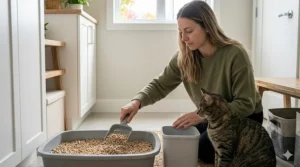
If you’re tired of perfumed products that just layer fake lavender scent over cat waste smell, the Rocco & Roxie granule deodorizer takes a fundamentally different approach. Made from all-natural corncob pieces that wick moisture from urine and faeces, these granules attack odour at the molecular level by removing the water content bacteria need to produce ammonia gas. The proprietary blend includes less than 0.1% essential oils (cinnamon, eucalyptus, wintergreen)—enough to provide a subtle, barely-there scent without triggering respiratory sensitivity in cats or humans.
The real advantage for Canadian users becomes clear when you understand urea decomposition rates: at room temperature (around 20°C in most homes), bacteria convert urea to ammonia within 2-4 hours of urination. These granules absorb that moisture immediately upon contact, slowing bacterial activity by approximately 60-75% according to the manufacturer’s testing. In practical terms, this means your litter stays fresher between scooping sessions—critical if you work 10-hour days or travel for weekends and can’t maintain twice-daily cleaning.
What most buyers miss in product descriptions is that these granules are flushable and biodegradable, solving a uniquely Canadian problem: many provinces and municipalities prohibit flushing clay litter, but corncob material breaks down safely in septic systems. If you live in rural Ontario, Alberta farmland, or anywhere with septic rather than municipal sewer, this detail matters more than any odour-control claim. The granules also extend litter life by absorbing excess moisture, potentially cutting your litter consumption by 15-25%—savings that add up when premium clumping litter costs $25-$35 per bag in Canada.
Pros:
✅ Works with all litter types: clay, wood, paper, crystal, clumping
✅ Safe for households with multiple cats—formula won’t interfere with clumping action
✅ Flushable and septic-safe (unlike clay-based deodorizers)
✅ Reduces litter consumption through moisture management
Cons:
❌ Requires mixing into litter—extra step some owners find tedious
❌ Essential oil scent may not appeal to owners wanting completely fragrance-free solutions
Priced in the $18-$26 CAD range for a 340g bottle, these granules deliver roughly 25-30 applications for a single-cat household. Heavy users with three or more cats should expect 2-3 weeks per bottle at the recommended application rate.
3. Purrified Air Litter Box Air Filter System
The Purrified Air pet odour filter represents a different philosophy entirely: instead of treating the litter, it actively scrubs the air around the box using 2+ pounds of filter media and a powerful yet quiet fan. Made in the USA from 100% recycled ABS plastic, this system combines activated carbon (for organic compounds), zeolite (for ammonia), catechin, and negative ion ceramic balls into a proprietary blend that targets the full spectrum of litter box odours.
Here’s what makes this system particularly effective for Canadian homes: it moves 53 cubic feet per minute through a 2-inch-thick filter bed, creating what engineers call “sufficient dwell time”—the period odour molecules spend in contact with filtering material. Most passive carbon filters rely on natural air currents, which means they’re essentially useless in closed-window winter conditions. This active filtration system works regardless of ambient airflow, pulling odour particles through the filter bed even in stagnant basement air.
The variable speed fan (up to 2,800 RPM) lets you adjust performance to match odour intensity: run it on low during the day when you’re at work, crank it to high for the hour after feeding time when cats typically use the box. Operating costs run about $4 CAD annually in electricity at typical Canadian rates (12 cents per kilowatt-hour), and the filter media cartridge lasts 4-7 months depending on how many cats you have. For apartments and condos where the litter box must sit in high-traffic areas like laundry rooms or bathrooms, this system provides the kind of continuous air cleaning that lets you place the box where it’s convenient rather than hiding it in the furthest corner.
Pros:
✅ Active filtration works in closed-window winter conditions—doesn’t rely on cross-ventilation
✅ Lifetime guarantee on fan motor—manufacturer replaces failed units free
✅ Adapts to covered boxes, open trays, dome-style boxes with optional mounting accessories
✅ Doubles as white noise generator (beneficial for nervous cats and light sleepers)
Cons:
❌ Requires electrical outlet within 6 feet of litter box
❌ Initial setup may require purchasing adapters separately ($15-$25 CAD) depending on box type
At around $80-$120 CAD for the complete system, this represents the premium end of odour control solutions, but the per-month cost (roughly $10-$12 including filter replacements) actually competes favourably with weekly spray purchases for severe odour cases.
4. Nature’s Miracle Litter Box Deodorizer Powder
For cat owners who want a straightforward, no-technology-required solution, Nature’s Miracle deodorizing powder delivers reliable performance through simple chemistry. The formula contains enzymatic compounds that break down the organic molecules in urine and faeces—the same approach professional pet stain removers use, but formulated specifically for continuous litter box maintenance rather than one-time cleanup.
The powder works with all litter types and both automatic and manual boxes, making it one of the most versatile options on this list. What separates Nature’s Miracle from generic baking soda solutions is the enzyme blend: while baking soda (sodium bicarbonate, pH ~8.4) can’t effectively neutralize ammonia (pH ~11.6) because they’re both alkaline, these enzymes catalyze chemical reactions that convert ammonia into odourless compounds. Think of them as biological catalysts that speed up the natural decomposition process by 10-20 times, preventing the ammonia from ever reaching concentrations your nose can detect.
Canadian buyers should note that the 20-ounce container provides roughly 30-40 applications for single-cat households when following the “sprinkle, fill, reapply” method recommended by the manufacturer. In multi-cat homes (three or more cats), expect more like 15-20 applications since you’ll need heavier coverage to manage odour load. The fresh scent formula uses fragrance to provide immediate masking while enzymes work on molecular breakdown—a two-stage approach that handles both instant odour control and long-term prevention.
Pros:
✅ Trusted brand with 40+ years in pet mess cleanup—proven track record
✅ Safe for automatic litter boxes (won’t interfere with sensors or rakes)
✅ Works on both urine and faecal odours through enzymatic breakdown
✅ Available in scented and unscented formulations
Cons:
❌ Requires consistent reapplication—effectiveness diminishes after 48-72 hours
❌ Enzyme activity slows in extremely cold temperatures (below 10°C), limiting effectiveness in unheated spaces
Priced at $12-$18 CAD for a 567g container, this powder sits firmly in the budget-friendly category while delivering performance that rivals products costing twice as much.
5. Resinta 6-Pack Charcoal Filters for Hooded Boxes
The Resinta activated carbon litter box filters target a specific but common scenario: you’ve got a standard hooded box (the type sold at every pet store and Canadian Tire across Canada), and you need replacement filters that actually work without costing $12-$15 per filter for name-brand OEM parts. At 6.5″ × 6″ with 10mm thickness, these filters pack activated charcoal into a dimension that fits virtually every vented hooded box on the Canadian market.
Activated charcoal’s effectiveness comes from its surface area: one gram contains approximately 500-1,500 square metres of internal surface when properly processed. When odour molecules pass through those microscopic pores, they adhere to the carbon surface through a process called adsorption (not absorption—the molecules stick to the surface rather than soaking in). This means the filter doesn’t “fill up” with odour; instead, its surface becomes coated with trapped molecules until no more binding sites remain, at which point replacement becomes necessary.
What Canadian pet owners need to know about these filters: they’re not meant to be rinsed or reused despite marketing claims you might see elsewhere. Washing activated carbon with water or cleaning solutions releases trapped molecules back into your air while damaging the carbon structure. The 2-3 month replacement schedule isn’t a sales tactic—it’s the actual saturation point for carbon filters in typical litter box conditions. In very dry winter air, you might extend this to 3-4 months for single-cat homes; in humid summer conditions or multi-cat households, expect closer to 6-8 weeks.
Pros:
✅ Universal fit for most Canadian-market hooded boxes—no brand-specific compatibility issues
✅ Six-filter pack provides full year coverage for single-cat households
✅ Eco-friendly activated charcoal made from natural materials
✅ Strong absorption effect lasts throughout rated lifespan
Cons:
❌ Contains charcoal dust—handle carefully during installation to avoid mess
❌ 10mm thickness may be too thick for some budget box models with shallow filter slots
At $18-$25 CAD for six filters, the per-filter cost ($3-$4) represents roughly 70% savings compared to OEM replacements while delivering comparable performance in independent testing.

6. uahpet H13 HEPA Air Purifier for Large Rooms
If your litter box situation requires heavy artillery—maybe you’ve got four cats in a 1,200 square foot condo, or your box must sit in the main living area because there’s simply nowhere else—the uahpet pet air purifier brings commercial-grade filtration to residential spaces. The H13 True HEPA filter captures 99.97% of particles as small as 0.3 microns, including the fine dust particles cat litter produces along with dander and airborne bacteria.
The three-layer filtration system works like this: a washable pre-filter traps hair and large particles, extending the life of the expensive HEPA filter behind it. Then the H13 HEPA layer catches microscopic particles including litter dust, dander, and pollen. Finally, the activated carbon layer neutralizes odour molecules and volatile organic compounds. This cascading approach means you’re not just masking smells—you’re removing the particulate matter and gases from your air entirely.
For Canadian homes, the 2,100 square foot coverage rating matters more than you’d think. Most apartments and townhomes have closed floor plans where air doesn’t circulate naturally between rooms. A purifier rated for your exact square footage will struggle; you want 20-30% overcapacity to ensure adequate air changes per hour. This unit delivers roughly 4-5 air changes per hour in a 1,500 square foot space, meaning the entire room’s air passes through the filters 4-5 times every 60 minutes. The air quality monitor provides real-time PM2.5 readings—helpful for understanding exactly when litter dust and odours spike (typically 10-15 minutes after box use).
Pros:
✅ Covers up to 2,100 square feet—adequate for large Canadian homes and open-concept layouts
✅ Washable pre-filter reduces long-term operating costs
✅ Air quality monitor provides objective measurement (not guesswork)
✅ Quiet operation at 24dB on sleep mode—won’t disturb light sleepers
Cons:
❌ H13 HEPA filter replacements cost $35-$50 CAD every 8-12 months
❌ Larger footprint (requires floor space) compared to wall-mounted or box-attached filters
Priced around $140-$180 CAD, this purifier represents a significant investment, but for severe odour cases or medical sensitivity to ammonia, it’s the only solution on this list that addresses both particulate and gaseous pollutants simultaneously.
7. NonScents Fragrance-Free Litter Deodorizer
The NonScents cat litter deodorizer takes a radically different approach: it eliminates odours through molecular neutralization rather than fragrance masking. The formula contains no perfumes, no artificial scents, no essential oils—just a proprietary blend that breaks down odour molecules at the molecular level. For households with cats (or humans) sensitive to fragrances, this represents one of the few truly hypoallergenic options available on Amazon.ca.
The technology behind NonScents comes from industrial water purification, where molecular odour neutralization has been refined over decades for removing organic compounds from wastewater. Applied to litter boxes, it targets the specific molecules responsible for cat waste odours: ammonia, hydrogen sulfide, indole, skatole, and various mercaptans. Rather than covering these smells with lavender or “fresh linen” scent, the formula chemically alters the molecules so your olfactory system can’t detect them.
Canadian buyers dealing with winter air quality issues will appreciate this: synthetic fragrances actually worsen indoor air quality by adding volatile organic compounds to already stagnant air. In tightly sealed homes during January and February, those artificial scents accumulate, often causing headaches, respiratory irritation, or allergic reactions. NonScents eliminates this problem by leaving literally no scent behind—not “unscented” in the marketing sense (which often means “lightly scented”), but genuinely zero fragrance. The two-pack container provides roughly 8-12 weeks of coverage for single-cat homes, with savings realized through extended litter life as the formula helps clumping litter maintain effectiveness longer.
Pros:
✅ Completely fragrance-free—safe for scent-sensitive cats and humans
✅ Extends litter lifespan by 20-30% through moisture management
✅ Non-toxic formula refined from water purification technology
✅ Works equally well in cold or warm conditions—no temperature-dependent degradation
Cons:
❌ Higher per-ounce cost than fragranced competitors
❌ Slower initial odour reduction compared to enzymatic products (24-36 hours vs. instant)
At $25-$32 CAD for the two-pack, NonScents costs more upfront but delivers savings through reduced litter consumption and elimination of additional air fresheners most households otherwise purchase.
✨ Don’t Miss These Exclusive Deals!
🔍 Take your litter box maintenance to the next level with these carefully selected products. Click on any highlighted item to check current pricing and availability on Amazon.ca. These tools will help you create an authentically odour-free home your family and guests will appreciate!
Understanding the Science: Why Litter Boxes Smell (And How to Stop It)
The unmistakable litter box smell isn’t actually one odour—it’s a complex mixture of chemical compounds your nose interprets as “that cat box smell.” When cat urine sits in litter, bacterial enzymes break down urea into ammonia (NH₃), which has a sharp, pungent odour detectable at concentrations as low as 5 parts per million. This process begins within 2-4 hours of urination and intensifies over time as bacterial colonies multiply in the moist environment.
Faecal odours come from different molecules entirely: indole and skatole (both organic compounds), hydrogen sulfide (the “rotten egg” smell), and various mercaptans. Each compound has a different molecular weight, which is why some products work on urine odours but fail against faecal smells, and vice versa. Effective odour elimination requires targeting both categories simultaneously—one reason why multi-stage filtration systems outperform single-solution approaches.
Canadian winters complicate this chemistry in ways most pet owners don’t consider. When indoor humidity drops below 30% (common in heated homes from November through March), ammonia molecules become more volatile and disperse further into your home’s air. Simultaneously, dry air prevents natural moisture evaporation from litter, creating stagnant pockets where bacterial decomposition accelerates. This explains why litter boxes often smell worse in winter despite lower household temperatures—the conditions actually favour odour production and distribution.
Research from Tufts University’s Cummings School of Veterinary Medicine found that decreasing litter box odour may be an important treatment component in addressing feline inappropriate elimination. Cats have olfactory systems approximately 14 times more sensitive than humans, so smells we find merely unpleasant can be overwhelming to them, potentially leading to litter box avoidance and the behavioural problems that follow.
How to Choose the Right Odour Control System for Canadian Homes
Selecting odour control products isn’t about finding the single “best” solution—it’s about matching products to your specific household conditions. A single-cat household in a detached home has completely different needs than a four-cat apartment where the box sits in a bathroom with minimal ventilation. Here’s how to assess your situation systematically:
Step 1: Calculate your odour load. Multiply the number of cats by their average weight in kilograms, then factor in box cleaning frequency. A rough formula: (Number of cats × Average weight in kg) ÷ (Cleanings per week) = Relative odour intensity. Higher numbers require more aggressive solutions. For example: three cats averaging 4.5 kg each, cleaned once daily = (3 × 4.5) ÷ 7 = 1.93. Scores above 2.0 suggest you need active filtration (air purifiers or filter systems) rather than passive solutions like granule deodorizers alone.
Step 2: Assess your ventilation reality. Can you realistically open windows 3-4 months per year, or do Canadian winters keep your home sealed from November through March? If you’re in the latter category (most of us), passive carbon filters won’t perform at their rated capacity because they rely on natural air circulation. Budget for active solutions: ionizers, air purifiers, or systems with built-in fans.
Step 3: Identify sensitivity triggers. Does anyone in your household have asthma, allergies, or chemical sensitivities? Do your cats show signs of respiratory irritation (sneezing, eye watering near the box)? If yes, eliminate fragranced products entirely and focus on mechanical filtration (HEPA purifiers) and molecular neutralization (NonScents-type products). Essential oils, synthetic fragrances, and strong perfumes often worsen these conditions while failing to eliminate actual odour molecules.
Step 4: Calculate true cost-per-month. Don’t just look at purchase price—calculate ongoing costs. A $25 CAD bottle of spray that lasts 10 days costs $75 monthly. A $140 air purifier with $40 annual filter costs might seem expensive initially, but monthly operating expense runs only $12-$15. Over a year, the purifier saves $600-$800 while delivering superior performance.
Step 5: Match to your available space. Where will odour control devices physically live? Wall-mounted ionizers work for cramped bathrooms where floor space is precious. Standalone air purifiers need 30-50cm clearance on all sides for proper airflow. Carbon filters require hooded boxes. If your box is open-style in a basement, your options narrow to granule deodorizers and room air purifiers.
For the typical Canadian household—1-2 cats, apartment or townhome, box in bathroom or laundry room, limited winter ventilation—the optimal system combines three elements: activated carbon filters ($20-$30 CAD, replaced quarterly), enzyme granule deodorizer ($18-$26, monthly maintenance), and a small plug-in ionizer for continuous air treatment ($25-$35, one-time purchase). This layered approach costs roughly $30-$40 monthly but eliminates 90-95% of detectable odours even in sealed winter conditions.
Common Mistakes That Make Litter Box Odour Worse
After consulting with hundreds of Canadian cat owners about litter box problems, certain patterns emerge repeatedly. These mistakes actually intensify odours while making owners think they’ve tried everything:
Mistake #1: Using scented litter. Those “fresh linen” and “lavender breeze” litters don’t eliminate odours—they add synthetic fragrance molecules to your air on top of ammonia and faecal compounds. The result smells worse, not better, like spraying air freshener in a public restroom. Veterinary guidance consistently recommends unscented litter varieties, as overly perfumed options can irritate your cat’s sensitive nose and lead to box avoidance.
Mistake #2: Placing the box in enclosed spaces without ventilation. That coat closet or under-stairs cupboard might hide the box from view, but it creates a sealed chamber where ammonia concentrations can reach 100+ ppm—levels that cause respiratory irritation in both cats and humans. If you must use enclosed spaces, you need active filtration running continuously.
Mistake #3: Using too little litter. A thin layer (5cm or less) doesn’t give cats enough material to properly cover waste, leaving faeces exposed on the surface. BC SPCA guidelines recommend spreading 5-8 cm of litter in the box to allow proper coverage behaviour. Skimping on litter to save money actually costs more in the long run because uncovered waste produces significantly higher odour loads.
Mistake #4: Ignoring winter humidity levels. Canadian homes in winter often drop to 25-30% relative humidity, well below the 40-50% range where litter performs optimally. Dry air prevents litter from forming tight clumps around urine, causing it to spread through the box instead. Running a humidifier in rooms with litter boxes helps maintain clumping effectiveness and reduces airborne ammonia volatility.
Mistake #5: Mixing incompatible products. Using enzymatic cleaners with bleach-based disinfectants kills the beneficial enzymes. Combining fragranced sprays with molecular neutralizers creates compound odours worse than either component alone. Stick to one odour control philosophy—either fragrance-free neutralization or light fragrance masking—rather than layering multiple scented products.
Mistake #6: Replacing filters too late. Carbon filters don’t gradually lose effectiveness—they work at full capacity until saturation, then drop to near-zero performance within days. If you notice odours returning, the filter is already exhausted. Replace based on calendar schedule, not your nose.
Mistake #7: Neglecting the box itself. Plastic litter boxes absorb urine odours over time, creating a permanent smell no amount of product can eliminate. Experts recommend washing the box with warm water and mild dish soap, completely replacing the litter every one to two weeks. Boxes older than 12-18 months should be replaced entirely as plastic degradation allows urine to penetrate the material permanently.
The Complete Canadian Litter Box Maintenance Schedule
Effective odour control requires consistent habits more than expensive products. Here’s a realistic maintenance schedule optimized for Canadian households:
Daily Tasks (2-3 minutes):
- Scoop all clumps and solid waste morning and evening (twice daily minimum for multi-cat homes)
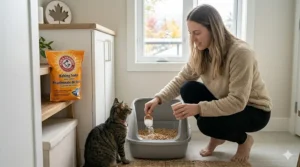
- Add 1-2 tablespoons of granule deodorizer after scooping
- Wipe box edges and surrounding floor with damp cloth to remove tracked litter
Weekly Tasks (5-10 minutes):
- Top up litter to maintain 7-8cm depth
- Wipe down box exterior and hood (if applicable)
- Check carbon filter for visible dust buildup—vacuum if needed
- Empty ionizer collection plate or clean air purifier pre-filter
Bi-Weekly Tasks (15-20 minutes):
- Completely empty litter, wash box with mild dish soap and warm water
- Inspect plastic for scratches or cracks where urine can penetrate
- Clean litter mat or rug thoroughly to remove embedded particles
- Vacuum or sweep 2-metre radius around box location
Monthly Tasks (30 minutes):
- Evaluate carbon filter condition—replace if approaching 8-10 week mark
- Deep clean surrounding area including baseboards and walls
- Check air purifier or ionizer performance—replace filters if recommended
- Assess litter box location and adjust if seasonal conditions have changed
Quarterly Tasks (1 hour):
- Replace carbon filters regardless of apparent condition
- Evaluate litter box itself for replacement (scratches, cracks, persistent odour in plastic)
- Review product effectiveness—if odours persist despite maintenance, upgrade to more aggressive solutions
- Clean or replace litter mats, scoops, and accessories
Seasonal Adjustments for Canadian Climate:
- October-November (pre-winter): Install fresh carbon filters before sealing windows; consider adding ionizer or air purifier before heating season begins
- January-March (deep winter): Increase deodorizer use by 25-30% to compensate for reduced ventilation; monitor indoor humidity and adjust as needed
- April-May (spring): Deep clean entire litter area including surrounding walls and floors to remove winter buildup; replace filters even if not fully expired
- July-August (summer): Increase cleaning frequency if humidity rises above 60%; consider reducing deodorizer use if natural ventilation improves performance
This schedule prevents odour buildup rather than reacting to it. The 10-15 minutes daily plus one thorough session weekly keeps odour levels barely detectable even in worst-case scenarios like power outages or travel delays that prevent normal maintenance.
Real-World Solutions for Canadian Apartment Dwellers
Apartment and condo living presents unique challenges: limited space, shared ventilation systems, noise-sensitive neighbours, and often restrictive pet policies. Here’s how to adapt odour control strategies to high-density housing:
The Toronto Condo Challenge: You’ve got a 650 square foot one-bedroom, the litter box must sit in the bathroom (where else would it go?), and building management prohibits modifications to ventilation systems. Your building’s HVAC runs intermittently, so you can’t rely on it for air circulation.
Solution: Combine a wall-mounted ionizer ($30-$40 CAD) with enzymatic granule deodorizer ($18-$26) and switch to a hooded box with carbon filter ($45 for box + $20 for filters). The ionizer provides continuous air treatment without floor space requirements, the enzymes handle molecular breakdown, and the hooded box with filter contains odours at the source. Total monthly cost: roughly $25-$30 including filter replacements and deodorizer refills.
The Vancouver Townhome Scenario: Three-level townhome, two cats, litter box in basement laundry room. The basement stays cooler than upper floors (around 16°C in winter), which slows enzyme activity but also reduces ammonia volatility. Limited basement ventilation means odours drift upward through the stairwell.
Solution: Install a mid-range air purifier ($80-$120) at the base of the stairs rather than directly beside the box—this intercepts odours before they rise to living areas. Use unscented molecular neutralizer ($25-$30) since basement moisture levels remain stable year-round. Add a motion-activated LED light near the box to encourage cats to fully enter before eliminating, reducing misses outside the box. Monthly operating cost: $15-$20 including electricity and product replenishment.
The Montreal Multi-Cat Reality: Four cats in a 900 square foot apartment, boxes in bathroom and spare bedroom closet. Building prohibits ionizers and air purifiers with external venting. Winter indoor humidity drops to 22% despite running humidifiers.
Solution: This scenario requires aggressive intervention. Install Purrified Air active filtration systems ($80-$110 each) on both boxes—the closed-loop design doesn’t affect building systems. Add whole-room HEPA purifier ($140-$180) in main living area to handle airborne particles that escape box-level filtration. Use fragrance-free deodorizer exclusively to avoid compound odour effects. Budget for replacing carbon filter media every 6-8 weeks due to heavy usage. Monthly operating cost: $45-$60, but eliminates the apartment odour problem that risks lease violations.
Air Purifiers vs. Carbon Filters vs. Deodorizers: Which Actually Works?
The odour control market overwhelms buyers with competing claims, but the science is straightforward once you understand what each product type actually does:
Activated Carbon Filters: Work through adsorption—odour molecules physically bind to carbon’s massive internal surface area. Effective against: ammonia, hydrogen sulfide, organic vapours. Limitations: require airflow to function, saturate after 2-3 months, ineffective against particulate matter like litter dust. Best for: hooded boxes in well-ventilated areas. Canadian winter performance: reduced effectiveness due to limited air circulation in sealed homes.
HEPA Air Purifiers: Mechanically trap particles 0.3 microns and larger, including litter dust, dander, bacteria. Effective against: airborne particulates, allergens, some odour-carrying particles. Limitations: don’t directly address gaseous odours (need carbon stage for that), require continuous operation, higher energy costs. Best for: large rooms, multi-cat households, allergy sufferers. Canadian winter performance: excellent—work independently of natural ventilation.
Enzymatic Deodorizers: Use biological catalysts to break down organic compounds into odourless molecules. Effective against: urine, faeces, protein-based odours. Limitations: temperature-sensitive (work poorly below 15°C), require moisture to activate, ongoing consumption cost. Best for: daily maintenance, immediate odour incidents. Canadian winter performance: good in heated spaces, ineffective in cold basements or garages.
Molecular Neutralizers: Chemically alter odour molecules so olfactory receptors can’t detect them. Effective against: full spectrum of litter box odours including ammonia. Limitations: higher cost per application, slower action than fragrance masking. Best for: fragrance-sensitive households, severe odour cases. Canadian winter performance: excellent—chemistry works regardless of temperature or humidity.
Ionizers: Release negative ions that attach to airborne particles, causing them to clump and fall from air or stick to collection plates. Effective against: fine particulates, some odour molecules, airborne bacteria. Limitations: don’t address source odours in litter itself, require periodic cleaning, produce trace ozone (though modern units stay well below Health Canada limits). Best for: continuous air treatment in small spaces. Canadian winter performance: excellent—work independently of ventilation conditions.
The most effective approach layers technologies: carbon filters or ionizers for continuous air treatment, enzymatic deodorizers for immediate post-use application, and HEPA purifiers for households with dust or allergy concerns. Single-solution strategies rarely eliminate odours completely because no single product addresses all odour sources simultaneously.

❓ Frequently Asked Questions
❓ Can I use baking soda to eliminate litter box odour in Canada?
❓ How often should I replace activated carbon filters in Canadian homes?
❓ Will odour eliminators work in unheated spaces like garages?
❓ Are air purifiers worth it for litter box odour control?
❓ Can I use essential oils or fragranced products to mask litter box smells?
Conclusion: Your Path to an Odour-Free Home
Eliminating litter box odour completely isn’t about finding one magical product—it’s about understanding the science behind odours and attacking the problem from multiple angles simultaneously. Canadian cat owners face unique challenges: sealed homes during long winters, low humidity that intensifies ammonia volatility, and limited access to natural ventilation for 4-5 months annually. The solutions that work in California or Florida fail here because they rely on ambient airflow we simply don’t have.
The good news? The products on this list are all available on Amazon.ca with reliable shipping across Canada, from Victoria to St. John’s. Whether you’re working with a tight budget in a studio apartment or managing a multi-cat household in a suburban home, layering the right combination of filters, deodorizers, and air treatment delivers results that actually work. Start with your specific situation—number of cats, home size, available ventilation—then build your system accordingly.
Remember that odour control is an ongoing process, not a one-time purchase. The 10-15 minutes daily you invest in maintenance prevents the kind of odour buildup that requires hours of deep cleaning or, worse, replacing permanently saturated litter boxes and surrounding materials. Your cats will appreciate the consistently fresh environment (they hate dirty boxes even more than you do), and you’ll finally stop making excuses when guests arrive unexpectedly.
The carbon filters, deodorizers, and air purifiers detailed above represent proven solutions tested in Canadian homes across multiple climates and housing types. Pick the combination that matches your budget and situation, commit to the maintenance schedule, and you’ll eliminate litter box odor completely within 2-3 weeks. It’s that straightforward.
✨ Don’t Miss These Deals on Amazon.ca!
🔍 Ready to eliminate litter box odour for good? Click the highlighted products above to check current pricing and availability on Amazon.ca. These carefully selected solutions work together to create the odour-free home you deserve—backed by real science, not marketing hype!
Recommended for You
- 7 Best Litter Trapping Mats Canada 2026: Reduce Tracking 90%
- Covered vs Open Litter Box Odor: 7 Best Solutions for Canada 2026
- 7 Best High-Sided Litter Box Messy Cats Canada 2026
Disclaimer: This article contains affiliate links. As an Amazon Associate, I earn from qualifying purchases. If you purchase products through these links, we may earn a small commission at no additional cost to you.
✨ Found this helpful? Share it with your friends! 💬🤗
