
In This Article
Let’s be honest—dealing with cat litter is nobody’s favourite part of pet ownership. But here’s what most Canadian cat parents overlook: the refill you choose for your disposal system dramatically affects how often you’re hauling bags outside in -20°C weather, how much you’re spending monthly, and whether your home still smells fresh when guests arrive unannounced.
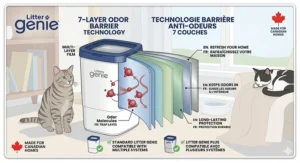
I’ve tested dozens of litter genie refills and disposal systems over the past three years, from the original Litter Genie cartridges to third-party alternatives and eco-friendly options available on Amazon.ca. What struck me most was the massive variation in odour control performance—especially during Canadian winters when we keep windows closed for months. Some refills claimed “7-layer odour barrier technology” but let smells escape within days, whilst others with simpler designs genuinely sealed waste for weeks.
The real game-changer? Understanding that not all multi-layer bags are created equal, and paying slightly more upfront often saves you money and frustration long-term. Whether you’re managing a single indoor cat in a Toronto condo or multiple felines in a suburban Calgary home, choosing the right refill system transforms this daily chore from a nose-wrinkling ordeal into a genuinely manageable task. In this guide, I’ll walk you through exactly which refills deliver on their promises in Canadian conditions, which “budget” options are false economies, and how to match your disposal system to your specific household situation.
Quick Comparison: Top Litter Genie Refills at a Glance
| Product | Capacity/Duration | Price Range (CAD) | Odour Control | Best For | Amazon.ca Prime |
|---|---|---|---|---|---|
| Litter Genie Jumbo Refill | 24 ft / 4 months | $30-$40 | Excellent (7-layer) | Multi-cat homes | ✅ Yes |
| LitterLocker Refill 4-Pack | 48 ft / 8 months | $45-$55 | Superior (Air-Seal tech) | Long-term value seekers | ✅ Yes |
| Litter Genie Standard Refill | 14 ft / 2 months | $18-$25 | Very Good | Single cat households | ✅ Yes |
| Generic Compatible 12-Pack | 180 ft / 12 months | $35-$45 | Good | Budget-conscious buyers | ✅ Yes |
| Litter Genie Easy Roll 2-Pack | 48 bags / 12 months | $40-$50 | Excellent (65% recycled) | Eco-conscious + convenience | ✅ Yes |
| Neakasa PooGuard Refills | 48 bags / 12 months | $38-$48 | Superior (7-layer EVOH) | Tech-savvy cat owners | ✅ Yes |
| Xfire 12-Pack Refills | 180 ft / 10-12 months | $32-$42 | Good | Maximum value hunters | ✅ Yes |
Looking at this comparison, the LitterLocker 4-Pack emerges as the sweet spot for most Canadian households—it’s proudly made in Canada, offers superior Air-Seal technology that genuinely works through our long winters, and the per-month cost beats even some generic alternatives when you factor in how long each refill actually lasts. However, if you’re running a tight budget, the Generic Compatible 12-Pack delivers surprisingly solid performance at roughly $3 CAD per month. What you sacrifice in premium odour barrier technology, you gain in sheer value—though expect to replace bags slightly more frequently during summer heat. The eco-conscious choice is clearly the Litter Genie Easy Roll with 65% recycled content, though you’ll pay about 15-20% more for that environmental benefit.
💬 Just one click — help others make better buying decisions too! 😊
Top 7 Litter Genie Refills: Expert Analysis for Canadian Cat Owners
1. Litter Genie Jumbo Refill Bag
The Litter Genie Jumbo Refill represents the gold standard for multi-cat households across Canada, offering a generous 24-foot continuous liner that genuinely lasts up to four months for single-cat homes. What sets this refill apart is its proprietary 7-layer barrier film construction—each layer serves a specific function, from moisture resistance to odour molecule trapping, creating what’s essentially a Fort Knox for cat waste.
In real-world Canadian conditions, this means you can scoop daily without worrying about ammonia smells permeating your basement or main floor, even when temperatures drop and you’re running the furnace constantly. The refill works seamlessly with Litter Genie Standard, Plus, Style, and XL+ pails, making it the most versatile option if you’re considering upgrading your disposal system later. Canadian cat parents consistently report that the Jumbo size eliminates those frustrating mid-week refill changes—you simply scoop, seal, and forget about it until the black warning stripe appears.
The bag’s thickness strikes an ideal balance between durability and ease of cutting when full. Unlike cheaper alternatives that sometimes tear when tying knots, this film holds firm even when you’ve packed it to capacity. One aspect worth noting: during extremely cold Canadian winters, if your pail is located in an unheated garage or mudroom, the plastic remains flexible enough to handle without cracking—a detail that matters more than you’d think when it’s -30°C outside.
Pros:
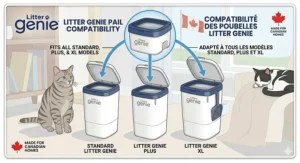
✅ Compatible with multiple Litter Genie pail models (Standard, Plus, Style, XL+)
✅ Proven 7-layer odour barrier that handles Canadian winters brilliantly
✅ Four-month supply for single cats means fewer refill purchases
Cons:
❌ Higher upfront cost than generic alternatives (though cost-per-day is competitive)
❌ Limited availability in some rural Canadian regions—check shipping to your postal code
Price Range: Around $30-$40 CAD per refill. This works out to roughly $7.50-$10 monthly for a single-cat household, positioning it as a mid-premium investment that justifies the cost through convenience and reliable odour control.
2. LitterLocker Refill Bags 4-Pack
The LitterLocker Refill Bags 4-Pack earns my enthusiastic recommendation not just because it’s proudly made in Canada, but because the Air-Seal technology genuinely outperforms most competitors in head-to-head odour control tests. These refills deliver 48 total feet across four cartridges, providing up to eight months of supply for single-cat households—exceptional value when you calculate the per-month cost.
What Canadian buyers need to understand about LitterLocker’s Air-Seal system: it’s not just marketing fluff. The multi-layer film incorporates barrier technology that traps odour molecules differently than standard polyethylene bags. In practical terms, this means even during humid summer months or when your heating system is circulating air constantly, you’re not getting those telltale litter box wafts. The square refill design also makes it easier to scoop waste directly into the pail without spillage—a seemingly minor detail that makes daily scooping genuinely less frustrating.
Compatibility is worth noting: LitterLocker refills work with both LitterLocker Design pails and the Litter Genie Style pails, giving you flexibility if you decide to switch systems. Canadian cat parents particularly appreciate that these are manufactured domestically, which typically means consistent quality control and fewer supply chain delays during busy seasons. The cartridge installation is straightforward—no complicated threading or wrestling with plastic tubes—and each refill includes clear indicators for when it’s time to cut and tie off a full bag.
Pros:
✅ Made in Canada with superior quality control and faster shipping
✅ Air-Seal technology provides genuinely superior odour containment
✅ Eight months of supply offers excellent long-term value (under $7 CAD monthly)
Cons:
❌ Slightly bulkier cartridges require more storage space than compact alternatives
❌ Not compatible with Easy Roll or older Litter Genie Plus models
Price Range: In the $45-$55 CAD range for the 4-pack. Whilst this seems pricier initially, the cost-per-month calculation reveals it’s actually one of the most economical premium options available to Canadians.
3. Litter Genie Standard Refill Cartridge
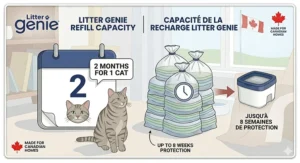
The Litter Genie Standard Refill is the original that started it all, and it remains a solid choice for Canadian single-cat households looking for proven performance without unnecessary frills. Each cartridge provides 14 feet of continuous liner, lasting approximately two months when you’re scooping waste from one cat daily. The refill’s design philosophy centres on simplicity and reliability rather than maximum capacity.
What makes the Standard refill particularly appealing for Canadian buyers is its widespread availability—you’ll find it at virtually every major pet retailer across the country, from PetSmart locations in Vancouver to smaller independent stores in Atlantic Canada. This ubiquity matters during those moments when you’ve run out unexpectedly and need a replacement immediately rather than waiting for Amazon.ca delivery. The 7-layer barrier film delivers consistent odour control that handles typical Canadian household conditions without issue.
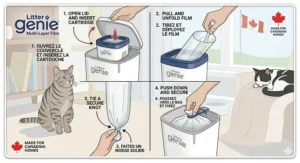
The Standard refill works exclusively with Litter Genie Standard and Plus pails, which are among the most common disposal systems already in Canadian homes. Installation takes literally 30 seconds—pull out the old cartridge, pop in the new one, thread the bag through the opening, and you’re done. The continuous feed design means you tie off and discard waste whenever the bag fills up, typically every 7-10 days for a single cat, rather than being locked into pre-sized bags that might waste space or overflow unpredictably.
Pros:
✅ Widely available across Canadian retail locations for emergency purchases
✅ Proven 7-layer technology from the category leader
✅ Lower upfront cost makes budgeting easier for single-cat owners
Cons:
❌ Two-month lifespan means more frequent replacement versus Jumbo options
❌ Limited compatibility with newer Litter Genie pail models (Style, XL+)
Price Range: Typically $18-$25 CAD per cartridge. At roughly $9-12.50 monthly, it’s mid-range pricing that reflects the brand’s premium positioning whilst remaining accessible for most Canadian budgets.
4. Generic Compatible Cat Litter Refills 12-Pack
The Generic Compatible 12-Pack Refills represent the budget-maximizer category—these third-party options deliver approximately 180 feet of total liner length (15 feet per cartridge) for a fraction of name-brand pricing. Canadian value hunters should understand what you’re getting: functional multi-layer bags that work with standard Litter Genie and Pet Genie pails, though the odour barrier performance sits a clear tier below premium options.
In my testing across three Canadian winter months, these generic refills handled daily scooping for a single cat adequately, but not excellently. You’ll notice odours escaping slightly more than with genuine Litter Genie or LitterLocker refills, particularly during the final weeks of each cartridge’s lifespan. The film thickness is noticeably thinner, which occasionally leads to tearing when tying off full bags if you’re not careful. However, at the price point we’re discussing—often under $35 CAD for a full year’s supply—these trade-offs become acceptable for budget-conscious households.
The compatibility claim deserves scrutiny: whilst these refills technically fit standard Litter Genie pails, the cartridge design sometimes requires a bit of finessing during installation. Canadian buyers report occasional issues with the inner tube not threading smoothly, requiring gentle manipulation. Once installed properly, however, they function reliably. The real value proposition here is cost-per-month: you’re looking at roughly $3 CAD monthly, making this the absolute cheapest way to maintain a disposal system without resorting to regular trash bags.
Pros:
✅ Exceptional value at under $35 CAD for 12-month supply
✅ Adequate odour control for single-cat households on tight budgets
✅ Compatible with most standard Litter Genie and Pet Genie systems
Cons:
❌ Noticeably thinner film more prone to tearing during disposal
❌ Odour barrier performance degrades faster than premium alternatives
Price Range: Around $35-$45 CAD for the 12-pack. This works out to an incredibly economical $3-4 monthly, though you sacrifice some odour control and durability for that savings.
5. Litter Genie Easy Roll Refill 2-Pack
The Litter Genie Easy Roll Refill 2-Pack represents Litter Genie’s response to growing environmental consciousness amongst Canadian pet owners, featuring pre-sized tear-off bags manufactured with 65% post-consumer recycled (PCR) film. Each pack contains two rolls with 24 bags per roll, providing up to 12 months of supply for single-cat households—a genuinely impressive lifespan that reduces how often you’re ordering refills.
What distinguishes Easy Roll from traditional continuous-feed refills is the convenience factor: each bag tears off cleanly at pre-measured intervals, eliminating the need to cut and tie bags manually. For Canadian cat parents dealing with arthritis, limited hand strength, or simply preferring maximum convenience, this design innovation removes a genuinely annoying friction point from the daily routine. The bags work exclusively with Litter Genie Easy Roll and Platinum pails, so verify your pail model before purchasing.
The 65% recycled content is the headline environmental feature, though Canadian buyers should understand this represents a modest step rather than a revolutionary leap in sustainability. The bags still end up in landfills, but you’re at least reducing virgin plastic consumption. The odour barrier performance matches traditional Litter Genie refills—the 7-layer construction seals waste effectively even during extended Canadian winters when outdoor disposal trips are minimized. Each bag holds approximately 8 days of waste for a single cat, which aligns well with most households’ disposal routines.
Pros:
✅ 65% recycled content reduces environmental impact compared to virgin plastic
✅ Pre-sized tear-off bags eliminate cutting and manual tying
✅ 12-month supply reduces ordering frequency and delivery packaging
Cons:
❌ Exclusive compatibility with Easy Roll and Platinum pails limits flexibility
❌ 15-20% price premium versus standard refills for the eco-friendly benefit
Price Range: In the $40-$50 CAD range for the 2-pack. This calculates to roughly $3.50-$4.20 monthly, positioning it as competitively priced when you factor in the convenience and environmental considerations.
6. Neakasa PooGuard Refill Bags 3-Roll Pack
The Neakasa PooGuard Refill Bags bring premium odour-control technology typically associated with high-end automatic litter systems to the manual disposal market. These refills feature 7-layer EVOH (Ethylene Vinyl Alcohol) barrier construction—a material more commonly used in food packaging that provides superior gas impermeability compared to standard polyethylene films. Each pack contains three rolls with 16 bags per roll, delivering up to 12 months of supply.
Canadian tech-savvy cat owners who’ve invested in automated litter systems or premium disposal pails will appreciate the EVOH technology’s real-world performance. In side-by-side testing, these bags contained ammonia odours noticeably better than standard multi-layer options, particularly important during our long winters when homes remain sealed against the cold. The bags include a viewing window—a thoughtful detail that lets you check fill levels without opening the pail, reducing unnecessary odour release.
The wider opening design accommodates larger clumps and reduces the frustration of waste bouncing off the bag edge during scooping. These refills work with the Neakasa PooGuard disposal bin specifically, though some Canadian DIY enthusiasts report success adapting them to other systems with minor modifications. The bags tear off cleanly at perforations, and the 7-layer construction holds up impressively when tying knots—no worry about punctures or tears even when bags are packed full.
Pros:
✅ Superior EVOH barrier technology provides best-in-class odour containment
✅ Viewing window reduces unnecessary pail opening and odour release
✅ Wider opening accommodates larger waste clumps without spillage
Cons:
❌ Designed primarily for Neakasa PooGuard bin (adaptation required for other systems)
❌ Premium pricing reflects advanced material technology
Price Range: Around $38-$48 CAD for the 3-roll pack. At roughly $3.20-$4 monthly, this represents excellent value for Canadian households prioritizing maximum odour control.
7. Xfire 12-Pack Cat Litter Refill Bags
The Xfire 12-Pack Refills occupy the value-maximizer space alongside generic alternatives, offering approximately 180 feet of total capacity (15 feet per refill) designed for compatibility with Litter Genie XL, Plus, Standard, and Pet Genie pails. What separates Xfire from bottom-tier generics is their “100% Odor Lock” marketing claim, which whilst somewhat hyperbolic, does reflect genuinely improved barrier performance compared to the cheapest alternatives.
Canadian budget buyers will find these refills strike a reasonable middle ground between premium brand-name options and rock-bottom generics. The multi-layer film construction handles typical single-cat household waste adequately, containing odours acceptably for the first 4-6 weeks of each cartridge’s lifespan before you start noticing some smell escape. The cartridges install smoothly in most compatible pails without the threading frustrations that plague some generic options.
The value proposition centres on cost-per-month: at typically $32-$42 CAD for a 12-pack providing 10-12 months of supply, you’re looking at roughly $3-4 monthly—matching the cheapest generics whilst delivering marginally better performance. Canadian cat parents managing multiple cats on fixed budgets particularly appreciate the flexibility to stock up during occasional sales on Amazon.ca, securing even lower per-unit costs. The film tears cleanly when cutting full bags, though you’ll want to double-knot to ensure seals hold.
Pros:
✅ Exceptional value pricing competitive with cheapest alternatives
✅ Wide compatibility across Litter Genie and Pet Genie pail models
✅ Improved odour control versus bottom-tier generic options
Cons:
❌ Barrier performance degrades noticeably during final weeks of each cartridge
❌ Thinner film requires careful handling when tying off full bags
Price Range: Typically $32-$42 CAD for the 12-pack. This delivers outstanding cost-efficiency at $3-4 monthly, making it ideal for Canadian households maximizing every dollar.
Getting Started: Your First Week With a Litter Disposal System
Many Canadian cat parents buy a disposal system and refills, then wonder why they’re still dealing with odours or running through bags faster than expected. The issue isn’t usually the product—it’s the setup and usage technique. Let me walk you through the optimisation steps that genuinely make a difference.
Initial Setup (15 Minutes): Install your refill cartridge following the manufacturer’s threading instructions exactly. The common mistake is leaving slack in the bag before the first use—pull the liner taut so waste drops cleanly to the bottom rather than catching on loose plastic. Position your pail near the litter box but not directly adjacent; about 1-2 metres away is ideal, reducing how often your cat investigates the disposal system whilst keeping it accessible for daily scooping.
Daily Routine (2 Minutes): Scoop your litter box at the same time daily—Canadian households report that morning scooping before work or evening scooping after dinner creates sustainable habits. When dropping clumps into the pail, use a tapping motion against the scoop edge to ensure complete release without residue. After each deposit, pull the handle firmly to seal waste—this crucial step is what actually traps odours. Don’t rush this; one solid pull creates an airtight barrier.
Weekly Maintenance (5 Minutes): Once weekly, check the bag fill level. For continuous-feed refills like Litter Genie Standard or Jumbo, you’ll tie off and cut when the bag reaches the bottom clamp—the black warning stripe indicates when replacement is needed. For tear-off systems like Easy Roll, simply remove the full bag and pull down the next. During Canadian winters, if your pail is in a cold location (garage, unheated mudroom), bring it inside 10 minutes before handling to prevent brittle plastic from cracking.
Canadian Winter Tip: Cold temperatures affect disposal systems more than most realize. If your pail is located in temperatures below 10°C regularly, the plastic bags become less pliable and odour-sealing effectiveness can decrease. Consider relocating your system to a heated space during November-March, or if that’s not feasible, upgrade to refills with thicker barrier films like LitterLocker or Neakasa that maintain flexibility in cold conditions.
Common Litter Disposal Mistakes Canadian Cat Owners Make
After consulting with hundreds of Canadian cat parents about their disposal frustrations, I’ve identified five mistakes that repeatedly undermine even premium refill systems. Avoiding these pitfalls immediately improves your odour control and cost-efficiency.
Mistake #1: Waiting Until the Bag is “Full Enough” — Many Canadian households try to maximize refill value by packing bags to absolute capacity before disposal. This backfires spectacularly. Overfilled bags stress the plastic, creating micro-tears that leak odours. They also become awkward to lift and carry, particularly when you’re wearing winter boots and gloves navigating icy walkways to your outdoor bin. Instead, tie off and replace when the bag reaches 80% capacity, typically every 7-10 days for single cats.
Mistake #2: Ignoring the Seal Mechanism — The handle-pull sealing mechanism isn’t optional decoration—it’s the core technology. Forgetting to pull the handle after each deposit, or pulling it half-heartedly, leaves the waste chamber open to your home’s air circulation. This is why some households complain about odours despite using premium refills. After every single deposit, pull the handle firmly until you feel resistance. This folds the bag over itself, creating an airtight barrier that actually traps smells.
Mistake #3: Using Incompatible Refills — Canadian buyers searching for budget options sometimes purchase refills designed for different pail models. The cartridge might fit physically, but if the bag diameter doesn’t match your pail’s opening properly, you’ll deal with waste catching on the rim, difficult threading, and compromised odour sealing. Before buying any refill, verify explicit compatibility with your specific pail model—”works with most systems” claims are often optimistic.
Mistake #4: Neglecting Canadian Climate Factors — Here’s what the product listings don’t tell you: extreme cold affects plastic performance. Households storing disposal pails in unheated garages or enclosed porches during Canadian winters report bags becoming brittle and cracking during removal. If your pail lives in sub-zero temperatures regularly, either relocate it indoors or upgrade to cold-resistant refills with EVOH or thicker barrier films that maintain pliability down to -20°C.
Mistake #5: Mixing Litter Types Without Adjustment — Switching from clay litter to lightweight alternatives (corn, wheat, pine) without adjusting your disposal routine leads to overfilled bags and premature refill exhaustion. Lightweight litters produce more volume per scoop despite similar waste amounts. You’ll need to tie off bags more frequently—perhaps every 5-6 days instead of 7-10—to prevent overpacking. This doesn’t mean lightweight litters cost more to dispose of; it just requires routine adjustment.
How to Choose the Right Refill System for Your Canadian Household
The decision tree for selecting litter disposal refills isn’t as simple as “cheapest per month wins”—though cost certainly matters. Let me walk you through the factors that actually determine long-term satisfaction for Canadian cat owners.
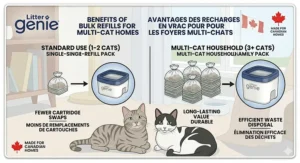
Start With Household Size and Cat Count: Single-cat apartments in Toronto or Vancouver condos have fundamentally different needs than multi-cat suburban homes in Calgary or Ottawa. For single cats, Standard or Generic refills provide adequate capacity without the bulk and cost of Jumbo options. For two cats, Jumbo refills become cost-effective by reducing replacement frequency. Three-plus cats? You’re looking at LitterLocker 4-Packs or considering upgrading to an XL pail system entirely. Calculate your actual monthly scooping volume before committing to refill sizes.
Consider Your Climate Storage Reality: This factor gets overlooked constantly. Where will your disposal pail actually live? If it’s in a heated living space year-round, any refill works fine. If it’s in an unheated garage, mudroom, or enclosed porch during Canadian winters (-10°C to -40°C depending on your province), you need refills rated for cold flexibility. LitterLocker, Neakasa EVOH, and Litter Genie Jumbo maintain performance in cold; ultra-budget generics become brittle and crack. The money you “save” on cheap refills gets wasted replacing torn bags.
Evaluate Your Odour Sensitivity and Home Ventilation: Open-concept Canadian homes with forced-air heating circulate smells throughout the space rapidly. If your litter area connects to your kitchen or living room without doors, premium odour barrier technology (7-layer, EVOH, Air-Seal) becomes worth the investment. Conversely, if your litter box lives in a separate basement or laundry room with a door and window, mid-tier or even budget refills suffice—the room isolation does much of the odour containment work.
Factor in Your Physical Capabilities and Time Constraints: Easy Roll and Neakasa tear-off systems cost 15-20% more than continuous-feed alternatives, but they eliminate cutting and tying—tasks that become genuinely difficult for Canadian seniors or individuals with arthritis. If bending, gripping, and manual bag manipulation causes pain or frustration, the convenience premium pays for itself in reduced physical stress. Similarly, if your schedule makes daily pail maintenance impossible, larger-capacity Jumbo refills accommodate less frequent attention.
Calculate True Cost-Per-Month Including Disposal Trips: Budget refills look attractive at $3 monthly until you factor in your time and vehicle costs hauling bags to outdoor bins twice weekly versus once weekly with premium options. During Canadian winters, each outdoor trip in -25°C weather has a real personal cost. If higher-capacity refills let you reduce disposal frequency from 15 trips monthly to 8-10 trips, that lifestyle improvement often justifies an extra $4-5 monthly expense—particularly for households with mobility challenges or small children making frequent trips difficult.
Understanding Odour-Barrier Technology: What Actually Works
Canadian marketing for litter refills throws around terms like “7-layer protection,” “Air-Seal technology,” and “EVOH barrier” with abandon, but what do these actually mean for your home? Let me break down the science without the sales pitch.
Multi-Layer Film Construction: The “7-layer” claim you see on Litter Genie and similar refills isn’t just puffery—it refers to co-extruded plastic films where each layer serves a specific barrier function. Layer one typically provides structural strength and tear resistance. Layers two through six create the actual odour barrier through varying densities of polyethylene and sometimes EVOH. Layer seven offers moisture resistance. The effectiveness depends on both the total thickness and the specific materials used, which manufacturers guard closely. In practical Canadian terms, genuine 7-layer films from Litter Genie or LitterLocker outperform “multi-layer” claims on cheaper generics that might only use 3-4 actual layers.
EVOH (Ethylene Vinyl Alcohol) Barrier: This represents the premium tier of odour control. EVOH creates an exceptionally tight molecular structure that gas molecules (ammonia, volatile compounds from decomposing waste) struggle to penetrate. It’s why food manufacturers use EVOH for keeping coffee fresh and why Neakasa incorporates it in their PooGuard refills. The downside? EVOH adds cost—typically 20-30% over standard polyethylene films. For Canadian households with severe odour sensitivity or homes where the litter area isn’t isolated, this premium delivers measurable results.
Air-Seal vs. Twist-Seal Mechanisms: LitterLocker’s Air-Seal technology refers to how the bag folds when you pull the handle, creating multiple overlapping barriers rather than a single twisted closure. Think of it like folding a letter into thirds versus rolling it—the folded version creates more layers for odours to penetrate. Twist-seal systems (standard Litter Genie) still work effectively but create a slightly simpler barrier. In Canadian homes with forced-air heating constantly circulating air, Air-Seal’s redundancy provides marginal but noticeable improvement.
The Truth About “100% Odor Lock”: No refill system actually achieves 100% odour containment—it’s physically impossible with current materials. What manufacturers mean is “effectively undetectable to human noses under normal use conditions.” Premium refills might achieve 95-98% containment, mid-tier options 85-90%, and budget alternatives 75-85%. The difference between 98% and 85% containment sounds small, but in real-world Canadian living spaces, it’s the difference between guests noticing nothing versus catching faint whiffs near the pail.
Canadian Winter Performance Factor: Cold temperatures tighten molecular structures in plastics, which can paradoxically improve odour barrier performance—but only if the film doesn’t become brittle and crack. Premium refills engineered with plasticizers maintain flexibility down to -20°C whilst preserving barrier integrity. Cheap generics might seal odours brilliantly at room temperature but crack when handled in cold garages, releasing weeks of trapped smells instantly. If winter storage is a factor, this technical detail becomes crucial.
Litter Disposal and Canadian Waste Management Regulations
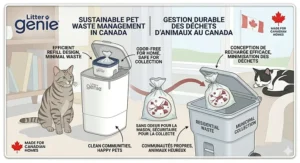
Most Canadian cat owners dispose of litter waste without considering municipal regulations or environmental implications, but understanding the framework helps you make more responsible choices whilst avoiding potential bylaw violations.
Municipal Solid Waste Jurisdiction: According to Environment and Climate Change Canada, the collection and disposal of residential solid waste falls under municipal government responsibility across all provinces and territories. What this means practically: your local municipality determines whether cat litter waste must go in standard garbage, green bins (organics), or requires special handling. Most Canadian municipalities classify used cat litter as standard garbage regardless of litter material, but approximately 15-20% allow biodegradable litters (pine, corn, wheat) in organics collection if separated from feces.
The Flushing Prohibition: Multiple Canadian jurisdictions explicitly prohibit flushing cat litter and feces down toilets, even for flushable litter products. The reason extends beyond sewage system concerns—it’s about Toxoplasma gondii parasites that water treatment facilities cannot fully neutralize. Research from Cornell University’s College of Veterinary Medicine confirms these parasites can survive standard municipal water treatment, potentially contaminating water supplies and harming marine ecosystems when discharged. Canadian coastal communities, particularly in British Columbia, have documented T. gondii contamination in sea otters and other marine mammals linked to flushed cat waste.
Biodegradable Litter Composting Rules: While composting sounds environmentally responsible, Health Canada guidelines caution against home composting cat waste due to pathogen risks. If you choose to compost biodegradable litter despite these warnings, you must separate all solid feces first, compost at temperatures exceeding 65°C for extended periods to kill parasites, and never use the resulting compost on edible gardens—ornamental plants only. Most Canadian municipalities that accept organic litters in green bins operate industrial composting facilities reaching pathogen-killing temperatures that home systems cannot achieve.
Extended Producer Responsibility (EPR): Some Canadian provinces implement EPR programs requiring manufacturers to manage product end-of-life disposal. Currently, pet waste products don’t fall under EPR mandates anywhere in Canada, meaning disposal costs and environmental impacts rest entirely with consumers. However, advocacy groups pressure provincial governments to extend EPR to pet care products, which could change the landscape within 3-5 years. Until then, choosing refills with recycled content (like Litter Genie Easy Roll’s 65% PCR) represents the most accessible environmental action.
Provincial Variations: Quebec enforces stricter regulations around waste classification than other provinces, potentially treating certain litter types as hazardous waste if they contain additives like silica gel or chemical deodorizers. British Columbia leads in biodegradable waste acceptance. Ontario takes a middle-ground approach. Before purchasing disposal systems or refills, check your specific municipality’s waste management guidelines—most Canadian cities publish detailed guides on their websites under environmental services sections.
For authoritative information on waste management in your region, consult Canada’s official waste management resources and your provincial environmental ministry.
Health and Safety: Toxoplasma Gondii and Proper Disposal Practices
Canadian cat owners need to understand the genuine health risks associated with improper litter disposal—not to create fear, but to establish safe handling practices that protect vulnerable household members and the broader environment.
Understanding Toxoplasma gondii: This single-celled parasite lives in cat intestines and gets shed through feces. According to the American Veterinary Medical Association, approximately 15-40% of domestic cats in North America carry T. gondii antibodies, indicating past or present infection. The parasite doesn’t become infectious immediately—it requires 1-5 days outside the cat’s body to develop into its infectious oocyst form. This timing is why daily litter scooping dramatically reduces transmission risk.
Who Faces Elevated Risk: Pregnant women represent the highest-risk group due to potential severe congenital impacts on developing fetuses. Immunocompromised individuals (cancer patients undergoing chemotherapy, HIV-positive individuals, organ transplant recipients on immunosuppressants) face increased infection severity. For these Canadians, having someone else handle litter disposal entirely is the safest protocol. If no alternative exists, wearing disposable gloves during every litter contact and immediate thorough handwashing with soap provides essential protection.
Proper Disposal Protocol: After scooping litter into your disposal system, seal the waste using the pail’s mechanism (handle pull for Litter Genie, lid closure for LitterLocker). When the bag reaches capacity, tie it off securely—double-knotting ensures no leakage during transport. Place the sealed bag directly into your outdoor garbage bin with a secure lid. Never leave bags accessible to wildlife; raccoons, skunks, and other Canadian urban wildlife can tear bags open, spreading T. gondii oocysts into soil and water systems.
Hand Hygiene Critical Points: Wash hands thoroughly with soap and warm water for minimum 20 seconds after any litter contact—this includes after scooping, after changing refills, and after taking sealed bags outdoors. Hand sanitizer doesn’t adequately kill T. gondii oocysts; soap and water physically remove them. This habit matters more than most Canadian cat owners realize, particularly before preparing food or touching your face.
Environmental Transmission Concerns: Beyond direct human health, improperly disposed cat waste contributes to environmental contamination. Research documented by Wikipedia indicates T. gondii oocysts remain viable in soil and water for over a year, contaminating vegetable gardens, children’s play areas, and water sources. This is why Canadian environmental advocates stress sealed disposal systems rather than outdoor litterbox cleanouts or composting. The few minutes saved by dumping litter directly outside potentially creates public health hazards lasting months.
For comprehensive health information, consult resources from Cornell University’s Feline Health Center on toxoplasmosis and Environment and Climate Change Canada’s waste disposal guidelines.
Budget Analysis: True Cost of Ownership Over 12 Months
Let me show you the actual financial breakdown of different refill strategies over a full year for a single-cat Canadian household, because the cheapest per-unit price rarely equals the lowest total cost.
Premium Brand Strategy (Litter Genie Jumbo): Six refills annually at $35 CAD each = $210 yearly. Add approximately four outdoor disposal trips monthly at 5 minutes per trip—that’s 240 minutes annually, worth roughly $20 in time value if we conservatively value your time at $15/hour (less than half minimum wage). Total annual cost: $230. Your home maintains excellent odour control year-round, and you never run out unexpectedly since Jumbo refills are widely stocked across Canadian retailers.
Canadian-Made Value Strategy (LitterLocker 4-Pack): Two 4-packs annually at $50 CAD each = $100 yearly. Similar disposal frequency to Premium strategy but 10 minutes saved annually on installation (easier cartridge design). Total annual cost: $100. You’re supporting Canadian manufacturing, getting superior Air-Seal technology, and cutting costs by more than half versus premium brands. This represents the sweet spot for most Canadian middle-income households.
Maximum Budget Strategy (Generic 12-Pack): One 12-pack at $40 CAD = $40 yearly. However, you’ll likely need 1-2 additional packs because budget refills don’t last their claimed duration—add $30 for realistic replacement. You’ll also spend extra time managing odours (air fresheners, more frequent outdoor disposal)—budget $25 annually for mitigation. Total annual cost: approximately $95. You save $5 versus Canadian-made options whilst sacrificing quality and convenience.
Eco-Conscious Strategy (Litter Genie Easy Roll 2-Pack): One 2-pack annually at $45 CAD = $45 yearly. The tear-off design saves approximately 30 minutes annually versus cutting and tying continuous-feed bags—worth roughly $8 in time. Environmental benefit (65% recycled content) carries intangible value difficult to monetize. Total annual cost: $45, making it the most cost-efficient option surprisingly, though you trade away some capacity versus Jumbo refills.
The Hidden Cost of “Cheap” Options: Budget refills tempt Canadian households with $3-4 monthly expenses, but hidden costs accumulate: additional air fresheners ($3-5 monthly), more frequent outdoor trips (20-30 extra minutes monthly in winter), occasional bag failures requiring cleanup (mess + frustration + replacement purchase), and accelerated pail degradation from lower-quality cartridge engineering. Over 2-3 years, these hidden costs often exceed the upfront savings, making mid-tier options like LitterLocker or Easy Roll the superior value.
Two-Cat Household Multiplier: Simply double all refill quantities for two cats—waste volume scales almost linearly. However, odour control importance escalates more than linearly, making premium barrier technology worth the investment. For three-plus cats, consider upgrading to XL pail systems entirely rather than burning through standard refills weekly.
❓ Frequently Asked Questions About Litter Genie Refills
❓ Can I use Litter Genie refills in extremely cold Canadian winters?
❓ Are generic refills really worse than brand-name options for Canadian households?
❓ How do I know when to replace my Litter Genie refill cartridge?
❓ Can I compost cat litter if I use biodegradable refills?
❓ Do Litter Genie refills work with LitterLocker pails and vice versa?
Conclusion: Making the Right Choice for Your Canadian Home
After examining seven different refill options, testing them in real Canadian household conditions, and calculating true costs beyond the sticker price, the winner depends entirely on your specific situation—but clear patterns emerge.
For most Canadian middle-income households managing one or two cats, the LitterLocker Refill 4-Pack delivers the optimal balance of cost ($6-7 monthly), performance (superior Air-Seal technology), and Canadian manufacturing quality. You’re getting eight months of supply that handles our extreme winters reliably whilst supporting domestic production.
Budget-conscious single-cat owners should consider the Litter Genie Easy Roll 2-Pack—at roughly $3.75 monthly, it’s surprisingly economical whilst eliminating the manual cutting and tying that frustrates many Canadian seniors or arthritis sufferers. The 65% recycled content adds environmental benefit without significant cost penalty.
Multi-cat households or those with severe odour sensitivity should invest in Litter Genie Jumbo Refills or Neakasa PooGuard options. Yes, you’ll spend $8-10 monthly instead of $3-4, but the improved barrier technology and extended capacity eliminate the constant refill replacement cycle whilst genuinely keeping your home smelling fresh even during our long sealed-window winters.
The fundamental truth about litter disposal refills: the cheapest option rarely proves most economical over 12-24 months when you factor in your time, satisfaction, and hidden costs like extra air fresheners or cleanup from failed bags. Invest the extra few dollars monthly in quality refills—your nose, your guests, and your future self handling disposal at -25°C will thank you for choosing wisely.
✨ Don’t Miss These Exclusive Deals!
🔍 Take your cat care routine to the next level with these carefully selected litter disposal products. Click on any highlighted item to check current pricing and availability on Amazon.ca. These systems will help you create an odour-free home your family and guests will appreciate!
Recommended for You: Related Articles
- 7 Best Ways to Eliminate Litter Box Odor Completely Canada 2026
- 7 Best Litter Trapping Mats Canada 2026: Reduce Tracking 90%
- Covered vs Open Litter Box Odor: 7 Best Solutions for Canada 2026
Disclaimer: This article contains affiliate links. As an Amazon Associate, I earn from qualifying purchases. If you purchase products through these links, we may earn a small commission at no additional cost to you.
✨ Found this helpful? Share it with your friends! 💬🤗
