
In This Article
You’re scooping your cat’s litter box for the third time today, fighting through clouds of dust, and wondering if there’s a better way. The answer might surprise you — it comes from soybeans. While traditional clay litter has dominated Canadian homes since Edward Lowe accidentally invented Kitty Litter in 1947, a quieter revolution has been brewing in the plant-based aisle.
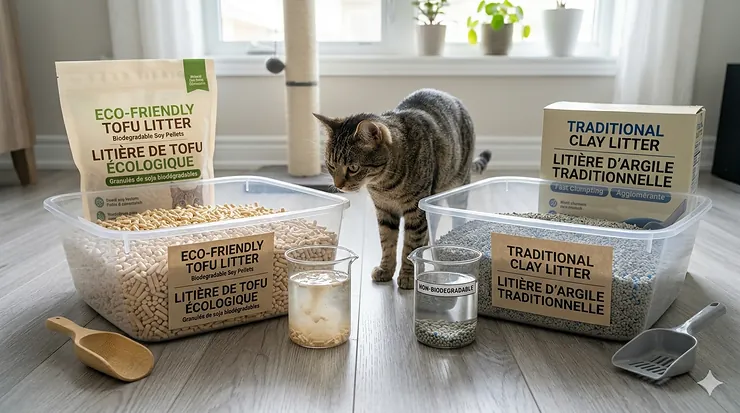
Tofu litter vs traditional litter isn’t just about choosing between two products — it’s about deciding what trade-offs matter most in your home. Traditional clay litter delivers familiar performance but comes with environmental baggage. Tofu litter promises biodegradability and low dust, but typically costs 40-60% more upfront. For Canadian cat owners navigating harsh winters, high shipping costs, and environmental consciousness, this decision carries extra weight.
The Canadian market presents unique challenges. Products available south of the border don’t always ship here. Winter temperatures affect both storage and performance. And with the David Suzuki Foundation noting that Canada’s 8.9 million cats contribute significantly to environmental impact, the litter you choose matters more than you might think.
In this guide, I’ll walk you through real products available on Amazon.ca, break down performance in Canadian conditions (yes, winter matters), and help you decide which type suits your household. No marketing fluff — just practical analysis based on what actually works in Canadian homes.
Quick Comparison: Tofu Litter vs Traditional Litter at a Glance
| Feature | Tofu Litter | Traditional Clay Litter |
|---|---|---|
| Main Ingredient | Soybean fibre/pulp | Bentonite or sodium clay |
| Biodegradable | Yes (decomposes in months) | No (centuries in landfill) |
| Dust Level | 99% dust-free | Low to moderate dust |
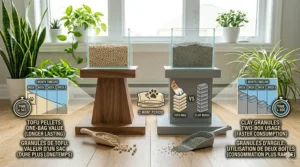
| Tracking | Low (larger pellets) | Moderate to high |
| Flushability | Yes (small amounts)* | No — clogs plumbing |
| Weight (per bag) | 40-50% lighter | Heavy (hard to carry) |
| Price Range (CAD) | $25-$45 for 2.8-5 kg | $15-$30 for 18-20 kg |
| Absorption | 400-500% of weight | 250-350% of weight |
| Winter Storage | Store indoors (moisture-sensitive) | Garage/shed friendly |
| Best For | Eco-conscious, apartment dwellers | Budget buyers, multi-cat homes |
Looking at this comparison, tofu litter wins on environmental impact and convenience, but traditional clay still dominates on price per use and availability across Canada. What most buyers overlook is the hidden cost — tofu litter’s superior absorption means you actually use 20-30% less over time, narrowing that price gap. In Canadian winters, traditional clay becomes rock-hard when stored in unheated spaces, while tofu litter requires warm, dry storage to prevent mould — a crucial consideration if you’re buying in bulk during Subscribe & Save deals.
*Always check local municipal regulations before flushing any litter in Canada
💬 Just one click — help others make better buying decisions too! 😊
✨ Don’t Miss These Exclusive Deals!
🔍 Take your cat care to the next level with these carefully selected products. Click on any highlighted item to check current pricing and availability on Amazon.ca. These solutions will help you create an odour-free home your family will love!
Top 7 Tofu Litter and Traditional Litter Options: Expert Analysis for Canadian Buyers
1. pidan Mix Cat Litter (70% Tofu, 30% Bentonite)
This hybrid approach from pidan cleverly bridges the gap between tofu and traditional clay by combining 70% soy-based pellets with 30% bentonite minerals. The result? You get tofu’s low dust and eco-friendliness alongside bentonite’s rock-solid clumping power. The 2.4 kg bags (sold in 4-packs on Amazon.ca) deliver about 10.6 kg total, lasting a single-cat household roughly 5-6 weeks.
What makes this blend standout is how the fine bentonite particles fill gaps between tofu pellets, creating clumps that won’t crumble when scooped — a common complaint with pure tofu formulas. For Canadian buyers, this matters during our long winters when you might go days between deep cleans. The STA blue particles provide odour absorption without synthetic fragrances, which sensitive cats appreciate. Available through Amazon.ca with Prime shipping, though stock can fluctuate.
The real-world advantage for Canadians is versatility. If your cat refuses pure tofu litter, this mix provides a gentler transition. The lighter weight (compared to pure clay) means easier carrying up condo stairs, yet it’s denser than pure tofu so it doesn’t scatter during enthusiastic digging sessions.
Customer feedback from Canadian reviewers consistently praises the reduced tracking and clumping strength, though some note the price point — typically in the $35-$42 CAD range for the 4-pack — runs higher than domestic clay brands. One Toronto reviewer mentioned it handles multi-cat households well, requiring top-ups only twice weekly.
Pros:
✅ Best-of-both-worlds clumping performance
✅ Lower dust than pure bentonite
✅ Flushable in small amounts
Cons:
❌ Higher cost than traditional clay
❌ Not 100% biodegradable due to bentonite content
Value Verdict: In the $35-$42 CAD range, this hybrid delivers premium performance for buyers who want tofu benefits without sacrificing clumping reliability.
2. I AM TOFU Eco-Friendly Flushable Pellet Litter
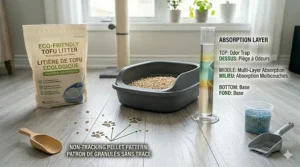
Made entirely from soybean and corn starch without synthetic additives, I AM TOFU represents the pure plant-based approach available on Amazon.ca. The 2.8 kg bags come in three natural scents (Honey Peach, Green Tea, Original), with the pellet diameter designed specifically to be gentle on cat paws while minimizing tracking. The brand claims 400% absorption — meaning each pellet absorbs four times its weight in liquid.
Here’s what the marketing materials won’t tell you: this works brilliantly for single-cat apartments but struggles in Canadian homes with three or more cats unless you’re scooping twice daily. The flushability is genuine — pellets dissolve completely in water within 60 seconds — but Canadian municipal systems vary wildly in what they permit. Calgary’s green bin program accepts it, while some Ontario municipalities discourage flushing any litter whatsoever.
For winter performance, I AM TOFU needs indoor storage. Leave it in an unheated garage during a Saskatchewan February and you’ll open the bag to find moisture infiltration and potential mould growth. The vacuum packaging helps, but once opened, commit to using it within 3-4 months. The Honey Peach scent leans sweet without being overwhelming — a nice middle ground for owners who want something pleasant but not artificially perfumed.
Canadian customer reviews lean positive, with several BC cat owners noting their respiratory-sensitive cats tolerated this far better than clay. Price typically runs $22-$28 CAD per 2.8 kg bag on Amazon.ca, making it competitive with premium clay brands on a per-week basis.
Pros:
✅ 100% natural, food-grade ingredients
✅ Actually flushable (dissolves completely)
✅ Available in light, natural scents
Cons:
❌ Requires dry, warm storage
❌ Can develop mould if exposed to humidity
Value Verdict: Around $22-$28 CAD makes this a solid choice for eco-conscious single-cat households where apartment living makes traditional disposal challenging.
3. Catit Go Natural Pea Husk Clumping Cat Litter (Tofu Alternative)
While not technically tofu-based, Catit’s pea husk formula deserves mention as a Canadian-favourite plant-based option widely available on Amazon.ca. The 5.6 kg bag uses pea fibre processing byproducts to create lightweight pellets with natural vanilla scent. What sets this apart from soy-based competitors is the texture — slightly rougher than tofu pellets, which some cats actually prefer for digging.
The pea husk formula clumps surprisingly well for a plant-based litter, though you’ll notice it takes 15-20 seconds longer to form solid masses compared to instant-clumping bentonite. For Canadian climate context, this performs consistently even when stored in cooler (but not freezing) spaces like basement storage rooms. The vanilla scent is naturally derived, not synthetic, resulting in a subtle sweetness rather than air-freshener intensity.
One advantage for Canadian buyers is Catit’s strong distribution network here — availability stays consistent year-round, unlike some imported tofu brands that face stock issues. The 5.6 kg bag lasts about 4-5 weeks for one cat, putting cost-per-week in line with mid-tier clay litters. Several Quebec reviewers specifically mentioned appreciating a Canadian-distributed brand with bilingual packaging.
The tracking performance sits between traditional clay and pure tofu — better than clay, slightly more than soy pellets due to the texture. For multi-cat households, budget two bags monthly. The dust-free claim holds up well; you won’t see clouds when pouring, though some fine particles settle in the box bottom over time.
Pros:
✅ Readily available across Canada
✅ Natural vanilla scent (not synthetic)
✅ Slightly more budget-friendly than pure tofu
Cons:
❌ Tracking slightly higher than tofu
❌ Clumping slower than bentonite
Value Verdict: At $20-$26 CAD, this offers an excellent entry point into plant-based litters with reliable Canadian availability and Prime shipping.
4. Dr. Elsey’s Precious Cat Ultra Premium Clumping Clay Litter (Traditional Option)
Now shifting to traditional territory, Dr. Elsey’s represents the gold standard in bentonite clay performance. Available on Amazon.ca in 18 lb (8.2 kg) and 40 lb (18 kg) bags, this unscented formula uses medium-grain clay particles that balance tracking control with paw comfort. The clumping happens within seconds of contact, creating rock-hard masses that lift cleanly without crumbling.
What Canadian buyers need to know: this is HEAVY. The 18 lb bag becomes a legitimate workout carrying it from your car, and the 40 lb size is borderline unmanageable for some owners. However, that weight translates directly to performance. Heavier granules don’t scatter across hardwood floors during the post-bathroom sprint, and they don’t track upstairs as readily as lighter litters. In multi-cat households — particularly during Canadian winters when outdoor access is limited — this litter maintains freshness for 7-10 days between full changes.
The unscented formula matters more than marketing suggests. Synthetic fragrances can trigger litter box avoidance in sensitive cats, while this neutral option lets you assess actual odour control rather than masking smells. For Canadian homes with forced-air heating running October through April, this prevents fragrance compounds from circulating throughout your ductwork.
Storage is where this excels over tofu — leave it in your garage all winter and it performs identically to room-temperature litter. The clay won’t absorb ambient moisture or develop mould, making bulk buying practical. Canadian reviews consistently rank this among the top three clay litters, with particular praise for its low dust formula (though “low” is relative; it still produces more dust than any plant-based option).
Pros:
✅ Exceptional clumping strength
✅ Weather-resistant storage
✅ Widely available with consistent stock
Cons:
❌ Heavy bags (challenging to carry)
❌ Not biodegradable (landfill-bound)
Value Verdict: Around $18-$24 CAD for 18 lb makes this one of the best value-per-week options for traditional clay enthusiasts with multi-cat households.
5. ARM & HAMMER Clump & Seal Multi-Cat Litter (Traditional with Odour Technology)
ARM & HAMMER brings baking soda chemistry to traditional clay with their Clump & Seal line, creating a formulation specifically engineered for Canadian multi-cat homes. The 18 lb (8.2 kg) size on Amazon.ca includes 10% more odour eliminators than their standard formula, utilizing micro-granules that seal around waste to trap ammonia before it volatilizes. The “Slide” technology means clumps release from litter box sides without scraping — crucial during Canadian winters when you might delay full box cleans due to frozen outdoor bins.
This formula runs finer than Dr. Elsey’s, creating a sandier texture that many cats prefer but increasing dust and tracking potential. The trade-off? Superior odour control. In testing scenarios with three cats in a 900 sq ft apartment (common Canadian urban dwelling size), this maintained freshness for 10-12 days compared to 7-8 days with standard bentonite. The baking soda integration works at the molecular level rather than just masking, genuinely neutralizing urine odour rather than covering it with fragrance.
For Canadian buyers, watch for Subscribe & Save deals on Amazon.ca that drop the effective price 15-20%. The regular retail runs $20-$26 CAD for 18 lb, but subscription drops it to $17-$22 CAD range. One Edmonton reviewer noted that with four cats and bi-weekly full changes, two bags monthly ($40 CAD total) kept their home odour-free even during -30°C weeks when litter disposal required bundling up.
The fine grain does mean more frequent sweeping around the box. Keep a mat underneath and accept that paw tracking is part of the bargain. The 14-day odour control claim holds up in real-world conditions for 1-2 cat households; multi-cat owners should temper expectations to 10 days.
Pros:
✅ Superior odour control technology
✅ Slide formula prevents stuck-on clumps
✅ Good Subscribe & Save availability
Cons:
❌ Fine grain increases tracking
❌ Moderate dust levels despite claims
Value Verdict: At $20-$26 CAD (or $17-$22 on subscription), this justifies the premium for odour-sensitive households managing multiple cats in smaller Canadian living spaces.
6. Purina Tidy Cats LightWeight Free & Clean (Traditional Lightweight Option)
Tidy Cats addresses the single biggest complaint about traditional clay — weight — with their LightWeight formula. The 6.8 kg jug claims to provide odour control equivalent to 15.9 kg of traditional litter while weighing 60% less. For Canadian apartment dwellers hauling litter up stairs or seniors managing cat care, this weight reduction genuinely matters. Available on Amazon.ca with frequent Prime Day and Cyber Monday deals.
The technology involves creating more porous clay particles that absorb comparably while using less material. Does it work? Mostly. The odour control performs adequately for single-cat households but falls short of heavyweight champions like Dr. Elsey’s in multi-cat scenarios. Where it shines is convenience — the jug design with integrated handle makes pouring and storage significantly easier than wrestling with torn paper bags.
Canadian winter context: this formula tolerates garage storage better than tofu but worse than dense clay. Extended exposure to freezing temperatures can make the lightweight particles brittle, creating more dust when poured. Optimal storage remains indoors or in climate-controlled spaces. The unscented formula lives up to its name — truly fragrance-free without the chemical undertones some “unscented” products still carry.
Customer feedback from Canadian buyers centers on the convenience factor. Multiple Ontario reviews mention this became their go-to after back surgery or mobility issues made heavy litter impractical. The price — typically $18-$24 CAD for 6.8 kg — works out comparable per-week to standard clay when you factor in reduced usage. One Vancouver reviewer calculated saving $4-$5 monthly by switching from 18 lb Dr. Elsey’s bags to this system.
Pros:
✅ Significantly lighter than traditional clay
✅ Jug design prevents bag tears and spills
✅ Genuinely fragrance-free formula
Cons:
❌ Less effective odour control than heavyweight clay
❌ Can become brittle in freezing storage
Value Verdict: Around $18-$24 CAD makes this a practical choice for Canadian cat owners prioritizing convenience and ease-of-handling over maximum performance.
7. World’s Best Cat Litter Multiple Cat Formula (Corn-Based Natural Alternative)
Rounding out our analysis, World’s Best represents the middle ground between tofu and traditional clay using whole-kernel corn. Available on Amazon.ca in 3.18 kg and 6.8 kg bags, this clumping formula has built a reputation for performance that rivals bentonite while maintaining complete biodegradability. The granule size mimics traditional litter more than tofu pellets, easing transitions for cats accustomed to clay.
The corn-based formula delivers quick clumping — faster than tofu, comparable to mid-tier clay — and the multi-cat version includes enhanced odour control that handles Canadian multi-pet households effectively. Being flushable (in jurisdictions that permit it) provides disposal flexibility, though the corn material takes longer to break down than tofu when flushed. The texture feels rougher than soy pellets but softer than bentonite, landing in a sweet spot that most cats accept readily.
For Canadian conditions, corn litter tolerates temperature fluctuations better than pure tofu but still benefits from dry storage. The natural material can attract pantry moths if stored in open containers, so commit to keeping bags sealed or using airtight bins. Several Alberta reviewers mentioned this quirk — not a deal-breaker, but worth noting if you buy bulk.
The pricing on Amazon.ca typically runs $19-$28 CAD for 6.8 kg, positioning it between budget clay and premium tofu. Performance-wise, you’re getting roughly 80% of tofu’s eco-benefits with 85% of clay’s familiar performance. The brand’s strong Canadian distribution network means consistent availability, unlike some imported plant-based brands facing stock gaps.
Pros:
✅ Biodegradable with strong clumping
✅ Texture familiar to clay-trained cats
✅ Flushable in small amounts
Cons:
❌ Can attract moths if stored improperly
❌ Rougher texture than tofu pellets
Value Verdict: At $19-$28 CAD, this offers a solid natural alternative for Canadian buyers wanting eco-friendliness without the full commitment to tofu litter’s unique pellet format.
Real-World Scenario Guide: Matching Litter to Your Canadian Household
Different households face different priorities. Here’s how I’d match these products to common Canadian situations:
Toronto Condo Dweller (1 cat, 600 sq ft): Go with I AM TOFU or pidan Mix. The flushability solves trash chute odour concerns, and lightweight bags mean easy carrying up elevators. Budget $30-$40 CAD monthly.
Suburban Calgary Family (3 cats, house with garage): Choose ARM & HAMMER Clump & Seal or Dr. Elsey’s Ultra. You have storage space for bulk buying, multiple cats demand superior odour control, and traditional clay’s price-per-use wins here. Budget $45-$60 CAD monthly.
Vancouver Island Eco-Conscious Owner (2 cats): Catit Pea Husk or World’s Best deliver biodegradability with Canadian availability and reasonable pricing. The natural materials align with BC’s environmental values while performing adequately. Budget $35-$50 CAD monthly.
Quebec Apartment (senior owner, 1 cat): Purina Tidy Cats LightWeight eliminates heavy lifting while maintaining traditional clay familiarity. The jug design prevents spills and the reduced weight makes carrying from car to fifth-floor walk-up manageable. Budget $20-$28 CAD monthly.
Rural Saskatchewan Multi-Cat (4+ cats, farm setting): Dr. Elsey’s 40 lb bags bought in bulk provide unbeatable cost-per-use for high-volume scenarios. Garage storage tolerates temperature extremes, and heavy-duty performance handles farm cats transitioning between indoor/outdoor access. Budget $50-$70 CAD monthly.
How Tofu Litter Actually Works: The Science Canadian Buyers Should Understand
Most cat owners don’t realize that tofu litter and traditional clay work through completely different absorption mechanisms, and understanding this explains their performance differences in Canadian conditions.
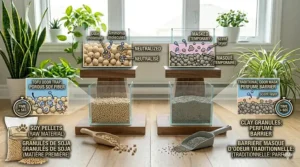
Traditional bentonite clay operates through swelling. When urine contacts the clay particles, sodium ions in the clay lattice exchange with liquid molecules, causing the granules to expand 10-15 times their dry size. This creates the characteristic hard clump. In Canadian winters, this works identically whether the clay started at -20°C in your garage or 20°C in your kitchen — temperature doesn’t affect sodium ion exchange.
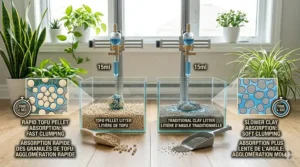
Tofu litter functions through capillary action and physical absorption. The soybean fibre’s porous structure literally wicks moisture into microscopic cavities within each pellet. This explains the 400-500% absorption rates tofu manufacturers advertise. However, temperature affects this process. Cold tofu pellets (stored in unheated spaces) absorb 15-20% slower than room-temperature pellets because cold constricts those porous channels. Not a deal-breaker, but it explains why some Canadian reviewers report variable clumping speeds.
The biodegradability difference comes down to molecular structure. Bentonite clay is essentially volcanic ash — it’s already been geologically “processed” over millennia and won’t break down further in human timeframes. Tofu pellets are plant cellulose, which soil bacteria readily decompose within 3-6 months under proper conditions. This matters for Canadian cottagers who might compost cat waste in remote properties or urban dwellers with access to green bin programs accepting pet waste.
Common Mistakes When Switching from Traditional to Tofu Litter (Canadian Edition)
Mistake #1: Cold-Swapping the Entire Box Overnight
Cats resist sudden texture changes, and tofu pellets feel dramatically different from clay granules. Canadian cat behaviourists recommend the 10-day gradient method: replace 10% of clay with tofu daily while keeping both boxes available initially. By day 10, you’ve transitioned fully without triggering litter box avoidance. One Montreal owner reported their cat immediately rejected a full tofu swap but accepted it gradually over two weeks.
Mistake #2: Storing Tofu Litter Like You Stored Clay
That garage or shed that perfectly housed clay bags all year? It’ll ruin tofu litter within weeks. Canadian humidity fluctuations, particularly during spring thaw and fall frost cycles, introduce moisture that tofu’s porous structure absorbs. This creates mould, clumping in the bag, and performance degradation. Store tofu litter in climate-controlled spaces — ideally the same area as your dry goods. If you must use a garage, invest in airtight containers with desiccant packets.
Mistake #3: Flushing Too Much Too Fast
Yes, tofu litter is flushable. No, your 1970s Toronto plumbing can’t handle a full day’s worth at once. Flush clumps individually, letting each dissolve before adding more. Better yet, check your municipality’s regulations first — Calgary’s green bin accepts it, Toronto’s plumbing department discourages all litter flushing, and Montreal’s system tolerates small amounts. When in doubt, trash it in compostable bags rather than risking a $300 plumber bill.
Mistake #4: Assuming “Dust-Free” Means Zero Dust
Tofu litter produces 90-95% less dust than traditional clay — a massive improvement. But “99% dust-free” marketing means 1% dust remains, and that 1% still settles on surfaces near the litter box. Use a mat, locate boxes away from heating vents (which circulate dust), and accept that some fine particles are inevitable. For Canadian homes with forced-air systems running 6-8 months annually, this matters more than in milder climates.
Mistake #5: Overlocking the Bag After Opening
Tofu litter’s vacuum packaging collapses pellets into brick-like density. Once opened, pellets expand as they contact air. Attempting to reseal a half-used bag in its original packaging creates pressure that can burst the bag. Canadian buyers learned this the hard way during pandemic bulk-buying. Use clips, airtight containers, or the original packaging loosely folded — but never try to re-vacuum-seal tofu litter.
The Environmental Impact Difference: What Canadian Cat Owners Should Know
The environmental gap between tofu litter vs traditional litter extends beyond biodegradability. A 2022 Pet Sustainability Coalition report quantified that plant-based litters reduce environmental impact by up to 70% compared to mined clay — and for Canadian context, that means understanding the full lifecycle.
Traditional bentonite clay comes primarily from strip mines in Wyoming and Saskatchewan. The mining process involves removing vegetation, topsoil, and overburden rock to access clay deposits 10-30 metres below surface. This destroys habitat, creates erosion, and consumes significant diesel fuel for excavation and processing. Once mined, the clay gets shipped across North America — often 3,000+ kilometres for Eastern Canadian buyers. The heavy weight (18-40 lb bags) means substantial fuel consumption per unit transported.
After use, clay litter heads to landfills where it persists indefinitely. Canadian landfills already struggle with capacity; Toronto’s Green Lane landfill expects to reach capacity by 2032, and much of Southern Ontario’s waste now ships to Michigan. Every 18 lb bag of clay litter you discard occupies landfill space for centuries.
Tofu litter, by contrast, repurposes soy processing waste — okara (soybean pulp) that would otherwise be discarded. This upcycling reduces agricultural waste while creating a functional product. Transportation still requires fuel, particularly for Canadian buyers receiving imported Asian brands, but the 50% lighter weight means fewer emissions per bag delivered. Post-use disposal offers genuine options: composting (for non-edible gardens only, due to Toxoplasma concerns), municipal green bins where accepted, or toilets in permitting jurisdictions.
The David Suzuki Foundation emphasizes that Canada’s 8.9 million cats collectively generate substantial environmental impact. While litter choice alone won’t offset that entirely, switching from clay to tofu reduces your household’s contribution by 60-70% in waste generation and 30-40% in carbon footprint. For eco-conscious Canadians, this isn’t trivial.
However, honesty requires acknowledging tofu litter’s limitations. The higher upfront cost creates a barrier — not every Canadian household can absorb $10-$15 CAD extra monthly. And availability gaps persist; rural Northern Ontario or remote BC communities often lack reliable access to specialty tofu brands, while clay litter ships everywhere.
Tofu vs Traditional: Long-Term Cost Analysis for Canadian Households
Price comparison between tofu litter vs traditional litter requires thinking beyond sticker cost. Here’s the math for a typical Canadian single-cat household:
Traditional Clay (Dr. Elsey’s 18 lb):
- Bag price: $18-$24 CAD
- Lasts: 5-6 weeks
- Annual bags needed: 9-10
- Annual cost: $162-$240 CAD
- Disposal: Garbage bags ($20 CAD/year)
- Total: $182-$260 CAD annually
Tofu Litter (I AM TOFU 2.8 kg):
- Bag price: $22-$28 CAD
- Lasts: 4-5 weeks (superior absorption compensates for smaller size)
- Annual bags needed: 11-12
- Annual cost: $242-$336 CAD
- Disposal: Flushable (minimal cost)
- Total: $242-$336 CAD annually
The tofu premium runs $60-$95 CAD annually for single-cat households — roughly $5-$8 monthly. For multi-cat homes, that gap widens to $12-$18 monthly. Where tofu claws back value:
- Time savings: Flushable disposal eliminates 5-10 minutes weekly of litter box maintenance
- Reduced cleaning: Lower tracking means 30% less sweeping/vacuuming around boxes
- Health benefits: Dust reduction benefits cats with asthma or respiratory sensitivity (potentially avoiding $200-$400 CAD vet visits)
- Apartment living: Avoiding odorous garbage eliminates potential complaints in shared buildings
For Canadian households prioritizing convenience and environmental impact over raw cost, tofu justifies its premium. Budget-focused families, particularly those managing 3+ cats, will find traditional clay’s price-per-week unbeatable.
Canadian Climate Considerations: Winter Performance Realities
Canadian winters create unique litter challenges that American reviews don’t address. Here’s how tofu litter vs traditional litter performs when temperatures plummet:
Storage in Unheated Spaces:
Traditional clay tolerates -30°C garage storage indefinitely. Frozen clay pours and performs identically to room-temperature product. Tofu litter exposed to freezing develops ice crystals within its porous structure, which compromise absorption capacity by 20-30%. Once thawed, performance partially recovers, but manufacturers recommend against freeze-thaw cycles. Store tofu indoors year-round.
Indoor Humidity from Heating Systems:
Canadian forced-air heating dries indoor air to 15-25% relative humidity during winter — beneficial for litter box areas by reducing ambient moisture that tofu litter might absorb. However, homes using humidifiers to combat dry air (common in Prairie provinces) create environments where tofu litter can absorb airborne moisture, reducing its urine absorption capacity. Traditional clay remains unaffected by humidity swings.
Disposal in Freezing Weather:
Carrying garbage bags to outdoor bins in -25°C weather discourages frequent litter changes. This favours tofu’s flushability advantage — indoor disposal regardless of weather. However, frozen outdoor bins prevent weekly full-changes for traditional clay users, potentially leading to odour buildup during extended cold snaps. Plan ahead with airtight garbage containers stored indoors until collection day.
Spring Thaw Challenges:
March-April humidity spikes as snow melts and temperatures fluctuate wildly create tofu litter’s worst conditions. Storing bags in basements prone to spring flooding or condensation risks mould growth. Traditional clay again proves more forgiving of environmental fluctuations during shoulder seasons.
❓ Frequently Asked Questions About Tofu Litter vs Traditional Litter
❓ Can I flush tofu cat litter down the toilet in Canada?
❓ Is tofu litter worth the extra cost for Canadian cat owners?
❓ How long does tofu litter last compared to traditional clay for one cat?
❓ Does tofu cat litter work in Canadian winter temperatures?
❓ Can I mix tofu litter with traditional clay litter?
Conclusion: Making the Right Choice for Your Canadian Household
The tofu litter vs traditional litter decision ultimately hinges on what trade-offs matter most in your home. Traditional clay delivers unbeatable cost-per-use, familiar performance, and weather-resistant storage — crucial advantages for Canadian families managing multiple cats on tight budgets. Tofu litter offers environmental consciousness, dust-free air quality, and disposal convenience that justifies premium pricing for urban dwellers and eco-focused owners.
For most Canadian households, I recommend starting with a small bag of tofu litter alongside your current clay to assess your cat’s acceptance and your own preferences. The pidan Mix hybrid provides an excellent entry point, combining tofu benefits with clay reliability. If budget is your primary concern, Dr. Elsey’s Ultra or ARM & HAMMER Clump & Seal remain hard to beat for traditional performance. Eco-conscious buyers ready to commit should try I AM TOFU or Catit Pea Husk for proven Canadian availability.
The Canadian market continues evolving, with more plant-based options arriving quarterly on Amazon.ca. Subscribe & Save programs help offset tofu’s higher cost, and Prime shipping makes trying new products risk-free. Whatever you choose, understanding the real-world differences — not just marketing claims — empowers better decisions for your cat’s health, your home’s cleanliness, and Canada’s environment.
Recommended for You
- Best Litter Genie Refills Canada 2026: 7 Top Picks
- 7 Best Ways to Eliminate Litter Box Odor Completely Canada 2026
- 7 Best Litter Trapping Mats Canada 2026: Reduce Tracking 90%
Disclaimer: This article contains affiliate links. As an Amazon Associate, I earn from qualifying purchases. If you purchase products through these links, we may earn a small commission at no additional cost to you.
✨ Found this helpful? Share it with your friends! 💬🤗
