
In This Article
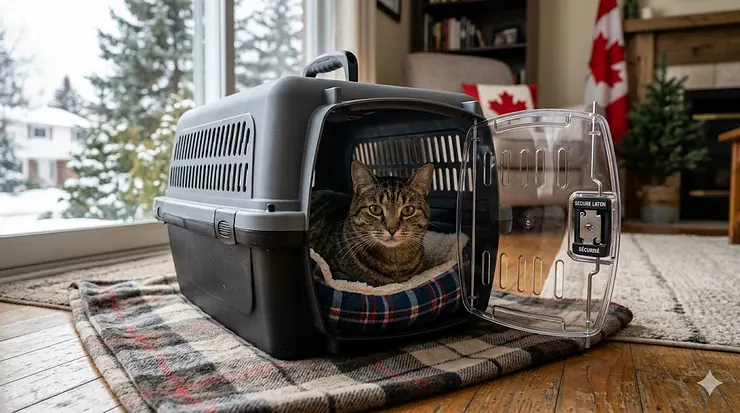
Does your cat vanish under the bed the moment they see their carrier? You’re not alone. Research shows that roughly 48 percent of Canadian cat owners skip annual vet visits, often because transporting their anxious feline feels overwhelming. But here’s what most people don’t realize: the right hard sided cat carrier for nervous cats can transform these stressful journeys into manageable experiences.
Hard sided carriers offer nervous cats something soft carriers can’t match—a solid, den-like enclosure that triggers their natural instinct to seek protected spaces during stress. When your cat retreats into a hard sided carrier, they’re surrounded by rigid walls that block visual stimuli and provide genuine security. This isn’t marketing fluff; veterinarians across Canada, including experts at VCA Canada Animal Hospitals, specifically recommend top-opening hard carriers for anxious cats because they eliminate the need to drag a frightened animal through a narrow front door.
The Canadian climate adds another layer to consider. During Edmonton’s -30°C winters or Vancouver’s torrential spring rains, a hard sided carrier maintains stable temperature and protection that soft fabric simply cannot provide. Salt spray from winter roads, extreme temperature swings, and the physical demands of trudging through snow—these Canadian realities make hard sided carriers not just preferable but essential for year-round pet transport.
Quick Comparison: Top Hard Sided Carriers for Anxious Cats
| Model | Size | Top Entry | Price Range (CAD) | Best For |
|---|---|---|---|---|
| IRIS USA 23″ Pet Carrier | Medium | ✅ Yes | $35-$50 | Budget-conscious owners |
| Amazon Basics Two-Door Top Load | 58 cm | ✅ Yes | $55-$75 | Easy access & value |
| SportPet Designs Foldable | Large | ✅ Yes | $45-$65 | Storage-limited homes |
| Petmate Top Load Kennel | 48 cm | ✅ Yes | $40-$60 | Vet-recommended design |
| MidWest Spree Travel | 48 cm | ✅ Yes | $38-$55 | Lightweight portability |
| Ferplast Atlas Top Opening | Multiple | ✅ Yes | $50-$80 | European quality build |
| Pet Gear No-Zip Entry | 51 cm | ❌ No | $80-$120 | Premium comfort |
Looking at this comparison, the Amazon Basics Two-Door Top Load delivers exceptional value under $75 CAD with both top and front access—crucial when your cat refuses to exit voluntarily. Budget buyers should note the IRIS USA model sacrifices nothing in quality despite its lower price point, while those willing to invest in the Pet Gear No-Zip get a premium experience that minimizes wrestling with zippers during high-stress moments. The key takeaway: top entry isn’t optional for nervous cats; it’s the difference between forcing an anxious animal through a narrow opening and gently lifting them out while they remain in the safety of the carrier bottom.
💬 Just one click — help others make better buying decisions too!😊
✨ Don’t Miss These Exclusive Deals!
🔍 Take your cat transport experience to the next level with these carefully selected products. Click on any highlighted item to check current pricing and availability on Amazon.ca. These carriers will help you create stress-free vet visits your feline will tolerate!
Top 7 Hard Sided Cat Carriers: Expert Analysis
1. IRIS USA 23″ Small Pet Travel Carrier
The IRIS USA 23″ carrier stands out as the budget champion without compromising on nervous cat essentials. This Japanese-engineered carrier features a completely removable top that swings open left or right—a thoughtful design element that matters when you’re working in tight spaces like a car back seat.
What the specifications won’t tell you is how this carrier handles Canadian winters. The hard plastic construction maintains integrity down to -40°C, unlike cheaper models that crack in extreme cold. At 4.4 kg (9.7 lbs) empty, it’s light enough for elderly owners or those managing mobility issues to carry comfortably from car to clinic. The spring-loaded latches lock firmly—important when nervous cats push against doors—yet release with one hand, crucial when you’re juggling keys and a frightened feline.
Canadian buyers particularly appreciate that this carrier accommodates cats up to 8.2 kg (18 lbs), slightly larger than advertised, according to reviews from Ontario and BC owners. The ventilation holes on three sides provide excellent airflow without creating drafts that chill cats during winter transport. One Calgary reviewer noted their anxious Persian stayed calmer in this carrier than previous soft-sided models because the solid walls blocked visual stimulation from passing cars.
Pros:
✅ Removable top swings both directions for flexible positioning
✅ Budget-friendly without sacrificing quality (around $35-$50 CAD)
✅ Collapsible design saves storage space in condos and apartments
Cons:
❌ Handle folds but doesn’t lock, can flip down unexpectedly
❌ No tie-down slots for securing to car seats
The verdict: Best value for nervous cats under 8 kg who need basic, reliable protection. Canadian pricing typically runs $10-$15 lower than equivalent American models when accounting for exchange rates, making this an exceptional deal on Amazon.ca.
2. Amazon Basics 2-Door Top-Load Pet Carrier
Amazon Basics brings corporate reliability to pet transport with this veterinarian-recommended design that’s become ubiquitous in Canadian clinics for good reason. The 58 cm (22.8″) length accommodates cats up to 11 kg (24 lbs), including larger breeds like Maine Coons that often struggle with standard carriers.
Here’s what makes this carrier specifically suited for nervous cats: the top door is genuinely massive, removing completely rather than just opening. Your vet can examine your cat while they remain in the carrier bottom—a game-changer for anxious animals. Dr. Carter at CatVetLife specifically recommends this model because it allows gradual exposure; frightened cats can be assessed without forceful extraction. The metal door provides better ventilation than plastic grates, and cats can’t damage it by clawing, unlike mesh alternatives.
Canadian winter performance is solid. The grey and blue plastic resists UV degradation better than cheaper clear carriers that yellow and crack. Toronto buyers report this carrier handles years of weekly transport without structural issues. The textured handle provides grip even with wet or gloved hands—a detail Edmonton owners appreciate during icy parking lot transfers.
Assembly takes literally 60 seconds with no tools required. The four corner bolts tighten by hand, and reviewers from Quebec to BC confirm they stay secure even after hundreds of uses. At 4.5 kg (9.9 lbs), it’s marginally heavier than budget options but the durability justifies the weight. One Vancouver veterinary clinic exclusively stocks these for hospitalized cats because the removable top makes medication administration stress-free.
Pros:
✅ Completely removable top for maximum vet access
✅ Accommodates larger nervous cats up to 11 kg
✅ Industry-standard reliability backed by Amazon warranty
Cons:
❌ Bulkier footprint makes condo storage challenging
❌ Not collapsible like some newer models
Price-wise, expect $55-$75 CAD, positioning this as the sweet spot between budget and premium. For nervous cats requiring regular vet visits, the investment pays off in reduced handling stress for both you and your feline.
3. SportPet Designs Foldable Travel Carrier
SportPet Designs solves the storage dilemma that plagues urban Canadian cat owners. This carrier collapses to just 7.6 cm (3 inches) thick, sliding easily into closets, under beds, or behind furniture—perfect for Toronto condos where square footage costs premium dollars.
The engineering here addresses a specific nervous cat challenge: getting them home after a stressful vet visit when they’ve urinated in the carrier. The entire bottom tray slides out for cleaning without disassembling the unit. One Montreal owner described this as “life-changing” after their anxious Siamese consistently lost bladder control during transport. The waterproof bed is machine washable, and the hard plastic base wipes clean in seconds.
What surprised Canadian reviewers is how sturdy this carrier feels despite its collapsible design. The patented side-opening door is unusually wide, providing an alternative entry point when top-loading isn’t possible. The latches are spring-loaded metal—far more reliable than plastic clips that snap in cold weather. Halifax owners report this carrier survived Maritime winters without the latch failures that plagued their previous soft carriers.
Size-wise, it accommodates cats up to 11 kg (25 lbs) in the large model. The grey and teal colour scheme hides dirt better than white carriers, practical for Canadian winter slush and mud. Ventilation is exceptional with side panels featuring geometric cutouts rather than tiny holes, improving airflow without compromising security.
Pros:
✅ Collapses to 7.6 cm for space-saving storage
✅ Removable bottom tray simplifies accident cleanup
✅ Wide side door provides alternative access point
Cons:
❌ Slightly more expensive at $45-$65 CAD
❌ Collapsible mechanism requires care to avoid pinched fingers
Best for: Canadian apartment dwellers who need full-size carrier functionality without permanent storage commitment. The fold-flat design means you’re not dedicating closet space to a carrier used twice yearly.
4. Petmate Top Load Cat Kennel
The Petmate Top Load Kennel is what Canadian veterinarians hand clients when asked “which carrier should I buy?” Veterinarian-recommended across North America, this American-made carrier features the classic top-loading design that’s become the gold standard for nervous cat transport.
What sets Petmate apart is attention to stress-reduction details. The top door removes completely but also features a “partial open” position using adjustable screws, allowing gradual exposure for extremely anxious cats. One Calgary vet explained this lets frightened cats acclimate slowly rather than experiencing sudden full exposure. The 360-degree ventilation provides excellent airflow while the solid plastic walls block visual stimuli that trigger panic.
Canadian winters reveal quality: this carrier’s screw-and-hex-nut assembly stays tight through temperature cycling that loosens inferior designs. Saskatchewan owners report using these carriers for 5+ years without structural degradation. The handle is ergonomically curved and textured—crucial when transporting nervous cats who shift weight unpredictably. At 3.6 kg (7.9 lbs) empty for the 48 cm model, it’s lighter than most competitors without feeling flimsy.
The interior dimensions are genuinely spacious. The 48 cm (19″) model comfortably fits cats up to 10 kg (22 lbs), though Petmate conservatively rates it for 4.5 kg (10 lbs). This gives nervous cats room to turn around and assume their preferred defensive position—usually the meatloaf stance with paws tucked protectively underneath. BC owners appreciate that stressed cats can sprawl flat, a calming posture unavailable in cramped carriers.
Pros:
✅ Veterinarian-recommended design across Canada
✅ Adjustable top opening for gradual cat exposure
✅ American-made durability withstands years of use
Cons:
❌ Conservative weight rating undersells actual capacity
❌ Available colours (purple, pink, green) not everyone’s aesthetic
Pricing runs $40-$60 CAD depending on size and colour. Purple models often cost $5-$10 less than neutral tones—something to consider if budget is tight. For nervous cats requiring frequent vet visits, the Petmate’s durability makes it cheaper long-term than replacing budget carriers annually.
5. MidWest Spree Travel Carrier
MidWest Spree targets weight-conscious owners—and we mean the carrier’s weight, not yours. At just 1.95 kg (4.3 lbs) for the 48 cm model, this is the lightest hard sided carrier that maintains structural integrity for nervous cats.
This matters more than specifications suggest. Canadian seniors, people with shoulder injuries, and those managing chronic pain conditions can transport cats without aggravating physical limitations. One Ottawa owner with arthritis noted this carrier “doesn’t punish me for loving my cat,” a sentiment echoed across Canadian reviews. The lightweight construction uses aerospace-inspired materials—thin but rigid plastic reinforced at stress points.
Don’t mistake light weight for weakness. The carrier accommodates cats up to 9 kg (20 lbs) and features unusually robust latches for its weight class. The top opens completely, swinging away on integrated hinges rather than detaching—this prevents the classic fumbling-with-loose-lid problem when handling a stressed cat. Manitoba owners appreciate that the hinged design means the top can’t blow away in prairie winds during parking lot transfers.
Ventilation is where MidWest overdelivers. The entire front door is wire mesh rather than plastic with holes, maximizing airflow critical during Canadian summers when car temperatures spike. The mesh is coated steel, resistant to rust from winter road salt exposure. Thunder Bay owners report multi-year use without the corrosion that plagues inferior metal components.
The bright red colour has a practical advantage: it’s visible in winter darkness and snow, preventing the “where did I put the carrier” panic in cluttered garages. Some Canadian buyers prefer neutral tones, but the visibility serves a safety function during early morning winter vet appointments when visibility is limited.
Pros:
✅ Exceptionally lightweight at 1.95 kg for mobility-limited owners
✅ Wire mesh door maximizes ventilation during warm weather
✅ Hinged top prevents losing pieces during stressful moments
Cons:
❌ Bright red colour not everyone’s preference
❌ No side door—top and front access only
Expect $38-$55 CAD, making this competitively priced for its weight class. Best suited for Canadian owners who prioritize easy carrying over storage compactness, particularly those managing health conditions that make heavy lifting challenging.
6. Ferplast Atlas Top Opening Carrier
Ferplast Atlas brings Italian engineering to Canadian cat transport, and it shows in details competitors overlook. Available in multiple sizes from extra-small to large, this carrier range accommodates everything from 3 kg kittens to 12 kg Maine Coons—rare versatility in hard sided carriers.
The Italian design philosophy prioritizes smooth surfaces and rounded edges, reducing injury risk for nervous cats who thrash during loading. The top door features Ferplast’s proprietary locking system with four corner latches instead of the standard two, distributing force more evenly. One Vancouver vet noted this design prevents the top-corner failures seen in other carriers when anxious cats push forcefully upward.
Canadian winter testing reveals thoughtful engineering. The hard plastic blend remains flexible at -30°C without cracking, while maintaining rigidity at +35°C without warping. Alberta owners report these carriers surviving trunk storage through temperature extremes that destroyed cheaper alternatives. The ventilation holes are strategically positioned to prevent direct drafts while maintaining airflow—nervous cats stay comfortable without wind chill during winter transport.
The colour options (purple, blue, green) feature UV-resistant pigments that don’t fade despite Canadian sun exposure. This matters for longevity; faded carriers look shabby and may indicate plastic degradation. The integrated handle includes soft-grip material that doesn’t harden in cold weather—a detail Montreal owners specifically praise for winter use.
Size selection is critical with Ferplast: the Atlas 10 suits cats under 5 kg, Atlas 20 for 5-8 kg cats, and Atlas 30 for larger breeds. Don’t size up excessively; nervous cats prefer snug spaces over roomy enclosures. One Toronto behaviorist recommends choosing the smallest size your cat fits comfortably, as excess space amplifies sliding and increases stress during transport.
Pros:
✅ Italian quality engineering with attention to detail
✅ Multiple sizes accommodate all cat breeds
✅ Four-corner latch system prevents top separation
Cons:
❌ Premium pricing at $50-$80 CAD depending on size
❌ Less common on Amazon.ca; availability varies by region
Best for Canadian owners who prioritize quality and plan to use the carrier for a decade-plus. The higher upfront cost amortizes to excellent value for cats requiring frequent transport, particularly if you value European design aesthetics.
7. Pet Gear No-Zip Entry
The Pet Gear No-Zip Entry represents premium hard sided transport, though calling it “hard sided” requires nuance—it’s technically semi-rigid with reinforced frame construction. This hybrid approach addresses the top complaint about traditional hard carriers: zipper failures during high-stress loading.
Pet Gear eliminated zippers entirely, using instead a push-button entry system that snaps open and closed reliably even when cats push against doors. Nervous cats can’t claw through plastic zippers or force teeth apart—common failures with hybrid carriers. One Calgary owner who’d destroyed three soft carriers in two years reported zero issues after switching to the No-Zip design.
The carrier features a removable top with steel frame reinforcement, maintaining structure while weighing substantially less than solid plastic equivalents. At 3.2 kg (7 lbs), it splits the difference between lightweight soft carriers and heavy traditional hard sides. The 51 cm (20″) length accommodates cats up to 9 kg (20 lbs) comfortably, with enough height for cats to sit naturally rather than crouch.
Canadian buyers praise the mesh ventilation panels that provide 360-degree visibility and airflow. For nervous cats, this is controversial—some veterinarians recommend blocking visibility to reduce stress, while others argue cats prefer seeing their environment. The included privacy cover resolves this: drape it over three sides for den-like security, remove it for transport visibility. One Ottawa owner uses the cover during car rides but removes it in waiting rooms, finding their anxious tabby calms faster when able to monitor surroundings.
The waterproof base is genuinely impermeable, not just water-resistant. Canadian reviewers confirm it contains urine, vomit, and diarrhea without leakage—crucial for nervous cats prone to stress-induced accidents. The entire base removes for hosing down, making cleanup trivially easy.
Pros:
✅ No-zip design eliminates most common carrier failure point
✅ Privacy cover allows customized visibility control
✅ Waterproof base contains inevitable stress-related accidents
Cons:
❌ Premium pricing at $80-$120 CAD strains budgets
❌ Semi-rigid construction less protective than solid hard sides
This carrier suits Canadian owners who transport nervous cats frequently enough to justify premium pricing, particularly those exhausted by zipper failures and carrier replacements. If your cat’s anxiety leads to destructive behaviour or accidents, the No-Zip design solves problems cheaper carriers can’t address.
Reducing Vet Visit Stress: A Canadian Veterinarian’s Perspective
Canadian veterinarians have observed something troubling: cats visit vets half as often as dogs, primarily because transport stress convinces owners to skip non-emergency care. Dr. Lisa Bales, a feline specialist at VCA Canada Animal Hospitals, explains that carrier choice directly impacts whether Canadian cats receive adequate preventive care.
The Top-Loading Advantage for Anxious Cats
Traditional front-entry carriers force you to wrestle reluctant cats through narrow openings. With top-loading hard sided carriers, you simply place the carrier on the floor, open the top, and wait. Most cats eventually investigate the carrier if left open as furniture in your home. One Alberta veterinarian shared this technique: “Leave the carrier beside their food bowl for a week. Feed them inside it. When transport day arrives, they’ll enter willingly because it smells like food and safety.”
The Canadian climate influences this strategy. During winter months when cats spend more time indoors, carrier habituation is easier—the carrier becomes part of their territory rather than an intrusion. Toronto behaviourists recommend starting carrier training in November, preparing cats for winter vet appointments when ice and snow already elevate stress levels.
Managing Temperature During Canadian Seasons
Canadian temperature extremes require specific carrier management. During summer, never leave carriers in direct sun—even briefly. Hard plastic carriers in 30°C vehicles can reach 60°C+ internally within 15 minutes, creating dangerous conditions for anxious cats already stressed and panting. Saskatchewan owners should use sun shades on carriers during prairie summer transport.
Winter presents opposite challenges. Carriers stored in freezing garages should be warmed indoors before use—placing a cat in a -20°C carrier triggers immediate stress responses. Maritime owners report success with battery-powered heated pads placed in carriers 20 minutes before departure, creating comfortable nest temperature. Never use plug-in heating devices; battery models avoid burn risks.
The CFIA’s Role in Canadian Pet Transport
Many Canadian cat owners don’t realize the Canadian Food Inspection Agency (CFIA) regulates pet transport under the Health of Animals Regulations. While enforcement primarily targets commercial operations, the regulations establish humane transport standards applicable to all Canadians traveling with pets.
The CFIA requires carriers to be appropriately sized, secure, and provide adequate ventilation. For nervous cats, these regulations offer helpful guidelines: carriers must allow cats to stand naturally, turn around, and lie down comfortably. Many budget carriers sold online don’t meet these standards—another reason to invest in properly designed hard sided carriers from reputable manufacturers.
How to Choose the Right Hard Sided Carrier in Canada
Canadian cat owners face decision paralysis when confronting dozens of carrier options on Amazon.ca. Let’s cut through marketing claims with practical selection criteria that actually matter for nervous cats.
Size Selection: Bigger Isn’t Better
Conventional wisdom suggests buying oversized carriers for comfort, but nervous cats disagree. Veterinary behaviourists explain that anxious cats seek enclosed spaces that match their body size—excess room amplifies disorientation during transport. Dr. Sarah Wooten, a Canadian veterinary expert, recommends this test: your cat should stand comfortably and turn around, but not much more. A 5 kg cat needs a different carrier than a 10 kg Maine Coon.
Canadian carriers typically use centimetre dimensions: 48 cm suits cats under 6 kg, 58 cm for 6-10 kg cats, and 70 cm for cats over 10 kg. Don’t apply dog-carrier logic to cats—their spatial needs differ fundamentally. One Hamilton owner discovered their anxious Persian calmed dramatically after downsizing from a large to medium carrier, validating the snug-is-better principle.
Top-Entry vs. Side-Entry: Why Top Wins for Anxious Cats
Side-entry carriers require extracting nervous cats horizontally, triggering defensive responses—claws extend, bodies stiffen, and even docile cats become difficult. Top-entry carriers leverage gravity and cat psychology. Lowering a cat downward into the carrier mimics their natural descent into hiding spots. Lifting them out vertically is less threatening than pulling them forward.
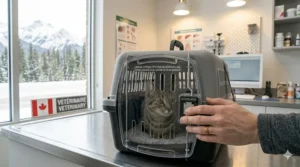
VCA Canada Animal Hospitals specifically recommends top-opening carriers because veterinarians can examine cats while they remain in the carrier bottom. Your anxious tabby stays in their “safe zone” during temperature checks, abdominal palpation, and even some vaccinations. This reduces stress so dramatically that some Canadian vets refuse to work with front-entry carriers for fractious cats.
Material Durability for Canadian Climates
Not all plastics withstand Canadian temperature cycling. Premium carriers use high-density polyethylene (HDPE) or polypropylene that remains flexible at -40°C and rigid at +40°C. Budget carriers often use cheaper ABS plastic that becomes brittle in cold, cracking during winter use. Check product specifications—if the manufacturer doesn’t specify plastic type, assume it’s budget-grade ABS.
UV resistance matters for Canadian summers, particularly in Prairie provinces where UV index peaks at 11+. UV-degraded plastic yellows, becomes brittle, and eventually fails. Quality carriers include UV stabilizers; cheaper ones degrade within 2-3 years of outdoor exposure. One Winnipeg owner learned this expensively when their carrier shattered during -35°C transport after summer UV degradation weakened the structure.
Ventilation vs. Privacy: Finding the Balance
Nervous cats present a paradox: they need airflow but also visual security. The optimal design provides 360-degree ventilation through small holes while maintaining solid walls that block most visual stimuli. Large mesh panels that expose cats to full environmental visibility often amplify anxiety rather than reduce it.
Canadian buyers should prioritize ventilation holes under 2 cm diameter—large enough for airflow, small enough to prevent paws getting stuck. Side ventilation matters more than front ventilation; anxious cats orient toward carrier backs, meaning side airflow reaches them better. One Montreal veterinary behaviourist recommends covering carrier fronts with towels during transport, maintaining airflow through sides while blocking forward vision that triggers stress.
Common Mistakes When Buying Hard Sided Carriers
Canadian first-time buyers consistently make preventable errors that compromise carrier effectiveness. Learning from others’ mistakes is cheaper than replacing unsuitable carriers.
Mistake #1: Choosing Carriers Based on Human Aesthetics
That beautiful designer carrier in seafoam green might look stunning in your condo, but does it open from the top? Does it have sufficient ventilation? Canadian buyers often prioritize appearance over function, then struggle with impractical carriers. One Vancouver owner admitted buying a gorgeous wicker-style carrier that cracked during her first winter, learning that aesthetics don’t survive Canadian climate realities.
Function trumps fashion for nervous cat transport. The ugly purple Petmate carrier that’s been discontinued because it’s “not trendy” often outperforms beautiful alternatives mechanically. If budget allows, buy two carriers: a practical hard sided carrier for vet visits and a soft-sided designer carrier for low-stress uses like visiting friends.
Mistake #2: Ignoring Canadian Shipping Realities
Amazon.ca prices fluctuate dramatically, and many “Canadian” listings actually ship from US warehouses. Canadian buyers pay currency exchange, customs duties, and international shipping—often adding 40-60% to displayed prices. One Saskatchewan buyer ordered a $45 carrier that cost $72 CAD after fees, discovering too late that identical models were available from Canadian warehouses for $55 including free shipping.
Always verify shipping origin before purchasing. Look for “Ships from Amazon.ca” or “Fulfilled by Amazon.ca” rather than “International shipping available.” Canadian-warehoused products arrive faster (2-3 days vs. 2-3 weeks), avoid customs delays, and include simpler returns. Remote areas like Yukon and Northwest Territories particularly benefit from domestic shipping, as international parcels to northern Canada often face multi-week delays.
Mistake #3: Buying Too Large “For Growth”
Kittens grow, but buying oversized carriers for future use backfires. A 3 kg kitten in a carrier designed for 10 kg cats experiences frightening disorientation during transport—sliding, tumbling, and associating the carrier with scary helplessness. One Ottawa owner bought a large carrier for their kitten, planning to use it for years. The kitten developed such carrier phobia they ultimately needed a veterinary behaviourist intervention costing far more than buying appropriately sized carriers during growth stages.
Kittens need kitten-sized carriers. Yes, you’ll upgrade as they mature, but the alternative is a cat who panics at carrier sight for their entire life. Budget-conscious Canadian buyers can purchase used carriers from local Facebook groups or Kijiji—hard plastic carriers last decades and sanitize easily with bleach solution.
Mistake #4: Skipping the Home Trial Period
Amazon.ca returns are straightforward, yet Canadian buyers hesitate to use them. Purchase your chosen carrier, place it open in your home for 2-3 days, and observe your cat’s reaction. Do they investigate willingly? Does the size look appropriate? Can you open the top easily while holding your cat? If anything feels wrong, return it—the minor hassle prevents years of struggling with unsuitable equipment.
One Toronto owner tested three carriers before finding one her anxious Siamese tolerated. The first two went back to Amazon within days; the third has now served five years. That trial period saved her from owning mediocre carriers and ensured her cat received proper veterinary care without transport trauma.
Preparing Your Nervous Cat for Carrier Use
Canadian veterinary behaviourists agree: carrier training reduces transport stress more effectively than any sedative or pheromone spray. The hard sided carrier sitting unused in your garage should become familiar furniture in your living space.
The Two-Week Desensitization Protocol
Start carrier introduction two weeks before your vet appointment. Place the carrier in your main living area with the top door open. Don’t force interaction—just leave it accessible. Most cats investigate new objects within 24-48 hours. One Calgary behaviourist explains that cats need to scent-mark carriers as territory before accepting them as safe spaces.
Week one focuses on passive exposure. Feed treats beside the carrier, gradually moving them closer to the entrance, then inside. Use high-value treats—freeze-dried salmon or shrimp, not regular kibble. Canadian owners can purchase freeze-dried treats specifically designed for training from most pet stores; these are more effective than standard grocery-store options.
Week two introduces active use. Feed meals inside the carrier with the top open. Most cats will enter freely for food if they’ve been investigating the carrier all week. One Vancouver owner reported success feeding breakfast inside the carrier every morning; by day 10, their anxious Persian slept in the carrier voluntarily.
Managing the Actual Vet Visit
Canadian winter vet appointments present unique challenges. Never leave carriers in freezing vehicles—bring them inside to warm up first. The shock of entering a cold carrier can undo weeks of training. One Edmonton owner keeps a battery-powered heated pad in her carrier during winter months, creating appealing warmth that anxious cats seek out.
Alberta Animal Health Source recommends scheduling the earliest morning appointments to avoid crowded waiting rooms. Canadian clinics typically see fewer patients at 8:00 AM openings, reducing exposure to barking dogs and unfamiliar animals that spike feline anxiety. Some Toronto clinics now offer cat-only hours—worth seeking out for extremely nervous cats.
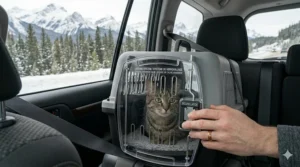
Transport the carrier horizontally, not tilted. Sliding and imbalance amplify stress during car rides. Canadian owners should secure carriers with seatbelts through built-in slots, preventing the sliding that occurs during typical city driving stop-and-go patterns. Never place carriers on seats without securing them; even gentle braking sends unsecured carriers sliding forward.
Post-Visit Stress Management
Your cat may smell different after vet visits due to clinic scents, triggering redirected aggression from other household cats. Canadian multi-cat households should implement a brief separation period after vet visits. One Ottawa owner with three cats discovered this the hard way when her unvisited cats attacked their returning sibling, mistaking clinic smells for a foreign cat.
Separate the returning cat in a quiet room with food, water, and their litter box for 2-4 hours. This allows clinic scents to dissipate while the stressed cat decompresses. Some Canadian behaviourists recommend rubbing all household cats with the same towel after the separation period, redistributing familiar colony scent. This technique, validated through behavioural research, prevents the confusion that leads to inter-cat aggression.
Hard Sided Carriers vs. Soft Sided Carriers
Canadian buyers constantly debate this choice. Both carrier types serve legitimate purposes, but for nervous cats specifically, hard sided carriers deliver advantages soft alternatives cannot match.
Structural Integrity for Anxious Behaviour
Nervous cats claw, bite, and throw themselves against carrier walls during panic episodes. Soft carriers, regardless of quality, eventually fail under this assault. Mesh tears, zippers break, and seams separate—each failure point represents potential escape during transport. One Manitoba owner watched helplessly as her anxious cat clawed through mesh during highway transport, creating a dangerous situation requiring immediate roadside intervention.
Hard sided carriers contain panic behaviours. Plastic walls absorb scratching and biting without degradation. The worst an anxious cat can accomplish is marking plastic with claw scratches—concerning aesthetically but irrelevant functionally. Metal door latches don’t fail like plastic zippers. For cats with documented escape history or severe anxiety, hard sided construction isn’t a preference—it’s a safety requirement.
Temperature Regulation in Canadian Extremes
Soft carriers provide minimal insulation against Canadian temperature extremes. Fabric transmits cold efficiently; cats in soft carriers during -20°C winter transport experience significant chill despite being inside vehicles. Hard plastic carriers create an air barrier that moderates temperature transfer. One Thunder Bay owner noted her cat arrived at the vet shivering in a soft carrier, prompting a switch to hard sided transport that resolved the issue completely.
Summer heat presents opposite challenges. Soft carriers in hot vehicles can cook cats quickly due to poor ventilation and heat-absorbing fabric. Hard sided carriers with proper ventilation holes maintain better airflow. The plastic reflects some solar heat that fabric absorbs, though neither carrier type should remain in direct sun during warm weather.
Cleaning After Stress-Induced Accidents
Nervous cats frequently urinate, defecate, or vomit during transport. Soft carriers absorb fluids into fabric and padding, requiring machine washing that often doesn’t fully eliminate odours. After three or four accidents, soft carriers typically remain permanently odorous despite cleaning attempts. Canadian owners with front-loading washing machines face additional challenges—many soft carriers don’t fit in compact urban washer drums.
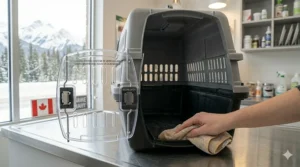
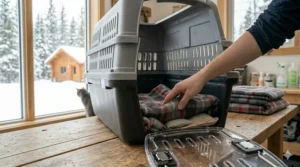
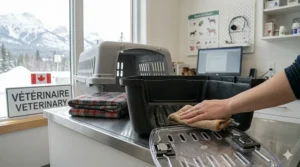
Hard sided carriers wipe clean in literally 60 seconds. Remove the bedding, spray the plastic with pet-safe disinfectant, wipe, rinse, done. The waterproof base contains accidents completely without seepage. One Montreal owner described this as “life-changing” after years of laundering soft carriers and ultimately discarding them due to persistent odours.
❓ Frequently Asked Questions
❓ Can I use a hard sided carrier for airline travel within Canada?
❓ How do I clean a hard sided carrier after my cat has an accident?
❓ Do I need a different carrier for Canadian winters vs. summers?
❓ Will top-loading carriers work if my cat is extremely aggressive?
❓ Are there crash-tested hard sided carriers available in Canada?
Conclusion: Choosing Your Cat’s Perfect Travel Companion
Hard sided carriers for nervous cats represent more than transport equipment—they’re stress-reduction tools that enable proper veterinary care for anxious felines. Canadian cat owners face unique considerations: extreme temperature swings, long distances between urban centres, and winter conditions that demand durable, reliable carriers.
The Amazon Basics 2-Door Top-Load delivers the best overall value for most Canadian nervous cat owners, balancing functionality, durability, and price under $75 CAD. Budget-conscious buyers should consider the IRIS USA 23″ model, while those prioritizing lightweight portability will appreciate the MidWest Spree. Premium buyers investing in long-term solutions should examine the Pet Gear No-Zip Entry, despite its higher price point.
Remember that the carrier itself is just one element of stress-free transport. Gradual desensitization, proper securing during transport, and understanding your individual cat’s anxiety triggers matter as much as equipment selection. Canadian veterinarians emphasize that skipped vet visits due to transport stress shorten cats’ lives—proper carrier investment and training literally save lives through enabled preventive care.
Recommended for You
- 7 Best Airline Approved Cat Carriers Canada 2026
- How to Switch Cat Litter Types: 7 Proven Methods for Canada 2026
- Pine Pellet Cat Litter: 7 Best Natural Options Canada 2026
Disclaimer: This article contains affiliate links. As an Amazon Associate, I earn from qualifying purchases. If you purchase products through these links, we may earn a small commission at no additional cost to you.
✨ Found this helpful? Share it with your friends! 💬🤗
