
In This Article
Damage-free cat proofing for renters means protecting furniture, walls, and floors from claw marks and accidents using removable, adhesive-free, or non-permanent products that leave no trace when you move out — no drilling, no screws, no sticky residue. If you’ve ever stared at a fresh scratch on your rental’s hardwood floor and mentally said goodbye to part of your damage deposit, you already know why this matters.
Renting with a cat in Canada is its own particular obstacle course. You’re juggling a curious, claw-equipped roommate against landlord inspections, move-out checklists, and the very real possibility of losing money you’ll never see again. The good news: you don’t have to choose between “happy cat” and “happy landlord.” A growing category of removable, adhesive-free cat deterrents lets you redirect scratching behaviour and prevent damage without touching drywall, varnish, or your lease agreement.
This guide walks through seven real products available on Amazon.ca, how to match them to your specific apartment and cat, and the Canadian rental rules that make “damage-free” more than just a nice-to-have.
Quick Comparison Table
| Product | Type | Price Range (CAD) | Amazon.ca Prime | Best For |
|---|---|---|---|---|
| FixZilla Anti-Scratch Furniture Protector | Self-adhesive vinyl sheets | $15–$25 | Yes | Couch corners, sofa arms |
| Polarduck Anti-Cat Scratch Tape | Double-sided clear tape | $10–$18 | Yes | Carpet edges, door frames |
| CLAWGUARD Plexiglass Scratch Shield | Rigid clear panel | $30–$45 | Yes | Doors, high-traffic walls |
| PetSafe SSSCAT Spray Deterrent | Motion-activated spray | $45–$65 | Yes | Counters, off-limits rooms |
| FELIWAY Classic Starter Kit | Pheromone diffuser | $35–$50 | Yes | Stress-related scratching |
| Amazon Basics Sisal Scratching Post | Freestanding scratcher | $30–$55 | Yes | Redirecting claw behaviour |
| HugsandTails Doorway Carpet Protector | Clear PVC runner | $20–$35 | Yes | Carpeted doorways, hallways |
Looking at this lineup, the cheapest fix (tape and vinyl sheets) only treats the symptom — it blocks one specific surface — while the pricier options like the SSSCAT and FELIWAY diffuser work on the underlying behaviour, which matters more if your cat scratches in unpredictable new spots every few weeks. Renters with a single problem zone (one couch corner, one carpet edge) get the best value-per-dollar from the tape and vinyl protectors, while multi-room or anxiety-driven scratchers justify the higher upfront cost of a behavioural product.
💬 Just one click — help others make better buying decisions too! 😊
✨ Don’t Miss These Exclusive Deals!
🔍 Take your damage-free cat proofing setup to the next level with these carefully selected products. Click on any highlighted item to check current pricing and availability on Amazon.ca. These tools will help you protect your security deposit and your cat’s happiness!
Top 7 Damage-Free Cat-Proofing Products: Expert Analysis
1. FixZilla Anti-Scratch Furniture Protector (10-Pack)
This kit ships with seven 17×12″ panels and three corner-sized pieces, enough to cover a sofa’s most vulnerable spots in one go. The self-adhesive backing peels off without leaving the gummy residue that makes landlords twitchy, and the panels are designed to defend upholstery against clawing and scratching without leaving residue when removed. What most renters miss: it’s explicitly not rated for leather, faux leather, or velvet — apply it to the wrong material and you risk a dull patch instead of a clean removal. Best for: tenants with one or two “problem” scratching zones on a fabric couch.
✅ Residue-free removal ·
✅ Cuttable to size ·
✅ Prime-eligible
❌ Not for leather/velvet ·
❌ Visible at close range Price: around $15–$25 CAD — solid value for spot protection.
2. Polarduck Anti-Cat Scratch Tape
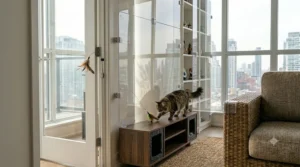
This is the renter’s duct tape: a 4-inch by 30-yard roll of double-sided clear tape that cats reflexively avoid because of the sticky texture on their paws. Run a strip along a carpet edge, stair runner, or door frame and it disappears visually while doing its job. The real-world insight here is that double-sided tape was specifically named by Canadian veterinary authorities as a recommended alternative to declawing, alongside spray deterrents and positive reinforcement — so this isn’t just a cheap hack, it’s a vet-endorsed redirect tool. Best for: carpeted hallways and stairs in older walk-up apartments.
✅ Cheapest option on this list ·
✅ Cut-to-length ·
✅ No tools needed
❌ Needs reapplication every few weeks ·
❌ Can lift carpet fibres on removal Price: around $10–$18 CAD.
3. CLAWGUARD Plexiglass Universal Scratch Shield
A rigid 32×24″ clear acrylic panel that mounts with adhesive strips or light-touch hooks rather than screws. Where flexible tape and vinyl sheets eventually peel at the edges, a plexiglass shield holds its shape against repeated, aggressive scratching — which matters if your cat is a “door-scratcher” who wants out the moment you leave for work. Because it’s rigid, it also resists the curling-at-the-corners look that ruins the aesthetic of cheaper
tape products after a Canadian winter’s worth of dry indoor heat. Best for: apartment doors and high-traffic wall corners.
✅ Long-lasting ·
✅ Nearly invisible ·
✅ Reusable if you move
❌ Pricier than tape options ·
❌ Heavier, slightly trickier to apply solo Price: around $30–$45 CAD.
4. PetSafe SSSCAT Motion-Activated Spray Deterrent
This battery-powered unit detects motion within roughly a metre and releases a short, odourless burst of spray that startles the pet without leaving stains or residue on furniture. Rather than protecting one surface, it teaches your cat to avoid an entire zone — a kitchen counter, a houseplant corner, a closet you don’t want pawed open. This is the product to reach for when your cat keeps finding new spots to scratch rather than fixating on one couch arm. Canadian winters mean more indoor time and more boredom-driven mischief, so a counter-training tool like this earns its keep from November through March.
✅ Trains behaviour, not just one surface ·
✅ No mess ·
✅ Refillable cans
❌ Runs on 4 AAA batteries (not included) ·
❌ Can trigger on people walking past Price: around $45–$65 CAD.
5. FELIWAY Classic Starter Kit
Unlike the mechanical deterrents above, this plug-in diffuser works on the cause rather than the symptom. It releases a synthetic copy of the feline facial pheromone, and the manufacturer reports that 9 out of 10 cat parents noticed reduced urine spraying and 8 out of 10 saw reduced scratching after use. What the spec sheet won’t tell you: stress-driven scratching often spikes during moves, renovations, or a new roommate — exactly the disruptions renters deal with constantly. If your cat’s scratching tracks with life changes rather than boredom, this is the more targeted fix.
✅ Treats anxiety-related scratching ·
✅ Covers up to 70 m² ·
✅ Non-sedating
❌ Doesn’t help claw-conditioning scratching ·
❌ Refill needed monthly Price: around $35–$50 CAD for the starter kit.
6. Amazon Basics Sturdy Cat Scratching Post
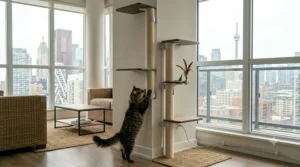
A freestanding sisal-wrapped post with a wide, weighted wood base — no wall mounting, no drilling, no anchors. The point isn’t just deterrence; it’s redirection, since scratching helps cats maintain claw conditioning, stretch their whole body, and mark territory both visually and by scent, meaning a determined scratcher needs an acceptable outlet, not just a blocked one. Placing this near (not instead of) your protected furniture gives your cat a legitimate “yes” to balance every “no.” Best for: any renter whose cat hasn’t yet been offered a proper scratching surface.
✅ Zero installation ·
✅ Portable between apartments ·
✅ Doubles as a behaviour fix
❌ Takes floor space ·
❌ Some cats need encouragement to switch surfaces Price: around $30–$55 CAD depending on height.
7. HugsandTails Doorway Carpet Protector
A clear, cut-to-fit PVC runner built specifically as a doorway damage deterrent and scratch-stopper for cats and dogs rather than a generic floor mat. Doorway carpet is a classic casualty in rental units — cats scratch at thresholds wanting through, and that high-traffic strip wears fast even without claws involved. This product sits loose (no adhesive, no tacks), so it lifts away cleanly at move-out with zero trace on the carpet underneath.
✅ No adhesive at all ·
✅ Cut to exact doorway width ·
✅ Doubles as wear protection
❌ Can shift slightly without anti-slip backing ·
❌ Visible if not trimmed neatly Price: around $20–$35 CAD.
Practical Usage Guide
Getting the most out of any cat-proofing product comes down to placement and patience, not brute force. Start by watching your cat for a week before buying anything — note exactly which corners, doorframes, or counters get targeted, since blanket-covering your whole apartment wastes money and annoys your cat unnecessarily. Apply adhesive products (tape, vinyl sheets) to a clean, dry surface; humidity from a Canadian winter’s indoor heating can weaken adhesive bonds within days if the surface isn’t properly wiped down first.
For motion-activated sprays, place the unit at cat height, not human height, or you’ll get false triggers every time you walk past — a common complaint that traces back to incorrect placement rather than a faulty unit. Pair every deterrent with a “yes” surface (a scratching post or pad) placed within a metre or two; deterrents alone tend to just relocate the problem to the next-nearest surface. Finally, when you eventually move out, remove all adhesive products slowly and at a slight angle rather than peeling straight up — this single habit prevents the paint-lift or fabric-snag damage that turns a “damage-free” product into an accidental security-deposit risk.
Real-World Scenario: Three Canadian Renters
The Toronto condo dweller with a 700-square-foot one-bedroom and a single cat who scratches the same hallway closet door nightly is the textbook case for the CLAWGUARD plexiglass shield paired with a scratching post nearby — rigid, durable, and able to survive nightly contact without curling.
The Vancouver basement-suite tenant sharing carpeted stairs with a downstairs neighbour benefits most from the double-sided tape on stair edges plus a FELIWAY diffuser, since shared walls and floors in older character homes often mean noise-sensitive cats acting out through scratching.
The Ottawa family in a townhouse with two cats and a toddler-proofed living room should lean on the SSSCAT spray deterrent for the kitchen counter and a freestanding scratching post in the living room — multi-cat households scratch more unpredictably, so a behaviour-training tool beats spot-treating individual surfaces one at a time.
How to Choose Damage-Free Cat Proofing in Canada
- Identify the scratch pattern first. One fixed spot calls for tape or vinyl sheets; multiple unpredictable spots call for a spray deterrent or scratching post.
- Check your lease’s pet clause before buying anything semi-permanent. Even removable products can raise questions at inspection if a landlord wasn’t told a cat lives there.
- Match the product to the surface material. Leather and suede need different solutions than fabric or carpet — check labels, since several of these products explicitly exclude leather.
- Budget for the behaviour fix, not just the barrier. A $200-furniture-protector habit beats a $30 scratching post your cat actually uses.
- Factor in Canadian winters. Indoor heating dries out adhesives and stresses cats with less outdoor stimulation, often spiking scratching from November to March.
- Plan your move-out removal in advance. Test-remove a small adhesive patch in an inconspicuous spot before committing to cover an entire couch arm.
- Talk to your landlord, not just your lease. A quick heads-up that you’re using removable protectors (not making permanent changes) heads off move-out disputes before they start.
Common Mistakes When Cat-Proofing a Rental
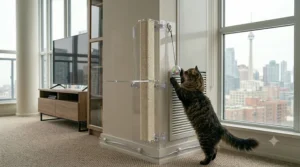
The single biggest mistake renters make is treating deterrents as a one-time purchase rather than an ongoing behaviour project — tape loses stickiness, plexiglass shields need occasional cleaning, and motion sensors need fresh batteries, so a “set and forget” mindset usually means the cat finds the next unprotected surface within weeks. A second common error is skipping the scratching-post step entirely; scratching is a normal feline behaviour used for claw maintenance and whole-body stretching, so blocking it everywhere without an alternative outlet just relocates the problem. Renters also frequently rip off adhesive products too aggressively at move-out, risking exactly the paint or varnish damage they were trying to avoid — always test removal speed and angle on a hidden spot first. Finally, many tenants assume “no holes” automatically means “no dispute,” but Canadian landlords assess wear and tear during move-in and move-out inspections, and the government’s own consumer guidance recommends documenting and photographing any visible damage at both inspections — so keep your own photo record regardless of how careful you’ve been.
Canadian Renters’ Rights and Damage Deposits
Security deposit rules vary significantly by province, which matters enormously for cat owners weighing how much to invest in prevention versus risk. According to Canada’s federal consumer guidance, a security deposit generally can’t exceed the cost of one month’s rent, and tenants should document and photograph any visible damage during move-in and move-out inspections with the landlord present. Some provinces, like British Columbia and Alberta, allow a separate pet damage deposit on top of the standard deposit, while Ontario prohibits damage deposits altogether and limits landlords to a rent-only deposit — so what counts as “at risk” if your cat scratches the wall varies depending on where in Canada you live. This is exactly why damage-free, removable products matter more for renters than for homeowners: there’s no universal Canadian standard protecting your deposit from claw damage, only a patchwork of provincial tenancy boards, and prevention is cheaper than a dispute.
It’s also worth knowing that scratching itself is considered a normal, even necessary, feline behaviour rather than a “fixable” flaw — the Canadian Veterinary Medical Association has gone as far as opposing declawing as a solution, noting that claws assist cats with balance, climbing, and self-defence, and that scratching helps with claw conditioning and territory marking. Framed that way, damage-free deterrents aren’t a workaround for a “bad cat” — they’re the renter-friendly middle ground between an unprotected apartment and an invasive surgical fix that’s already restricted in several Canadian provinces and opposed by the national veterinary association.
What to Expect: Real-World Performance in Canadian Conditions
Indoor heating during a Prairie or Maritime winter dries out adhesives faster than manufacturers’ lab tests usually account for — expect tape and vinyl sheets to need reapplication every 3–4 weeks indoors during heating season, versus 6–8 weeks in milder shoulder seasons. Cats also tend to scratch more in winter simply because there’s less outdoor stimulation and more boredom, which is the practical reason a behavioural tool like FELIWAY or a scratching post often outperforms a purely physical barrier over a full Canadian year. In humid summer apartments without air conditioning (common in older Montreal and Toronto walk-ups), check adhesive products more often too, since humidity can loosen backing just as readily as dry winter air can.
Long-Term Cost in CAD
Spending $15–$25 CAD on tape or vinyl sheets every month adds up to $180–$300 CAD a year if you’re constantly re-protecting the same spot — compare that to a one-time $30–$55 CAD scratching post that, paired with light behavioural redirection, can eliminate the need for ongoing barrier purchases entirely. The SSSCAT and FELIWAY products sit in the middle: a higher upfront cost ($35–$65 CAD) but lower ongoing spend (refill cans or pheromone refills run roughly $15–$20 CAD every 30–90 days). For most renters, a mixed approach — one barrier product for the worst spot, one scratching post, and patience — ends up cheaper over a full lease term than relying on barriers alone.
FAQ
❓ Can I use cat scratch deterrent tape on rental carpet without damaging it?
❓ Will my landlord notice removable cat proofing products at inspection?
❓ Does Amazon.ca ship cat-proofing products to all provinces?
❓ Is declawing a legal alternative to cat proofing in Canada?
❓ How long does a motion-activated spray deterrent battery last?
Conclusion
Damage-free cat proofing isn’t about punishing your cat for being a cat — it’s about giving claws somewhere appropriate to go while protecting the deposit you’ll want back when your lease ends. Start small: identify your cat’s actual problem spots, pick one or two products from this list that match the surface and the behaviour, and add a proper scratching post so your cat has a “yes” alongside every “no.” Combine that with Canada’s patchwork of provincial deposit rules in mind — document everything, talk to your landlord proactively, and you’ll spend far less time worrying about move-out inspections.
✨ Don’t Miss These Exclusive Deals!
🔍 Ready to protect your apartment and your damage deposit? Check current pricing and availability on Amazon.ca for the products above — your cat (and your landlord) will thank you.
Recommended for You
- Cat Proofing Tips for Multiple Cats: 7 Best Products Canada 2026
- 7 Best Cat Proof Plant Protector Solutions in Canada (2026 Guide)
- 7 Best Childproof Cabinet Locks for Cats in Canada (2026 Guide)
Disclaimer: This article contains affiliate links. As an Amazon Associate, I earn from qualifying purchases. If you purchase products through these links, we may earn a small commission at no additional cost to you.
✨ Found this helpful? Share it with your friends! 💬🤗
