
In This Article
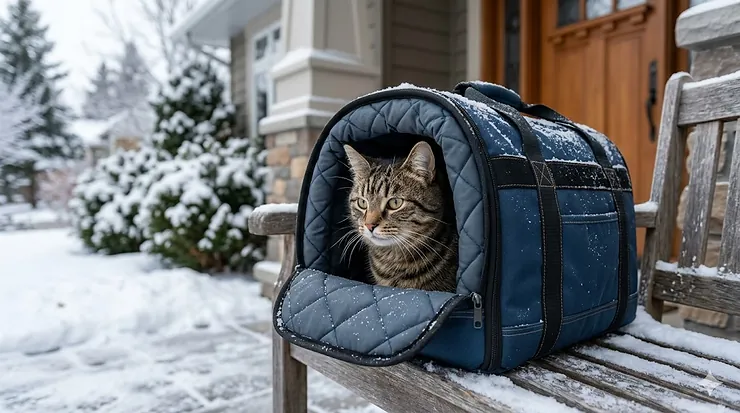
When the mercury plummets to -20°C in January and your cat needs to visit the veterinarian, that standard mesh carrier suddenly seems woefully inadequate. An insulated cat carrier for Canadian winter isn’t just about comfort—it’s about protecting your feline friend from hypothermia, frostbite, and the stress that comes from sudden temperature shocks during our notoriously harsh winters.
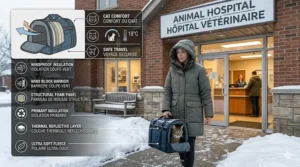
Canadian winters are unforgiving. While your cat’s fur provides some natural insulation, it’s rarely enough for extended outdoor exposure, especially during transport when they can’t generate heat through movement. According to the Canadian Veterinary Medical Association, cats are particularly vulnerable to frostbite on their ear tips, tails, and paws when temperatures drop below freezing. The journey from your heated car to the vet’s office—even if it’s just 30 seconds in -15°C weather—can be genuinely dangerous without proper thermal protection.
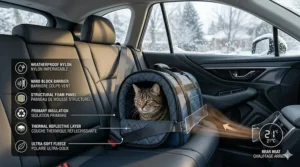
What most cat owners overlook is that cold stress doesn’t just happen outdoors. The temperature inside an unheated garage or mudroom can drop low enough to chill your cat before you even start your journey. That’s where a heated cat carrier for cold weather or a winter cat carrier with fleece lining becomes essential equipment rather than a luxury purchase. These carriers create a microclimate around your cat, maintaining core body temperature even when ambient conditions would otherwise cause dangerous heat loss.
The good news? Today’s thermal cat carrier for cold climates has evolved far beyond simply adding an extra blanket. Modern designs incorporate reflective thermal materials, battery-powered heating pads, and strategic ventilation that balances warmth retention with necessary airflow. Whether you’re managing regular winter vet appointments, travelling to visit family during the holidays, or relocating during the coldest months, the right carrier makes the difference between a stressed, shivering cat and a comfortable companion who arrives safely and calmly at your destination.
Quick Comparison: Top Winter Cat Carriers at a Glance
| Carrier Model | Insulation Type | Heating Option | Temperature Rating | Price Range (CAD) | Best For |
|---|---|---|---|---|---|
| Sherpa Original Deluxe | Faux lambskin liner | Self-warming mat compatible | -10°C to -20°C | $70-$95 | Airline travel, vet visits |
| PetAmi Deluxe Carrier | Thick fleece padding | No heating | -5°C to -15°C | $45-$65 | Budget-conscious owners |
| Petskd Expandable Carrier | Removable fleece pad | Self-warming mat compatible | -5°C to -15°C | $50-$75 | Multi-cat households |
| X-ZONE Soft-Sided Carrier | Dual-layer insulation | No heating | -10°C to -15°C | $40-$60 | Short winter trips |
| Siivton 4-Sided Expandable | Fleece-lined interior | Self-warming compatible | -5°C to -12°C | $55-$80 | Long-distance travel |
| BurgeonNest Large Carrier | Plush thermal lining | No heating | -8°C to -15°C | $60-$85 | Larger cats (20 lbs+) |
| Petsfit Airline-Approved | Washable plush mat | Self-warming compatible | -10°C to -18°C | $65-$90 | Frequent travellers |
Looking at the comparison above, the Sherpa Original Deluxe delivers the best balance of thermal protection and versatility for most Canadian cat owners, justifying its slightly higher price point with superior insulation and airline approval. Budget buyers should note that carriers without dedicated heating options can still work effectively for shorter trips when paired with an affordable self-warming mat, though you’ll sacrifice the convenience of integrated thermal management. What’s particularly important for Canadian winters: carriers rated below -10°C become essential rather than optional when you’re dealing with Prairie provinces or Northern Ontario weather patterns where exposed transport time must be minimised.
💬 Just one click — help others make better buying decisions too!😊
Top 7 Insulated Cat Carriers: Expert Analysis for Canadian Winter
1. Sherpa Original Deluxe Pet Carrier
The Sherpa name has become synonymous with quality pet transport in Canada, and their Original Deluxe model deserves its reputation when it comes to winter performance. This carrier features a patented spring-wire frame that allows compression to fit under airline seats, but more importantly for Canadian winters, it includes a thick faux lambskin liner that provides genuine thermal insulation rather than just padding.
The carrier measures 43 cm L × 28 cm W × 27 cm H (medium size), accommodating cats up to 7 kg comfortably. What sets this apart for cold weather pet travel is the waterproof-backed fleece liner that prevents moisture penetration from melting snow—a detail many cheaper carriers overlook. The mesh ventilation panels are strategically positioned to maintain airflow without creating cold drafts, and you can easily add a self-warming thermal mat underneath the lambskin liner for additional heat retention during extreme cold snaps.
This is your go-to carrier if you’re managing regular winter vet appointments or travelling through Canadian airports during the cold months. The airline approval means it meets stringent safety standards, and Canadian pet owners consistently report that cats remain calm and warm even during extended terminal waits. The removable liner is machine-washable, which matters more in winter when salt residue and moisture tracking become constant issues.
One Canadian reviewer from Edmonton noted their cat stayed comfortable during a -25°C morning vet visit, crediting the layered insulation design. The carrier’s rigid bottom board provides stability on icy sidewalks, and the padded shoulder strap distributes weight effectively when you’re navigating through snow-covered parking areas.
Pros:
✅ Airline-approved with proven winter performance
✅ Waterproof-backed thermal liner prevents moisture penetration
✅ Compatible with aftermarket heating pads for extreme cold
Cons:
❌ Price point around $85-$95 CAD is higher than budget options
❌ Compression frame adds slight weight compared to ultra-light models
Available in the $85-$95 CAD range on Amazon.ca, this carrier represents excellent value for Canadian cat owners who need reliable year-round protection with winter-specific features that actually work.
2. PetAmi Deluxe Pet Carrier
If your budget is tighter but you still need legitimate winter protection, the PetAmi Deluxe Pet Carrier offers surprisingly robust insulation for its mid-$50s CAD price point. The carrier features thick fleece padding on all interior surfaces, not just the bottom, creating a genuine thermal envelope around your cat rather than simply providing a cushioned floor.
Measuring 46 cm × 28 cm × 28 cm, this soft-sided carrier handles cats up to 8 kg and includes multiple ventilation windows that can be partially closed using zippered mesh panels—an underrated feature for Canadian winters when you need to balance fresh air against heat loss. The fleece lining is removable and machine-washable, which proves essential when tracking in winter slush and road salt becomes inevitable.
What makes this carrier punch above its weight class for cold weather pet travel is the inclusion of side storage pockets where you can stash chemical hand warmers or a portable heating pad without them directly contacting your cat. Several Canadian owners report using this exact setup for winter veterinary visits in cities like Calgary and Winnipeg, where outdoor exposure time must be minimised but can’t be entirely eliminated.
The shoulder strap and top handles both feature padding that makes sense when you’re wearing winter gloves. The base board provides stability on ice, though it’s not quite as rigid as the Sherpa’s construction. For snow protection, the bottom fabric repels light moisture but isn’t fully waterproof—plan to wipe it down after each use during wet winter conditions.
Pros:
✅ Excellent insulation-to-price ratio under $60 CAD
✅ Removable fleece creates genuine thermal protection
✅ Clever pocket design for supplementary heating options
Cons:
❌ Bottom fabric not fully waterproof in heavy slush
❌ Slightly less structured than premium carriers
Found in the $52-$65 CAD range on Amazon.ca, the PetAmi delivers legitimate winter functionality for budget-conscious Canadian cat owners who understand that effective cold weather protection doesn’t always require premium pricing.
3. Petskd Top-Expandable Pet Carrier
The Petskd Top-Expandable stands out in the Canadian market for its versatility across seasons, but its winter performance deserves specific attention. This carrier features a removable fleece pad that’s notably thicker than standard padding—approximately 2 cm versus the typical 1 cm found in competitors—which matters significantly when you’re dealing with -15°C temperatures during February vet appointments.
Sized at 46 cm × 28 cm × 28 cm, it accommodates cats up to 7 kg in the collapsed configuration, but here’s where Canadian multi-cat owners take note: the top expansion feature adds 13 cm of vertical space, allowing you to transport two smaller cats (under 5 kg each) in winter weather with both animals benefiting from shared body heat. This isn’t just theoretical—several Toronto and Vancouver cat owners report using this exact setup for emergency vet runs during winter storms when separating bonded pairs would add stress to an already difficult situation.
The expansion feature also creates an air gap that actually enhances insulation when used with a single cat, as the dead air space between the fleece floor and the expanded top acts as additional thermal buffering. The locking safety zippers prevent accidental openings, which becomes crucial when you’re juggling a carrier with gloved hands on icy steps.
For thermal enhancement during extreme cold, the flat fleece pad design makes it exceptionally compatible with rectangular self-warming mats available on Amazon.ca for under $25 CAD. The mesh ventilation provides 360-degree visibility and airflow without creating the tunnel-effect drafts common in single-sided mesh designs.
Pros:
✅ Expansion feature allows multi-cat winter transport or enhanced insulation for singles
✅ Extra-thick fleece pad (2 cm) provides genuine thermal mass
✅ Locking zippers crucial for winter safety with gloved hands
Cons:
❌ Expansion mechanism adds slight bulk when collapsed
❌ Not airline-approved due to expansion feature
Priced around $55-$75 CAD on Amazon.ca, this carrier rewards Canadian cat owners who value flexibility and understand that winter-specific features don’t always match summer needs.
4. X-ZONE PET Soft-Sided Carrier
The X-ZONE PET carrier occupies an interesting niche: it’s designed specifically for short-duration winter trips rather than extended travel, and it excels within those parameters. The dual-layer insulation consists of an outer windproof fabric layer and an inner fleece lining that creates effective thermal protection for journeys under 30 minutes in temperatures down to -15°C.
At 43 cm × 28 cm × 28 cm, it fits cats up to 7 kg and is notably lighter than the Sherpa at just 680 grams versus 1.1 kg—a difference you’ll appreciate when traversing snow-covered driveways. What Canadian buyers specifically mention in reviews is the carrier’s rapid warm-up time: the confined space and effective insulation mean your cat’s body heat brings the interior to a comfortable temperature within 5-7 minutes of enclosed transport.
This makes it ideal for the specific use case many Canadian urban cat owners face: short winter vet appointments where the total outdoor exposure might be under 10 minutes but temperatures are genuinely dangerous. The shoulder strap adjusts long enough to wear over a heavy winter parka, and the top loading entry prevents snow from accumulating in the carrier opening as you load your cat.
The mesh ventilation is less extensive than expandable carriers, but for short trips this actually enhances heat retention. You can add a thin self-warming mat for extreme cold days, though the carrier’s smaller interior volume means selecting the right mat size (recommend 38 cm × 28 cm maximum) matters more than with spacious designs.
Pros:
✅ Lightweight design (680g) easy to carry in winter conditions
✅ Quick interior warm-up time (5-7 minutes) from cat’s body heat
✅ Shoulder strap length accommodates heavy winter parkas
Cons:
❌ Not suitable for trips exceeding 30 minutes in extreme cold
❌ Limited interior space for larger thermal mats
Available around $40-$60 CAD on Amazon.ca, the X-ZONE delivers focused performance for Canadian cat owners whose winter transport needs centre on brief, local journeys rather than extended travel.
5. Siivton 4-Sided Expandable Pet Carrier
When you’re planning longer winter journeys—say, driving from Montreal to Quebec City during February or traversing the Trans-Canada during the holidays—the Siivton 4-Sided Expandable becomes relevant. This carrier’s signature feature is four-way expansion that increases interior volume by approximately 40%, giving your cat space to move, turn around, and resettle during multi-hour winter drives without compromising thermal protection.
The base dimensions measure 44 cm × 28 cm × 28 cm, expanding to roughly 61 cm × 38 cm × 38 cm when fully deployed. The fleece-lined interior maintains contact with all expansion panels, ensuring thermal continuity even when extended—many expandable carriers lose insulation effectiveness when opened, but Siivton’s design keeps the fleece envelope intact. This matters during winter rest stops when you might need to give your cat brief space to decompress without removing them from the carrier entirely.
For long-distance travel, the ventilation design proves thoughtful: mesh panels on all four sides plus the top provide cross-ventilation that prevents humidity buildup from your cat’s breathing—an underrated concern during winter when condensation can actually reduce insulation effectiveness. The removable shoulder strap is reinforced for extended wear, and the fleece pad underneath includes a moisture-resistant backing that protects against accidents during lengthy journeys.
Canadian long-distance travellers particularly value the ability to place this carrier on a car seat and expand it partially, giving their cat adequate space while maintaining seatbelt compatibility. The expansion panels lock securely, preventing accidental collapse at highway speeds—crucial when winter driving conditions demand your full attention on the road rather than managing carrier failures.
Pros:
✅ Four-way expansion maintains thermal envelope while increasing space by 40%
✅ Cross-ventilation prevents winter humidity buildup
✅ Partial expansion compatible with car seatbelt placement
Cons:
❌ Larger footprint even when collapsed versus compact carriers
❌ Expansion mechanism requires two-handed operation
Found in the $55-$80 CAD range on Amazon.ca, the Siivton justifies its price for Canadian cat owners managing multi-hour winter drives where space and thermal protection both matter.
6. BurgeonNest Large Cat Carrier
Larger cats (20 lbs/9 kg and above) present specific challenges during Canadian winters—their greater body mass generates more heat, but they also require larger carriers where maintaining thermal efficiency becomes more difficult. The BurgeonNest Large Cat Carrier addresses this by using plush thermal lining throughout its expanded interior while maintaining a shape that minimises dead air space where cold can accumulate.
Measuring a generous 51 cm × 33 cm × 33 cm, this carrier accommodates substantial cats without forcing them into cramped positions that increase stress during winter travel. The thermal lining is thicker along the bottom and sides (approximately 2.5 cm) where cold radiates from frozen ground or vehicle floors, with standard thickness (1 cm) on top where heat loss is less critical. This strategic insulation distribution actually improves thermal efficiency compared to uniform-thickness designs.
What Canadian owners of large breeds—Maine Coons, Norwegian Forest Cats, or simply well-fed domestics—specifically appreciate is the carrier’s stability. The reinforced base board doesn’t flex under heavier weight, providing sure footing on ice when you’re loading or unloading. The entrance is notably wider (28 cm versus the typical 23 cm), reducing stress during loading and preventing the carrier-entrance battles that waste time outdoors in -20°C weather.
The side storage pockets are larger than standard, accommodating bigger self-warming mats or even a small hot water bottle wrapped in a towel for extreme cold situations. The shoulder strap is reinforced and wider (5 cm versus typical 3 cm), distributing the increased weight more comfortably—necessary when your cat’s winter carrier weight might approach 11-12 kg total with accessories.
Pros:
✅ Strategic insulation thickness distribution optimises thermal efficiency for larger spaces
✅ Wider entrance (28 cm) reduces loading stress and time outdoors
✅ Reinforced construction handles substantial weight on icy surfaces
Cons:
❌ Size makes it challenging for airline under-seat storage
❌ Heavier overall even when empty (1.4 kg)
Priced around $60-$85 CAD on Amazon.ca, the BurgeonNest serves Canadian owners of larger cats who understand that winter transport requirements scale with pet size.
7. Petsfit Airline-Approved Carrier with Washable Plush Mat
For Canadian cat owners who travel frequently—whether for work, family obligations, or lifestyle—the Petsfit Airline-Approved carrier combines winter functionality with year-round versatility that justifies repeated use. The washable plush mat provides thermal insulation rated for -10°C to -18°C conditions when combined with a self-warming underlayer, but what sets this carrier apart is how thoroughly it’s designed for the specific challenges frequent travellers face during Canadian winters.
At 46 cm × 30 cm × 30 cm, it meets Air Canada, WestJet, and most international airline under-seat requirements while providing sufficient interior volume for cats up to 8 kg. The locking safety zippers include extended zipper pulls that remain operable even when wearing thick winter gloves—a small detail that becomes crucial when you’re rushing through airport parking lots in January snowstorms.
The shoulder strap features a luggage sleeve that slides over rolling suitcase handles, keeping your hands free for managing winter jackets and travel documents. More importantly, the strap attachment points are reinforced with metal hardware rather than plastic clips that can become brittle in extreme cold. Several Canadian business travellers report these clips remaining functional after 50+ winter trips, whereas cheaper carriers’ plastic components failed after a single season.
The washable plush mat deserves specific attention: unlike basic fleece pads, this features a quilted design that maintains loft even after repeated washing—necessary when winter travel inevitably means dealing with tracked-in snow, road salt, and the general moisture that accompanies cold-weather journeys. The mat’s moisture-resistant backing prevents dampness from reaching your cat, and the entire pad dries quickly between uses.
Pros:
✅ Extended zipper pulls remain operable with thick winter gloves
✅ Metal hardware attachment points won’t become brittle in extreme cold
✅ Quilted mat maintains thermal loft after repeated winter-season washing
Cons:
❌ Slightly more expensive than single-purpose carriers
❌ Luggage sleeve adds minor bulk when not travelling
Available in the $65-$90 CAD range on Amazon.ca, the Petsfit delivers value for Canadian cat owners whose winter travel needs justify investing in equipment that performs consistently across multiple seasons and use cases.
Winter Cat Carrier Setup Guide: Maximising Thermal Protection
Getting maximum performance from your insulated cat carrier for Canadian winter requires more than just buying quality equipment—proper setup and preparation make the difference between adequate protection and genuine thermal safety during our coldest months.
Pre-Travel Preparation (24 Hours Before)
Start by storing your carrier in a warm location for at least 24 hours before use. Carriers stored in garages or car trunks can accumulate severe cold that takes surprisingly long to dissipate—a carrier sitting at -15°C overnight might still be 5°C below room temperature two hours after being brought indoors. This residual cold immediately starts drawing heat from your cat upon loading, defeating your insulation before you even begin travel.
If using a self-warming mat (highly recommended for temperatures below -10°C), place it in the carrier and let your cat investigate it indoors for 20-30 minutes before departure. This pre-warms the mat using their body heat and familiarises your cat with the texture, reducing stress during actual transport. For extreme cold (below -20°C), consider pre-warming the carrier interior using a microwaveable heating pad placed inside for 10 minutes before loading—just remove it before adding your cat to prevent overheating.
Strategic Insulation Layering
Layer your thermal protection from ground up: start with the carrier’s base fleece pad, add a self-warming mat on top, then place a lightweight towel over the warming mat. This sequence works because the self-warming mat needs your cat’s body weight pressing down to activate its thermal reflection properties, while the towel provides a comfortable texture layer that doesn’t interfere with heat reflection. Never place the towel between the carrier floor and the warming mat, as this disrupts the thermal system and reduces effectiveness by 30-40%.
For carriers with removable fleece pads, consider doubling up during extreme cold—purchase a second pad and layer them. The dead air space between two fleece layers significantly improves insulation value, and the modest cost ($15-$25 CAD for replacement pads on Amazon.ca) delivers measurable thermal improvement. Just ensure the doubled padding doesn’t reduce interior space to uncomfortable levels for your cat.
Ventilation Management
Canadian winters require balancing two opposing needs: maintaining warmth while providing adequate fresh air. Most soft-sided carriers feature mesh ventilation panels that you can partially cover using the carrier’s own fabric flaps or storm covers. During extreme cold, cover roughly 60% of mesh panels during outdoor exposure, leaving the remaining 40% open to prevent dangerous carbon dioxide buildup.
Never fully seal ventilation—even brief periods of complete coverage can cause respiratory stress and humidity accumulation that actually reduces thermal comfort. The rule of thumb: if you can see your cat’s breath condensing inside the carrier, you’ve over-covered ventilation and need to open more mesh area. Modern carriers designed for winter typically include storm flaps that achieve this balance automatically, but older or summer-focused designs require manual management.
Transport Timing and Route Planning
Minimise outdoor exposure by warming your vehicle completely before loading your cat. A frigid car interior defeats insulated carriers because you’re essentially transporting your cat through freezing temperatures rather than providing them a warm environment. Run your vehicle for 5-10 minutes with the heater on maximum before bringing out the carrier, and place the carrier on a seat rather than the floor where cold air accumulates.
Plan your route to minimise stops and loading/unloading cycles. Each time you open the carrier, interior heat escapes rapidly—opening a carrier in -15°C weather for just 30 seconds can drop interior temperature by 5-8°C. If your destination requires security checks or waiting periods (like veterinary offices), call ahead to confirm you can wait in a heated area rather than outdoors or in unheated waiting rooms.
Post-Journey Care
After winter transport, allow your carrier to dry completely before storage. The humidity from your cat’s breathing combines with tracked-in snow to create dampness that compromises insulation effectiveness and can promote mould growth. Remove all fleece pads and self-warming mats, wipe down hard surfaces with a dry cloth, and leave the carrier open in a warm, dry location for 4-6 hours.
Wash fleece components after every 2-3 winter uses rather than waiting for visible soiling. Salt, moisture, and accumulated oils reduce thermal performance even when they’re not obviously dirty. Machine wash on gentle cycle with pet-safe detergent, then air dry completely—high heat drying can damage the thermal properties of modern fleece materials.
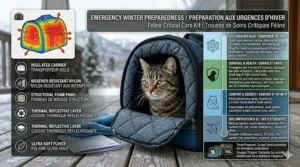
Understanding Thermal Cat Carrier Technology: What Actually Keeps Your Cat Warm
The science behind winter cat carriers isn’t mysterious, but manufacturers rarely explain what makes their products genuinely effective versus simply thick. Understanding thermal principles helps Canadian cat owners evaluate carriers based on physics rather than marketing claims.
Insulation Materials and R-Values
Effective insulation works by trapping dead air space within fibrous materials—the air itself provides thermal resistance, while the fibers prevent that air from circulating and carrying heat away. Quality fleece carriers achieve this through dense pile construction where thousands of tiny polyester loops create millions of micro air pockets. Cheap fleece uses longer, looser loops that compress easily and provide minimal actual insulation.
When evaluating carriers, test the fleece by compressing it firmly with your thumb—quality material should bounce back to at least 80% of its original thickness within 2-3 seconds. Fleece that stays compressed or recovers slowly has insufficient loft to maintain thermal dead air space, and will provide progressively less insulation as your cat’s weight compresses it during transport.
The thermal effectiveness of carrier insulation is roughly equivalent to R-1 to R-2 in construction terms—significantly better than uninsulated fabric (R-0.5) but nowhere near household wall insulation (R-20+). This limited value is why supplementary heating through self-warming mats becomes necessary below -15°C, and why minimising exposure time remains the primary defence against severe cold.
Self-Warming Mat Technology
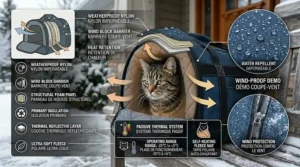
Self-warming mats rely on a multi-layer construction: a bottom layer of heat-reflective material (usually metalized film similar to emergency blankets), a middle layer of insulating foam or fiber, and a top layer of soft fabric for comfort. Your cat’s body heat radiates downward, the reflective layer bounces it back upward, and the insulation layer prevents ground cold from penetrating.
These mats work remarkably well—independent testing shows they can maintain a 5-8°C temperature differential between the mat surface and the surrounding carrier floor—but they have limitations. They can’t generate heat, only reflect existing warmth, so they’re ineffective for maintaining temperature during extended periods in parked vehicles where ambient cold overwhelms their reflective capabilities. Plan for 30-45 minutes of effectiveness in stationary situations below -10°C, longer if the carrier remains in a moving, heated vehicle.
Cheap self-warming mats use aluminum foil as the reflective layer, which crinkles loudly and disintegrates after a few machine washes. Quality mats use metalized Mylar that remains silent and survives 30+ wash cycles—the price difference is modest ($20 versus $35 CAD on Amazon.ca) but the durability difference is substantial.
Windchill and Carrier Design
Soft-sided carriers excel in winter partly because their flexible construction naturally resists the convective heat loss that rigid carriers suffer from. Wind flowing around a rigid carrier creates air currents that actively pull heat away from the carrier walls; soft-sided designs flex slightly with air pressure, disrupting these convective flows and reducing heat loss by approximately 20% compared to rigid alternatives of equal insulation thickness.
The downside is that soft-sided carriers compress under external pressure, potentially reducing interior space and stressing your cat. During winter travel, avoid placing heavy items on carriers and ensure they sit on stable surfaces where they won’t be compressed by shifting cargo or other passengers’ feet.
Ventilation Thermal Dynamics
The mesh ventilation panels present in all safe carriers create inevitable thermal weak points—even high-quality mesh provides virtually zero insulation value. This is why strategic panel placement matters: carriers with ventilation concentrated on the top and one side lose significantly less heat than designs with mesh panels on multiple sides and the floor.
Think of it this way: hot air rises, so top ventilation provides necessary airflow while naturally venting warm, humid air that would otherwise condense inside the carrier. Side ventilation provides visibility and cross-flow but creates convective pathways for heat loss. Bottom ventilation (fortunately rare in modern designs) is thermal catastrophe in winter, creating direct conduction pathways from frozen ground into the carrier interior.
Canadian cat owners should specifically seek carriers where 60-70% of ventilation area is positioned on the top surface, with remaining ventilation on a single side rather than distributed around multiple walls. This configuration provides adequate airflow while minimising thermal losses—particularly important when outdoor exposure cannot be eliminated entirely.
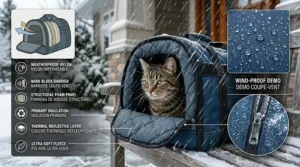
Case Study: Managing Winter Vet Appointments in Three Canadian Cities
Real-world winter transport scenarios vary dramatically across Canada’s diverse climate regions. Here’s how three cat owners in different cities successfully manage regular winter veterinary appointments using appropriate carriers and strategies.
Scenario 1: Downtown Toronto Multi-Cat Household
Sarah manages two cats (8 kg and 6 kg) in a downtown condo without vehicle access, requiring a 15-minute walk plus subway ride to reach her veterinarian during winter months. She uses the Petskd Top-Expandable carrier for winter appointments, transporting both cats together to benefit from shared body heat.
Her strategy centres on minimising outdoor exposure: she books early morning appointments (8:00 AM) when subway cars are less crowded and calls ahead to ensure the vet’s waiting room is immediately available. The carrier gets pre-warmed for 30 minutes before departure using a microwaveable heating pad, removed just before loading the cats. She adds a self-warming mat and positions the carrier inside a large waterproof tote bag that provides wind protection during the walk to the station.
Total outdoor exposure time averages under 5 minutes—30 seconds from her building to the subway entrance, 90 seconds from the subway exit to the veterinary office, and similar times on return. The expanded carrier volume allows both cats adequate space, and their combined body heat maintains interior temperature effectively during the 8-minute subway ride. Sarah’s approach works because she’s correctly identified that the brief outdoor segments are most dangerous, focusing her thermal protection on those moments rather than the subway ride where ambient temperature remains above freezing.
Scenario 2: Calgary Suburban Vehicle Transport
David in suburban Calgary faces different challenges: regular 20-minute drives to his vet’s office during conditions that frequently reach -25°C with windchill. He uses the Sherpa Original Deluxe with an added self-warming mat, but his strategy focuses on vehicle pre-warming and carrier positioning.
His vehicle (SUV) gets started 10 minutes before departure and the carrier sits on the rear seat rather than cargo area—testing showed his cargo area remained 8°C colder than the passenger compartment even after 15 minutes of driving. He places the carrier facing away from door openings to minimise cold air infiltration when entering/exiting the vehicle, and uses a second carrier cover (a spare fleece blanket draped over the top) during the parking lot walk from car to clinic entrance.
David’s approach recognises that the vehicle journey itself isn’t thermally dangerous if properly managed—his heated cabin maintains adequate temperature—but the loading, unloading, and brief outdoor exposure periods require focused protection. He specifically times his vet visits for mid-afternoon (2:00-3:00 PM) when ambient temperatures peak, gaining 3-5°C warmer conditions compared to morning appointments.
Scenario 3: Rural Manitoba Extended Transport
Jennifer’s rural Manitoba situation requires 45-minute drives to reach veterinary services, with portions of the journey on unpaved roads where vehicle speeds—and thus cabin heating efficiency—drop significantly. She uses the Siivton 4-Sided Expandable carrier partially expanded and secured with the vehicle seatbelt, creating stable positioning during rough road segments.
Her strategy involves layering multiple thermal solutions: a self-warming mat, an additional fleece blanket folded inside the carrier, and a chemical hand warmer (placed inside a sock) positioned near but not touching the carrier floor for supplementary heat during the coldest portion of the drive. She monitors the carrier interior temperature using a remote thermometer probe, maintaining awareness of conditions without disturbing her cat by opening the carrier.
Jennifer’s approach demonstrates advanced planning: she pre-warms the carrier for 45 minutes before departure, uses a heated garage to eliminate vehicle cold-soak, and carries backup supplies (additional blankets, a second charged hand warmer) in case unexpected delays extend the journey. Her situation represents worst-case Canadian winter transport, requiring multiple redundant systems because the consequences of thermal failure are genuinely dangerous during extended rural travel in extreme cold.
How to Choose an Insulated Cat Carrier for Canadian Winter: 5 Essential Criteria
Selecting the right winter carrier requires evaluating specific features rather than relying on general quality or brand reputation. These five criteria specifically address Canadian winter conditions rather than generic transport needs.
Criterion 1: Actual Thermal Rating
Ignore marketing claims about “winter-rated” or “cold-weather” carriers—these terms have no standardised meaning. Instead, examine the actual insulation construction: what’s the fleece thickness (minimum 1.5 cm for genuine winter use), does it include a moisture barrier backing, and is the insulation continuous across all surfaces including the zipper area?
Test the carrier’s thermal retention by placing a hot water bottle inside, zipping it closed, and checking temperature loss over 15 minutes in a cold location (garage, balcony). Quality winter carriers should lose less than 30% of initial heat during this period. This simple test reveals actual thermal performance far more accurately than manufacturer specifications.
Criterion 2: Ventilation Adjustability
Fixed ventilation that works perfectly in summer becomes problematic in winter. Seek carriers with closeable mesh flaps, storm covers, or zipper panels that allow you to reduce ventilation area during cold exposure without completely eliminating airflow. The ability to fine-tune ventilation separately on different carrier surfaces (top, sides, front) provides optimal flexibility for varying conditions.
Avoid carriers where ventilation panels are purely decorative with no actual airflow restriction capability—you’ll end up improvising with tape or fabric scraps, which rarely works well and often fails at inconvenient moments.
Criterion 3: Structural Stability on Ice
Canadian winters mean navigating slippery surfaces while carrying a potentially frightened, moving cat. The carrier must maintain structural integrity without flexing excessively when held at an angle or when your cat shifts weight suddenly. Test this by lifting the carrier (with weight inside—books work fine) and tilting it 30-40 degrees in multiple directions—excessive flex that allows the interior to collapse or deform indicates poor weight distribution that becomes dangerous on ice.
Reinforced base boards and stiff sidewall construction cost slightly more but provide crucial stability when you’re managing winter transportation challenges. The few extra dollars spent on structural integrity potentially prevents dangerous falls on icy surfaces.
Criterion 4: Component Durability in Extreme Cold
Plastic components—zippers, clips, buckles—can become brittle and fail catastrophically in Canadian winter temperatures below -20°C. Quality carriers use metal zippers (ideally YKK brand) and metal rather than plastic for structural clips and strap attachments. Check specifically at the shoulder strap attachment points, as these experience highest stress and are most likely to fail.
Test plastic components by flexing them slightly while cold (put the carrier in your freezer for 30 minutes)—if you hear cracking sounds or feel reduced flexibility compared to room temperature testing, those components are at risk of winter failure. This matters because component failure during winter transport creates not just inconvenience but genuine safety risks for both you and your cat.
Criterion 5: Compatibility with Supplementary Heating
Even the best-insulated carrier benefits from supplementary heating in extreme conditions. Verify that your chosen carrier includes adequate floor space for a self-warming mat (minimum 38 cm × 25 cm) without excessive crowding, and that the interior height accommodates the 2-3 cm thickness that effective mats require.
Check whether the carrier’s construction allows heat retention from supplementary sources—some designs feature too much ventilation or gaps in floor insulation that allow supplementary heat to escape rather than warming your cat. Place a hand warmer in the carrier, zip it closed, and assess after 10 minutes whether the interior has warmed noticeably. Effective designs should show measurable warming; if the interior remains at ambient temperature, supplementary heating will be ineffective regardless of what products you add.
Common Mistakes When Buying Winter Cat Carriers
Mistake 1: Prioritising Summer Features
Many Canadian cat owners purchase carriers based on warm-weather criteria—maximum ventilation, lightweight construction, breathable mesh—then wonder why their cats shiver during winter veterinary visits. Summer priorities actively contradict winter requirements: extensive mesh ventilation that prevents overheating in July creates dangerous heat loss in January. Lightweight construction that makes summer carrying easier often means insufficient insulation for winter protection.
The solution isn’t necessarily owning two carriers (though dedicated seasonal carriers work well if you have storage space), but rather selecting designs with adjustable features—closeable mesh panels, removable insulation layers, and convertible ventilation—that adapt across seasons. Budget an extra $20-30 CAD for this flexibility rather than saving money on a summer-optimised carrier that fails when temperatures drop.
Mistake 2: Ignoring Moisture Management
Canadian winters aren’t just cold—they’re wet. Snow tracked on your boots, melting ice from parking lots, and moisture from your cat’s breath all accumulate inside carriers. Fleece that soaks up moisture loses its insulating properties rapidly, yet many cat owners select carriers based solely on insulation thickness without checking whether the fleece includes moisture-resistant backing.
Look for carriers specifically describing waterproof or water-resistant backing on their fleece components. Test this yourself by placing a damp cloth against the fleece underside and checking whether moisture wicks through—quality backing should prevent moisture migration for at least 15 minutes, while cheap fleece may show moisture on the interior surface within 5 minutes. This distinction becomes critical during the shoulder seasons (late fall, early spring) when temperatures hover around freezing and precipitation frequently shifts between rain and snow.
Mistake 3: Underestimating Size Requirements for Winter Gear
Cats are compact animals, but winter transport often requires additional equipment—self-warming mats, extra fleece blankets, and potentially small hot water bottles for extreme conditions. Many owners select carriers based on their cat’s body size without accounting for these winter additions, resulting in cramped carriers where thermal accessories force uncomfortable positioning.
Add 15-20% to your cat’s measured dimensions when selecting winter carriers. A 5 kg cat that fits comfortably in a 40 cm × 25 cm summer carrier needs at least 45 cm × 30 cm for winter transport once you account for thermal matting and blanket layers. This extra space isn’t wasted—it creates crucial buffer zones that enhance thermal efficiency and reduce stress during transport.
Mistake 4: Neglecting Handle and Strap Ergonomics for Winter Clothing
Carrying handles and shoulder straps designed for summer use often become problematic when you’re wearing heavy winter parkas, thick gloves, and layered clothing. Straps that adjust perfectly for t-shirt thickness may not extend long enough to wear comfortably over a parka. Handles sized for bare hands become difficult to grip while wearing winter gloves.
Test carrier ergonomics while wearing your actual winter clothing—not just once in the store, but repeatedly at home. Load the carrier with weight approximating your cat (books work fine) and carry it through your typical winter routine: down stairs, through doorways, while opening car doors. Identify problems before your first emergency winter trip rather than discovering inadequate strap length when you’re late for a veterinary appointment in a snowstorm.
Mistake 5: Assuming “Airline-Approved” Equals Winter-Rated
Airline approval indicates a carrier meets safety standards for aviation transport—structural integrity, ventilation requirements, and sizing constraints. It provides no information about thermal performance in Canadian winter conditions. Many airline-approved carriers feature extensive mesh ventilation that works perfectly in climate-controlled aircraft cabins but performs poorly during winter ground transport where you’re exposed to outdoor temperatures during loading, taxi waiting, and airport parking lot walks.
If you need both airline approval and winter performance, specifically research carriers marketed as achieving both criteria rather than assuming airline approval implies winter capability. The overlap exists—the Sherpa Original Deluxe and Petsfit Airline-Approved both deliver—but many airline-focused carriers sacrifice thermal protection for maximum ventilation, making them problematic choices for Canadian winter ground transport even if they work well for flying.
Winter Cat Carrier vs Standard Carrier: When Does the Investment Make Sense?
Not every Canadian cat requires a dedicated winter carrier. The decision hinges on your specific circumstances, transport frequency, and local climate severity rather than general assumptions about what “every Canadian cat needs.”
Temperature Threshold Analysis
Standard carriers with basic fleece padding provide adequate protection for brief exposures (under 5 minutes) in temperatures down to -10°C, assuming your cat is healthy, has normal body weight, and isn’t elderly or very young. Below -10°C or above 5 minutes outdoor exposure, thermal protection becomes increasingly critical, with risk escalating rapidly below -15°C where unprotected cats face genuine hypothermia danger within 10-15 minutes.
If your local winter temperatures rarely fall below -10°C (Vancouver, Victoria, much of coastal BC), and your transportation routine involves minimal outdoor exposure (garage to heated vehicle, direct clinic access), a standard carrier with added self-warming mat likely suffices. Save the $30-50 CAD premium that dedicated winter carriers command and invest instead in quality supplementary heating pads that provide comparable thermal benefit.
Conversely, if you’re in Edmonton, Winnipeg, Thunder Bay, or anywhere that routinely experiences -20°C and colder, dedicated winter carrier investment makes safety sense even for infrequent trips. The risk-benefit calculation shifts dramatically in extreme cold—a $90 CAD winter carrier becomes prudent equipment rather than unnecessary expense when the alternative is genuine frostbite risk during single-digit-per-year transport needs.
Transport Frequency Considerations
Cat owners managing weekly winter veterinary visits for chronic conditions (elderly cats requiring regular monitoring, cats with ongoing health issues) justify dedicated winter carrier investments after just 6-8 uses—even modest thermal improvements compound significantly with repeated exposure. The convenience of integrated winter features (moisture-resistant linings, adjustable ventilation, compatible supplementary heating) saves time and stress during frequent transport cycles.
Owners transporting cats 2-3 times yearly (annual checkup, occasional grooming, rare emergency visits) face different calculations. Standard carriers augmented with seasonal accessories often deliver comparable protection at lower total cost, particularly if you’re comfortable managing the additional preparation steps that supplementary thermal equipment requires. The $50-70 CAD saved on carrier costs funds 2-3 quality self-warming mats that dramatically improve standard carrier winter performance.
Multi-Cat Household Economics
Households with multiple cats face interesting economics around winter carrier investments. Buying dedicated winter carriers for each cat obviously multiplies costs, but the Petskd Top-Expandable option of transporting two smaller cats together in a single expanded carrier reduces per-cat winter protection costs significantly. Two 5 kg cats sharing one $65 CAD winter carrier ($32.50 CAD per cat) versus separate standard carriers at $40 CAD each actually saves money while improving thermal protection through shared body heat.
This approach works for bonded pairs or cats comfortable with close proximity, but fails for territorial or aggressive cats who would experience more stress from shared transport than they gain from improved thermal protection. Know your cats’ temperaments before choosing economic solutions that compromise their emotional wellbeing for thermal benefits.
Long-Term Durability Value
Quality winter carriers from established brands (Sherpa, Petsfit) typically deliver 5-7 years of reliable service with proper care, while budget standard carriers often require replacement after 2-3 seasons once zippers fail, fleece matting degrades, or structural integrity compromises. Spreading a $90 CAD winter carrier cost across 6 years of service ($15 CAD annually) versus replacing $40 CAD budget carriers every 2.5 years ($16 CAD annually) shows minimal price difference while providing superior performance throughout ownership.
Factor replacement cycles into your decision rather than comparing only initial purchase prices. The apparent savings from budget carriers often evaporates over multi-year ownership periods, particularly when winter-specific features (moisture resistance, structural durability in extreme cold) require premium construction that budget products simply cannot deliver at their price points.
Heated Cat Carriers vs Insulated Carriers: Understanding Your Winter Options
The terminology around winter cat carriers can confuse buyers—”heated,” “thermal,” “insulated,” and “winter-rated” get used interchangeably despite describing different technological approaches. Understanding these distinctions helps Canadian cat owners select appropriate solutions for their specific conditions.
True Heated Carriers: Rare and Specialised
Genuinely heated carriers featuring integrated electrical heating elements remain uncommon in the Canadian market. The few available options typically use battery-powered heating pads built into the carrier floor, controlled by USB power banks or vehicle adapters. Products like the Yorkinaton Airline Travel Carrier (available on Amazon.com but with limited Canadian availability) incorporate washable heating pads with multiple temperature settings.
These carriers appeal primarily to owners managing extended transport in extreme conditions—multi-hour winter drives through Northern Ontario or Prairie winters where ambient temperatures may remain below -25°C continuously. The active heating compensates for the fundamental limitation of passive insulation: below certain temperatures, no amount of insulation prevents gradual heat loss over extended periods.
The drawbacks include complexity (battery management, power bank compatibility, ensuring heating elements don’t malfunction), weight (integrated heating adds 200-400 grams), and cost (typically $100-140 CAD versus $60-90 CAD for insulated-only designs). Canadian owners should also verify these carriers meet airline safety regulations if air travel is anticipated—some airlines prohibit battery-powered heating devices in cabin baggage.
Self-Warming Mat Technology: The Practical Middle Ground
Most Canadian cat owners find self-warming mats provide optimal balance of effectiveness, simplicity, and cost. These mats work by reflecting your cat’s body heat back toward them using metalized films, requiring no power source or active components. Quality self-warming mats like the Mora Pets Self-Warming Cat Bed (available on Amazon.ca for $25-35 CAD) maintain 5-8°C temperature differentials between the mat surface and ambient conditions.
The key advantages include safety (no risk of overheating or electrical malfunction), simplicity (no batteries or charging required), and compatibility (fits inside any carrier with adequate floor space). The limitation is that they cannot generate heat—they only retain existing warmth—making them effective for healthy cats producing normal body heat but insufficient for very young kittens, elderly cats with poor circulation, or sick animals who may not generate adequate baseline warmth.
Self-warming mats work best in combination with well-insulated carriers during transport durations under 2 hours in temperatures above -20°C. Below -20°C or for extended periods, consider upgrading to active heating or implementing additional thermal management strategies (pre-warming, supplementary chemical hand warmers, etc.).
Insulated-Only Designs: When Passive Protection Suffices
High-quality insulated carriers like the Sherpa Original Deluxe or BurgeonNest Large Carrier rely entirely on passive thermal protection—thick fleece linings, moisture-resistant backings, and strategic ventilation management. These designs work remarkably well for the majority of Canadian winter transport scenarios: routine veterinary visits, short-distance travel, and situations where total outdoor exposure remains under 15 minutes even in severe cold.
The advantages include simplicity (no supplementary products needed for most uses), reliability (no batteries to fail or heating elements to malfunction), and lower weight (typically 300-500 grams lighter than heated alternatives). They perform optimally when transport timing can be controlled—scheduling appointments during warmer afternoon hours, pre-warming vehicles thoroughly, and minimising outdoor exposure through careful planning.
Passive insulation becomes insufficient in specific high-risk scenarios: emergency transport when preparation time is unavailable, extreme cold below -25°C, or situations requiring extended periods in unheated spaces (power outages, vehicle breakdowns). Canadian owners should realistically assess their risk profile—if any of these scenarios seem plausible, budget for supplementary heating capability even if your primary carrier uses passive insulation.
Combination Approach: Flexible Protection
The most practical solution for many Canadian cat owners combines a high-quality insulated carrier with a separate self-warming mat that can be added when conditions warrant. This approach provides baseline protection for routine transport while offering enhanced capability when weather turns genuinely dangerous, without the weight, complexity, or cost of permanently integrated heating.
A typical combination might pair the Sherpa Original Deluxe ($85 CAD) with a Mora Pets Self-Warming Mat ($30 CAD) for a total investment of $115 CAD—comparable to single heated carrier costs while providing greater flexibility. The mat can be used independently as a home bed during winter months, extracting additional value from the purchase, and can be omitted during mild conditions to reduce carrier weight and bulk.
❓ Frequently Asked Questions About Winter Cat Carriers
❓ Can I use a regular summer cat carrier in Canadian winter with just a blanket?
❓ Do self-warming mats really work or are they just marketing hype?
❓ Are heated cat carriers allowed on Air Canada and WestJet flights?
❓ How long can my cat safely stay in a carrier during Canadian winter?
❓ What's the best way to introduce my cat to a winter carrier before an emergency trip?
Conclusion: Making the Right Winter Carrier Choice for Your Canadian Cat
Selecting an insulated cat carrier for Canadian winter ultimately comes down to honest assessment of three factors: your local climate severity, your typical transport patterns, and your cat’s individual vulnerability to cold. A 3 kg elderly cat in Winnipeg requires different solutions than a healthy 6 kg adult in Vancouver, and attempting to apply one-size-fits-all recommendations across Canada’s diverse climate regions sets you up for either under-protection in genuinely dangerous conditions or wasteful over-spending on unnecessary features.
For most Canadian cat owners managing routine winter veterinary visits in urban areas where outdoor exposure can be minimised, carriers like the Sherpa Original Deluxe or PetAmi Deluxe combined with self-warming mats provide excellent protection without excessive complexity or cost. These mid-range solutions deliver genuine thermal safety during typical use cases—15-20 minute drives in -15°C conditions with brief outdoor exposure during loading and unloading—while remaining practical for year-round use when winter needs are occasional rather than constant.
Owners facing more extreme scenarios—rural locations requiring extended transport, regions experiencing regular -25°C or colder conditions, or cats with elevated vulnerability due to age or health—justify premium investments in dedicated winter carriers with supplementary heating capabilities. The incremental $40-60 CAD cost difference between mid-range and premium winter carriers becomes negligible when weighed against the genuine medical risks and treatment costs that inadequate thermal protection can create during Canadian winters.
The single most important takeaway transcends specific product recommendations: thermal protection during Canadian winters requires active preparation and planning rather than assuming any carrier will simply work. Pre-warm carriers before use, minimise outdoor exposure through route planning, verify your chosen carrier’s limitations, and maintain backup heating options (spare self-warming mats, chemical hand warmers) for unexpected situations. Equipment quality matters, but even the best winter carrier fails if you don’t understand its capabilities and limitations within your specific transport context.
Your cat depends on you to make informed decisions about their safety during winter transport. Invest the time to understand thermal principles, honestly assess your situation, and select equipment matched to your actual needs rather than marketing claims or cost minimisation. Canadian winters are unforgiving, but with appropriate equipment and planning, winter cat transport can be managed safely and with minimal stress for both you and your feline companion.
Recommended for You
- 7 Best Hard Sided Cat Carriers for Nervous Cats Canada 2026
- 7 Best Airline Approved Cat Carriers Canada 2026
- How to Switch Cat Litter Types: 7 Proven Methods for Canada 2026
Disclaimer: This article contains affiliate links. As an Amazon Associate, I earn from qualifying purchases. If you purchase products through these links, we may earn a small commission at no additional cost to you.
✨ Found this helpful? Share it with your friends! 💬🤗
