
In This Article
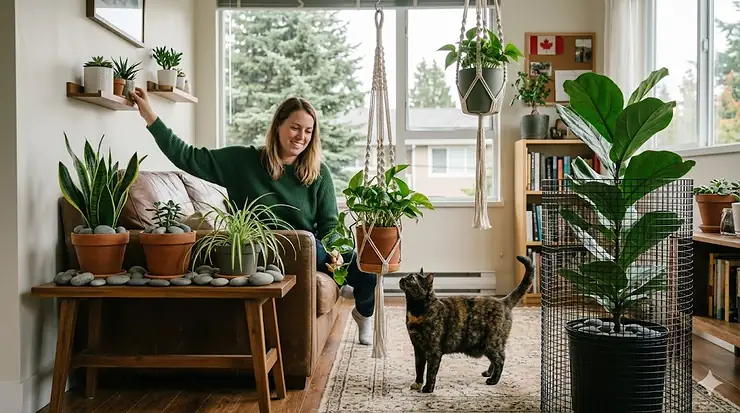
If you’ve ever walked into your living room to find soil scattered across the floor and a guilty-looking cat sitting in your favourite fiddle leaf fig, you already know why cat proof plant protector solutions exist. Cats dig, chew, and nap in pots for reasons that have nothing to do with spite — soil feels like an oversized litter box, leaves are fun to bat at, and a sunny windowsill plant is basically a cat bed with a view. The good news is that you don’t have to choose between a green thumb and a happy cat.

Canadian plant owners have it slightly different from their neighbours south of the border. Long winters mean houseplants — and indoor cats — spend more time together indoors than almost anywhere else in North America, and a growing share of Canadian households filled their homes with houseplants during the pandemic, a trend that has stuck around. That’s a lot of potential cat-versus-plant standoffs happening in condos in Toronto, bungalows in Calgary, and apartments in Halifax.
This guide breaks down seven real cat proof plant protector solutions you can find on Amazon.ca, plus the deterrent sprays, hanging plant protectors for cats, and cat safe indoor garden barriers that actually hold up. We’ll also cover toxic plant protection basics, plant chewing prevention strategies, and a few mistakes that waste green thumb cat owners’ money. All prices below are shown in CAD as ranges, since exact pricing shifts often — always confirm the current price on Amazon.ca before buying.
Quick Comparison Table
| Product Type | Best For | Price Range (CAD) | Cat-Friendly Rating |
|---|---|---|---|
| Motion-activated spray deterrent | Training cats to avoid a specific spot | $45–$65 | ★★★★☆ |
| Cuttable mesh pot grid covers | Stopping digging in individual pots | $15–$22 | ★★★★★ |
| Cuttable prickle/scat mat | Keeping cats off soil and ledges | $15–$25 | ★★★★☆ |
| Plant-based deterrent spray | Scent-training cats away from leaves | $25–$35 | ★★★☆☆ |
| Cat grass planter with grid | Redirecting chewing behaviour | $15–$25 | ★★★★★ |
| Elevated plant stand | Getting plants out of paw’s reach | $35–$70 | ★★★★☆ |
| Mini greenhouse/cloche cabinet | Fully enclosing vulnerable plants | $50–$120 | ★★★★★ |
Looking at this table, no single product is a silver bullet — the mesh grid covers and cat grass planters score highest because they remove temptation rather than relying on a cat reacting “correctly” to a smell or noise. Sprays and motion sensors work well as a second layer, especially for stubborn chewers, but Canadian winters keep cats indoors longer, which means consistent daily use matters more here than in milder climates. Budget-conscious apartment dwellers tend to start with mesh covers and scat mats, while owners of larger or toxic plant collections often combine a barrier with a spray for extra insurance.
✨ Don’t Miss These Exclusive Deals!
🔍 Take your plant protection setup to the next level — click through to check current pricing and availability on Amazon.ca before your cat finds plant number twelve.
Top 7 Cat Proof Plant Protector Solutions: Expert Picks
1. PetSafe SSSCAT Automatic Spray Pet Deterrent
The PetSafe SSSCAT is a motion-activated canister that releases a quick, odourless burst of air when it senses movement within about a metre, and it’s sold through Amazon.ca as well as Canadian retailers like Pet Valu. The sensor range matters more than it sounds: a 3-foot detection radius is wide enough to cover a windowsill grouping of pots, but you’ll want two units if you’re protecting a large plant shelf. Because the spray is unscented and doesn’t stain, it’s one of the few options safe to point directly at fabric-lined plant stands or wicker baskets.
This is best suited to persistent chewers and counter-jumpers rather than cats who simply nap in soil, since it reacts to motion, not presence. Refill canisters run out faster than people expect — budget for a replacement every few weeks in a multi-cat home.
Pros: hands-free, no chemical residue, works even when you’re at work.
Cons: batteries (not included) drain quickly with heavy traffic; some cats habituate to the sound after months of exposure.
Price sits in the $45–$65 CAD range for the starter kit; refill cans typically add another $20–$25 CAD.
2. Catit Senses 2.0 Cat Grass Planter with Protective Grid
Made by Rolf C. Hagen Inc., a Montreal-based pet products company, the Catit Senses 2.0 Cat Grass Planter takes a redirection approach instead of a deterrent one. Its built-in grid sits over the soil to stop digging while the grass grows, and a low, wide base resists tipping when an enthusiastic cat decides to commit to the bit. The seeds and growing medium are sold separately as a refill kit, so factor that into your first purchase.
What makes this a strong fit for Canadian cat owners is that it gives indoor cats — who, during a Canadian winter, may go months without outdoor access — something legitimate to chew that isn’t your monstera. It won’t stop a cat from investigating other pots, but pairing it with a barrier on your real houseplants and a Catit planter as the “approved” chew toy noticeably reduces overall plant damage.
Pros: Canadian-made brand, easy to find on Amazon.ca, doubles as enrichment.
Cons: needs refilling every couple of weeks; doesn’t protect anything except itself.
Price runs $15–$25 CAD for the planter, plus roughly $8–$12 CAD per refill kit.
3. Cuttable Mesh Plant Pot Grid Covers (3–4 Pack)
These cuttable plastic mesh discs — sold under various listings on Amazon.ca with stakes included — sit directly on top of the soil and physically block paws from digging while still letting water and light through. Because the mesh can be trimmed with scissors, one multi-pack typically covers pots ranging from small herb containers to medium floor planters, which makes it one of the more versatile cat safe indoor garden barriers on this list.
The main thing to interpret correctly here: the grid stops digging and soil-flinging, but it does very little against a cat that wants to chew leaves hanging over the rim. Use this as your base layer, then add a spray or elevation if chewing — not digging — is the bigger issue in your home.
Pros: cheap, reusable, works on almost any pot shape.
Cons: visible mesh isn’t exactly decorative; large plants may need two discs joined together.
Expect to pay $15–$22 CAD for a 3–4 pack.
4. Cuttable Cat Scat Mat with Soft Spikes
A scat mat is a flexible plastic strip covered in blunt, finger-like spikes that feel unpleasant under a paw without causing injury — Gardener’s Supply Company popularized the format, and several comparable cuttable versions are listed on Amazon.ca. Because the strip can be trimmed and shaped, it works equally well wrapped around the base of a floor plant, laid across a windowsill, or tucked into the rim of a large planter.
Canadian apartment dwellers with limited floor space often find this more practical than a full barrier system, since one roll can be cut into pieces for multiple problem spots — the top of a bookshelf, the edge of a plant stand, even a balcony railing in summer. The trade-off is appearance: it’s functional, not pretty, so most owners hide it under a layer of decorative moss or bark mulch once a cat has learned to avoid the area.
Pros: flexible, reusable, works indoors and outdoors.
Cons: needs anchoring with staples or ties to stay in place; visible until trained behaviour kicks in.
Price typically lands at $15–$25 CAD for a 6+ foot roll.
5. Nature’s Mace Cat Mace Spray (40 oz)
Nature’s Mace Cat Mace is a plant-based deterrent spray formulated with cinnamon, castor, and peppermint oils rather than synthetic chemicals, and the manufacturer markets it as safe for direct application on plant foliage when used as directed. Unlike contact-irritant sprays, it works on scent and taste aversion, so expect a week or two of consistent reapplication before a cat reliably avoids the treated area — this is a training tool, not an instant fix.
Availability on Amazon.ca can be inconsistent for this specific U.S. brand, so if it’s out of stock when you check, look for a comparable plant-safe, essential-oil-based cat repellent spray as a substitute; the active-ingredient profile (cinnamon, citrus, or peppermint oils) is the feature to match, not the brand name.
Pros: plant-safe formula, works indoors and outdoors, rain-resistant for balcony planters.
Cons: scent is noticeable to humans too; needs reapplication after watering. Price generally falls in the $25–$35 CAD range for a ready-to-use spray bottle.

6. Elevated Plant Stand (Tall, Multi-Tier)
Sometimes the simplest cat proof plant protector solution is moving the plant somewhere the cat can’t comfortably reach. Tall, narrow plant stands — typically 90 cm to 140 cm in height — put pots above the height most cats will casually jump to, especially when the stand’s base is too narrow to be a comfortable landing spot. Multi-tier versions let you cluster several pots at staggered heights, which also happens to look better than a row of mesh-covered planters on the floor.
This solution shines for toxic plant protection specifically: if you own anything from the lily family or other plants flagged on toxic plant lists, getting it physically out of reach is more reliable than any spray, since you’re removing the opportunity for ingestion entirely rather than hoping the cat respects a smell.
Pros: no maintenance once set up, improves room aesthetics, doubles as toxic plant protection.
Cons: determined or younger cats may still climb; not practical for very heavy planters.
Stands run $35–$70 CAD depending on height and material (metal tends to be sturdier than bamboo for persistent climbers).
7. Mini Greenhouse / Plant Cloche Display Cabinet
For a handful of prized or genuinely toxic plants, a fully enclosed mini greenhouse cabinet — a glass or acrylic-fronted display case with shelving — removes cat access entirely while still letting the plant get light. These are sold in various sizes on Amazon.ca under “indoor greenhouse cabinet” or “plant display cabinet” listings, and they double as a humidity booster for tropical species that struggle with dry, heated Canadian homes in January.
This is the most expensive option here, so it’s best reserved for plants that are either irreplaceable, expensive, or genuinely dangerous if eaten — sago palm, certain lilies, or dieffenbachia, for example — rather than as a blanket solution for an entire plant collection.
Pros: total physical separation, bonus humidity control for winter heating season, looks intentional rather than improvised.
Cons: significant upfront cost; limited capacity per unit.
Expect $50–$120 CAD depending on size and shelf count.
Practical Usage Guide: Setting Up Your Cat-Proof System
Getting any of the above products to actually work depends more on setup than on the product itself.
Start with the worst offenders first. Rather than barrier-proofing every pot in the house on day one, identify the two or three plants your cat actually targets and apply a layered defence there — a mesh grid plus a spray, for example — before expanding to lower-risk plants.
Give deterrent sprays time. Scent-based products like Nature’s Mace are training tools, not instant fixes. Reapply every few days for the first two weeks, then taper off as the cat’s habit breaks.
Reapply after watering. Canadian tap water and indoor heating both speed up scent fade indoors; outdoor planters lose deterrent faster after rain. A quick recheck whenever you water solves most “it stopped working” complaints.
Mind the winter humidity swing. Forced-air heating common in Canadian homes from November through March dries out both soil and scat mats’ adhesive backing faster than in summer — check that mats and stakes haven’t loosened every few weeks during heating season.
Common first-30-day mistake: giving up after one application. Most physical barriers work immediately, but scent and motion-based deterrents need repetition before the behaviour change sticks.
Real Canadian Household Scenarios
The downtown Toronto condo dweller with three floor plants and one curious kitten will usually get the most value from cuttable mesh grid covers paired with an elevated stand for anything toxic — condo square footage rewards solutions that don’t take up extra floor space.
The Ottawa family with kids and a senior cat who naps rather than digs is often better served by a simple scat mat around the base of a few favourite plants, since aggressive chewing isn’t the issue — discouraging lounging is.
The Vancouver plant collector with dozens of specimens, including a few toxic varieties, benefits most from combining a mini greenhouse cabinet for the riskiest plants with spot-treatment spray on everything else, since one barrier system won’t scale to a large collection on its own.

How to Choose a Cat Proof Plant Protector in Canada
- Identify the behaviour first. Digging calls for a physical barrier; chewing calls for taste-deterrent spray or relocation; lounging calls for a scat mat or elevation.
- Check toxicity before anything else. If the plant is genuinely toxic, prioritize removal or full enclosure over a deterrent that merely reduces — but doesn’t eliminate — the chance of contact.
- Match the product to your space. Apartments and condos generally do better with compact mesh covers and stands; houses with more floor area can use bulkier scat mats or freestanding greenhouse cabinets.
- Factor in your heating season. Anything relying on scent will need more frequent reapplication during the dry, forced-air months of a Canadian winter.
- Budget for consumables, not just the upfront product. Spray refills, cat grass refill kits, and replacement scat mat staples add up — build that into your CAD budget from the start.
- Consider your cat’s specific motivation. A bored indoor cat chewing out of curiosity responds differently than an anxious cat digging out of stress; the latter may need behavioural support beyond any product.
Common Mistakes When Buying Cat Proof Plant Protector Solutions
- Buying one product for the whole house. A single mesh grid or scat mat rarely fits every pot size — most homes need a mix of solutions.
- Skipping the toxicity check. Owners sometimes invest in deterrents for a plant that should simply be removed or relocated, since some toxic plants pose risk from pollen or sap, not just ingestion.
- Expecting instant results from scent sprays. These work through repeated negative association, not a single application.
- Ignoring the cat’s underlying motivation. Products address access, not always the boredom or anxiety driving the behaviour in the first place.
- Forgetting Canadian seasonal shipping realities. Remote or northern postal codes can see longer delivery windows on bulkier items like greenhouse cabinets — order with a buffer if you’re outside major urban centres.
Deterrent Sprays vs. Physical Barriers: Which Wins?
Sprays and physical barriers solve different problems, and most successful setups use both. A spray relies on the cat learning an association between a smell or sensation and the off-limits area — effective, but it requires consistency and doesn’t physically stop access in the meantime. A barrier like a mesh cover or scat mat removes the option immediately, with no training period, but it can’t address chewing on overhanging leaves the way a taste-deterrent spray can.
For toxic plant protection specifically, barriers and elevation are the more reliable choice, since they don’t depend on the cat’s compliance. For general nuisance digging or scratching, a spray alone is often enough, and it’s cheaper to scale across many pots than buying individual covers for each one. The strongest, lowest-maintenance setups in Canadian homes tend to combine a one-time physical barrier on the highest-risk plants with a spray as backup on everything else.
Canadian Regulations & Safety Standards for Pet Deterrent Products
Any spray-based cat repellent sold in Canada falls under the Pest Control Products Act, administered by Health Canada’s Pesticides Regulatory Directorate. Products legally sold here must be registered, carry a Canadian label, and pass a science-based safety review before they can claim to repel an animal — which is one reason product availability sometimes differs between Amazon.com and Amazon.ca; a formula approved in the U.S. isn’t automatically cleared for sale here. If a listing seems to disappear or show “currently unavailable” on Amazon.ca, that’s often the explanation rather than a stocking issue.
This regulatory layer is also a good reason to avoid unregistered imported sprays purchased through third-party marketplaces, since they may not have gone through the same review. For physical barriers like mesh covers, scat mats, and stands, there’s no equivalent pesticide regulation since no active chemical ingredient is involved — but basic product safety standards still apply to materials like the plastics used in mesh grids and stake points.
It’s also worth knowing which common houseplants are actually a health risk before you decide which products are worth the investment. A Canadian veterinary resource, the New Brunswick Veterinary Medical Association, points pet owners toward the wider toxic and non-toxic plant lists maintained by groups like the ASPCA, which catalogue plants with systemic or gastrointestinal effects on cats — useful groundwork before deciding whether a deterrent is enough or a plant needs to go entirely.

Long-Term Cost & Maintenance in Canada
| Solution | Upfront Cost (CAD) | Ongoing Cost (CAD) | Maintenance Frequency |
|---|---|---|---|
| Mesh pot grid covers | $15–$22 | None | One-time |
| Scat mat | $15–$25 | Replacement ties/staples ~$5 | Yearly |
| Motion-activated spray | $45–$65 | Refill cans ~$20–$25 | Every 4–6 weeks |
| Plant-based spray | $25–$35 | Reapplication (same bottle) | Weekly for 2 weeks, then monthly |
| Cat grass planter | $15–$25 | Refill kits ~$8–$12 | Every 2–3 weeks |
| Elevated stand | $35–$70 | None | One-time |
| Greenhouse cabinet | $50–$120 | None | One-time |
Looking at total cost of ownership rather than sticker price, the one-time physical solutions — mesh covers, stands, and cabinets — work out cheaper over a year than consumable sprays, even though the spray systems often look less expensive at checkout. If you’re protecting more than four or five plants, the math tends to favour investing in barriers up front rather than buying multiple spray refills every month.
Features That Actually Matter (And Those That Don’t)
Matters: mesh thickness and cuttability (a too-thin grid bends under a determined paw), spray bottle nozzle quality (fine mist vs. stream changes how evenly a deterrent coats foliage), and stand base width relative to height (a tall, narrow stand tips more easily than a wider one).
Doesn’t matter much: decorative colour options on scat mats (cats don’t perceive colour the way the packaging implies matters), “extra strength” claims on plant-based sprays (the active ingredients are usually similar concentrations across brands), and oversized multi-packs if you only have two or three plants to protect.

FAQ
❓ Can cats get sick from eating regular potting soil?
❓ Is it safe to ship glass plant cloches and greenhouse cabinets across Canada?
❓ Do cat deterrent sprays work on kittens the same way as adult cats?
❓ What's a non-toxic way to stop a cat from digging without chemicals?
❓ Are scat mats cruel to cats?
Conclusion
There’s no single cat proof plant protector solution that fits every home, but that’s actually good news — it means you can match the product to the specific problem instead of overspending on a do-everything gadget. If digging is the issue, a cuttable mesh grid solves it outright with no ongoing cost. If chewing is the problem, a plant-based spray paired with a cat grass planter redirects the behaviour instead of just blocking it. And for anything genuinely toxic, elevation or a full enclosure is worth the extra investment over hoping a spray works every single time.
Canadian winters mean more indoor time for both plants and cats, so building a routine — reapplying sprays, checking mesh covers, refilling cat grass — matters more here than in climates where pets spend half the year outside. Start with your highest-risk plant, get that one right, and expand from there.
Recommended for You
- 7 Best Childproof Cabinet Locks for Cats in Canada (2026 Guide)
- Best Cat Scratch Carpet Protector for Stairs in Canada 2026 (Top 7 Picks)
- Cat Deterrent for Kitchen Counters: 7 Top Picks for Canada (2026)
Disclaimer: This article contains affiliate links. As an Amazon Associate, I earn from qualifying purchases. If you purchase products through these links, we may earn a small commission at no additional cost to you.
✨ Found this helpful? Share it with your friends! 💬🤗
