
In This Article
Fleas are the world’s worst houseguests. They arrive uninvited, bring the whole extended family, and treat your cat like an all-you-can-eat buffet. If you’re shopping for flea shampoo for cats because you just spotted a suspicious black speck on the couch, take a breath. This is fixable, and you can fix it without risking your cat’s health.
What Is Flea Shampoo for Cats?
Flea shampoo for cats is a medicated or plant-based cleanser that kills adult fleas on contact and rinses flea dirt out of the coat. Cat-labelled formulas use low concentrations of actives such as pyrethrins or insect growth regulators. They are never interchangeable with dog products, some of which can be dangerous to cats.
That last point is why this guide leans harder on safety than most. Health Canada’s own advisory on flea and tick products says to use dog products on dogs and cat products on cats, and to look for a Pest Control Product (PCP) number or a Drug Identification Number (DIN) on the package. Throughout this article, “health approved cat flea shampoo” means a product that carries one of those numbers. Health Canada doesn’t “endorse” brands.
One transparency note. I haven’t bathed a single cat for this piece. Everything below comes from label ingredients, manufacturer specs, regulatory guidance and the aggregated sentiment in published review roundups. I flag where I couldn’t verify something, especially amazon.ca review pools and Canadian PCP numbers. Prices are approximate Canadian-dollar ranges, and they move.
Flea Shampoo for Cats at a Glance: Quick Comparison Table
| Product | Key Actives / Approach | Minimum Age (per label) | Approx. Price Range (CAD) | Best For |
|---|---|---|---|---|
| Adams Plus | Methoprene + pyrethrins + piperonyl butoxide | 12 weeks | C$20–C$30 | Mixed cat-and-dog homes with an active infestation |
| Adams Cleansing Shampoo for Cats | Pyrethrins + piperonyl butoxide + pyriproxyfen | 12 weeks | C$16–C$26 | Cat-only households |
| Sentry PurrScriptions Plus | Pyrethrins + synergist + pyriproxyfen | 12 weeks | C$10–C$18 | Tight budgets |
| Vet’s Best | Plant-based formula | Check label | C$18–C$30 | Owners avoiding pyrethrins |
| SimpleSource | Lemongrass and cedarwood oils | Over 12 weeks | C$16–C$26 | Plant-powered, pyrethrin-free preference |
| Veterinary Formula | Essential-oil blend, dog-and-cat label | Over 12 weeks | C$18–C$30 | Multi-pet homes wanting big bottles |
| Sergeant’s Gold | Pyrethrins + pyriproxyfen + synergist | Check label | C$16–C$28 | Conventional formula with egg control |
Prices are ballpark figures at the time of research, so check current pricing. The pattern worth noticing is that the cat-specific, conventional formulas (Adams Cleansing Shampoo for Cats, Sentry PurrScriptions Plus) cluster at the budget end. The plant-based options (Vet’s Best, SimpleSource) cost more per millilitre, and you’re paying for the pyrethrin-free positioning. If you have one cat and one bathroom, Sentry PurrScriptions Plus makes the lowest-risk financial bet. Multi-pet homes will find Veterinary Formula or Adams Plus more practical.
💬 Just one click — help others make better buying decisions too!😊
Top 7 Flea Shampoo for Cats: Expert Analysis
Each pick below is judged on what the label says, what the numbers mean in practice, and what review roundups consistently report. Check the PCP number on whichever bottle reaches your door.
1. Adams Plus Flea & Tick Shampoo with Precor — egg-hatch control for up to 28 days
The headline feature is Precor (methoprene), an insect growth regulator. It targets the stage that most shampoos ignore: eggs.
The listing I reviewed shows methoprene at 0.10%, pyrethrins at 0.15% and piperonyl butoxide at 1.88%. Piperonyl butoxide is a synergist that makes pyrethrins hit harder. In plain English, the pyrethrins knock down adult fleas on contact while the methoprene stops eggs from maturing. The label suggests repeating every 7 to 10 days if needed, with egg-hatch inhibition lasting about 28 days.
Based on the spec comparison, this is a dog-and-cat formula with a stronger pyrethrin load than the cat-only Adams Cleansing Shampoo for Cats. That makes it a sensible choice for homes where the dog and the cat are both scratching. Cat-only households should read the cat directions twice. Its US listing sat near 4.4 out of 5 across tens of thousands of ratings when I checked, and review roundups often name it a top overall pick. I couldn’t verify the amazon.ca rating pool.
Pros:
- ✅ Insect growth regulator targets flea eggs
- ✅ One bottle covers cats and dogs
- ✅ Extremely well-reviewed on the US listing
Cons:
- ❌ Higher pyrethrin strength than cat-only formulas
- ❌ A bath, not a monthly preventive
Expect to pay around C$20–C$30. Good value for mixed-pet infestations.
2. Adams Flea & Tick Cleansing Shampoo for Cats — cat-only formula with roughly 30-day egg control
If Adams Plus is the multi-pet workhorse, this is its cat-only sibling.
The label lists pyrethrins at 0.075%, piperonyl butoxide at 0.750% and pyriproxyfen, another growth regulator, at 0.086%. Half the pyrethrin concentration of the Precor version means a gentler profile on paper. The directions are specific: 1–2 tablespoons worked into the coat, then five minutes of lather contact before rinsing. That five-minute wait is where the killing happens, so don’t skimp on it. The brand also advises consulting a veterinarian before use on debilitated, aged, medicated, pregnant or nursing animals.
Who is it for? Anyone with cats only and no dog-product confusion at home. The cat-only labelling removes the wrong-species risk that causes so many poisonings. I couldn’t verify a large, current review pool for this exact cat-only listing on amazon.ca, so check the rating count before buying.
Pros:
- ✅ Cat-and-kitten-only label avoids species mix-ups
- ✅ Lower pyrethrin concentration than the dual-species version
- ✅ Growth regulator targets egg development
Cons:
- ❌ Five-minute lather time tests cat patience
- ❌ Review pool unverified for amazon.ca
Around C$16–C$26. Solid value for single-species homes.
3. Sentry PurrScriptions Plus Flea & Tick Shampoo for Cats & Kittens — the budget pick with a growth regulator
Budget doesn’t have to mean bare-bones here.
The label lists pyrethrins at 0.05%, a synergist (N-octyl bicycloheptene dicarboximide) at 0.50%, and pyriproxyfen at 0.01%. The pyrethrin concentration is the lowest of the conventional picks in this roundup. For a nervous cat or a small owner-to-cat ratio, lower is reassuring. Directions say to use only on cats, not on cats under 12 weeks, and to consult a vet for medicated, aged, pregnant or nursing cats. Roundups describe a spring-freesia scent plus a conditioning, deodorizing effect, and one lists it as the cheapest cat flea shampoo they’d seen.
On a budget, it’s an easy yes. The caveat is that cheap and low-strength doesn’t suit a heavy infestation. Consider the Adams Plus route there. I couldn’t verify amazon.ca review data for this specific listing.
Pros:
- ✅ Lowest pyrethrin load among conventional picks
- ✅ Cat-only label with clear age restriction
- ✅ Typically the cheapest in roundups
Cons:
- ❌ May under-deliver on severe infestations
- ❌ Fragranced, which some cats dislike
Roughly C$10–C$18. Best value for light-to-moderate cases.
4. Vet’s Best Plant-Based Formula Flea & Tick Cat Shampoo — pyrethrin-free for cat-specific skin
This is the pick for owners who want to skip pyrethrins entirely.
Roundups describe it as plant-based and formulated specifically for cats, and one names it a top choice for kittens. I couldn’t verify its minimum age, so read the bottle, because kittens under 12 weeks are a veterinary conversation regardless. One honest caveat: “natural” doesn’t mean “risk-free.” Plant oils can irritate skin, and cats process some essential oils slowly. Another is that, as far as I could verify, the labels don’t list a growth regulator, so egg control may be thinner than with Adams Plus.
The cost sits at the premium end. One roundup flags it as one of the pricier ways to treat fleas. If your cat has sensitive skin and a mild flea problem, it’s worth the splurge. If your couch is already crawling, a conventional shampoo and a flea comb will beat it.
Pros:
- ✅ Pyrethrin-free, plant-based formula
- ✅ Made specifically for cats
- ✅ Popular in kitten-focused roundups
Cons:
- ❌ Pricier than conventional budget picks
- ❌ Egg-control claims less clear than IGR formulas
Roughly C$18–C$30. Worth it only if avoiding pyrethrins matters to you.
5. SimpleSource Flea & Tick Cat Shampoo — lemongrass and cedarwood in a pyrethrin-free bottle
Plant power is the pitch, and it’s backed by a short ingredient list: cedarwood oil, lemongrass oil, geraniol and sodium lauryl sulfate.
The brand says it kills fleas, flea eggs, larvae and ticks while deodorizing the coat. Treat that as a brand claim, because I couldn’t independently verify it. Roundups say it’s safe for adult cats and kittens over 12 weeks. The sodium lauryl sulfate is a strong cleanser, which means a thorough rinse matters. Rinse-off essential oils are lower-risk than leave-on ones, but many veterinarians still urge caution with concentrated oils on cats, so run it past yours first, particularly for kittens or cats with health conditions.
The sweet spot is an owner who wants to avoid synthetic actives and accepts a probable trade-off in residual protection. Expect a distinctly herbal scent, and your cat may have opinions about it.
Pros:
- ✅ Short, plant-based ingredient list
- ✅ Pyrethrin-free alternative
- ✅ Over-12-weeks labelling is clear
Cons:
- ❌ Essential oils warrant a vet check first
- ❌ Strong herbal scent may bother some cats
Around C$16–C$26. Fair value if plant-powered is your priority.
6. Veterinary Formula Clinical Care Flea & Tick Shampoo — big bottles for multi-pet households
Size is the story here. Roundups mention 16-fl-oz (about 473 mL) and one-gallon (about 3.8 L) options. That’s a lot of bath.
It’s labelled for dogs and cats over 12 weeks. A retailer listing names clove, lemongrass, cedarwood, cinnamon and sesame seed oils among its ingredients. Clove and cinnamon oils in particular are strong, and many vets are cautious about using them around cats, so a quick vet check makes sense here. One roundup names it the best value for money.
Who benefits? Households with several pets or a foster-cat habit, where a larger bottle gets used before it expires. Single-cat owners may find it overkill. I couldn’t verify amazon.ca review data for this exact listing.
Pros:
- ✅ Large sizes lower the per-bath cost
- ✅ Dog-and-cat label suits multi-pet homes
- ✅ Frequently named best value in roundups
Cons:
- ❌ Strong essential-oil blend needs vet input
- ❌ Overkill for single-cat households
Around C$18–C$30 for the 16-fl-oz size. Best value when you actually need the volume.
7. Sergeant’s Gold Flea & Tick Cat Shampoo — conventional formula with residual egg control
This is the “premium conventional” pick in several roundups.
The Sergeant’s pyrethrin-pyriproxyfen shampoo family lists pyrethrins, pyriproxyfen, piperonyl butoxide and a second synergist as actives. The label copy I reviewed claims immediate killing from the pyrethrins and residual egg action for about a month. It also appears to limit repeat bathing on cats, roughly twice a month, so follow the bottle in front of you. The sheer number of actives suggests thoroughness, but more actives also means more to read, so confirm age limits and PCP status on your copy.
It suits owners who want a conventional, growth-regulator-equipped formula and don’t mind paying a bit more. I couldn’t verify amazon.ca review data.
Pros:
- ✅ Pairs adult-flea killer with egg control
- ✅ Cat-specific variant exists
- ✅ Named a premium choice in roundups
Cons:
- ❌ Label limits how often you can re-bathe cats
- ❌ Review pool unverified for amazon.ca
Roughly C$16–C$28. Fair value for the conventional-plus-IGR combination.
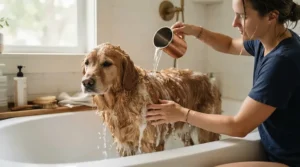
Flea Shampoo for Cats: Your Step-by-Step Bath and Flea Comb Routine
Buying the right bottle is half the job. Technique is the other half. Here is a routine built around what the labels and the veterinary guidance agree on.
- Prep your space. Close the bathroom door, lay down a non-slip mat, and gather towels, a regular brush and a flea comb before the cat enters the room.
- Brush, then comb. Detangle first. Then work a flea comb through the coat, pulling gently upward against the skin, and dunk every catch into a cup of soapy water. Skip towels at this stage because they trap stray fleas and eggs.
- Wet with lukewarm water. Soak the coat thoroughly, avoiding eyes, ears and nose.
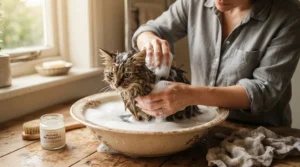
- Apply and lather. Follow your label’s amount. For example, Adams Cleansing Shampoo for Cats asks for 1–2 tablespoons and about five minutes of lather contact.
- Rinse like you mean it. Leftover shampoo ends up in your cat’s mouth during grooming.
- Towel dry, keep warm, then comb again. A second pass catches survivors.
- Wash bedding hot and vacuum. Roughly 95% of a flea population lives in the home, not on the cat.
Common mistakes in the first 30 days: bathing too often (labels set repeat limits), skipping the home clean-up, and expecting one bath to finish a flea life cycle that can run three weeks or more. Watch for drooling, twitching or lethargy after the bath. Those signs mean a call to your vet, not a wait-and-see.
Problem → Solution Guide: When Flea Shampoo for Cats Isn’t Working
Problem: “My cat hates baths.” Start with the flea comb alone for a few days. It’s non-toxic, it shows you whether fleas are present at all, and it’s the only option for very young kittens. If baths are non-negotiable, use a sink with a non-slip mat and a second person.
Problem: “Fleas came back in three days.” That is almost always the environment talking. Adult fleas are a small fraction of the problem. Eggs and larvae in carpets and bedding re-seed the cat. Wash bedding hot, vacuum daily, and ask your vet about a monthly preventive. Shampoos like Adams Plus and Sergeant’s Gold include egg control, but they can’t reach what’s in your sofa.
Problem: “The itching continues even after the fleas are gone.” Some cats develop a strong reaction to even a single bite. This is flea allergy dermatitis, and it needs a vet, not a stronger shampoo.
Problem: “My kitten is under 12 weeks.” Every label in this roundup draws a line at 12 weeks, or tells you to check. Use the flea comb and call your vet.
Problem: “I have a dog on a permethrin product.” Keep the cat away from the dog until the product is dry. That can take up to 24 hours for spot-ons. More on this below.
How to Choose Flea Shampoo for Cats: 7 Steps
- Confirm it’s labelled for cats. Species labelling is the single biggest safety lever. Dog-only products can be dangerous.
- Find the PCP or DIN number. Health Canada says products on pets should carry one of these. The agency’s pesticide compliance page explains how to confirm a registration, and says inspections cover online sales too.
- Check the minimum age. Twelve weeks is the common floor.
- Match the formula to the infestation. Light problem? A lower-strength option like Sentry PurrScriptions Plus may do. Heavy problem? Consider growth-regulator formulas such as Adams Plus.
- Decide on conventional or plant-based. Pyrethrin-free picks like Vet’s Best and SimpleSource trade potency for philosophy. Neither is automatically safer.
- Think about the whole household. Dogs, kittens, pregnant or medicated cats each change the answer. Ask your vet.
- Plan the follow-up. Shampoo is a rescue. A flea comb and a preventive are the maintenance plan.
Is Permethrin Safe for Cats? What Veterinary Science and Health Canada Say
Short answer: not in dog-strength products, and not worth gambling on. If you’ve been wondering whether permethrin is safe for cats, here is the evidence.
Permethrin is a synthetic pyrethroid that dogs process efficiently and cats don’t. A veterinary review describes cats as especially sensitive because their liver handles the compound poorly. Signs include drooling, paw flicking, ear twitching, tremors, seizures and, in the worst cases, death. Symptoms usually appear within minutes to hours of exposure, though they can be delayed up to 72 hours.
Concentration is the crux. Dog spot-ons commonly run around 45–65% permethrin, while feline-marketed products contain far less. A CBC Marketplace investigation found that Health Canada received 4,726 incident reports involving cats and dogs and topical flea treatments between 2009 and 2013, and it noted labelling rules introduced in 2012 requiring clearer warnings on some dog products.
Practical rules:
- Never use a dog flea product on a cat, even a “small amount” of it.
- Don’t split a dog dose among pets.
- Keep cats away from recently treated dogs until the product dries.
- Treat any exposure as an emergency and call your vet immediately.
Natural pyrethrins, the actives in several shampoos above, are a different compound from permethrin. They are used at low concentrations in cat-labelled products, but sensitivities can still happen.
PMRA Registration Explained: How to Spot a Health Approved Cat Flea Shampoo
PMRA is Health Canada’s Pest Management Regulatory Agency. It regulates pest control products, and that includes pet flea and tick products. Ask what “health approved cat flea shampoo” should mean, and the grown-up answer is PMRA registration.
A registered pet pesticide carries a registration number on the label, formatted something like “Registration No. 00000 Pest Control Products Act.” Products sold as veterinary drugs carry a DIN instead. Health Canada says only products bearing a PCP or DIN number should be used on pets, because that number means the product was reviewed for safety and effectiveness.
Here is the catch for shoppers. A bottle made for the US market may carry a US EPA registration number, which is not PMRA registration. Health Canada has tightened rules on importing unregistered pesticides, so a US-labelled bottle shipped across the border can be a red flag. I couldn’t verify the PCP status of each product in this roundup, so check the bottle you receive. You can confirm a number with Health Canada’s Search Product Label tool.
Why does it matter in practice? In a Health Canada-linked analysis of incident reports, the PMRA received 708 companion-animal reports about spot-on flea and tick products between April 2007 and May 2009. Over 75% of flea and tick incidents involved spot-ons, and cat incidents were reported more often than dog incidents. Shampoos weren’t the main culprit, but the lesson holds: labels are the safety system.
Fast-Acting Flea Shampoo for Cats: What “Fast” Really Means
“Fast-acting flea shampoo for cats” is a marketing phrase, so let’s translate it. Shampoos kill adult fleas on contact, which is why contact time matters. Adams Cleansing Shampoo for Cats specifies five minutes of lather. The “fast” is real, but it only applies to fleas currently on your cat.
What fast does not mean:
- It doesn’t mean long-lasting. Once the shampoo is rinsed, it won’t stop new fleas from jumping aboard.
- It doesn’t mean egg-proof. Formulas with growth regulators, like Adams Plus and Sergeant’s Gold, address eggs, but the brand’s own claim is about one month.
- It doesn’t mean safe to repeat daily. Label limits exist for a reason.
For pure speed, the best pairing is a conventional shampoo for the initial knockdown, a flea comb for the survivors, and a vet-recommended preventive to prevent a rerun. If you need very rapid relief, say for a cat covered in fleas, ask your vet about faster options than a bath. The cat’s comfort, and the cat’s tolerance for bath time, count.
Flea Shampoo for Indoor Cats: Do They Really Need One?
Probably not routinely, but yes when fleas show up. Indoor cats get fleas more often than people expect. Fleas hitch rides on dogs, shoes, trouser cuffs and visiting pets, and an apartment neighbour’s infestation can seep through a shared wall.
Veterinary guidance is clear that all cats, including indoor-only cats, can get fleas. Cats are also such good self-groomers that they remove much of the evidence, so you may notice the flea dirt before the fleas.
A sensible plan for flea shampoo for indoor cats:
- Check weekly with a flea comb. If it’s clean, stop there.
- Do the paper test. Dab combed debris on damp white paper. Red-brown smears suggest flea dirt, which is digested blood.
- Bathe only when fleas are confirmed. A gentle, cat-specific option like Sentry PurrScriptions Plus suits light cases.
- Talk to your vet about prevention. Shampoo is the rescue, not the routine.
Flea Comb vs Flea Shampoo for Cats
A flea comb is the quiet hero of this whole story. It’s cheap, non-toxic, and doubles as a detection tool. Metal teeth last longer and suit thick or matted coats. Short teeth suit short-haired cats and kittens, and longer teeth help with long fur. The comb can’t reach every flea or egg, so it works best alongside other methods.
| Method | Speed | Lasts | Best For | Watch-Out |
|---|---|---|---|---|
| Flea comb | Immediate, per pass | Only as long as you keep combing | Kittens, detection, mild cases | Time-consuming; misses some eggs |
| Flea shampoo (e.g., Sentry PurrScriptions Plus) | Kills on contact in the bath | Egg control for weeks on some formulas | Active infestations | Bath stress; label limits on repeats |
| Growth-regulator shampoo (e.g., Adams Plus) | Contact kill plus egg control | Roughly 28–30 days of egg-hatch inhibition per labels | Heavier infestations | Stronger actives; read cat directions |
| Vet-recommended preventive | Varies by product | Typically monthly | Ongoing protection | Needs a vet conversation |
The table shows why a flea comb and flea shampoo for cats belong together. The comb confirms the problem and cleans up survivors, while the shampoo does the heavy lifting in the bath. Neither provides ongoing protection, which is the preventive’s job. Think of it as a three-part team: comb, bath, preventive.
Long-Term Cost and Value: What Flea Shampoo for Cats Really Costs
| Product | Typical Size | Approx. Price Range (CAD) | Value Verdict |
|---|---|---|---|
| Sentry PurrScriptions Plus | 12 fl oz (~355 mL) | C$10–C$18 | Best entry price |
| Adams Cleansing Shampoo for Cats | 12 fl oz (~355 mL) | C$16–C$26 | Good for cat-only homes |
| Adams Plus | 12 fl oz (~355 mL) | C$20–C$30 | Strong for multi-pet infestations |
| SimpleSource | 12 fl oz (~355 mL) | C$16–C$26 | Fair for plant-based buyers |
| Veterinary Formula | 16 fl oz (~473 mL) or larger | C$18–C$30 | Best per-mL value |
| Vet’s Best | 12 fl oz (~355 mL) | C$18–C$30 | Premium for pyrethrin-free |
| Sergeant’s Gold | Typically 12 fl oz; check listing | C$16–C$28 | Fair for conventional plus egg control |
These are approximate ranges, so check current prices. A bottle holds enough shampoo for several baths, and most cats need one or two. Per-use cost is therefore small. Where owners actually lose money is repeat purchases when a home isn’t treated, so factor in a flea comb, a vacuum and a vet-recommended preventive. A single successful treatment beats three failed baths.

FAQ
❓ Can I use dog flea shampoo on my cat?
❓ How often can I use flea shampoo for cats?
❓ Is a flea comb enough on its own?
❓ What age can kittens have flea shampoo?
❓ Do I need to treat my home too?
Conclusion
Choosing flea shampoo for cats comes down to three questions: is it labelled for cats, does it carry a PCP or DIN number, and does it fit your cat’s age and health? For most cat-only homes, Sentry PurrScriptions Plus and Adams Cleansing Shampoo for Cats are the logical starting points. Multi-pet households may prefer Adams Plus or Veterinary Formula. If you want to skip pyrethrins, Vet’s Best and SimpleSource are the plant-based routes, with the usual essential-oil caveats. Sergeant’s Gold rounds out the conventional options with egg control.
Remember the bigger picture. A bath kills fleas on the cat, but a flea comb, a clean home and a vet-recommended preventive keep them gone. And if your question was whether permethrin is safe for cats, the answer is no for dog-strength products, so keep them well apart.
Not every claim here could be independently verified, particularly amazon.ca review pools and the Canadian registration status of each bottle. Treat the label and your vet as the final word.
✨ Ready to put your cat’s comfort first?
🛒 Check current prices and availability on amazon.ca, confirm the PCP number on the label, and give your cat a flea-free home. 🐾
Recommended for You
- Best Cat Shampoo: 7 Proven Picks For Canadian Cats (2026)
- Two-Way Audio Pet Camera For Elderly Cat Owners: 7 Easy Picks (2026)
- Two-Way Audio Camera vs One-Way Audio Pet Camera: 7 Best Picks 2026
Disclaimer: This article contains affiliate links. As an Amazon Associate, I earn from qualifying purchases. If you purchase products through these links, we may earn a small commission at no additional cost to you.
✨ Found this helpful? Share it with your friends! 💬🤗
