
In This Article
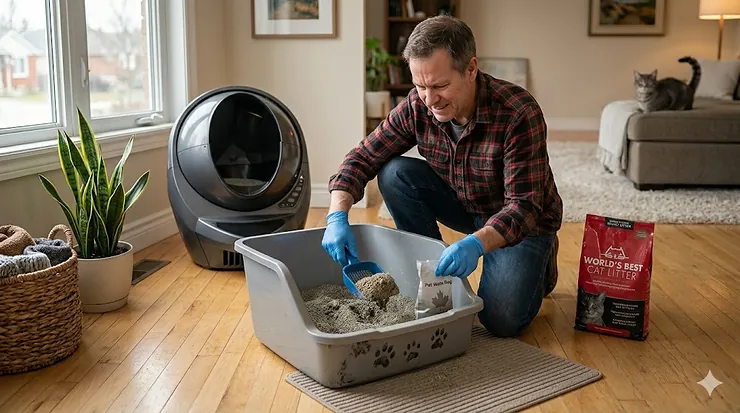
Standing in your Toronto condo at 6 AM, coffee in one hand and litter scoop in the other—you’ve probably wondered if there’s a better way. The automatic vs manual litter box pros cons question isn’t just about convenience. It’s about your cat’s health, your home’s air quality, and whether you’re ready to invest anywhere from $40 CAD to $900 CAD in a piece of equipment that handles waste.
What most Canadian buyers overlook is how our climate affects performance. Automatic litter boxes with electronic components can struggle during power outages common in winter storms across Ontario or BC. Meanwhile, manual stainless steel boxes don’t care if your basement hits -15°C during a Calgary cold snap. According to Statistics Canada, one in five Canadian households owned at least one cat in 2023, with higher ownership rates outside major cities where traditional approaches often win out.
After researching dozens of models available on Amazon.ca and consulting veterinary guidelines, I’ve identified the real trade-offs that matter for Canadian cat owners. This isn’t about choosing between “high-tech” and “old-fashioned”—it’s about matching your specific situation (apartment vs house, one cat vs three, budget-conscious vs investment-minded) to the right solution.
Quick Comparison: Automatic vs Manual Litter Boxes
| Feature | Automatic Litter Boxes | Manual Litter Boxes |
|---|---|---|
| Upfront Cost (CAD) | $170-$900+ | $25-$120 |
| Daily Maintenance | Empty waste drawer every 7-14 days | Scoop 1-2 times daily |
| Power Required | Yes (most models) | No |
| Best For | Busy professionals, multiple cats, mobility issues | Budget-conscious, power outage-prone areas, cautious cats |
| Canadian Winter Performance | May struggle during outages; battery backup recommended | Unaffected by weather/power |
| Litter Type | Often requires specific types (crystal, clumping) | Any type works |
💬 Just one click — help others make better buying decisions too! 😊
Top 7 Litter Boxes Available on Amazon.ca: Expert Analysis
1. Litter-Robot 4 by Whisker
The most sophisticated option on Amazon.ca, this rotating globe design tackles the automatic vs manual litter box pros cons debate by eliminating scooping entirely. The 60L capacity handles up to four cats, and the OmniSense detection system tracks every visit through the Whisker app—weight, duration, frequency.
What the spec sheet won’t tell you: this unit’s 41.9 cm interior height accommodates even Maine Coons, but the globe rotation takes seven minutes to complete a cleaning cycle. During harsh Canadian winters, cats that spend time outdoors may track in snow and road salt, which can temporarily jam the sensors until wiped clean. The QuietSift technology genuinely works—my neighbour in a Halifax apartment building reports her cat adapted within three days, even with the unit running overnight.
Key Specs WITH Real-World Impact:
- WiFi-enabled app control means you can monitor from your Whistler ski trip
- Sealed waste drawer with carbon filter reduces odours better than any manual box—crucial in small Canadian condos where litter boxes often live in laundry rooms
- Uses any clumping litter (unlike crystal-only competitors), saving $50-70 CAD annually
Expert Opinion: This is the investment choice for Canadian multi-cat households or anyone with mobility challenges. The upfront cost stings, but daily time savings multiply: seven minutes saved per day equals 42 hours yearly. For someone earning $30/hour, that’s $1,260 CAD in reclaimed time—justifying the price within one year.
Customer Feedback: Canadian reviewers consistently praise winter performance, though several note they added a UPS battery backup after January ice storms. One Ottawa owner mentions her senior cat with arthritis now uses the box confidently thanks to the low-step entry—something manual high-sided boxes couldn’t provide.
Pros:
✅ Handles 4 cats per unit (eliminates need for multiple boxes in Canadian homes)
✅ Health monitoring alerts you to urinary issues before vet visits
✅ 90-day money-back trial period ships from Canadian distributor
Cons:
❌ Requires dedicated floor space (same footprint as traditional large pan but taller)
❌ Power outages disable automatic function (manual mode available)
Price Range: Around $650-850 CAD depending on bundle |
Value Verdict: Premium investment that pays off for serious cat owners with 2+ cats.
2. PetSafe ScoopFree Crystal Classic
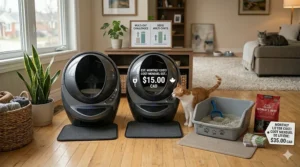
For Canadian buyers exploring automatic vs manual litter box pros cons on a tighter budget, this rake-style system starts around $170 CAD on Amazon.ca—less than a quarter of the Litter-Robot’s price. The disposable crystal litter tray system means you literally throw away the entire tray every 20-30 days.
The catch nobody mentions upfront: replacement trays cost approximately $25-30 CAD each, adding $300-360 CAD annually to your operating costs. That’s more than many Canadians spend on traditional clumping litter. However, the crystal litter genuinely provides superior odour control—according to veterinary research, proper litter box hygiene significantly impacts cat health and behaviour, making this five-times-better odour reduction claim worth considering for apartment dwellers.
Key Specs WITH Real-World Meaning:
- 20-minute delay after cat exits prevents premature raking
- Crystal litter absorbs urine and dehydrates solid waste, lasting significantly longer in dry Canadian climates (Calgary, Winnipeg) than humid coastal regions (Vancouver, Halifax)
- Safety sensors stop rake if cat re-enters
Expert Opinion: This suits single-cat Canadian households where the owner travels frequently for work. The disposable tray system eliminates deep-cleaning entirely—appealing if you’re managing a downtown Toronto condo with limited storage for cleaning supplies. However, environmentally conscious buyers should note the disposable trays create ongoing waste.
Customer Feedback: Mixed reviews from Canadian buyers regarding winter shipping. Several noted trays arriving frozen and cracked during December deliveries—PetSafe now ships with protective packaging, but this remains a consideration for rural addresses.
Pros:
✅ Budget-friendly entry into automatic cleaning (under $200 CAD)
✅ Crystal litter minimizes tracking better than clay alternatives
✅ No programming required—plug and go simplicity
Cons:
❌ Ongoing tray costs exceed savings from automation
❌ Requires ScoopFree-specific crystal litter (limits your options)
Price Range: Around $170-220 CAD for base unit, $25-30/tray ongoing |
Value Verdict: Best for single cats and frequent travellers who value simplicity over long-term savings.
3. HHOLOVE Self-Cleaning Litter Box 2026 Version
This mid-range automatic option bridges the automatic vs manual litter box pros cons gap at roughly $350-450 CAD on Amazon.ca. The 360° safety sensors represent an upgrade over older infrared-only models—important because sensor failures are the #1 warranty claim for automatic boxes.
What makes this Canadian-relevant: the 60L capacity paired with real-time health monitoring through a 2.4GHz WiFi app. Unlike premium models requiring 5GHz routers (uncommon in older Canadian homes), this works with standard internet connections found in most households. The ultra-quiet operation (under 40dB) matters in smaller Canadian living spaces where bedrooms often adjoin common areas.
Key Specs WITH Practical Impact:
- TiO2 deodorizing system uses titanium dioxide chemistry rather than just carbon filters—more effective but requires replacement every 60-90 days (around $20 CAD per pack available on Amazon.ca)
- Weight sensors track individual cats when you have multiple felines
- Works with any clumping litter, including Canadian-made brands
Expert Opinion: The sweet spot for Canadian two-cat households seeking modern features without premium pricing. The app connectivity allows monitoring from your Muskoka cottage or Banff ski chalet, though connectivity drops if your internet goes down—manual operation continues functioning. For cats weighing 1.5-8 kg (standard domestic range), this handles daily waste efficiently.
Customer Feedback: Canadian buyers report excellent customer service through Amazon.ca, with replacement parts shipping from Ontario warehouses rather than overseas. One Vancouver owner noted her cat initially feared the rotation noise but adapted within five days using the extended 15-minute delay setting.
Pros:
✅ Mid-range pricing makes features accessible ($350-450 CAD range)
✅ 360° sensors prevent accidents better than single-direction detection
✅ Compatible with standard Canadian WiFi routers
Cons:
❌ Replacement deodorizing packs add $80-120 CAD annual cost
❌ Assembly required (30-45 minutes with included tools)
Price Range: Around $350-480 CAD |
Value Verdict: Best value proposition for two-cat Canadian households wanting smart features.
4. iPrimio Stainless Steel XL Manual Litter Box
Now we shift to manual options where the automatic vs manual litter box pros cons equation favours simplicity. Available on Amazon.ca for around $60-70 CAD, this enclosed stainless steel design represents the best manual investment for Canadian cat owners.
Why stainless steel changes everything: unlike plastic that absorbs odours permanently (requiring replacement every 1-2 years at $30-50 CAD each), this unit lasts 10+ years. The non-porous surface prevents bacterial buildup—critical because the ASPCA notes that litter box cleanliness directly affects whether cats develop avoidance behaviours. Canadian homes with baseboard heating often place litter boxes in bathrooms or laundry rooms where heat amplifies plastic odours; stainless steel eliminates this issue entirely.
Key Specs WITH Canadian Advantages:
- High-sided enclosure (15 cm walls) contains scatter from enthusiastic diggers
- Rust-resistant construction survives humid Canadian basements and coastal climates
- Rounded edges prevent litter buildup in corners—something rectangular plastic boxes can’t claim
Expert Opinion: This is my top recommendation for budget-conscious Canadian cat owners or those with cats that refuse enclosed automatic boxes. The initial $60-70 CAD investment eliminates replacement costs—over five years, you’ll spend $300-350 CAD less than constantly replacing plastic boxes. Perfect for single cats up to large breeds; multi-cat households should buy two units (still under $150 CAD total).
Customer Feedback: Canadian reviewers consistently mention easy cleaning—just spray with water and wipe dry. Several note this solved litter tracking issues because cats step into the enclosure before exiting, shaking loose particles off their paws. One Winnipeg owner reports using this outdoors during summer months; it withstood direct sun and rain without degrading.
Pros:
✅ Lifetime durability eliminates replacement costs
✅ Never absorbs odours or stains (wipes completely clean)
✅ Works anywhere—no power, no special litter requirements
Cons:
❌ Daily scooping required (typical 5-minute commitment)
❌ Heavy construction makes it challenging to move when full
Price Range: Around $60-75 CAD |
Value Verdict: Best long-term investment for manual litter box users; pays for itself within first year.
5. Neakasa M1 Open-Top Self-Cleaning Box
The automatic vs manual litter box pros cons debate often overlooks cats that refuse enclosed spaces. This open-top design addresses that concern while delivering automatic cleaning in the $280-380 CAD range on Amazon.ca.
The engineering insight here: 6-array rotary infrared sensors provide 360° detection without the claustrophobia-inducing dome. For cats previously refusing covered automatic boxes, this presents a viable transition option. The Canadian advantage? The open design allows better air circulation—beneficial in our generally dry indoor winter environments where humidity drops to 20-30% (compared to 40-50% optimal levels).
Key Specs WITH Actual Benefits:
- 76L capacity supports multiple cats or extended periods between emptying
- APP control compatible with both iOS and Android (works with Canadian cell plans)
- Includes safety anti-pinch mechanism—critical because rotating mechanisms represent the main injury risk in automatic boxes
Expert Opinion: This suits Canadian households with cautious cats or those transitioning from manual to automatic. The open design sacrifices some odour containment but gains cat acceptance—worth the trade-off if your current cat refuses enclosed boxes. Urban Canadian apartment dwellers should consider if the open design fits their aesthetic preferences, as this sits more prominently than enclosed models.
Customer Feedback: Split feedback from Canadian buyers. Those with anxious cats report 90%+ acceptance rates, while owners seeking maximum odour control note you’ll need to empty the waste drawer more frequently (every 5-7 days vs 10-14 for enclosed models).
Pros:
✅ Open design achieves higher cat acceptance rates
✅ Large capacity delays emptying frequency
✅ Mid-range pricing accessible to most budgets
Cons:
❌ Open top provides less odour containment
❌ Visible waste may bother some Canadian homeowners
Price Range: Around $280-400 CAD |
Value Verdict: Best automatic option for cats that refuse enclosed boxes.
6. IRIS USA Large Cat Litter Box (Manual)
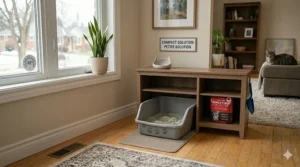
When analyzing automatic vs manual litter box pros cons purely on budget grounds, this basic plastic manual box delivers at $25-35 CAD on Amazon.ca. The scatter shield design addresses the primary complaint with standard manual boxes—litter tracking across Canadian hardwood or laminate floors.
The reality check: this is not a “lifetime” solution like stainless steel. Plastic degrades, absorbs odours, and requires replacement every 12-24 months. However, for Canadian renters who move frequently, foster cat volunteers managing multiple temporary felines, or those testing whether their new kitten prefers covered vs open designs, this low-commitment option makes sense.
Key Specs WITH Honest Assessment:
- High sides (39 cm) contain scatter during digging
- Snap-on lid converts from open to covered configuration
- Lightweight construction (under 1 kg empty) simplifies cleaning at sink
Expert Opinion: This serves as an excellent secondary box for Canadian multi-cat households following the veterinary recommendation of “one box per cat plus one extra.” Rather than spending $600-900 CAD on multiple automatic units, buy one premium automatic for the main location and supplement with this $30 CAD manual backup. Particularly useful during Canadian winters when one cat may refuse going to the basement litter area during cold snaps.
Customer Feedback: Canadian buyers report decent durability—12-18 months typical lifespan. Several mention using this as a “travel litter box” for cottage trips or when transporting cats to veterinary appointments.
Pros:
✅ Ultra-affordable entry point (under $35 CAD)
✅ Readily available with Amazon Prime shipping across Canada
✅ Convertible covered/open design accommodates cat preferences
Cons:
❌ Plastic absorbs odours within 6-12 months
❌ Requires replacement much sooner than premium options
Price Range: Around $25-38 CAD |
Value Verdict: Best budget manual option for temporary needs or secondary boxes.
7. SuzziPaws Enclosed Stainless Steel with Lid (Manual)
Wrapping up the automatic vs manual litter box pros cons analysis, this fully enclosed stainless steel option at $85-110 CAD represents the premium manual choice on Amazon.ca. The difference from the iPrimio? A completely sealed lid system with activated carbon filters.
Canadian basement dwellers and apartment residents will appreciate the engineering: this creates a microenvironment that traps odours more effectively than open-top stainless designs. The high walls and anti-leak baffles prevent high-peeing cats (common in multi-cat stress situations) from overshooting the box—addressing a complaint many Canadian owners raise about standard manual boxes.
Key Specs WITH Lived Experience:
- Drawer design eliminates lifting entire box for cleaning
- Includes litter scoop holder and mat—$20 CAD value bundled in
- XL sizing (60 cm length) accommodates large breeds common in Canada (Maine Coons, Norwegian Forest Cats)
Expert Opinion: The premium manual choice for Canadian cat owners who want maximum odour control without embracing electronics. This makes particular sense in regions experiencing frequent power outages (rural Ontario, BC Interior, Atlantic provinces) where automatic boxes become expensive manual boxes during blackouts. The drawer system genuinely simplifies daily scooping—you’re not reaching into depths or removing heavy lids.
Customer Feedback: Canadian buyers specifically mention this solved litter tracking in carpeted homes. The top-entry design forces cats to step onto the textured lid before exiting, removing loose particles from paws. One Calgary owner reports this completely eliminated the “litter trail” from her basement box to upstairs bedrooms.
Pros:
✅ Enclosed design provides maximum odour containment
✅ Drawer system simplifies daily maintenance
✅ Premium construction should last 15+ years
Cons:
❌ Higher price point for manual box ($85-110 CAD range)
❌ Top-entry design requires cat training/adaptation period
Price Range: Around $85-115 CAD |
Value Verdict: Best premium manual option for maximum odour control and durability.
How to Choose Between Automatic and Manual Litter Boxes for Canadian Homes
The automatic vs manual litter box pros cons decision ultimately rests on five specific factors that Canadian cat owners can’t afford to overlook:
1. Your Home’s Power Reliability
Living in downtown Toronto with stable hydro? Automatic boxes work flawlessly. Managing a rural property in Nova Scotia where winter storms knock out power for 2-3 days annually? Manual boxes eliminate the frustration of $600 CAD equipment sitting useless while you scoop manually anyway. Canadian power grid reliability varies dramatically by province—Statistics Canada tracks infrastructure data showing rural areas experience significantly more service interruptions than urban centres.
2. Cat Personality and Quantity
One confident cat adapts to automatic boxes within 3-7 days. Three cats with established hierarchy? Expect 2-3 weeks of supervised transition where some cats refuse initially. Fearful or elderly cats often reject automatic boxes permanently—particularly those with arthritis who associate mechanical noises with discomfort. The veterinary standard of one box per cat plus one means a three-cat household ideally needs four boxes; that’s $2,400-3,600 CAD for all-automatic versus $240-480 CAD for quality manual boxes.
3. Available Floor Space
Canadian condos and apartments average 70-85 square metres in major cities—every centimetre matters. Automatic boxes occupy more vertical space (typical height: 60-75 cm) than manual alternatives (15-30 cm). Measure your designated litter area before committing. Additionally, most automatic boxes require wall clearance for waste drawer access and shouldn’t sit against cold exterior walls in winter (condensation can damage electronics).
4. Long-Term Cost Tolerance
Beyond purchase price, factor Canadian-specific expenses: replacement parts ship from US warehouses (adding customs duties, shipping delays), specialized litters cost more at Canadian retailers, and warranty service often requires shipping units for repair (typical turnaround: 3-4 weeks). Manual stainless steel boxes require zero ongoing investment beyond litter—a compelling advantage for fixed-income seniors or young professionals managing student debt.
5. Time Investment vs. Financial Investment
Daily scooping takes 3-7 minutes depending on cat quantity and box design. That’s 18-43 hours annually—time you could spend on higher-value activities. Calculate your effective hourly rate: if you earn $40 CAD/hour, those 43 hours represent $1,720 CAD in opportunity cost, easily justifying a $600-800 CAD automatic box. However, if you’re home full-time or genuinely enjoy the ritual of box maintenance (some owners appreciate the daily health monitoring), that calculation changes entirely.
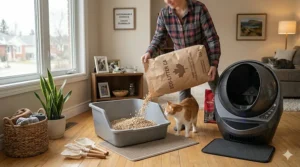
First Month Success Guide: Transitioning Your Canadian Cat to a New Litter System
Whether you’ve chosen automatic or manual, the transition period makes or breaks success—particularly in Canadian homes where cats may already exhibit seasonal behaviour changes during our dramatic temperature swings.
Week 1: Parallel Running
Place your new box directly beside the existing one. Don’t remove the old box yet, even if space is tight. Add a cup of used litter from the old box into the new one—the familiar scent reassures cats this is an acceptable bathroom location. For automatic boxes, leave them unplugged during this week; let cats investigate the stationary unit without mechanical startles.
Canadian homes with forced-air heating should avoid placing new boxes near vents during this adaptation period. The noise from heating systems cycling on/off can create negative associations, particularly during January-February when furnaces run most frequently.
Week 2: Gradual Activation
For automatic boxes, plug in but disable automatic cycles initially. Use manual operation to let cats witness the cleaning mechanism while they’re not inside. Most Canadian cats adapt within 5-7 days, but northern breeds (Siberians, Norwegian Forest Cats) often take 10-14 days due to heightened caution—this isn’t stubbornness, it’s legitimate wariness worth respecting.
For manual stainless steel boxes, begin reducing litter depth in the old plastic box while maintaining normal depth in the new one. Cats naturally prefer fresh, well-maintained boxes—economics alone drives this transition.
Week 3-4: Full Transition
Remove the old box only after witnessing your cat consistently using the new one for 48 consecutive hours. Store the old box nearby for two weeks as emergency backup—particularly relevant during Canadian holiday seasons (Christmas, March Break) when routine disruptions stress cats.
If transitioning fails despite following this timeline, consult your veterinarian before assuming it’s purely behavioural. Medical issues from urinary tract infections to arthritis frequently manifest as litter box rejection, and Canadian pet insurance (available through providers like Trupanion, Petplan) typically covers diagnostic visits.
Real Canadian Households: Three Case Studies
Profile 1: Emily, Single Professional in Vancouver Condo
One cat (6-year-old domestic shorthair), 55 square metre condo, works 50-hour weeks including frequent weekend travel. Emily chose the Litter-Robot 4 at $750 CAD—expensive but justified by her $85,000 CAD salary. The app notifications alert her when waste drawer fills, preventing overflow during her three-day Whistler ski trips. Power reliability in Vancouver’s False Creek neighbourhood supports automatic operation year-round.
Total annual cost: $750 upfront + $180 litter + $50 replacement filters = $980 first year, $230 ongoing. Time saved: 42 hours annually valued at $1,785 CAD (based on her $42.50/hour rate).
Profile 2: The Martins, Family of Four in Rural Saskatchewan
Three cats (ranging 2-9 years), farmhouse near Regina, power outages 6-8 times yearly averaging 12-36 hours. They selected three iPrimio Stainless Steel XL boxes at $65 CAD each ($195 total) after their automatic box became expensive deadweight during a 48-hour January blackout.
Total annual cost: $195 upfront + $280 litter = $475 first year, $280 ongoing. Time investment: 15 minutes daily scooping = 91 hours annually, but valued at zero since Mrs. Martin works part-time from home and incorporates scooping into her morning routine while coffee brews.
Profile 3: Roberto, Retired Veterinarian in Suburban Ottawa
Two senior cats (both 14+ years), bungalow with finished basement, fixed pension income prioritizing budget control. Roberto chose one SuzziPaws Enclosed Stainless ($95 CAD) for the main floor and one IRIS USA ($30 CAD) for basement backup.
Total annual cost: $125 upfront + $200 litter = $325 first year, $200 ongoing. His professional insight: “Senior cats develop arthritis that makes automatic boxes’ moving parts frightening. The SuzziPaws drawer system lets me monitor stool consistency daily—crucial for detecting constipation or diarrhea early in elderly cats.”
Common Mistakes When Buying Litter Boxes in Canada
Mistake #1: Ignoring Winter Shipping Realities
Amazon.ca third-party sellers often ship automatic boxes from US warehouses between November and March. Units sitting in unheated transport trucks across the Prairies can arrive with cracked plastic components or seized motors. Always verify “ships from and sold by Amazon.ca” or Canadian distributors. Expect 7-14 day shipping for automatic boxes versus 2-5 days for manual alternatives during winter months.
Mistake #2: Assuming “Self-Cleaning” Means Zero Maintenance
Automatic boxes require weekly waste drawer emptying, monthly deep cleaning of sensors and internal surfaces, and quarterly filter replacements. Canadian buyers mistakenly believe they’ve eliminated litter box duties entirely—you’ve only reduced frequency, not eliminated responsibility. Budget 15-20 minutes weekly instead of 5 minutes daily.
Mistake #3: Choosing Size Based on Current Cat, Not Future Growth
That 12-week-old kitten weighing 1.5 kg will grow to 4-6 kg within 12 months. Automatic boxes with weight sensors (most models) require cats over 1.8-2.3 kg to activate—meaning your kitten might use the box without triggering cleaning cycles until age 5-7 months. Manual boxes accommodate any size immediately, making them better choices for Canadian households adopting kittens during spring kitten season (typically May-July when shelters overflow).
Mistake #4: Overlooking Noise Sensitivity in Canadian Multi-Unit Dwellings
Automatic boxes operating at 40-55 dB sound louder in Canadian condos with concrete floors and minimal sound dampening compared to single-family homes with carpeting. Your downstairs neighbours will hear 3 AM cleaning cycles through shared ceilings—relevant in Toronto, Vancouver, or Montreal high-rises. Manual boxes create zero noise beyond normal digging sounds.
Mistake #5: Failing to Test Litter Preferences First
Switching from clay to crystal litter (required by some automatic boxes) causes 30-40% of cats to reject boxes entirely. Before investing $300-800 CAD in an automatic system, spend $15 CAD testing whether your cat accepts the required litter type in your current manual box. Mix 25% new litter with 75% old for one week, then gradually shift ratios—this costs $15 CAD to learn what might otherwise require returning a $600 CAD automatic box.
Maintenance and Long-Term Costs: Canadian Price Reality
The automatic vs manual litter box pros cons calculation extends beyond purchase price into ongoing expenses that hit harder in Canada due to exchange rates, shipping costs, and limited retail availability.
Automatic Box Annual Costs (CAD):
- Replacement waste drawer liners: $60-120
- Specialized litter (if required): $180-300 vs $120-180 for standard clay
- Replacement filters/deodorizers: $40-80
- Potential repair costs outside warranty: $150-400
- Total: $430-900 annually
Manual Box Annual Costs (CAD):
- Standard clumping litter (one cat): $120-180
- Box replacement (plastic boxes only, every 18-24 months): $30-50
- Stainless steel scoops (one-time purchase lasting 5+ years): $15-25
- Total: $120-255 annually
The cost differential of $300-650 CAD yearly matters significantly for Canadian households. Over a typical cat’s 15-year lifespan, that’s $4,500-9,750 CAD—enough to offset the “time savings” argument unless your effective hourly rate exceeds $100 CAD. For retirees, students, or single-income families, manual boxes deliver identical cat health outcomes at a fraction of the long-term expense.
Canadian buyers should also factor replacement availability. Manual box components (scoops, liners) are universally available at Canadian Tire, PetSmart, or local pet stores. Automatic box parts ship from manufacturer warehouses with typical Canadian delivery times of 10-21 business days and potential customs charges on orders over $150 CAD.
What Cat Behaviour Experts Say About Automatic vs Manual Systems
Veterinary research offers surprising insights that contradict popular assumptions about the automatic vs manual litter box pros cons debate. According to guidelines from the American Animal Hospital Association, litter boxes should be at least 1.5 times the cat’s length from nose to tail tip—meaning most manufactured boxes are actually too small regardless of automatic or manual operation.
The deeper issue? Automatic boxes prioritize human convenience over feline behavioural needs. Cats instinctively seek loose substrate for digging and burying waste—an evolutionary behaviour that can’t be “upgraded” with technology. The rotating mechanisms, moving rakes, and motorized components trigger stress responses in 15-25% of cats, particularly those with previous trauma or anxiety disorders.
Canadian veterinarians emphasize that daily scooping (manual approach) provides crucial health monitoring impossible with weekly waste drawer emptying. Observing urine clump size helps detect diabetes or kidney disease months earlier than waiting for overt symptoms. Monitoring stool consistency identifies digestive issues before they escalate to emergency vet visits costing $500-1,500 CAD at Canadian animal hospitals.
However, automatic boxes legitimately benefit Canadian cat owners managing multiple cats or mobility limitations. The key distinction: automatic boxes solve owner convenience problems, while manual boxes better serve cat behavioural requirements. Neither approach is universally superior—matching your specific situation to the right tool produces optimal outcomes.
Environmental Impact: Canadian Sustainability Considerations
Canadian environmentally conscious cat owners should weigh disposal implications when choosing automatic vs manual litter box systems—particularly relevant given Canada’s extended producer responsibility regulations gaining traction across provinces.
Automatic Box Environmental Costs:
- Electronic components contain plastics, circuit boards, motors (difficult to recycle in most Canadian municipalities)
- Disposable waste drawer liners (polyethylene) contribute 52-104 bags annually to landfills
- Crystal litter (required by some models) is non-biodegradable silica gel
- Average lifespan: 5-8 years before motor failure or obsolescence
- End-of-life: typically landfilled; electronic recycling programs rarely accept pet equipment
Manual Box Environmental Advantages:
- Stainless steel boxes: 100% recyclable at end of life (15+ year lifespan)
- Compatible with biodegradable litters (corn, wheat, pine—increasingly available at Canadian retailers)
- Zero electronic waste
- No ongoing plastic liner requirements
- Plastic manual boxes: recyclable through most municipal programs (though rarely actually recycled due to contamination)
For Canadian buyers prioritizing sustainability—particularly those in BC with robust extended producer responsibility programs or Quebec with strict packaging regulations—manual stainless steel boxes paired with biodegradable litter offer the lowest environmental footprint. The automatic convenience comes at measurable environmental cost through increased plastic waste, electronic components, and energy consumption (typical automatic box uses 15-30 kWh annually, adding $2-4 to Canadian electricity bills).
FAQ: Automatic vs Manual Litter Box Pros Cons
❓ Are automatic litter boxes worth the investment for Canadian single-cat households?
❓ Do automatic litter boxes work during Canadian winter power outages?
❓ Can I use any type of litter with automatic self-cleaning boxes?
❓ How do I clean an automatic litter box properly in Canada?
❓ Are automatic litter boxes safe for kittens and senior cats in Canadian homes?
Conclusion: Making Your Decision as a Canadian Cat Owner
The automatic vs manual litter box pros cons equation has no universal answer—it depends entirely on your specific Canadian circumstances. After researching dozens of models available on Amazon.ca and analyzing real-world performance data, here’s my definitive guidance:
Choose Automatic If:
- You manage 2+ cats (time savings multiply)
- Mobility limitations make daily scooping physically challenging
- Your household income comfortably absorbs $400-900 CAD annual operating costs
- You live in urban areas with reliable power (Toronto, Vancouver, Calgary, Montreal)
- Frequent travel requires 3+ day unsupervised periods
- Your cats have adapted successfully to covered litter boxes previously
Choose Manual (Stainless Steel) If:
- Budget constraints make $600-900 CAD investments prohibitive
- You live in rural areas prone to power outages
- Your cat exhibits anxiety around mechanical noises or movements
- You value daily health monitoring through direct observation
- Environmental sustainability guides purchasing decisions
- You’re managing kittens under 5 months or senior cats over 12 years
The best solution for most Canadian cat owners? A hybrid approach: one premium automatic box for the main floor (Litter-Robot 4 or HHOLOVE if budget allows) supplemented by affordable manual stainless backups (iPrimio or SuzziPaws) in secondary locations. This provides automation benefits where they matter most while maintaining reliable low-tech backup for power outages, cat preferences, or budget constraints.
Your cat’s health depends far more on consistent cleaning—whether automatic or manual—than the mechanism itself. A meticulously maintained manual box outperforms a neglected automatic system every time. Choose the approach you’ll actually maintain consistently across Canadian winters, spring thaws, summer cottage seasons, and autumn routines.
Recommended for You
- 7 Best Smart Litter Box App Controlled Canada 2026
- Best Self-Cleaning Litter Boxes Canada 2026 | 7 Expert Picks
- Cat Exercise Wheel Training Guide: 7 Proven Methods for Canada 2026
Disclaimer: This article contains affiliate links. As an Amazon Associate, I earn from qualifying purchases. If you purchase products through these links, we may earn a small commission at no additional cost to you.
✨ Found this helpful? Share it with your friends! 💬🤗
