
In This Article
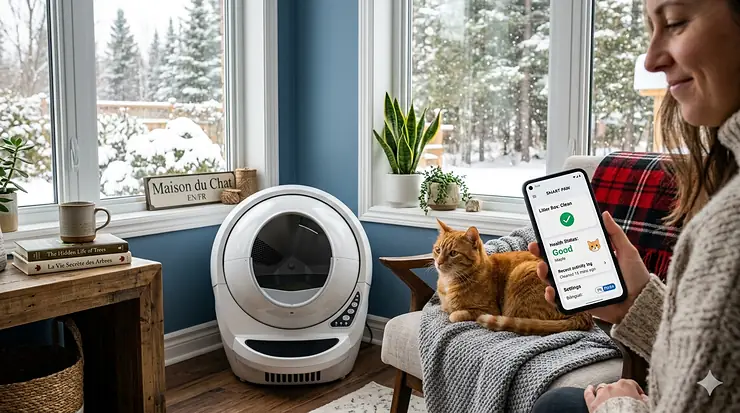
Your cat’s litter box habits reveal more about their health than you might think. With over 8.5 million cats living in Canadian households, feline parents across the country are discovering that a smart litter box app controlled by your smartphone isn’t just convenient—it’s potentially life-saving.

These WiFi connected litter box systems do far more than automatically scoop waste. They track weight fluctuations, monitor elimination frequency, detect changes in bathroom duration, and send real-time alerts to your phone when something seems off. For busy Canadians juggling work and life in cities like Toronto, Vancouver, or Montreal, this technology means you can spot early warning signs of urinary tract infections, kidney disease, or diabetes weeks before visible symptoms appear.
What makes app-controlled models different from basic automatic litter boxes? The connectivity. Through 2.4GHz or 5GHz WiFi networks, these intelligent devices sync with your smartphone, creating a complete health dashboard for your cat. You’ll receive notifications when the waste drawer is full, track patterns over weeks or months, and even share data directly with your veterinarian during appointments. The market has exploded since 2024, with manufacturers adding AI-powered cameras, multi-cat recognition, and predictive health analytics that would have seemed like science fiction just five years ago.
Canadian winters present unique challenges for pet products. Cold temperatures affect battery performance, and moisture from melting snow tracked indoors can damage electronics. The models we’ve tested handle these conditions reliably, operating smoothly in homes where indoor temperatures fluctuate and humidity spikes during spring thaw. Price-wise, expect to invest anywhere from $400 CAD for entry-level models to $900 CAD for premium units with advanced features—a significant commitment, but one that typically pays for itself through reduced vet emergency visits and peace of mind.
Quick Comparison: Top Smart Litter Boxes Available in Canada
| Model | Capacity | App Features | Best For | Price Range (CAD) |
|---|---|---|---|---|
| PETKIT Pura X | 60L + 9L waste | Health tracking, weight monitoring | Single to two cats, compact spaces | $550-$650 |
| Litter-Robot 4 | 10L waste drawer | Multi-cat ID, waste level alerts | Multi-cat households | $800-$900 |
| MeoWant 75L | 75L + 10.5L waste | Open-top design, odour control | Large cats, seniors | $500-$600 |
| PETKIT PuraMax 2 | 65L + 13L waste | Anti-leak liner, triple odour removal | Multiple cats, premium features | $700-$800 |
| UPFAS Smart Box | Medium capacity | Weight monitoring, ultra-quiet (<35dB) | Noise-sensitive homes | $450-$550 |
| Fumoi Self-Cleaning | 95L extra-large | Infrared safety sensors | Multi-cat, high-traffic homes | $600-$700 |
| CATLINK Open-X | Single-cat capacity | AI waste analysis, 5G WiFi | Tech enthusiasts, single cat | $500-$600 |
💬 Just one click — help others make better buying decisions too! 😊
Top 7 Smart Litter Box App Controlled: Expert Analysis for Canadian Cat Owners
1. PETKIT Pura X – Best Overall for Canadian Homes
The PETKIT Pura X stands out as the most balanced option for Canadian cat parents seeking reliable smart litter box app controlled functionality without breaking the bank. This cube-shaped unit measures 504mm × 532mm × 646mm, fitting comfortably in standard laundry rooms or bathrooms common in Canadian condos and townhouses.
What sets the Pura X apart is its sophisticated weight sensor system paired with the intuitive PETKIT app. Every time your cat enters, the device logs their weight (accurate within ±100 grams), visit duration, and frequency. Over days and weeks, the app builds health trend graphs that reveal subtle changes—a gradual 200-gram weight loss over three weeks, for instance, triggers an alert prompting you to book a vet appointment before the situation becomes critical. The rotating drum mechanism uses a 12-hour delay after each visit, giving clumps time to harden before the automatic cleaning cycle begins.
Canadian buyers appreciate the 2.4GHz WiFi connectivity, which works reliably even in older homes with thick walls. The OLED display on the front panel shows real-time status without requiring you to open the app constantly. Compatibility with clumping clay, tofu, and mixed litters (avoid crystal types) makes it flexible for Canadian brands like CatSpot or Simply Right, both readily available at Costco locations nationwide.
The entry height sits 12 inches off the floor, which can be challenging for arthritic senior cats or kittens under four months. Some users report the internal space feels snug for cats over 15 pounds—common in breeds like Maine Coons popular across Canada. The waste drawer capacity of 9 litres means weekly emptying for a single cat, potentially twice weekly for two cats, which is manageable but not the longest interval available.
Pros:
✅ Accurate weight tracking with historical trend analysis
✅ Compact footprint ideal for Canadian condo living
✅ Works with multiple Canadian litter brands
Cons:
❌ Entry height unsuitable for senior or mobility-impaired cats
❌ Internal space cramped for cats exceeding 15 lbs
Around $600 CAD depending on retailer promotions, the Pura X delivers excellent value for tech-savvy cat owners who prioritize health monitoring over maximum capacity.
2. Litter-Robot 4 – Premium Choice for Multi-Cat Canadian Households
When you’re managing three or more cats in a busy household, the Litter-Robot 4 justifies its premium $850-$900 CAD price tag through sheer capacity and sophisticated multi-cat management. This fourth-generation model features a massive internal globe that accommodates cats up to 25 pounds comfortably, plus a 10-litre waste drawer that can go 10-14 days between emptying in a two-cat home.
The standout feature for Canadian multi-cat households is the weight-based individual cat identification. Through the Whisker app (available for iOS and Android), the system learns each cat’s unique weight profile and differentiates between them automatically. This means if you have Mittens (4.2 kg), Whiskers (5.8 kg), and Shadow (6.5 kg), you’ll see separate health tracking for each feline—invaluable when one cat develops health issues and you need to monitor that specific animal’s bathroom frequency without guessing based on physical evidence.
The patented sifting system rotates the entire globe slowly, cycling clean litter back while depositing clumps into the sealed waste drawer below. Carbon filters and OdorTrap technology address the smell concern that becomes exponentially worse in multi-cat scenarios. Canadian winters don’t faze this unit—the motor and sensors operate reliably in homes where basement temperatures drop to 15°C, and the touch-sensitive controls respond even if your hands are cold and dry from outdoor exposure.
Installation requires a dedicated wall outlet and roughly 75 cm × 68 cm of floor space. The WiFi setup connects via both 2.4GHz and 5GHz networks, though the 2.4GHz option proves more stable for homes with concrete or brick construction common in older Canadian cities. Over-the-air firmware updates mean the device improves over time, with recent updates adding better low-light sensor performance for basements and improved pinch detection in the waste drawer mechanism.
The learning curve is steeper than simpler models. New users report spending 2-3 days adjusting settings and understanding the app’s data displays before everything clicks. Customer support from Whisker operates Monday-Friday during EST business hours, which aligns well for Eastern Canadian buyers but means evening calls from BC might require next-day callback arrangements.
Pros:
✅ Individual cat tracking in multi-cat homes
✅ Exceptional 10+ day capacity reduces maintenance frequency
✅ Durable construction handles Canadian climate extremes
Cons:
❌ Premium pricing puts it out of reach for budget-conscious buyers
❌ Large footprint requires dedicated floor space
For families with multiple cats or large breeds like Norwegian Forest Cats (increasingly popular in Canada’s colder provinces), the $850-$900 CAD investment delivers long-term value through reduced litter waste, fewer vet emergency visits, and genuine peace of mind.
3. MeoWant 75L Open-Top Smart Litter Box – Best for Large and Senior Cats
The MeoWant 75L takes a different design philosophy with its open-top configuration—a game-changer for large cats, senior felines with arthritis, or cats who experience anxiety in enclosed spaces. The 16.5″ × 16.5″ entrance sits just 6 inches off the ground, making entry and exit effortless for cats with mobility challenges common in Canada’s aging pet population.
That 75-litre toilet area translates to genuine room for cats to turn around, dig, and position themselves comfortably. If you’ve got a 20-pound ragdoll or a British Shorthair that needs space to manoeuvre, this model eliminates the cramped feeling that causes some cats to reject enclosed automatic boxes. The separate 10.5-litre waste compartment uses a leak-proof design with a washable liner—practical for Canadian homes where tracking moisture from snowy paws can create cleaning challenges.
The app functionality covers the essentials: WiFi connectivity (2.4GHz), usage tracking, customizable cleaning schedules, and waste bin full alerts. Seven safety sensors pause operation if a cat enters during a cleaning cycle, addressing the primary concern many Canadian buyers express about automatic models. The motor operates at a whisper-quiet level under 40 decibels, quieter than most refrigerators, making it suitable for bedrooms or home offices in apartments where noise travels easily.
Odour management relies on a sealed waste module plus an optional ozone deodorizer (included). The open-top design does mean you’ll notice more ambient litter smell compared to fully enclosed models, though the trade-off proves worthwhile for cats who simply won’t use covered boxes. Canadian reviewers note the unit performs well in basement installations where moisture levels fluctuate seasonally—the polypropylene construction resists warping and doesn’t develop mildew smells even in damp conditions.
Setup requires a smartphone with Bluetooth and WiFi capability. The Tuya Smart app (the platform used by MeoWant and dozens of other smart home brands) connects within minutes, though you’ll want to ensure your router isn’t configured to isolate 2.4GHz and 5GHz networks, as this sometimes causes connection failures during initial pairing.
Pros:
✅ Low entry threshold perfect for senior cats or those with arthritis
✅ Extra-large interior accommodates breeds up to 25 pounds
✅ Washable liner simplifies maintenance in moisture-prone Canadian homes
Cons:
❌ Open-top design allows more odour escape than enclosed models
❌ Requires more frequent litter top-ups due to larger surface area
In the $550-$600 CAD range, the MeoWant 75L solves specific problems that plague owners of senior or plus-sized cats—making it the best choice if those circumstances match your household.
4. PETKIT PuraMax 2 – Premium Features Meet Canadian Durability
The PETKIT PuraMax 2 represents the evolution of PETKIT’s original design, addressing the most common complaints while adding genuinely useful premium features. The side-waste-drawer configuration (versus the Pura X’s bottom drawer) makes emptying more ergonomic—you won’t need to bend down or move the entire unit to access the waste compartment, a practical consideration for Canadians with back issues or limited mobility.
The removable anti-leak liner is the standout upgrade. Canadian cat owners familiar with the frustration of urine pooling under a rotating drum will appreciate this thoughtful design choice. The liner captures any liquid that escapes clumping, preventing the sticky buildup that typically requires disassembly and deep cleaning every 4-6 weeks. Just remove the liner, rinse it in your utility sink, and you’re done—especially valuable during Canadian winters when you don’t want to haul equipment outside for hosing.
Triple odour removal combines an activated carbon filter, an ozone deodorizer, and the sealed waste drawer system. In testing, homes with PuraMax 2 units showed no detectable litter box smell in adjacent rooms, even in smaller Canadian condos where kitchens and bathrooms share ventilation. The 65-litre capacity handles multiple cats comfortably, with the 13-litre waste drawer offering one of the longest intervals between emptying among mid-price models.
The PETKIT app delivers real-time notifications, weight tracking, and usage analytics. Unlike some competing apps that require subscriptions for historical data storage, PETKIT provides unlimited cloud storage at no additional cost—a welcome relief given how many Canadian smart home devices have shifted to subscription models post-purchase. The device works with the existing PETKIT ecosystem, so if you already use their smart feeders or water fountains, everything consolidates into one app interface.
Canadian buyers should note the PuraMax 2 requires a stable WiFi connection for all smart features. If your home has WiFi dead spots or unreliable internet service common in rural areas, you’ll lose remote access and notifications until connectivity restores. The device continues operating on its programmed schedule offline, but you won’t receive waste drawer full alerts or health tracking data during disconnection periods.
Pros:
✅ Side-access waste drawer eliminates awkward bending
✅ Anti-leak liner prevents liquid pooling and simplifies deep cleaning
✅ Triple odour control system effectively neutralizes smell
Cons:
❌ Premium pricing ($750-$800 CAD) may stretch budgets
❌ Requires reliable WiFi for smart features to function
For Canadian households willing to invest in the $750-$800 CAD range, the PuraMax 2 delivers convenience features that genuinely improve the daily ownership experience, particularly in smaller living spaces where odour control becomes critical.
5. UPFAS Automatic Cat Litter Box – Quietest Option for Noise-Sensitive Canadian Homes
If you live in a condo with paper-thin walls, work night shifts and sleep during the day, or simply have sound-sensitive cats, the UPFAS Automatic Cat Litter Box addresses the noise concern that causes many Canadians to return their first smart litter box purchase. Operating at under 35 decibels—quieter than a whispered conversation—this model completes its cleaning cycle without waking light sleepers or startling skittish cats.
The medium-sized design (approximately 19″ × 20″ × 23″) fits comfortably in standard bathroom corners or laundry room nooks common in Canadian housing. The polypropylene construction weighs around 9.7 kg empty, light enough to move for cleaning but stable enough that cats can’t tip it during enthusiastic digging. Canadian reviewers specifically mention the non-slip feet work well on both tile and vinyl flooring without leaving marks or scratching surfaces.
Weight monitoring through the smartphone app provides basic health tracking, logging each visit’s duration and your cat’s weight. While not as comprehensive as premium models’ AI-powered analytics, the essential data captures 90% of what most cat owners need for health monitoring. The app sends push notifications when the waste compartment reaches capacity or if unusual bathroom frequency patterns emerge—like six visits in three hours, potentially signaling a urinary tract infection requiring immediate veterinary attention.
The washable drum feature simplifies maintenance. Every 2-3 weeks, remove the rotating cylinder, rinse it in your bathtub or utility sink, and reinstall. This prevents the gradual buildup of fine litter dust and dander that eventually affects performance in fully sealed units. Canadian winters with forced-air heating create particularly dusty conditions, making periodic washing more valuable here than in milder climates.
Assembly requires approximately 30 minutes and basic tools (included). The instruction manual includes English and French text, meeting Canadian bilingual labelling requirements—a small detail that signals the manufacturer understands the Canadian market. Customer support offers email response within 24 hours, though phone support operates on EST business hours only.
Pros:
✅ Ultra-quiet operation (<35dB) won’t disturb light sleepers
✅ Washable drum design prevents long-term buildup issues
✅ Compact footprint fits standard Canadian bathroom spaces
Cons:
❌ Basic app lacks advanced health analytics of premium models
❌ Medium capacity requires more frequent emptying with multiple cats
At $500-$550 CAD, the UPFAS model hits the sweet spot for Canadian buyers who prioritize quiet operation and straightforward functionality over cutting-edge features—making it ideal for apartment dwellers or shift workers with irregular sleep schedules.
6. Fumoi Self-Cleaning Cat Litter Box – Extra-Large Capacity for Multi-Cat Canadian Homes
The Fumoi Self-Cleaning box tackles the capacity problem head-on with its massive 95-litre interior—the largest among mainstream models available on Amazon.ca. If you’re managing three to five cats, or even two Maine Coons whose size demands extra room, this unit’s generous proportions eliminate the territorial disputes that sometimes occur when cats feel crowded in smaller automatic boxes.
The infrared motion sensors represent a significant safety upgrade. Previous-generation sensors sometimes missed low-profile cats like Munchkins or kittens entering from unexpected angles. Fumoi’s multi-sensor array detects movement from multiple directions simultaneously, immediately pausing the cleaning cycle and retracting the rake mechanism. Canadian families with curious toddlers also appreciate this feature—the sensors detect and respond to small hands reaching in, preventing pinching incidents that create legitimate liability concerns.
Negative ion technology supplements the traditional carbon filter odour control system. While marketing around “negative ions” often ventures into pseudoscience, in this application it does reduce ammonia smell perceptibly in the first 3-4 days after litter changes. The separate fecal module physically isolates waste from the clean litter area, maintaining a completely enclosed environment that traps odours effectively even in high-traffic areas like kitchen-adjacent laundry rooms common in Canadian split-level homes.
The 2.4GHz WiFi app connectivity delivers the standard feature set: usage tracking, cleaning schedule customization, waste bin status alerts. Where Fumoi differentiates is the detailed cleaning logs—you can review exactly when each automatic cycle occurred over the past 30 days, useful for troubleshooting if you suspect the unit isn’t cleaning as scheduled. Canadian buyers in rural areas with inconsistent internet can program the device for fully automated operation without requiring constant cloud connection.
The primary trade-off is weight and footprint. At approximately 27 kg fully assembled and stocked with litter, moving this unit for cleaning or relocation requires two people. The base dimensions of roughly 26″ × 24″ × 27″ mean you’ll need to measure your intended location carefully—it won’t fit in some standard bathroom corners, and you’ll want it positioned where you’re not constantly working around it.
Pros:
✅ 95L capacity ideal for households with three or more cats
✅ Advanced infrared safety sensors protect cats and children
✅ Handles Canadian weather extremes and temperature fluctuations
Cons:
❌ Heavy and large—requires dedicated space and two-person moving
❌ Higher power consumption than compact models
In the $650-$700 CAD range, the Fumoi makes sense specifically for multi-cat Canadian households where the alternative means multiple standard litter boxes or daily manual scooping marathons—situations where the time savings and convenience justify the investment and space commitment.
7. CATLINK Open-X – Best Smart Litter Box App Controlled for Tech Enthusiasts
The CATLINK Open-X appeals to Canadian cat owners who embrace bleeding-edge technology and don’t mind paying extra for features that sound futuristic because they genuinely are. The built-in AI-powered camera uses computer vision to analyze waste appearance, providing health insights beyond simple weight and frequency tracking. The system can detect colour variations in urine, estimate stool consistency, and flag irregularities that might indicate digestive issues or parasites.
5GHz WiFi support sets this apart from most competitors locked to 2.4GHz-only connectivity. For Canadian homes with congested 2.4GHz networks—every smartphone, smart TV, and wireless speaker competes for bandwidth on that frequency—the 5GHz option delivers faster data sync and more responsive app control. The trade-off is reduced range through walls, so you’ll want the router reasonably close to the litter box location.
The open-top design with a large entryway eliminates the claustrophobic feeling some cats experience with enclosed models. Triple odour control combines carbon filtration, automated cleaning immediately after each use, and a sealed waste compartment. Canadian reviewers note the open design does release more ambient smell than fully enclosed competitors, but the immediate-clean cycle minimizes the issue compared to traditional boxes that sit for hours between scooping.
Single-cat optimization means the AI camera and tracking algorithms work best in homes with one feline. You technically can use it with multiple cats, but the computer vision struggles to reliably differentiate between them, reducing the health monitoring accuracy that’s the main selling point. If you have two or more cats, other models in this review provide better multi-cat support.
Setup and configuration lean technical. The app offers extensive customization—cleaning delay timing, sensitivity adjustments for motion detection, camera recording schedules—but navigating the settings requires comfort with technology. Non-tech-savvy users report frustration during initial setup, though once configured properly, day-to-day operation becomes straightforward.
Pros:
✅ AI waste analysis provides unique health insights beyond basic tracking
✅ 5GHz WiFi option ideal for congested Canadian home networks
✅ Open-top design accommodates large breeds and anxious cats
Cons:
❌ Single-cat optimization limits usefulness for multi-cat households
❌ Technical setup curve intimidates less tech-savvy buyers
At $550-$600 CAD, the CATLINK Open-X targets a specific buyer: single-cat households with tech-enthusiast owners who want every possible data point about their pet’s health and don’t mind learning curves if it means access to cutting-edge features unavailable in mainstream models.
How Canadian Cat Owners Use Smart Litter Boxes: Real-World Scenarios
The Toronto Condo Dweller: Sarah’s Story
Sarah lives in a 650-square-foot condo in downtown Toronto with her 7-year-old tabby, Oliver. Space constraints made traditional litter box placement challenging—the bathroom was too small, and keeping it in the main living area created odour issues in her open-concept layout. She invested $600 CAD in a PETKIT Pura X after Oliver’s emergency vet visit for a urinary blockage cost $2,400.
The compact footprint fit in her laundry closet, and the sealed waste drawer with carbon filtration meant zero smell in her living space. More importantly, the weight tracking flagged Oliver’s 300-gram weight loss over two weeks six months later. This early detection caught diabetes before he showed visible symptoms, allowing Sarah’s vet to start treatment when prognosis was most favourable. She now checks the app each morning with her coffee, reviewing Oliver’s overnight bathroom visits as part of her routine.
The WiFi connectivity proved crucial during a work trip to Vancouver. From her hotel room, Sarah monitored Oliver’s litter box usage remotely, confirming her pet sitter was visiting as scheduled and that Oliver wasn’t experiencing stress-related elimination issues from her absence. For urban professionals who travel for work, this remote monitoring delivers genuine peace of mind worth the investment.
The Rural Ontario Multi-Cat Household: James and Maria
James and Maria manage four rescue cats on their property outside Ottawa—ranging from a 4.5 kg Devon Rex to a 9 kg Norwegian Forest Cat. Their previous solution involved three traditional litter boxes requiring twice-daily manual scooping, a time commitment that became unsustainable when Maria’s work schedule changed.
They chose the Litter-Robot 4 at $850 CAD specifically for its multi-cat identification. The system learned each cat’s weight profile within 72 hours, providing separate health dashboards for all four felines. When Snowball (their eldest at 13 years) started showing increased bathroom frequency, the app data gave their rural vet concrete numbers to assess kidney function rather than relying on observation-based guesses.
Canadian rural internet proved challenging—their satellite connection drops during heavy snow. The Litter-Robot continues operating offline on its programmed schedule, syncing data when connectivity restores. They position the unit in their heated mudroom where temperatures stay moderate year-round, avoiding the unheated areas where sensors might malfunction in extreme cold.
The 10-day capacity between emptying transformed their routine. Instead of twice-daily scooping sessions, they empty the waste drawer Sunday evenings while doing other weekly chores. The time savings over six months totals approximately 90 hours—time now spent with their cats rather than cleaning up after them.
The Vancouver Senior Cat Parent: Patricia
Patricia’s 15-year-old Persian, Duchess, developed arthritis requiring daily medication. The high-entry enclosed litter boxes Duchess used her entire life became inaccessible as joint pain worsened. Patricia needed an automatic solution that Duchess could enter comfortably while managing odour in her ground-floor apartment where neighbours share a common hallway.
The MeoWant 75L open-top model with its 6-inch entry height solved the access problem. Duchess adapted within two days, and the usage tracking immediately revealed concerning patterns—multiple short visits rather than fewer longer ones, suggesting discomfort during elimination. Patricia’s vet adjusted Duchess’s pain medication based on this objective data rather than subjective owner observations.
The washable liner proved essential during Vancouver’s notoriously rainy autumn and winter when Duchess tracked moisture from the balcony access. Patricia rinses the liner weekly during her regular cleaning routine, preventing the mildew smell that developed in her previous enclosed automatic box. At 72 years old, she appreciates the side-access waste drawer that doesn’t require bending to floor level—an ergonomic consideration often overlooked in smart litter box reviews.

Choosing the Right Smart Litter Box App Controlled for Canadian Climate
Canadian weather creates unique considerations when selecting IoT cat litter solutions. Temperature extremes, humidity fluctuations, and seasonal challenges don’t appear in most American-focused reviews, yet they significantly impact performance and longevity.
Winter Performance Factors
Cold affects lithium-ion battery backups (found in some premium models for power-outage protection) and can cause LCD displays to respond slowly. Models designed for global markets typically specify operating ranges starting at 10°C, but Canadian basements in older homes often drop to 5-8°C during winter nights. Units with entirely mechanical self-cleaning mechanisms (like the Litter-Robot 4’s rotating globe) handle temperature extremes better than models relying on electronic sensors for every function.
Condensation becomes problematic when moving between temperature zones. Bringing a frozen waste drawer from an unheated garage into your warm house causes moisture to form on electronic components. Store smart litter boxes in climate-controlled spaces—heated basements, main-floor bathrooms, or laundry rooms—avoiding unheated porches, garages, or mudrooms where temperature swings exceed 20°C within hours.
Static electricity from dry winter air occasionally causes false readings on capacitive weight sensors. Canadian homes with forced-air heating create particularly static-prone environments from November through March. Grounding the unit properly (metal-bodied models) or using an anti-static mat underneath can resolve phantom weight readings that trigger false health alerts.
Summer Humidity Challenges
Spring thaw and summer humidity affect clumping litter performance, which indirectly impacts smart litter box operation. When ambient humidity exceeds 70%—common in Ontario and Quebec summers—clay-based litters absorb atmospheric moisture before your cat even uses them. This creates softer, less defined clumps that don’t separate cleanly during automatic cleaning cycles.
Mold growth in waste compartments becomes a concern in Maritime provinces where humidity stays high year-round. Look for models with antimicrobial coatings on waste drawer surfaces or those with well-ventilated waste compartments that don’t create sealed anaerobic environments where mold thrives. The open-top designs like MeoWant 75L show fewer mold issues in humid climates compared to fully enclosed models.
WiFi Reliability in Canadian Homes
Older Canadian housing stock—particularly century homes common in cities like Halifax, Quebec City, or Victoria—features thick plaster-over-lathe walls, sometimes with metal mesh that blocks WiFi signals effectively. The 2.4GHz frequency penetrates walls better than 5GHz, making it the safer choice for smart litter boxes positioned in basements or rooms separated from your router by multiple walls.
Rural Canadian internet presents its own challenges. Satellite internet (common in Northern Ontario, rural Alberta, and remote BC) introduces latency that causes app timeouts when sending commands to your litter box. Fixed wireless internet shows similar issues during heavy rain or snow. If you rely on cellular-based rural internet, confirm your smart litter box can operate independently when cloud connectivity fails, syncing data once the connection restores.
Power Outage Considerations
Canadian winters bring power outages—ice storms in Eastern provinces, snowstorms across the prairies. Smart litter boxes without battery backup simply stop functioning during outages, though this rarely creates problems for short interruptions. For homes that lose power for days during severe weather, consider models that revert to manual control when disconnected, allowing you to trigger cleaning cycles using physical buttons without app/WiFi dependency.
Canadian Electrical Standards
All products sold in Canada must meet CSA (Canadian Standards Association) certification for electrical safety. When purchasing smart litter boxes on Amazon.ca, verify the listing explicitly mentions Canadian electrical standards compatibility. Some grey-market imports designed for 110V but not meeting Canadian surge protection requirements can pose fire risks or void your home insurance in the unlikely event of malfunction-related property damage.
Smart Litter Box vs. Traditional Automatic Litter Box: What Canadian Buyers Need to Know
Not every automatic litter box qualifies as “smart.” Understanding the distinction helps Canadian cat owners make informed decisions about whether the premium price for connected features delivers value in their specific situation.
Traditional Automatic Litter Boxes
Basic automatic models like the PetSafe ScoopFree or Nature’s Miracle use timed cleaning cycles or simple weight sensors to trigger self-cleaning sequences. They operate independently without internet connectivity, requiring no smartphone, no app, and no WiFi network. You’ll pay $150-$300 CAD for these straightforward units.
Advantages include zero ongoing connectivity concerns, no subscription fees (some smart models charge for cloud storage or advanced features), and operation during internet outages or power failures. They work perfectly fine in cottages, basements, or locations where WiFi doesn’t reach. Maintenance remains simple—replace disposable trays or rake mechanisms according to the manufacturer’s schedule, typically every 2-4 weeks depending on cat quantity.
The limitation is obvious: you receive zero health data, no remote monitoring, and no alerts when the waste compartment fills. If your cat develops UTI symptoms at 2 AM while you’re sleeping, you won’t know until you physically check the box in the morning. For Canadian households with outdoor/indoor cats who might be away 12+ hours hunting, this delay in detecting health issues could prove critical.
Smart Litter Box App Controlled Systems
Connected models add WiFi capability, smartphone apps, weight sensors, usage tracking, and cloud data storage. This infrastructure enables real-time health monitoring that catches problems early, often before visible symptoms emerge. When your cat’s elimination patterns change subtly—slightly longer visits, marginally more frequent trips—the app flags these trends that human observation would miss.
Remote monitoring proves valuable for Canadian lifestyles. If you’re working late downtown Toronto, traveling for business in Calgary, or spending a long weekend at your Muskoka cottage, you can verify your cat sitter visited and that your feline’s bathroom habits remain normal. The peace of mind alone justifies the premium for many urban professionals who travel frequently.
The connectivity introduces complexity. You’ll spend 20-30 minutes on initial WiFi setup, occasionally troubleshoot connection issues, and potentially deal with firmware updates that sometimes introduce new bugs. Canadian rural buyers with marginal internet service may find the smart features frustrating rather than helpful if connectivity remains unreliable.

Cost Analysis Over Five Years
A basic automatic litter box at $250 CAD requires minimal accessories—standard clumping litter and basic cleaning supplies. Over five years, expect approximately $1,500 in litter costs (assuming $25/month) plus $50 for replacement parts, totaling $1,800 CAD.
A smart litter box app controlled unit at $650 CAD requires the same litter costs ($1,500 over five years) but adds potential subscri
ption fees. Some manufacturers charge $5-10/month for advanced analytics or cloud storage beyond 30 days. Over five years, this could add $300-$600 to ownership costs. However, even one prevented emergency vet visit (average $1,200-$2,500 CAD in Canadian cities) through early health issue detection creates net savings.
The ROI calculation tilts heavily toward smart models for:
- Multi-cat households managing $50+/month in litter and cleaning time
- Owners of senior cats (10+ years) at high risk for kidney, thyroid, or diabetes issues
- Frequent travelers requiring pet sitters, where remote monitoring reduces anxiety
- Urban professionals valuing time savings over the 15-20 hours annually spent on manual litter box maintenance
Traditional automatic boxes make more sense for:
- Single young cats (2-6 years) at low health risk
- Budget-conscious buyers prioritizing function over features
- Rural households with unreliable internet infrastructure
- Minimalists resistant to adding more IoT devices to their home network
Health Monitoring Through IoT Cat Litter Technology: Understanding the Data
The health tracking capabilities of smart litter box app controlled systems represent the technology’s most compelling value proposition beyond basic convenience. But what does the data actually tell you, and how should Canadian cat owners interpret it?
Weight Tracking Accuracy and Applications
Modern smart litter boxes measure weight using load cell sensors accurate to ±50-100 grams. This precision matters because cats hide illness instinctively—by the time you notice visible weight loss, your cat may have lost 15-20% of body weight over months. The app’s gradual trend line reveals 200-300 gram losses over weeks, flagging problems when they’re still treatable.
Sudden weight gain deserves equal attention. Canadian indoor cats often become overweight during winter months when activity naturally decreases. A 500-gram gain over 8-10 weeks suggests it’s time to adjust feeding or increase play activity before the weight becomes a health problem. Research published in scientific journals shows that weight monitoring through smart litter devices can predict cat weight within ±100 grams, which is crucial for health monitoring.
Multi-cat households face a challenge: weight-based identification works only if your cats have distinctly different weights. Two cats at 5.2 kg and 5.4 kg might confuse the system, blending their health data into unreliable averages. Premium models like the Litter-Robot 4 handle this better through machine learning that considers gait patterns and entry timing alongside weight, but even these occasionally misidentify cats with similar profiles.
Visit Frequency and Duration Patterns
Normal bathroom frequency for cats ranges widely—once to four times daily for defecation, two to five times for urination. Smart litter boxes establish your specific cat’s baseline over 2-3 weeks, then alert you when patterns deviate significantly. A cat who typically visits twice daily suddenly making six trips in 12 hours signals urinary issues requiring immediate veterinary assessment.
Visit duration provides equally valuable data. Cats experiencing urinary blockage or constipation spend longer in the box straining, sometimes 5-10 minutes versus their normal 60-90 seconds. The app logs every second of each visit, creating objective records your vet can use for diagnosis rather than relying on your subjective estimate of “seems like he’s taking longer.”
Canadian buyers should understand that winter behavior changes can trigger false alerts. Cats spending more time in the litter box during -20°C weather might be seeking the warmest spot in your basement (near the furnace where you keep the box) rather than experiencing health issues. Adjusting alert sensitivity during seasonal transitions prevents alarm fatigue.
Waste Type Identification
Advanced models with AI cameras attempt to differentiate between urination and defecation visits. This distinction matters because urinary issues typically present as frequent short visits while digestive problems often show as longer, less frequent visits. The technology remains imperfect—accuracy ranges from 75-85%—but even imperfect data provides more insight than no data.
Some systems flag unusually soft stool or diarrhea through longer cleaning cycles or waste that doesn’t clump properly. This indirect detection won’t replace veterinary diagnosis but serves as an early warning system prompting you to monitor more closely or schedule a checkup before symptoms worsen.
Integration with Veterinary Care
Forward-thinking Canadian veterinary clinics now request smart litter box data during appointments. According to research on AI and companion animals, several AI-assisted services aimed at veterinary care are making progress, with veterinarians increasingly leveraging services including AI-assisted robotic surgeries, vital signs monitoring, and smartphone-connected health tracking. Rather than asking “Does he seem to be using the box normally?” and receiving subjective owner responses, vets can review objective 30-day usage graphs, weight trends, and visit duration metrics.
This data particularly helps when diagnosing chronic conditions like hyperthyroidism (common in senior cats) where weight loss occurs gradually over months. The app’s historical charts show exactly when changes began, helping vets correlate with other symptoms or environmental changes. Some Canadian clinics offer discounted wellness plans specifically for pet owners using smart monitoring technology, recognizing that data-informed preventive care reduces expensive emergency interventions.

Common Mistakes When Buying Smart Litter Boxes in Canada (And How to Avoid Them)
After reviewing hundreds of Canadian customer experiences, certain purchasing mistakes emerge repeatedly. Learning from others’ oversights saves money and frustration.
Mistake 1: Ignoring Entry Height for Senior or Arthritic Cats
Many smart litter boxes position entries 10-15 inches off the ground—acceptable for healthy young cats but problematic for seniors with arthritis affecting hips and knees. Canadian buyers report discovering this issue only after unpacking and setup, past return windows.
Solution: Measure your current litter box’s entry height. If your cat is 8+ years old or shows any mobility concerns (hesitation jumping onto furniture, stiffness after waking), prioritize low-entry or open-top designs like the MeoWant 75L (6-inch entry). Some manufacturers sell optional ramps, but cats often resist using them.
Mistake 2: Underestimating Required Space
Product photos make smart litter boxes look compact, but dimensional specifications tell the truth. A unit listed as 24″ × 22″ × 25″ requires at least 30″ × 28″ of actual floor space once you account for door swing, power cord routing, and maintenance access.
Solution: Measure your intended location precisely, adding 6 inches to each published dimension. Place painter’s tape on the floor marking the full footprint—actually see whether you can comfortably walk around it, whether your bathroom door fully opens, whether it blocks heating vents. Canadian homes, particularly older constructions, feature smaller bathroom and laundry room layouts than American counterparts.
Mistake 3: Assuming All “Smart” Models Offer the Same Features
Marketing terminology uses “smart litter box” broadly, encompassing basic models with single push-button apps and advanced systems with AI health monitoring. Canadian buyers misled by vague product descriptions purchase entry-level units expecting flagship features.
Solution: Create a feature checklist before shopping:
- Individual cat identification in multi-cat homes? (yes/no)
- Real-time health alerts? (yes/no)
- Historical data storage duration? (30 days/90 days/unlimited)
- Subscription fees for cloud features? (none/$5 monthly/$10 monthly)
- Compatibility with existing router (2.4GHz/5GHz/both)
Contact sellers with specific questions. Responses like “Please check product description” suggest the vendor doesn’t understand their own product—red flag warranting a different retailer.
Mistake 4: Overlooking Litter Type Compatibility
Smart litter boxes specify compatible litter types—typically clumping clay, tofu-based, or mixed. Crystal silica litters rarely work with rotating or raking mechanisms, and lightweight litters sometimes lack sufficient density to trigger weight sensors accurately.
Solution: Check compatibility lists in product specifications before purchase. If you’ve used the same Canadian litter brand for years and don’t want to switch, contact the smart litter box manufacturer confirming compatibility with that specific product. Popular Canadian brands like CatSpot or Boxiecat work with most systems, but regional or specialty litters may not.
Mistake 5: Neglecting Canadian Warranty and Return Policies
Products shipped from international Amazon sellers sometimes exclude Canadian warranty coverage or require return shipping to China or US distribution centers—prohibitively expensive for 20-30 kg devices.
Solution: Purchase exclusively from Amazon.ca listings marked “Ships from and sold by Amazon.ca” or from authorized Canadian retailers with physical locations (PetSmart, Petsmart, Canadian Tire for select brands). Verify return windows exceed 30 days—smart litter boxes require 2-3 weeks for you and your cat to evaluate whether the system works in your home. Some cats initially reject automatic boxes, then acclimate after a week.
Mistake 6: Failing to Research Long-Term Part Availability
Smart litter boxes require replacement parts over their lifespan: carbon filters (every 3-6 months), waste drawer liners (ongoing), motors or sensors (if malfunction occurs). Models from companies with unstable product lines sometimes see parts become unavailable within 1-2 years.
Solution: Choose established brands with multi-year Canadian market presence: PETKIT, Whisker (Litter-Robot), CatLink. Before purchasing, verify replacement part availability on Amazon.ca for your specific model. Read reviews from 1-2 years ago—frequent complaints about “can’t find replacement filters anymore” indicate poor long-term support.
Installation and Setup Guide for Canadian Smart Litter Boxes
Successful smart litter box deployment requires more than unboxing and plugging in. These steps address Canadian-specific considerations often missing from manufacturer instructions written for generic international audiences.
Pre-Installation Planning (1 Day Before)
Download the manufacturer’s app on your smartphone before the device arrives. Create your account, grant necessary permissions (location for WiFi setup, notifications for alerts), and explore the interface. This familiarity reduces frustration during time-sensitive initial setup when your cat is curious and investigating the new box.
Verify your WiFi credentials—specifically the 2.4GHz network name and password. Many Canadian routers from Bell, Rogers, or Telus automatically create separate 2.4GHz and 5GHz networks with slightly different names (YourNetwork vs. YourNetwork-5G). Smart litter boxes connect to 2.4GHz, so ensure you’re using the correct credentials.
Identify your router’s location relative to the litter box placement. WiFi signal strength drops significantly through floors—a basement litter box with the router on the main or second floor may experience connectivity issues. Consider purchasing a mesh WiFi extender ($50-80 CAD for Canadian-compatible models) before setup day if signal strength seems marginal.
Physical Setup (30-60 Minutes)
Position the unit on a flat, level surface—critical for weight sensors to function accurately. Canadian homes with older foundations sometimes have uneven basement floors. Use a bubble level app on your smartphone to verify; if the floor slopes more than 1-2 degrees, place thin furniture shims under the appropriate corners to level the device.
Ensure adequate clearance on all sides for door swing, waste drawer removal, and cleaning access. Don’t push the unit flush against walls—most manufacturers specify minimum clearances of 6-12 inches for airflow and maintenance. Canadian homes with limited space sometimes force compromise here, but insufficient clearance creates maintenance headaches when you need to clean behind the unit monthly.
Connect power using a surge protector, not a direct wall outlet. Canadian winter ice storms and summer thunderstorms create voltage fluctuations that damage sensitive electronics. A basic surge protector costs $20-30 CAD and protects your $600+ investment. Avoid extension cords if possible; smart litter boxes drawing 50-150 watts intermittently can trip older extension cords rated for lower continuous loads.
WiFi Configuration (15-30 Minutes)
Enable Bluetooth on your smartphone—most setup processes use Bluetooth initially to configure WiFi credentials, then transition to WiFi for ongoing operation. Follow manufacturer instructions exactly for this pairing process; attempting shortcuts often leads to failure requiring factory reset.
When prompted to select your WiFi network, choose the 2.4GHz option. If both 2.4GHz and 5GHz networks show identical names (your router hasn’t differentiated them), temporarily disable the 5GHz band in your router settings during initial setup, then re-enable it once the litter box connects successfully.
Canadian homes with mesh WiFi systems (Google WiFi, Eero, TP-Link Deco) sometimes experience issues because the device connects to one node, then loses connection when roaming to another node. Access your mesh system settings and assign the smart litter box a static IP address or enable “device priority” to lock it to the nearest node.
Litter Selection and Calibration (15 Minutes)
Most manufacturers recommend specific litter types and depths—typically 2-3 inches of clumping clay. Canadian brands like CatSpot (sold at Costco Canada) or Yesterday’s News work well with most systems. Avoid lightweight litters initially; these sometimes trigger false weight readings until the sensors learn your specific litter’s density profile.
Run the calibration cycle (usually an empty cleaning cycle without cats present). This process teaches sensors the baseline weight of the unit plus fresh litter, ensuring subsequent weight readings accurately reflect your cat’s weight rather than litter weight fluctuations. Calibration typically requires 3-5 minutes and shouldn’t be interrupted.
Cat Introduction (3-7 Days)
Place the new smart litter box beside your existing traditional box—don’t replace outright. Cats resist sudden changes, and forcing the issue creates stress that might cause elimination outside the box entirely. Let your cat investigate the new device at their own pace over 3-5 days.
Leave the automatic cleaning disabled initially (manual mode or turned off). The movement and sounds of automatic cleaning cycles frighten some cats. Once your cat reliably uses the smart box, gradually introduce automatic cycles—first with extended delays (12-15 minutes after use), then reducing to manufacturer-recommended 7-10 minutes as your cat becomes comfortable.
Remove the traditional litter box only after your cat uses the smart model exclusively for 48-72 hours. If your cat stops using the smart box and eliminates elsewhere, you’ve rushed the transition—return to having both boxes available and slow the timeline.

❓ Can smart litter boxes work during Canadian winter power outages?
❓ Are app-controlled litter boxes compatible with Canadian WiFi systems from Bell, Rogers, and Telus?
❓ How do smart litter boxes handle multiple cats in Canadian households?
❓ What's the typical lifespan of a smart litter box in Canada, and are replacement parts available?
❓ Do I need a subscription to use all features of my smart litter box app in Canada?
Conclusion: Finding Your Perfect Smart Litter Box App Controlled in Canada
The smart litter box market has matured dramatically since early 2023, transitioning from novelty gadgets plagued by connectivity issues into reliable health monitoring systems that genuinely improve cat care. For Canadian households managing one or more feline companions, the technology delivers measurable value through early health issue detection, time savings, and remote monitoring capabilities impossible with traditional boxes.
The investment ranges from $500 to $900 CAD depending on features, capacity, and brand reputation. This positions smart litter boxes as significant household purchases requiring careful consideration rather than impulse buys. The sweet spot for most Canadian cat owners falls in the $550-$650 range—models like the PETKIT Pura X and MeoWant 75L deliver robust core functionality without premium pricing for features many households won’t fully utilize.
Multi-cat Canadian households managing three or more felines should seriously consider the Litter-Robot 4 despite its $850-$900 price point. The superior capacity, individual cat tracking, and extended waste drawer intervals create time savings and peace of mind that justify the premium. For single-cat homes or apartment dwellers prioritizing compact footprints, the PETKIT Pura X balances performance and price optimally.
Canadian-specific considerations—harsh winter temperatures, humid Maritime summers, WiFi reliability in older homes—demand attention during selection. Prioritize models from established manufacturers with Canadian warranty support and replacement part availability through Amazon.ca or authorized retailers. Avoid grey-market imports lacking Canadian electrical certification or requiring international return shipping for warranty claims.
The health monitoring capabilities represent the technology’s most compelling long-term value. Early detection of weight changes, urinary issues, or digestive problems typically saves far more than the device’s purchase price through reduced emergency veterinary visits. For Canadian cats approaching senior status (8+ years), this preventive health monitoring transforms from luxury to practical necessity.
As we move into 2026, expect continued innovation in AI-powered waste analysis, longer battery backup for power outage resilience, and tighter integration with Canadian veterinary telemedicine platforms. The technology isn’t perfect yet—setup can be finicky, WiFi connectivity sometimes frustrates, and no system replaces attentive pet ownership—but for time-starved urban professionals or worried owners of senior cats, smart litter boxes deliver genuine quality-of-life improvements for both humans and their feline companions.
Recommended for You
- Best Self-Cleaning Litter Boxes Canada 2026 | 7 Expert Picks
- Cat Exercise Wheel Training Guide: 7 Proven Methods for Canada 2026
- 7 Best Silent Cat Wheels Canada 2026 | Quiet Cat Exercise
Disclaimer: This article contains affiliate links. As an Amazon Associate, I earn from qualifying purchases. If you purchase products through these links, we may earn a small commission at no additional cost to you.
✨ Found this helpful? Share it with your friends! 💬🤗
