
In This Article
Ever watched your indoor cat stare longingly out the window, their tail twitching at every passing bird? That’s not just curiosity—it’s a genuine need for environmental stimulation that many Canadian cat owners struggle to fulfil. While keeping cats indoors protects them from traffic, predators, and disease, it can also lead to boredom, anxiety, and destructive behaviours. This is where an outdoor cat tunnel enclosure becomes a game-changer for both you and your feline friend.
These ingenious systems—often called “catios” or cat tunnel systems—offer the perfect compromise. Your cat gets fresh air, sensory enrichment, and the thrill of outdoor exploration, whilst remaining completely safe from the hazards that come with free-roaming. According to research published by the National Institutes of Health, cats with access to enriched environments exhibit fewer stress-related behaviours and demonstrate improved problem-solving skills.
In Canada, where our weather ranges from scorching summers to harsh winters, choosing the right outdoor cat tunnel enclosure requires careful consideration. You’ll need weatherproof materials that can handle rain, snow, and UV exposure, plus designs that accommodate seasonal temperature fluctuations. Whether you live in a Toronto condo with a small balcony or own a sprawling property in rural Alberta, there’s an outdoor cat tunnel solution perfectly suited to your situation—and your budget.
Let’s explore the best options available on Amazon.ca in 2026, complete with real pricing in CAD, authentic customer feedback from Canadian buyers, and expert insights to help you make an informed decision.
Quick Comparison Table
| Product | Price Range (CAD) | Size | Material | Best For | Rating |
|---|---|---|---|---|---|
| PawHut Extendable Wooden Tunnel (59″) | $149-$179 | 59″L x 15″W x 15″H | Fir wood, wire mesh | Single cats, window connections | 4.3/5 |
| Aivituvin Metal Cat Tunnel (90.6″) | $129-$169 | 90.6″L x 15″W x 15″H | Powder-coated iron, waterproof fabric | Multi-cat households, expandable systems | 4.4/5 |
| Pawtenda 4-in-1 Portable System | $89-$119 | 60″ total length | Oxford mesh fabric | Budget-conscious, seasonal use | 4.2/5 |
| PawHut Extended Tunnel (98″) | $249-$299 | 98″L x 15″W x 15″H | Fir wood, galvanized mesh | Long-distance connections | 4.3/5 |
| Kitty City Modular System | $159-$189 | Customizable | Weatherproof fabric, plastic | Flexible layouts, multiple entry points | 4.1/5 |
| KOOPRO Catio Tent & Tunnel Combo | $69-$99 | 72″L x 48″W x 36″H tent | Mesh fabric, steel frame | Temporary outdoor access | 4.0/5 |
| Aivituvin AIR37 Premium System | $389-$449 | 71″L x 49″W x 71″H | Fir wood, waterproof tarp | Permanent installations, multiple cats | 4.5/5 |
💬 Just one click – help others make better buying decisions too! 😊
✨ Don’t Miss These Exclusive Deals!
🔍 Take your outdoor cat enrichment to the next level with these carefully selected products available in Canada. Click on any highlighted item to check current pricing and availability on Amazon.ca. These systems will help you create authentic outdoor experiences your feline family will love!
Top 7 Outdoor Cat Tunnel Enclosures: Expert Analysis
1. PawHut 59″ Extendable Wooden Cat Tunnel
The PawHut 59″ Extendable Wooden Cat Tunnel stands as a solid mid-range choice for Canadian cat owners seeking a permanent outdoor solution. This tunnel measures 59 inches in length with a 15-inch width and height, providing ample room for most cats to move comfortably whilst maintaining a compact footprint suitable for urban spaces.
Key Specifications: Constructed from fir wood with wire mesh sides and water-resistant paint coating. Features four entrance points for versatile connectivity. Supports cats up to 10 lbs (4.5 kg).
Price in Canada: Currently ranging from $149 to $179 CAD on Amazon.ca, with occasional discounts bringing it down to around $129 CAD during seasonal sales.
Canadian Customer Feedback: Buyers from Ontario and British Columbia particularly appreciate this tunnel’s durability through winter conditions. One Toronto customer noted, “Survived our entire winter on the balcony with just a bit of snow clearing needed.” However, some Maritime customers mentioned that the paint requires annual touch-ups in coastal environments.
✅ Pros:
- Weatherproof construction handles Canadian climate well
- Multiple connection points allow future expansion
- Compact size fits balconies and small patios
❌ Cons:
- Weight limit may exclude larger breeds like Maine Coons
- Assembly requires approximately 45 minutes with basic tools
Best For: Single-cat households in urban Canadian settings looking for reliable window-to-patio connections.
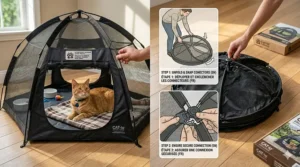
2. Aivituvin Metal Cat Tunnel with Waterproof Fabric (90.6″)
At 90.6 inches, the Aivituvin Metal Cat Tunnel offers impressive length for cats who crave longer exploration paths. Unlike wooden alternatives, this model uses powder-coated iron construction that resists rust—a critical advantage in Canada’s wet spring seasons and snowy winters.
Key Specifications: Black powder-coated iron frame with galvanized steel mesh (0.5″ x 0.5″ openings). Includes waterproof Oxford fabric cover. Five entrance doors for maximum versatility. Compatible with Aivituvin AIR37 and AIR37-M catio systems.
Price in Canada: Typically priced between $129-$169 CAD, making it excellent value considering the length and durability.
Canadian Customer Feedback: Quebec customers particularly praise its ability to handle heavy snow loads without warping. A Montreal buyer shared, “Three winters in and the frame hasn’t shifted at all—unlike the wooden tunnel my neighbour bought.” Alberta customers appreciate that the metal construction doesn’t attract wood-boring insects during summer months.
✅ Pros:
- Longest single-unit option at 90.6 inches
- Rust-proof construction ideal for humid Canadian regions
- Waterproof fabric prevents rain and snow infiltration
❌ Cons:
- Metal can get hot in direct summer sunlight (fabric cover helps)
- Slightly more expensive than comparable wooden options
Best For: Multi-cat households or long-distance connections between house and garden catio.
3. Pawtenda 4-in-1 Portable Outdoor Cat System
The Pawtenda 4-in-1 system takes a completely different approach with its portable, pop-up design. This set includes two tents and two tunnels that connect via zippers, creating a modular outdoor play space that can be reconfigured or stored away when not needed.
Key Specifications: High-density breathable mesh fabric, collapsible steel frame. Total assembled length approximately 60 inches. Includes carry bag for storage. Available in green and rainbow colours.
Price in Canada: Budget-friendly at $89-$119 CAD, with frequent promotions bringing it under $80 CAD.
Canadian Customer Feedback: This option receives consistent praise from Canadians who use seasonal cottages or want flexibility. A Nova Scotia customer mentioned, “Perfect for our cottage weekends—sets up in minutes and packs flat for winter storage.” However, Manitoba customers note it’s not suitable for leaving outdoors year-round due to UV degradation of mesh over 1-2 seasons.
✅ Pros:
- Most affordable complete system
- Sets up and breaks down in under 5 minutes
- Lightweight enough to move around yard following shade
❌ Cons:
- Not designed for permanent outdoor installation
- Mesh can tear if cats are particularly aggressive scratchers
Best For: Seasonal use, renters, or cat owners who want portable outdoor enrichment for camping and cottages.
4. PawHut 98″ Extended Wooden Cat Tunnel
When you need maximum length in a single unit, the PawHut 98″ Extended Wooden Cat Tunnel delivers. This nearly 8-foot tunnel creates impressive aerial walkways or long ground-level exploration paths—perfect for connecting distant outdoor spaces.
Key Specifications: 98.4 inches long, maintaining the standard 15″W x 15″H dimensions. Fir wood construction with galvanized wire mesh. Eight access doors. L-shaped configuration possible with multiple units.
Price in Canada: Premium pricing at $249-$299 CAD reflects the extended length and materials.
Canadian Customer Feedback: British Columbia customers with large properties love this for connecting their house to garden catios across longer distances. One Vancouver Island reviewer noted, “Connects our sunroom to the backyard catio about 7 feet away—cats use it constantly.” Saskatchewan buyers appreciate that the length allows cats to build up speed for running and playing.
✅ Pros:
- Longest wooden tunnel available in Canadian market
- Eight access points provide maximum versatility
- Can create impressive multi-level installations
❌ Cons:
- High price point may exceed budget for some buyers
- Requires sturdy mounting or support posts for elevated installations
Best For: Large properties, multi-cat households, or ambitious catio projects requiring long connections.
5. Kitty City Outdoor Cat Tunnel System
The Kitty City Modular System earns recognition for its LEGO-like approach to cat tunnel design. Individual weatherproof sections connect together, allowing you to build custom configurations that grow with your cat’s needs and your budget.
Key Specifications: Modular interlocking sections in various shapes (straight, curved, T-junctions). Weatherproof fabric panels over steel frames. Expandable design.
Price in Canada: Entry-level kit starts around $159 CAD, with expansion packs available for $45-$65 CAD each. Complete systems typically run $189-$229 CAD.
Canadian Customer Feedback: Ontario customers praise the modularity, noting, “Started with the basic kit and added pieces over three months as we figured out the best layout.” Some customers in coastal regions mention that the fabric connectors can develop wear at connection points after extended outdoor exposure.
✅ Pros:
- Build exactly the configuration you need
- Can expand system gradually as budget allows
- Easy to reconfigure as needs change
❌ Cons:
- Total cost can exceed fixed-length alternatives if building large systems
- Connection points may require occasional maintenance
Best For: DIY enthusiasts, growing cat families, or complex yard layouts requiring custom solutions.
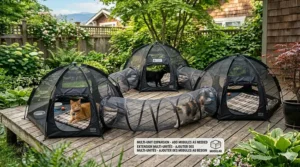
6. KOOPRO Catio Outdoor Cat Enclosure with Tunnel
The KOOPRO system combines a spacious tent enclosure with an attached tunnel, offering over 28 square feet of total activity space. This budget-friendly option provides excellent value for cats who want both a play tunnel and a larger lounging area.
Key Specifications: 72″L x 48″W x 36″H main tent with attached tunnel. Breathable mesh construction. Steel frame with ground stakes. Includes carry bag.
Price in Canada: Exceptional value at $69-$99 CAD for the complete tent-and-tunnel system.
Canadian Customer Feedback: Canadian buyers frequently mention this as an excellent “starter catio” for testing whether their cat enjoys outdoor time before investing in permanent structures. An Alberta customer shared, “Used this to see if our indoor cat would actually use outdoor space—turned out she loves it, so now we’re planning a permanent installation.” However, customers in windy Prairie regions recommend additional anchoring beyond the included stakes.
✅ Pros:
- Lowest price point for a tent-and-tunnel combination
- Large activity space for the price
- Easy to relocate around yard
❌ Cons:
- Mesh fabric less durable than wood or metal alternatives
- Not suitable for unsupervised outdoor use in areas with predators
Best For: Budget-conscious first-time catio buyers or supervised outdoor playtime.
7. Aivituvin AIR37 Premium Walk-In Cat Enclosure with Tunnel
The Aivituvin AIR37 represents the premium tier of outdoor cat tunnel systems available in Canada. This walk-in enclosure includes multiple platforms, resting houses, and can be connected to a dedicated AIR7007 tunnel system for comprehensive outdoor access.
Key Specifications: 71″L x 49″W x 71″H main enclosure. Seven multi-tiered platforms with two resting houses. Fir wood frame with galvanized steel mesh. Heavy-duty UV-resistant Oxford cloth roof. Walk-in door (67″ tall). Can connect to windows or AIR7007 tunnel.
Price in Canada: Premium investment at $389-$449 CAD for the base unit. Compatible AIR7007 tunnel adds $129-$169 CAD.
Canadian Customer Feedback: This system receives consistent praise from customers across Canada who view it as a permanent outdoor living space for their cats. A Calgary customer noted, “Worth every penny—cats spend 4-6 hours daily in here during good weather, and the walk-in design makes cleaning and interaction easy.” British Columbia customers appreciate the waterproof roof during rainy seasons. Some customers mention assembly takes 2-3 hours with two people but results in a very sturdy structure.
✅ Pros:
- Most comprehensive system with multiple levels and features
- Walk-in design allows human interaction
- Heavy-duty construction suitable for Canadian weather extremes
❌ Cons:
- Highest price point in this guide
- Requires significant space commitment
Best For: Serious cat owners, multiple cats, permanent installations, or those wanting the ultimate outdoor cat enrichment system.
Understanding Outdoor Cat Tunnel Enclosure Systems
The concept of a catio or outdoor cat tunnel enclosure might seem modern, but it addresses age-old feline behavioural needs. Cats are naturally curious predators who benefit immensely from environmental complexity and sensory stimulation. When we bring cats indoors for their safety, we inadvertently deprive them of experiences crucial to their psychological wellbeing.
Research from the Journal of Feline Medicine and Surgery demonstrates that cats with access to environmental enrichment show significantly reduced stress markers and fewer behavioural issues. The beauty of outdoor cat tunnel systems lies in their ability to provide this enrichment whilst eliminating outdoor dangers like traffic, predators, and disease transmission from other animals.
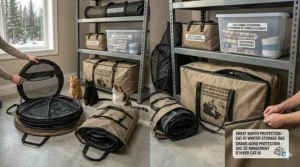
In Canada’s diverse climate zones—from British Columbia’s wet winters to Manitoba’s extreme cold—choosing weatherproof materials becomes paramount. Fir wood treated with water-based paint offers decent protection but requires annual maintenance in coastal regions. Powder-coated metal provides superior rust resistance in humid environments but needs temperature consideration in extreme cold. Modern fabric mesh systems work brilliantly for seasonal use but typically need winter storage in most Canadian provinces.
The sizing of your outdoor cat tunnel enclosure depends on multiple factors: your cat’s size and activity level, available outdoor space, connection distances between structures, and whether you’ll eventually add more cats to your household. Standard tunnel dimensions of 15″W x 15″H accommodate most domestic cats comfortably, though larger breeds like Maine Coons or Norwegian Forest Cats may appreciate wider options if available.
Weatherproofing Your Cat Tunnel for Canadian Conditions
Canadian weather presents unique challenges that make weatherproofing essential rather than optional. From Vancouver’s rain to Winnipeg’s minus-40 windchills, your outdoor cat tunnel enclosure must withstand conditions that would quickly destroy unsuitable materials.
Rain and Moisture Management
British Columbia, Atlantic Canada, and parts of Ontario experience substantial rainfall that can quickly deteriorate unprotected materials. For wooden tunnels, look for water-based paint or stain specifically rated for outdoor furniture use. Canadian customers consistently report that annual resealing before spring prevents water damage and extends tunnel lifespan by years.
Metal frame tunnels with waterproof fabric covers excel in rainy regions because water runs off without penetrating the structure. The Aivituvin metal tunnel performs particularly well in this regard—Quebec customers report excellent water shedding even during heavy spring runoff seasons.
Snow Load Considerations
Prairie provinces and mountainous regions face serious snow accumulation that can damage structures not designed to handle weight loads. Flat-roofed tunnels should be cleared after heavy snowfall to prevent structural stress. Angled roof designs naturally shed snow but may require securing loose snow that could frighten cats when it slides off.
The AIR37 system’s peaked roof design specifically addresses this concern, performing well in Alberta and Saskatchewan winters according to customer reviews. Budget mesh tunnels should absolutely be stored during winter in regions expecting more than occasional light snow.
UV Protection and Summer Heat
Southern Ontario and Prairie provinces experience intense summer sun that degrades materials through UV exposure and can create uncomfortably hot tunnel interiors. Metal frames heat up quickly, making fabric covers essential for summer comfort. Wooden tunnels need UV-resistant finishes to prevent weathering and cracking.
Several Manitoba customers reported success positioning tunnels in partially shaded areas or adding awnings over wooden structures to reduce direct sun exposure during peak afternoon hours. The waterproof fabric covers on metal tunnels serve double duty—blocking rain and providing crucial shade.
Temperature Extremes
Canada’s temperature swings from plus-30 in summer to minus-40 in winter create expansion and contraction cycles that stress materials. Quality hardware—stainless steel or zinc-plated screws and brackets—prevents rust and maintains structural integrity through these cycles. Cheap hardware rusts quickly in Canadian conditions, leading to structural failure within 1-2 years according to customer experiences.
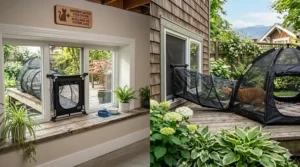
Safe Outdoor Cat Access: Security Considerations
Creating safe outdoor access means balancing your cat’s need for enrichment against genuine safety threats. In Canada, these threats vary by region but commonly include predators like coyotes, raccoons, and birds of prey, extreme weather events, escape risks, and potential encounters with other cats or wildlife.
Predator Protection
Urban Canadian centres face surprisingly high predator populations. Toronto and Vancouver report regular coyote sightings even in residential neighbourhoods. Calgary and Edmonton customers note significant bird of prey activity. Your outdoor cat tunnel enclosure must provide protection from these threats.
Wire mesh spacing of 0.5″ x 0.5″ (as used in Aivituvin and PawHut systems) prevents most predators from reaching cats whilst maintaining visibility and airflow. Larger mesh openings—1″ or greater—allow determined predators to injure cats through the mesh or create fear responses from close encounters. Canadian customers consistently emphasize that mesh quality matters more than tunnel price when considering predator safety.
Elevated tunnels remove cats from ground-level predators but increase risk from birds of prey in open areas. Ground-level tunnels in landscaped areas provide natural visual barriers that reduce stress from predator sightings whilst maintaining safety through proper mesh.
Escape Prevention
Even indoor cats possess remarkable escape instincts when startled or motivated. Your outdoor cat tunnel system needs secure connections at every junction—tunnels to house, tunnels to enclosures, doors and access points. The modular nature of systems like Kitty City requires special attention to connection points where determined cats might create gaps.
Canadian customers emphasize testing all connections before allowing unsupervised access. One Quebec reviewer learned this lesson when their cat discovered a slight gap at a tunnel-to-window connection and escaped within minutes of first use. After securing properly, they reported two years of problem-free daily use.
Supervision Requirements
While permanent wooden or metal tunnels typically allow unsupervised access once properly secured, fabric mesh systems generally require supervision—at least initially. Budget options lack the structural security of premium systems, making them better suited for supervised outdoor time rather than allowing cats independent access via cat doors.
Manitoba customers who use portable mesh systems report keeping cats supervised or only allowing access when they’re home and aware. This approach works well for seasonal use but wouldn’t suit households wanting 24/7 outdoor access options.
Installation and Maintenance for Canadian Conditions
Proper installation dramatically impacts your outdoor cat tunnel enclosure’s longevity and your cat’s safety. Canadian conditions demand more thorough installation than warmer climates, but the effort pays dividends through years of reliable use.
Foundation and Support
Wooden tunnels require level, stable support whether mounted to structures or standing free. Concrete patios and wooden decks provide excellent mounting surfaces using L-brackets or specialized deck screws rated for outdoor use. Canadian customers mounting to house siding emphasize finding studs rather than just siding material—critical during windstorms that generate significant lateral forces.
Ground-level installations need consideration for frost heave in most Canadian regions. Saskatchewan and Alberta customers report using concrete blocks as foundations with great success—they’re stable, prevent ground moisture contact, and accommodate seasonal ground movement without stressing tunnel structures.
Weatherproofing Connections
Where tunnels connect to houses via windows or cat doors, weatherproofing these junctions prevents heat loss and moisture infiltration. Canadian winter heating costs make this consideration especially important. Foam weather stripping around connections provides effective sealing whilst remaining flexible enough to accommodate slight movement.
British Columbia customers note that even in milder coastal climates, proper sealing prevents rain-driven moisture problems that could damage interior walls or create mould growth. The few dollars for quality weatherstripping provides excellent return on investment compared to potential water damage repairs.
Seasonal Maintenance Schedule
Canadian conditions warrant seasonal maintenance routines that may seem excessive to customers in milder climates but prove essential for longevity:
Spring (March-May): Inspect for winter damage, clean thoroughly, check and tighten all connections, reapply water-resistant coating to wooden surfaces, replace any damaged mesh sections.
Summer (June-August): Monitor for excessive heat buildup, ensure adequate shade coverage, check mesh for UV damage, verify that ground stakes remain secure in soft summer soil.
Fall (September-November): Deep clean and inspect before winter, apply protective coatings, secure any loose components, consider whether portable systems should be stored or winterized.
Winter (December-February): Clear snow accumulation after storms, inspect for ice damage, ensure heated water sources work properly (for enclosures), check that exits remain accessible.
Backyard Cat Tunnel Systems: Design Considerations
Designing an effective backyard cat tunnel system requires balancing multiple factors: your available space, your cats’ behaviour patterns, connection requirements, future expansion possibilities, and integration with existing outdoor features.
Layout Planning
Before purchasing components, Canadian customers consistently recommend mapping your proposed system. Consider your cat’s typical movement patterns—do they prefer elevated perches or ground-level exploration? Will they need access during both day and night? Which windows or doors offer practical connection points?
Ontario customers with small urban backyards emphasize vertical space utilization—elevated tunnels connected to multi-level catios maximize activity space whilst maintaining small footprints. Rural Alberta and Saskatchewan customers with larger properties often create ground-level exploration networks that meander through garden beds and landscaping.
Integration with Existing Structures
Most Canadian homes offer multiple potential tunnel connection points: basement windows typically sit low enough for easy ground-level tunnel access, main-floor windows suit elevated tunnel approaches, sliding patio doors can accommodate side-entry connections, and dedicated cat doors provide convenient access points requiring tunnel alignment.
The PawHut tunnels’ four-door design excels for creating flexible connection options whilst maintaining structural integrity. You can connect to houses, lead to separate enclosures, or create T-junctions for multi-directional exploration.
Expansion Considerations
Initial installations rarely represent final configurations. Cats’ preferences evolve, families add more cats, or budgets allow gradual system expansion. Choosing expandable systems like Kitty City modular components or compatible PawHut/Aivituvin tunnels provides future flexibility without wasting initial investments.
British Columbia customers report starting with single tunnels connected to small catios, then gradually adding sections to create networks that eventually encompass multiple yard areas. This phased approach distributes costs whilst allowing observation of cats’ actual use patterns before committing to expensive permanent installations.
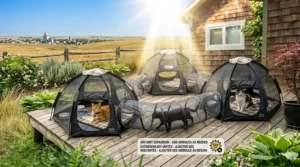
Catio Tunnel Connections: Technical Specifications
Successfully connecting outdoor cat tunnel enclosures to houses or other structures requires attention to technical details that ensure safety, weatherproofing, and long-term reliability.
Window Mounting
Window-mounted tunnels offer the most straightforward installation path for most Canadian homes. The process typically involves measuring window dimensions precisely (including frame depth and opening mechanism clearance), selecting tunnels with compatible mounting flanges or adapters, creating weatherproof seals using appropriate materials, ensuring structural support doesn’t rely solely on window frames, and providing emergency exit options should primary access become blocked.
Toronto customers note that older homes’ window frames may require reinforcement before mounting tunnels—original framing might not safely support tunnel weight plus cats’ dynamic loads. Simple plywood backing plates distributed tunnel loads across multiple studs solve this concern effectively.
Cat Door Integration
Dedicated cat doors provide permanent, weather-sealed access points that many Canadian homeowners prefer over modified windows. Quality cat doors suitable for Canadian climates include features like magnetic or electronic sealing mechanisms that prevent drafts, insulated flaps rated for extreme temperatures, security locks for nighttime closure, and compatibility with tunnel mounting systems.
Prairie province customers emphasize electronic cat doors’ value for controlling outdoor access during extreme cold snaps or severe weather warnings. These systems allow monitoring exactly when cats venture outside whilst maintaining general freedom of movement.
Wall Penetrations
Permanent installations sometimes require wall penetrations for optimal tunnel routing. This approach demands careful planning in Canadian climates where improper penetrations create significant energy loss and moisture infiltration risks. Hiring professionals for wall penetrations often proves worthwhile—they ensure proper vapour barrier integrity, insulation continuity, flashing installation, and structural member clearance.
British Columbia customers in earthquake-prone regions should consult local codes about penetrating shear walls or other structural elements. Most tunnel installations don’t impact structural integrity, but verification prevents expensive problems.
Multi-Level Connections
Creating vertical elements adds complexity but substantially increases exploration opportunities. Canadian customers report that cats absolutely love elevated walkways overlooking yards—these satisfy both hunting instincts (high perches) and curiosity about outdoor activity.
Support structures for elevated tunnels need consideration for Canadian winter conditions. Treated lumber suitable for ground contact proves essential for support posts. Metal options avoid rot concerns but require careful attention to thermal bridging that could create ice formation at connection points during winter freeze-thaw cycles.
Garden Cat Tunnels: Landscaping Integration
Thoughtfully integrated garden cat tunnels create beautiful outdoor features whilst providing your cats enriching exploration opportunities. Canadian landscaping integration requires consideration for seasonal changes that affect both aesthetic appearance and practical function.
Ground-Level Garden Paths
Ground-level tunnels meandering through garden beds offer cats close encounters with plants, insects, and ground-level wildlife whilst protecting both cats and gardens. British Columbia customers create tunnel paths along existing garden borders, allowing cats to observe birds and small wildlife from protected vantage points.
Choosing plants for areas adjacent to cat tunnels requires some strategy. Avoid toxic plants like lilies, tulips, and daffodils near tunnel openings where cats might nibble foliage. Catnip, cat grass, silvervine, and catmint planted near tunnels provide additional enrichment—many Canadian customers report their cats pausing at mesh openings to sniff these plants, clearly enjoying the aromatherapy.
Seasonal Aesthetic Considerations
Canadian gardens transform dramatically across seasons—tunnel systems should complement these changes rather than clashing. Wooden tunnel finishes in natural wood tones blend well with most Canadian landscaping styles. Some customers paint tunnels to match home exteriors for cohesive appearances.
Winter presents aesthetic challenges. Snow-covered tunnels can appear bulky in otherwise pristine winter landscapes. Saskatchewan customers note that regular snow clearing not only maintains tunnel function but also reduces visual bulk. Some opt for seasonal covers that transform tunnels into winter garden features.
Wildlife Observation Zones
Strategic tunnel placement creates wildlife observation opportunities that benefit both cats and gardeners. Positioning tunnels near bird feeders (with appropriate predator-safe distances) allows cats to observe birds whilst feeders remain secure. This arrangement satisfies cats’ hunting instincts through visual stimulation without endangering bird populations.
Ontario customers report setting up tunnel viewing areas overlooking bird baths or feeding stations, creating what they describe as “cat television”—their cats spend hours watching bird activity from safe, enclosed tunnel vantage points. This represents ideal environmental enrichment: mental stimulation without ecological harm.
Outdoor Cat Enrichment Through Tunnel Systems
Environmental enrichment extends far beyond simply providing outdoor access. Thoughtfully designed outdoor cat tunnel enclosures incorporate multiple enrichment types that address cats’ complex behavioural needs.
Visual Enrichment Opportunities
Cats are highly visual predators whose brains are wired to track movement and monitor environments for potential prey or threats. Outdoor tunnel systems provide constantly changing visual stimuli—moving leaves, insects, birds, squirrels, changing shadows, and weather patterns—that indoor environments simply cannot replicate.
Research published in PMC/NIH journals confirms that visual enrichment significantly reduces stress-related behaviours in confined cats. Canadian customers consistently report calmer, less destructive cats after providing regular outdoor visual access. A Montreal customer noted, “Our cat was constantly knocking things off shelves and scratching furniture. Since installing the tunnel to our catio three months ago, those behaviours have nearly disappeared.”
Positioning tunnels strategically maximizes visual enrichment potential. Ground-level tunnels offer close-up insect and plant observations. Elevated tunnels provide bird-watching opportunities and overhead territorial surveying. T-junctions and multiple-entry designs allow cats to choose viewing angles based on moment-to-moment interests.
Olfactory Stimulation
Cats rely on scent information far more than humans realize—their sense of smell is approximately 14 times stronger than ours. Outdoor tunnel systems expose cats to constantly changing scent landscapes that provide mental stimulation and environmental information processing.
Alberta customers report their cats frequently pause at mesh openings, spending minutes sampling outdoor scents—grass, flowers, rain, snow, other animals’ markings. This behaviour represents active environmental engagement that satisfies natural investigatory drives whilst requiring minimal human involvement.
Consider planting cat-safe aromatic plants near tunnel routes to enhance olfactory enrichment. Catnip, cat grass, and silvervine naturally attract feline interest. Lavender and certain herbs provide pleasant scents (though cats’ reactions vary individually). Avoid strongly scented plants that might overwhelm cats’ sensitive noses.
Physical Activity Promotion
Length matters for physical enrichment. Longer tunnels encourage running and playing—multiple Canadian customers report their cats racing back and forth through tunnels, especially during dawn and dusk activity peaks. This natural exercise helps maintain healthy weights and muscle tone whilst providing outlet for energy that might otherwise manifest as destructive indoor behaviour.
The 98″ PawHut tunnel receives particular praise from customers whose cats use its full length for speed runs. One Saskatchewan customer measured their cat regularly hitting speeds sufficient to make the entire tunnel rock slightly—testament to cats’ enthusiasm for these longer paths.
Multi-level systems incorporating height changes add valuable vertical exercise. Climbing represents natural feline behaviour that many indoor environments inadequately support. Even modest elevation changes—two or three feet—provide satisfying climbing opportunities.
Mental Stimulation Through Novelty
Environmental complexity and novelty drive mental engagement. Tunnels with multiple pathways, junction choices, and varying elevation create decision-making opportunities that exercise cats’ cognitive abilities. Simple straight tunnels provide less mental stimulation than systems requiring navigation choices.
Canadian customers who added tunnel networks report observing their cats apparently planning routes—pausing at junctions, looking both directions before choosing paths. This behaviour suggests genuine cognitive engagement rather than simple automatic responses.
Periodically modifying tunnel routes or adding new sections maintains novelty. The modular Kitty City system excels here—reconfiguring components takes minutes but creates entirely new exploration experiences from cats’ perspectives.
Frequently Asked Questions
❓ How much does a good outdoor cat tunnel enclosure cost in Canada?
❓ Can outdoor cat tunnels withstand Canadian winters?
❓ How do I connect an outdoor cat tunnel to my house window?
❓ Are outdoor cat tunnel enclosures safe from predators in Canada?
❓ How long do outdoor cat tunnels last in Canadian weather?
Conclusion: Choosing Your Perfect Outdoor Cat Tunnel Enclosure
Creating safe outdoor access for your indoor cat represents one of the most impactful enrichment improvements you can make. The seven outdoor cat tunnel enclosures we’ve reviewed offer solutions for virtually every Canadian household—from urban Toronto condos with limited balcony space to sprawling rural properties in British Columbia and Alberta.
Budget-conscious Canadians will find excellent value in the Pawtenda 4-in-1 system at $89-$119 CAD, providing genuine outdoor enrichment whilst remaining flexible for seasonal use or relocation. Mid-range buyers seeking permanent solutions should seriously consider the PawHut 59″ or Aivituvin 90.6″ metal tunnel options—both deliver excellent weatherproof construction suitable for year-round Canadian use at reasonable price points.
For cat owners committed to providing the ultimate outdoor experience, the Aivituvin AIR37 premium system justifies its $389-$449 CAD investment through superior construction, extensive features, and walk-in convenience. Multiple Canadian customers describe this as “life-changing” for their cats’ quality of life and behaviour.
Remember that successful outdoor cat tunnel implementation requires more than just purchasing equipment. Proper installation weatherproofed for Canadian conditions, regular seasonal maintenance, strategic placement considering your cats’ preferences and your yard’s features, and gradual introduction allowing cats to explore at their own pace all contribute to success.
The environmental enrichment benefits are undeniable. Canadian customers consistently report calmer, more content cats exhibiting fewer destructive behaviours after providing outdoor tunnel access. Research from veterinary behavioural specialists confirms these observations—cats with enriched environments demonstrate improved psychological wellbeing and reduced stress markers.
Your cat’s longing gaze out the window signals genuine need, not simple curiosity. An outdoor cat tunnel enclosure transforms that need into safe, enriching reality. Whether you start with a modest single tunnel or commit to an expansive network, you’re providing your cat with experiences that dramatically enhance their quality of life whilst maintaining the safety that indoor living provides.
Take the first step today. Review the options that fit your budget and space, check current Amazon.ca pricing for seasonal promotions, and begin planning your cat’s outdoor adventure. Your feline friend’s mental health, physical wellbeing, and overall happiness will thank you—though probably through purrs and contented outdoor lounging rather than words.
Recommended for You
- 7 Best Collapsible Cat Tunnels Canada 2026
- 7 Best Horizontal vs Vertical Cat Scratchers Canada 2026
- 7 Best Corner Cat Scratcher Furniture Savers Canada 2026
Disclaimer: This article contains affiliate links to Amazon.ca. If you purchase products through these links, we may earn a small commission at no additional cost to you.
✨ Found this helpful? Share it with your friends! 💬🤗
