
In This Article
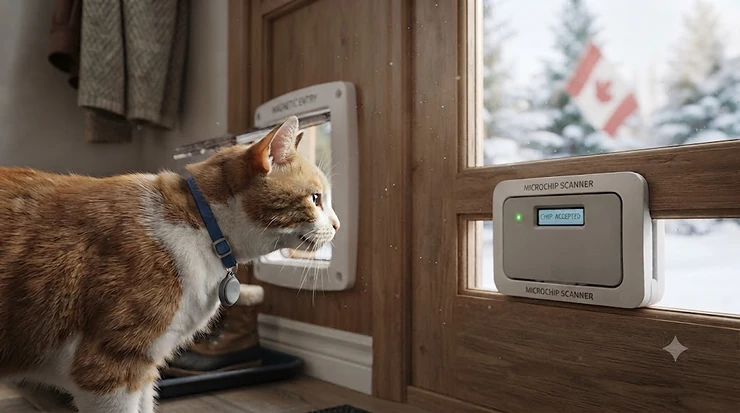
Somewhere around 2 a.m., a neighbourhood tom cat is going to find the soft-swinging flap in your back door and decide it leads to an all-you-can-eat buffet. This is the exact moment most Canadian cat owners discover that not all pet doors are created equal, and that the phrase magnetic vs microchip cat door isn’t just marketing noise — it’s the difference between a peaceful house and a 3 a.m. hissing match in your kitchen. Both styles promise “selective entry,” but they get there through completely different hardware, and that hardware determines whether your cat sails through effortlessly or whether a clever raccoon eventually cracks the code.
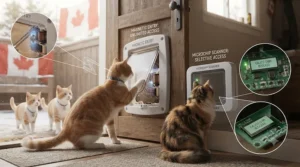
Here’s the short version: a magnetic cat door reads a small magnet on your cat’s collar, while a microchip cat flap scans the identification chip already implanted under your cat’s skin (the same one a vet or shelter would scan if your cat ever went missing). One relies on something your cat wears; the other relies on something your cat is. That distinction ripples through security, cost, reliability, and — as you’ll see below — how many nights you spend chasing a stray tabby out of your living room.
This guide breaks down seven real models sold in Canada, from budget electromagnetic flaps under C$100 to app-connected microchip systems, with honest analysis pulled from real specs and aggregated review sentiment rather than recycled marketing copy. According to VCA Canada Animal Hospitals, cats without microchips have less than a 5% chance of being reunited with their families if lost, which is worth keeping in mind as you weigh a system that’s already tied to that same chip. Let’s get into which door actually earns its keep.
Quick Comparison Table
| Door Type | Entry Method | Typical Price Range (CAD) | Stray-Proof Rating | Best For |
|---|---|---|---|---|
| Magnetic Flap | Collar-worn magnet | C$50–C$150 | Moderate | Budget buyers, single-cat homes |
| Microchip Flap (basic) | Existing implanted chip | C$100–C$260 | High | Multi-cat homes, raccoon-prone areas |
| Microchip Flap (connected) | Chip + app/hub | C$260–C$400+ | Very High | Tech-savvy owners wanting usage data |
A magnetic system wins on sticker price and simplicity, but it hands security to a piece of plastic your cat can lose, chew off, or leave on the wrong collar entirely. A microchip flap costs more upfront because it’s reading something permanent and un-losable, which is exactly why shelters and vets already rely on that same chip for identification. Connected microchip doors add a third layer — smartphone control and activity logs — that’s genuinely useful for multi-pet households but is overkill if you’ve got one indoor-outdoor cat and a quiet street.
💬 Just one click — help others make better buying decisions too!😊
Top 7 Magnetic and Microchip Cat Doors: Expert Analysis
1. SureFlap Microchip Pet Door Connect — app-controlled entry with usage tracking
The standout feature here isn’t the flap itself — it’s the hub. Pair this door with the Sure Petcare app and you get a running log of every time your cat comes and goes, plus the ability to lock the door remotely from your phone if you forget before leaving for work. Under the hood, it’s the same DualScan microchip tech SureFlap has used for over a decade: the door reads your cat’s existing implanted chip and, using DualScan technology, can set separate entry and exit permissions so you decide who’s allowed to leave and who has to stay in. It’s compatible with all standard 9, 10, and 15-digit microchip formats used in Canada, so there’s no proprietary tag to lose or replace.
Based on the spec comparison, this is the only door on this list built around a companion ecosystem rather than a standalone flap, which matters if you’ve got a senior cat you want to monitor for changes in outdoor activity — a sudden drop in trips outside is often one of the first signs something’s wrong. Reviewers consistently report that the app occasionally lags behind real-time activity by a few minutes, and that the hub requires a stable Wi-Fi connection to sync, which isn’t ideal for detached garages or basement installs with weak signal.
Pros:
- ✅ Remote lock/unlock and curfew scheduling via smartphone
- ✅ DualScan tech separates entry and exit permissions per cat
- ✅ Stores up to 32 registered pets for multi-cat households
Cons:
- ❌ Requires stable home Wi-Fi for the hub to sync properly
- ❌ Premium price compared to non-connected microchip flaps
Expect to pay in the C$300–C$400 range for the door-and-hub bundle, which puts it firmly in premium territory — but for households already juggling multiple cats and wanting a paper trail of who’s coming and going, the value case is solid.
2. SureFlap Microchip Cat Flap (Classic) — the industry benchmark for microchip security
This is the flap most veterinary clinics and shelters point to when a client asks “what actually works,” and the standout feature is its sheer track record: it’s been reading implanted chips reliably since long before “smart pet door” was a marketing term. The flap opening measures roughly 4¾ inches high by 5⅝ inches wide, and it stores up to 32 individual microchip codes in memory, so multi-cat households don’t need a second unit. Battery life runs up to 12 months on four AA batteries, with a red flashing indicator when it’s time to swap them out.
What most buyers overlook about this model is that it doesn’t need the hub or app to work at full security — the core function (reading a chip, opening only for registered pets) runs entirely on the unit itself, no Wi-Fi required. That makes it the more dependable pick for rural properties or older homes with patchy internet. Reviewers consistently note the door holds up well through Canadian winters thanks to a magnetic closure seal on the flap itself (used here purely for weatherproofing, not identification), though a handful mention the read range is short enough that cats need to approach fairly close to the flap before it unlocks.
Pros:
- ✅ No app or Wi-Fi required for core security function
- ✅ Compatible with all common microchip types worldwide
- ✅ Three-year manufacturer warranty included
Cons:
- ❌ Short chip-read range compared to newer connected models
- ❌ No usage tracking without the separate hub accessory
Pricing on Amazon.ca typically sits in the C$220–C$240 range depending on colour and seller. For a household that just wants strays kept out without any smart-home fuss, this remains the benchmark buy.
3. Cat Mate Elite Microchip Cat Flap with Timer (355) — LCD tracking for multi-cat homes on a mid-range budget
The standout feature on this one is the built-in LCD display, which shows the lock status, last-used time, and rough location for up to three selected cats — a genuinely useful readout that most flaps in this price bracket simply don’t offer. It reads either your cat’s implanted microchip or a Cat Mate RFID collar disc (handy if a cat’s chip location makes it awkward to scan consistently), and it supports up to nine registered pets, which comfortably covers even a busy multi-cat household.
Here’s what the spec sheet won’t tell you, but reviewers note: the timer-controlled curfew function is the feature people end up using most, since it lets you set an automatic overnight lockout without having to remember to flip a manual switch before bed. On paper this means less chance of a half-asleep 11 p.m. decision to “just leave it unlocked tonight” turning into an unwanted 3 a.m. visitor. The trade-off is a four-way rotary lock that a few reviewers describe as stiffer to turn than SureFlap’s equivalent, particularly in cold weather when the plastic housing contracts slightly.
Pros:
- ✅ LCD display tracks status for up to three cats
- ✅ Built-in timer for automatic overnight curfews
- ✅ Works with microchips or RFID collar discs
Cons:
- ❌ Four-way lock reported as stiffer in cold weather
- ❌ LCD only tracks three cats even if nine are registered
At roughly C$100–C$140, it undercuts the classic SureFlap by a wide margin while still delivering genuine microchip security — a strong pick if the app-and-hub ecosystem of the Connect model feels unnecessary for your household.
4. Cat Mate Microchip Activated Cat Flap (360) — the budget entry point into true microchip security
If the phrase cheapest secure cat flap describes exactly what you’re shopping for, this is where the microchip category gets genuinely affordable. The standout feature is straightforward: it reads ISO 15-digit microchips and Cat Mate ID discs, stores up to 30 pets, and skips the LCD screen and timer functions entirely to keep the price down. Programming a new cat’s chip is a single-button process, with an LED that flashes to confirm the registration went through.
Based on the spec comparison, this is essentially the no-frills version of the Elite (355) above — same microchip-reading core, same 4-way rotary lock, same weatherproof brush seal, just without the display and scheduling extras. What most buyers overlook is that stripping those features doesn’t touch the part that actually matters for stray prevention: the chip-reading accuracy. Reviewers consistently describe it as functionally identical to pricier Cat Mate models for the core job of keeping unregistered animals out, with the main complaint being that self-lining only extends to about 85mm, which can be tight for very thick exterior doors.
Pros:
- ✅ Genuine microchip security at the lowest price in the category
- ✅ Stores up to 30 registered pets
- ✅ Simple one-button programming for new cats
Cons:
- ❌ No LCD display or curfew timer
- ❌ Limited self-lining depth for thick doors
Priced around C$130–C$160 on Amazon.ca, this is the door to recommend to anyone who wants the security tier without the connected-hardware premium.
5. PetSafe Staywell Deluxe Magnetic Cat Flap — the most familiar name in magnetic entry
PetSafe has been in the pet-door business for nearly three decades, and the standout feature of this model is its 4-way locking flexibility: fully open, fully closed, in-only, or out-only, all controlled by a simple dial rather than a phone app. Entry is granted by a small magnetic key clipped to your cat’s collar — no microchip scanning, no batteries in some configurations, just a magnet triggering a mechanical latch.
Here’s what to weigh: the magnetic closure on the flap door itself does double duty, sealing out drafts and rain while also being part of the branding around “magnetic” security — but functionally, the actual access control is the separate collar key, not the door’s weatherstripping. What most buyers overlook is that this distinction matters for multi-cat homes, because every cat needs its own magnetic key, and if two cats share a collar or a key falls off, the system has no way to tell them apart the way a microchip flap would. Reviewers consistently report the flap itself is quiet and low-friction for cats to push through, but a recurring complaint is that the collar magnet occasionally falls off the collar clip during outdoor roughhousing, which means a locked-out cat scratching at the door until someone notices.
Pros:
- ✅ Simple 4-way manual lock with no batteries required
- ✅ Universal fitting for doors, windows, or walls
- ✅ 3-year manufacturer warranty
Cons:
- ❌ Collar magnet can detach during play, locking cats out
- ❌ Can’t distinguish between multiple cats sharing one key
Expect a price in the C$60–C$100 range, making it one of the more affordable “selective entry” options — provided you’re comfortable with a physical key instead of biometric-style identification.

6. Cat Mate 4-Way Electromagnetic Cat Flap (254) — the cheapest genuinely selective flap on this list
For sheer value-per-dollar, this is the standout: a magnetic-key system with a 4-way lock, weatherproof brush seal, and a fast-reacting circuit that Cat Mate’s own materials describe as designed for instant entry regardless of a cat’s size or how quickly it approaches the flap. It ships with two collar magnets, runs on a single 9-volt battery rated for roughly 12 months, and self-lines up to 60mm — enough for most standard exterior doors.
Based on the aggregated review sentiment, this model draws a genuinely mixed response that’s worth being upfront about: many owners report years of trouble-free use, while a smaller but consistent group describes the “in only” or “out only” settings failing to hold reliably, occasionally trapping a cat outside when the lock defaults to the wrong direction. That’s a meaningful pattern for anyone in a neighbourhood with real predator or stray-cat pressure, where an unreliable lock isn’t just inconvenient — it’s a security gap. If your street is relatively low-traffic and you mainly want to keep casual strays from wandering in, the price makes this an easy budget pick; if raccoons or aggressive strays are a known problem on your block, it’s worth reading the fuller comparison in the security section below before committing.
Pros:
- ✅ Lowest price point among true selective-entry flaps
- ✅ Two collar magnets included, no separate purchase needed
- ✅ Fast, brush-sealed flap for draft protection
Cons:
- ❌ Directional lock settings reported as inconsistent by some owners
- ❌ Magnet-based entry, same lose-the-key risk as other magnetic doors
Typical pricing lands around C$50–C$80, making it the cheapest secure cat flap in this roundup by a comfortable margin — just budget mentally for the possibility of troubleshooting the lock mechanism down the line.
7. PetSafe Microchip Cat Door (Multi-User RFID) — microchip security with 4-way locking for larger households
Rounding out the list is PetSafe’s answer to the microchip category, and its standout feature is capacity: it supports RFID access for up to 40 registered pets, noticeably more headroom than most competitors, which makes it a natural fit for foster-cat households or anyone running a small in-home rescue setup. Like the Cat Mate and SureFlap microchip models, it reads your cat’s existing implanted chip rather than requiring a separate collar accessory, and it includes the same 4-way locking flexibility (open, closed, in-only, out-only) found across PetSafe’s magnetic lineup.
The spec sheet won’t tell you this, but user reports suggest the DIY installation kit is genuinely beginner-friendly, with a cutting template that lines up cleanly for standard exterior doors — a detail that matters if you’re not hiring a contractor for the install. On paper, the weatherproof seal and durable plastic flap put this in the same performance tier as the Cat Mate Elite, but reviewers note the RFID scan occasionally requires cats to pause briefly at the flap rather than walking straight through at full speed, a minor adjustment period most cats work out within a week or two.
Pros:
- ✅ Supports up to 40 registered pets, the highest capacity here
- ✅ Beginner-friendly DIY installation with cutting template
- ✅ 4-way locking matches PetSafe’s magnetic model for consistency
Cons:
- ❌ Brief pause required at the flap for RFID scanning
- ❌ Pricing sits above budget microchip competitors
Priced roughly C$150–C$200, it sits comfortably between the Cat Mate Elite and the full SureFlap Connect system — a solid middle path for anyone who wants microchip-level security without hub-and-app complexity.
Magnetic Cat Door Pros and Cons: The Honest Breakdown
Setting the individual products aside, it’s worth zooming out on magnetic cat door pros cons as a category, because the appeal is real but so are the limits. On the plus side, magnetic systems are typically the cheapest way into “selective entry,” they don’t require batteries in every model, and the mechanism is simple enough that troubleshooting rarely needs a manual. For a single-cat household on a quiet street, that simplicity is genuinely attractive.
The honest downside is that magnetic security is only as good as a small plastic key clipped to a collar. Collars snap, keys fall off during a fence-top scramble, and a lost magnet means either a locked-out cat or — if you leave the door unlocked as a workaround — no security at all. Multi-cat households also run into a ceiling here: most magnetic systems can’t distinguish between individual cats, so a shared or misplaced key defeats the entire point of selective entry. What most buyers overlook is that “magnetic” branding sometimes refers only to the weatherproof flap seal, not the actual access-control mechanism, which can create confusion when comparing specs across brands.
Microchip Cat Flap vs Magnetic Cat Flap: Which Wins in Practice?
Zooming in on microchip cat flap vs magnetic cat flap directly, the practical difference comes down to what can go wrong and how often it actually does. A magnetic flap’s failure point is external — a lost or broken key — while a microchip flap’s failure point is almost entirely internal to the unit itself, since the chip it’s reading is already permanently implanted and can’t be misplaced. Reviewers consistently note that microchip flaps also scale better in multi-cat homes, since each registered chip is genuinely unique, whereas magnetic keys are functionally interchangeable unless carefully managed.
Where magnetic systems still hold an edge is upfront cost and simplicity of setup — there’s no chip to program, no app to configure, just a magnet and a dial. For a household with one indoor-outdoor cat and low predator pressure, that simplicity might genuinely be enough. But based on the spec comparison across all seven products above, microchip flaps are the more resilient long-term investment for anyone dealing with persistent strays, multiple cats, or raccoons determined to treat your cat door as a drive-through window.
Cat Door Security Comparison: Stray and Wildlife Resistance
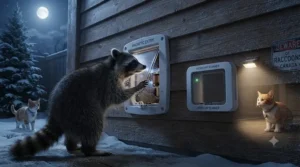
A cat door security comparison isn’t complete without addressing the animal most likely to defeat either system: raccoons. A widely shared video out of New Westminster, B.C. showed an indoor cat confronting a pack of raccoons that had gathered outside a pet door, a reminder that in many Canadian neighbourhoods, the real security question isn’t “will another cat get in” but “will something considerably less welcome get in.” Magnetic flaps offer essentially no protection here — a magnet only proves a collar is nearby, not that the animal wearing it is actually a cat, and raccoons have been documented manipulating simple mechanical latches with their dexterous front paws.
Microchip flaps close that gap significantly, since a raccoon obviously can’t carry your cat’s implanted chip, but they’re not entirely immune to persistence — some owners of dual-scan models report raccoons learning to paw at the flap edge while a cat is mid-entry, slipping through in the brief open window. The practical takeaway: if wildlife pressure is a known issue on your property, prioritize models with faster-closing flaps and consider pairing a microchip door with a simple physical barrier (like keeping the flap locked overnight via curfew timer) rather than relying on the scanning technology alone.
| Threat | Magnetic Flap Risk | Microchip Flap Risk |
|---|---|---|
| Stray cats | High — no chip check | Low — chip required |
| Raccoons | High — can trigger mechanical latch | Low-Moderate — can’t carry a chip |
| Lost/shared collar key | High — defeats system entirely | N/A — no external key used |
The table makes the pattern clear: microchip systems remove the “lost key” failure mode entirely and add a meaningful barrier against wildlife, while magnetic systems trade that security for a lower price and simpler setup. Households in raccoon-dense areas — much of suburban Ontario and B.C.’s Lower Mainland included — will generally get more real-world value out of the microchip tier, even at the higher upfront cost.
✨ Ready to compare specific models? Scroll back up to the Top 7 breakdown to match a door to your household.
Practical Installation and First 30 Days: A Usage Guide
Getting either door type working well isn’t just about the hardware — it’s about the setup and the first month of use. Start by measuring your cat at the shoulder and chest before ordering; most flap openings (roughly 4¾ by 5⅝ inches on standard models) comfortably fit average adult cats, but larger breeds like Maine Coons may need a “big cat” or pet-door-sized variant instead. For exterior door installs, use the manufacturer’s cutting template exactly as provided rather than eyeballing it — a slightly crooked cut-out is one of the most common causes of drafts and misaligned locking mechanisms reported in reviews.
Once installed, resist the urge to just let your cat “figure it out.” Most manufacturers recommend taping the flap open for the first few days so your cat can walk through without pushing against resistance, then gradually lowering it so the flap brushes their back on the way through. For microchip models specifically, register the chip immediately and test it with the door in “in-only” mode before trusting it for full access — this catches read-range issues while you’re still standing right there to help. As the Hamilton/Burlington SPCA notes, a microchip offers permanent identification that, unlike a collar or tag, cannot be lost or removed — the same reliability that makes a properly registered chip such a solid foundation for a cat door’s security. A common first-30-days mistake is leaving the door in an unrestricted setting overnight before you’ve confirmed the lock schedule actually works as expected; test the curfew function manually for at least a week before relying on the automatic timer.
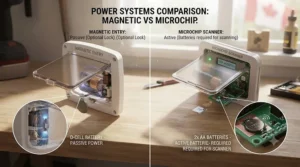
Maintenance is minimal but not zero: wipe down the brush seal every few months to keep drafts out, replace batteries proactively rather than waiting for the low-battery flash (especially before a Canadian winter cold snap, when battery performance drops), and re-check the collar magnet or chip registration any time you get a new cat or your existing cat gets a new collar.
Real-World Scenarios: Matching the Door to Your Household
Consider three fairly typical Canadian households. First, a downtown Toronto condo owner with one indoor cat who occasionally supervises balcony or patio access — for them, a mid-range magnetic flap like the PetSafe Staywell Deluxe Magnetic Cat Flap is probably plenty, since the security demands are low and the priority is simplicity and weatherproofing.
Second, a suburban family in a raccoon-heavy Hamilton or Mississauga neighbourhood with two cats and a backyard adjoining a ravine — here, the calculus changes sharply. A microchip flap like the Cat Mate Elite Microchip Cat Flap with Timer (355) or the Cat Mate Microchip Activated Cat Flap (360) makes far more sense, since the curfew timer alone reduces overnight wildlife exposure, and the chip-based entry closes the “shared key” gap that would otherwise let either cat lock the other out.
Third, picture a rural property owner in B.C. with three barn cats and patchy rural internet — for this household, the SureFlap Microchip Cat Flap (Classic) is the more sensible premium pick over the Connect model, since it delivers the same core chip security without depending on a Wi-Fi connection the property may not reliably have.
Common Mistakes When Buying a Cat Door
The single most common mistake is buying based on price alone without checking flap dimensions against your specific cat’s size — a flap too small for a large breed gets avoided entirely, wasting the purchase. A close second is assuming “magnetic” and “microchip” security are roughly interchangeable; as the comparisons above show, they solve genuinely different problems. Buyers in wildlife-heavy areas also frequently underestimate raccoon persistence, opting for a basic magnetic model and then facing repeated nighttime intrusions before upgrading.
Another frequent misstep is skipping the manufacturer’s cutting template and eyeballing the install, which reviewers across every brand cite as the leading cause of drafts, misaligned locks, and voided warranties. Finally, many owners forget to register their cat’s microchip details with the flap immediately after buying a microchip model, leaving the door essentially non-functional (or accidentally open to any chip) for days or weeks after installation.
How to Choose Between Magnetic and Microchip: 6 Deciding Factors
- Number of cats in the household. More than one cat sharply favours microchip systems, since each chip is genuinely unique while magnetic keys are easily mixed up or shared.
- Local wildlife pressure. Raccoon-dense suburbs and rural properties benefit disproportionately from microchip security and curfew timers.
- Budget ceiling. If cost is the deciding factor, a budget magnetic or entry-level microchip flap (like the Cat Mate 254 or 360) covers most basic needs.
- Internet reliability at the install location. Skip connected/app-based models if your Wi-Fi doesn’t reach the install point reliably.
- Cat’s collar habits. Cats that regularly lose collars or go collar-free are poor candidates for magnetic-key systems by default.
- Desire for usage data. Owners managing a senior cat’s health or a multi-pet household’s comings and goings get real value from app-connected models like the SureFlap Connect.
Long-Term Cost and Maintenance: What You’re Actually Paying For
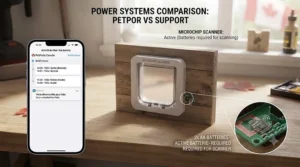
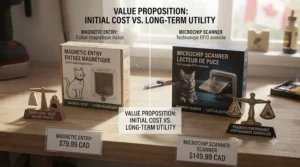
Total cost of ownership rarely stops at the sticker price. Magnetic systems have a hidden recurring cost most buyers don’t budget for: replacement collar keys, typically sold in two-packs, which add up if a household loses a couple a year. Microchip flaps skip that cost entirely since the “key” is already implanted, but they generally carry a higher upfront price and, on connected models, sometimes a subscription or hub-replacement cost down the line.
Battery replacement is a wash across both categories — most flaps run 6 to 12 months per set regardless of entry method — but Canadian winters do shorten that window somewhat, since cold reduces battery output. Factoring in a realistic 5-year ownership window, a budget magnetic flap plus a couple of replacement keys often lands close in total cost to a mid-range microchip flap purchased once and left alone, which tips the long-term value case meaningfully toward microchip models for anyone planning to keep the door installed for years rather than one season.
🔍 Ready to shortlist a door for your household? Head back up to the Top 7 for real pricing on each model.
Features That Actually Matter (And Those That Don’t)
Genuinely useful: 4-way locking (open/closed/in-only/out-only), a proper weatherproof brush seal, and — for microchip models — a reasonably fast scan response so cats aren’t hesitating at the flap. A curfew timer is also worth paying for if overnight wildlife activity is a known issue in your area.
Less essential for most households: LCD activity tracking (nice, but not a security feature), app connectivity if your cat rarely leaves your immediate property, and support for 30+ registered pets unless you’re genuinely running a multi-cat rescue. These extras aren’t bad, but they’re the features to skip first if you’re trying to trim a budget without sacrificing actual security.
Safety, Regulations, and Compliance Guide
Cat door regulations in Canada are mostly a non-issue at the federal level, but local rules on pet identification do intersect with this purchase in an important way. As Trupanion Canada explains, microchipping became compulsory for all cat and dog owners in Montreal in 2020, and British Columbia requires some permanent form of pet identification such as a microchip or tattoo, which means a microchip-based cat door isn’t just a security upgrade in some cities — it’s compatible with an identification requirement you may already need to meet.
If you install a cat door in an exterior wall rather than an existing door, check whether your municipality or condo board has any restrictions on wall penetrations before drilling — this is more relevant to condo and townhouse owners than detached-home owners, but it’s a five-minute check that avoids a much bigger headache later.
Frequently Asked Questions
❓ Is a microchip cat door better than a magnetic one?
❓ Can a microchip cat door work without my cat's collar?
❓ What is the cheapest secure cat flap available in Canada?
❓ Do magnetic cat doors keep raccoons out?
❓ How long does the battery last in a microchip cat flap?
Conclusion
Choosing between a magnetic and a microchip cat door really comes down to how much your specific household has to lose from a security gap. If you’ve got one relaxed indoor-outdoor cat on a quiet street, a magnetic flap like the Staywell Deluxe or the budget Cat Mate 254 will likely serve you fine for years, at a fraction of the upfront cost. If you’re managing multiple cats, dealing with real raccoon or stray-cat pressure, or simply want the peace of mind that comes from a system that can’t be lost, dropped, or shared by accident, the microchip tier — from the budget Cat Mate 360 up through the fully connected SureFlap system — is worth the extra spend.
None of the seven doors covered here are flawless, and the honest review patterns above (stiff locks in cold weather, occasional directional-lock quirks, brief RFID pauses) are worth weighing against your own patience for troubleshooting. But across budget, mid-range, and premium tiers, there’s a genuinely solid option here for nearly every Canadian household’s cat door needs — the trick is matching the security level to the actual risk on your street, not just the lowest price on the page.
Recommended for You
- Best Magnetic Cat Flap in Canada 2026: 7 Top 4-Way Picks
- How Does a Microchip Cat Flap Work? 7 Top Picks for 2026
- SureFlap vs PetSafe Microchip Cat Door: 7 Real Picks (2026)
Disclaimer: This article contains affiliate links. As an Amazon Associate, I earn from qualifying purchases. If you purchase products through these links, we may earn a small commission at no additional cost to you.
✨ Found this helpful? Share it with your friends! 💬🤗
