
In This Article
So, your cat stares longingly out the window every morning, and you’ve finally decided: this is the year you both go outside together. Welcome to the club — leash walking cats is one of the fastest-growing pet trends in Canada right now, with veterinarians from Victoria to Halifax recommending it as a safe, enriching way to give indoor cats a taste of the big wide world. But here’s the thing: before you can start your first-time cat walking adventure, you need the right gear — and not just any harness will do.
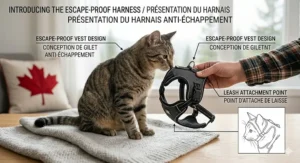
A cat harness for walking beginners is not simply a miniature dog harness. Cats are biologically built differently: their necks and heads are nearly the same circumference, which means a collar alone creates real injury risk during any resistance. A well-fitted vest harness distributes pressure across the chest and torso — dramatically safer and far more comfortable. Whether you’re a new cat parent in downtown Toronto, a condo dweller in Vancouver, or a family in suburban Calgary, the right harness makes all the difference between a pleasant stroll and a panicked escape artist situation.
In this guide, I’ve done the deep research so you don’t have to. You’ll find seven real, verified-available products on Amazon.ca (prices in CAD), a step-by-step leash training guide tailored for Canadian cats and climates, honest expert commentary on what specs actually matter, and a sizing guide that prevents the most common beginner mistake. As a bonus, I’ll point you to trusted Canadian resources like the BC SPCA’s guide to safe outdoor cat enrichment and the Toronto Wildlife Centre’s leash training tips — because walking your cat responsibly also means understanding your local wildlife.
Let’s get started. 🐱🇨🇦
Quick Comparison: Best Cat Harnesses for Walking Beginners (Amazon.ca, 2026)
| Product | Type | Best For | Escape-Proof | Price Range (CAD) | Prime Eligible |
|---|---|---|---|---|---|
| rabbitgoo Cat Harness & Leash Set | Vest/Jacket | Overall beginners | ✅ 4-point adjust | $20–$35 | ✅ |
| Halypet Cat Harness 4th-Gen | Vest | Tech-savvy beginners | ✅ Integrated buckle | $25–$40 | ✅ |
| PetSafe Come With Me Kitty | Figure-H style | Nervous/resistant cats | ✅ Martingale loop | $25–$40 | ✅ |
| Dooradar Cat Harness & Leash | Mesh Vest | Budget-conscious shoppers | ✅ Reflective strips | $18–$30 | ✅ |
| Voyager Step-In Lock Cat Harness | Step-In Mesh | Laid-back, cooperative cats | ✅ Step-in lock | $25–$38 | ✅ |
| Kitty Holster Cat Harness | Soft Cotton Wrap | Comfort-sensitive cats | ✅ Hook-and-loop | $35–$50 | ✅ |
| Sleepypod Martingale Cat Harness | Martingale Mesh | Adventurous/travel cats | ✅ Velcro + martingale | $45–$65 | ✅ |
The table above tells you the what, but let me walk you through the why. The rabbitgoo and Halypet dominate the budget-to-mid range for a reason — they’re genuinely well-engineered for beginners who are still figuring out what their cat will tolerate. For cats with sensory sensitivities (common in anxious indoor cats), the Kitty Holster’s soft cotton construction is worth the price bump. And if your cat has already mastered the basics and you’re planning outdoor adventures? The Sleepypod justifies its premium tag with durability built for real-world exploration — not just backyard lounging.
💬 Just one click — help others make better buying decisions too! 😊
✨ Don’t Miss These Exclusive Deals!
🔍 Take your first-time cat walking experience to the next level with these carefully selected products. Click on any highlighted item to check current pricing and availability on Amazon.ca. These tools will help you create safe, joyful outdoor memories with your feline companion!
Top 7 Cat Harnesses for Walking Beginners: Expert Analysis
1. rabbitgoo Cat Harness and Leash Set for Walking
The rabbitgoo vest harness has earned its place as one of the most popular adjustable cat walking harness sets on Amazon.ca — and having spent time researching hundreds of Canadian buyer reviews, it’s clear why: it strikes the rare balance of escape-proof security and beginner-friendly design.
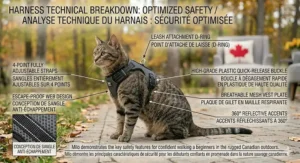
Specs with real-world meaning: The four-point adjustment system (neck, chest, and two lateral straps) is genuinely important here. Standard cat harnesses often have only two adjustment points, which means a cat with a narrow chest relative to their neck — a very common feline body ratio — can slip backwards out of the harness when they panic. The four-point system closes that gap. The breathable padded mesh is a meaningful design choice for Canadian spring and summer walks; it prevents overheating during humid Ontario or BC coastal weather. The included 150 cm (59-inch) nylon leash offers enough slack for your cat to explore a garden at their own pace without yanking you along.
Expert opinion: For absolute beginners, this is my top recommendation. The vest-style design is the single easiest harness type to introduce to a new cat because it requires no complicated threading — you slip it on, fasten the buckles, and you’re done. Canadian buyers with cats in the XS–Medium size range will find the sizing chart accurate; I’d suggest sizing up if your cat is between sizes, especially for breeds like Maine Coons who carry a lot of chest width. Reviewers across Canada consistently note the reflective strips are a nice practical touch for those early spring morning walks where daylight is still limited.
Customer feedback: Canadian buyers praise the value for money, noting the harness holds up well through multiple wash cycles. A small number of reviewers with particularly slim or wiry cats (Siamese, Devon Rex) found their cats could still wriggle free if the harness wasn’t adjusted tightly enough — a reminder that fitting is everything.
✅ Four-point adjustable fit — reduces escape risk significantly
✅ Breathable mesh — ideal for warm Canadian summer walks
✅ Includes 150 cm leash — no separate purchase needed
❌ Slim/wiry cat breeds may need extra adjustment care
❌ Limited colour selection in smaller sizes on Amazon.ca
Price range: $20–$35 CAD. Outstanding value — this is the most cost-effective way to start a cat harness and leash starter kit in Canada.
2. Halypet Cat Harness and Leash Set — MAX Safety 4th-Gen
Halypet has been iterating on its cat harness design with genuine engineering discipline — the 4th Generation model available on Amazon.ca represents a real improvement over earlier versions, particularly in the buckle system, which is the single point of failure most beginners struggle with.
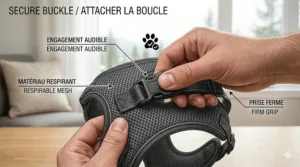
Specs with real-world meaning: The integrated snap buckle design is the headline feature — it’s a one-step click to secure and one-button press to release. In practice, what this means for a beginner is fewer fumbled attempts while your cat is squirming. The harness is constructed from lightweight breathable fabric with reflective strips sewn into the seams — not added as an afterthought. For Canadian users walking near roads at dusk (which happens earlier in October through February), that 360-degree visibility is legitimately useful, not just a marketing bullet point.
Expert opinion: Who is this for? The Canadian cat owner who values ease of use above all else. The snap buckle is noticeably faster than traditional side-release buckles, which is a real practical advantage when dealing with a reluctant cat who has decided that harness time is the worst time. The 4th-Gen version also features a wider chest panel than earlier models, which distributes pressure more evenly — important for cats with any tendency toward respiratory sensitivity. Available in several fun patterns including “Inky Meowy” and “Green Tropics,” which sounds trivial but honestly matters if you want your cat to be your cat on Instagram.
Customer feedback: Reviews on Amazon.ca highlight the improved buckle reliability over the 3rd-Gen model. A handful of buyers noted the leash attachment D-ring could be sturdier on the XS size.
✅ Integrated snap buckle — fastest on/off of any harness on this list
✅ Reflective strips at 360° — excellent for dawn/dusk walks in Canadian winter
✅ Wider chest panel — better pressure distribution
❌ D-ring on XS may feel less robust
❌ Sizing runs slightly small — measure carefully before ordering
Price range: $25–$40 CAD. Mid-range pricing with premium usability — worth the extra dollars over basic options for beginners who value convenience.
3. PetSafe Come With Me Kitty Harness and Bungee Leash
PetSafe is a well-established pet product brand with strong distribution on Amazon.ca, and the Come With Me Kitty harness has been a staple recommendation from veterinarians for years. What makes it different from the vest-style options on this list is its Figure-H design with a built-in martingale loop — a feature that’s genuinely clever for beginners dealing with resistant cats.
Specs with real-world meaning: The martingale loop is the key differentiator here. When your cat pulls back or tries to back out of the harness (the classic feline escape move), the martingale loop tightens slightly — not painfully, but enough to prevent escape. This is fundamentally different from a standard buckle harness where a determined cat can just keep reversing. The bungee leash that’s included is another thoughtful addition: it absorbs sudden lunges, which reduces the jarring sensation on your cat’s chest during those inevitable “squirrel sighting” moments. For nervous cats who are still building confidence outdoors, that gentler leash tension makes a meaningful difference.
Expert opinion: I’d specifically recommend this for cat owners whose cats are skittish or have previously escaped other harnesses. The martingale mechanism is the same principle used in dog training for dogs who back out of collars, and it translates well to feline escape prevention. That said, this is not the easiest harness to put on a resistant cat — the Figure-H straps require threading around both the neck and body, which takes a few practices to get right. Once you have the sizing dialled in, though, it becomes routine.
Customer feedback: Highly rated by Canadian buyers for reliability. Some owners note the figure-H style works less well on very muscular or barrel-chested cats (British Shorthair, Ragdoll) where the straps can sit awkwardly.
✅ Martingale loop — actively prevents backing-out escapes
✅ Bungee leash — absorbs lunging shock for nervous cats
✅ Vet-recommended design
❌ More complex to put on than vest-style harnesses
❌ Less ideal for very muscular, broad-chested breeds
Price range: $25–$40 CAD. Solid mid-range investment, especially for anxious cats.
4. Dooradar Cat Harness and Leash Set
The Dooradar is the smart budget choice on this list — available on Amazon.ca in multiple colours including pink, black, and blue, with a mesh vest construction that punches well above its price point for a comfortable vest harness for cats.
Specs with real-world meaning: The soft breathable mesh construction keeps the weight minimal — we’re talking under 100 grams for most sizes — which matters a great deal when introducing a harness to a cat for the first time. A lighter harness means your cat is less aware of wearing it, which accelerates the desensitization process. The reflective strips along the edges follow the harness outline rather than being placed in a single stripe, meaning visibility from multiple angles is genuinely improved. The included leash is a standard 120 cm (47-inch) nylon leash — functional but not bungee-assisted.
Expert opinion: For Canadian first-timers who want to test whether their cat will tolerate a harness at all before investing more, the Dooradar is the ideal entry point. If your cat turns out to love outdoor walks, you can always upgrade to a Sleepypod or Halypet later. If your cat decides harnesses are an affront to their dignity (common — cats do that), you haven’t spent $50 CAD finding out. It’s also available in XS, which is important for smaller breeds or younger cats that most mid-range harnesses don’t size down to adequately.
Customer feedback: Buyers appreciate the quality-to-price ratio. Sizing accuracy is noted as good by most reviewers, with the caveat that XS fits true to size and S runs slightly large.
✅ Lightweight — easier first-time harness introduction
✅ Available in XS — fits small and younger cats well
✅ Budget-friendly entry point
❌ Standard leash (no bungee) — less ideal for reactive cats
❌ Fewer adjustment points than rabbitgoo or Halypet
Price range: $18–$30 CAD. The best budget-friendly adjustable cat walking harness set on Amazon.ca.
5. Voyager Step-In Lock Cat Harness & Leash Set by Best Pet Supplies
The Voyager harness takes a different mechanical approach: instead of slipping over your cat’s head, your cat steps into it from below — front paws through two holes, snap closed across the back. In theory, this is more comfortable for cats who hate anything going near their head. In practice, it works brilliantly if your cat is cooperative enough to lift their paws on cue.
Specs with real-world meaning: The all-weather mesh construction is one of the Voyager’s genuine strengths — it’s designed to handle rain exposure, which in Vancouver or Halifax is basically a prerequisite for year-round use. The step-in lock closure on the back is engineered with a secondary clip to prevent accidental opening, which addresses the main vulnerability of traditional step-in harnesses. At 140 cm (55 inches), the included leash gives enough range without being unwieldy on urban sidewalks.
Expert opinion: The Voyager is best suited for calm, food-motivated cats that have already done some initial harness desensitization. The step-in mechanism is genuinely faster to secure than any over-the-head vest once your cat accepts it, but convincing a resistant cat to cooperate with the “put your paws in here” motion takes real patience. I’d categorize this as a “step 2” harness for beginners — start with a rabbitgoo or Dooradar for the first few weeks of indoor training, then transition to the Voyager once your cat is comfortable with the general concept.
Customer feedback: Praised for durability and colour range. Lime green and pink are fan favourites among Canadian buyers.
✅ Step-in design — no head threading required
✅ All-weather mesh — ideal for coastal and wet Canadian climates
✅ Secondary lock closure prevents accidental opening
❌ Requires cat cooperation to step in — less suitable for resistant cats
❌ Works better as a “step 2” harness after initial training
Price range: $25–$38 CAD. Good value for cats who’ve moved past the initial training stage.
6. Kitty Holster Cat Harness
If your cat has texture sensitivities — and some cats genuinely do struggle with synthetic mesh fabrics — the Kitty Holster is the harness you’ve been looking for. Made in the USA from 100% soft cotton, it’s veterinarian-recommended and carries strong loyalty among experienced cat walkers who’ve tried the mesh alternatives and found their cats uncomfortable.
Specs with real-world meaning: The soft cotton construction isn’t just a comfort preference — it’s a meaningful design choice for cats with skin sensitivities, post-surgical care situations, or cats who overheat in synthetic mesh during Canadian summer humidity. The hook-and-loop (Velcro-style) closure wraps around the cat’s torso rather than requiring threading, which means it can be applied with minimal handling — a genuine advantage for cats who become defensive when touched. The two D-ring attachment points (one on the back, one on the chest) give you control options depending on your training stage.
Expert opinion: This is my pick for cats who have rejected every other harness due to texture complaints — you know the type, the cat who immediately flattens to the floor and refuses to move the moment anything synthetic touches their belly. The cotton construction is breathable but less moisture-resistant than mesh, so it’s better suited for dry-weather walks or the Canadian summer months. For Victoria BC or Southern Ontario spring-to-autumn walking, it’s excellent. For rainy Vancouver or Halifax year-round use, consider drying time between sessions. The Kitty Holster is also one of the most supportive harnesses for senior cats who may have joint sensitivities — the soft contact surface is genuinely gentler on arthritic shoulders.
Customer feedback: Strong loyalty ratings. Some buyers note the hook-and-loop closure can collect cat fur over time — a lint roller becomes your friend.
✅ 100% soft cotton — ideal for texture-sensitive cats
✅ Minimal handling required for application
✅ Two D-ring options — back and chest
❌ Less moisture-resistant than mesh — not ideal for rainy climates
❌ Hook-and-loop attracts cat fur over time
Price range: $35–$50 CAD. A worthwhile investment for cats who’ve refused every other harness.
7. Sleepypod Martingale Cat Harness
The Sleepypod Martingale is the premium option on this list — and it earns that designation not through flashy branding but through engineering quality that becomes obvious within the first week of use. If you’re planning to take your cat on actual adventures beyond the backyard — camping in Banff, hiking trails in the Rockies, or urban exploring in Montreal — this is the harness to own.
Specs with real-world meaning: The laminated polyester mesh provides durability that standard mesh simply doesn’t — it resists stretching and deformation after repeated washes and outdoor exposure. The martingale tightening loop combined with Velcro adjustable straps creates a dual-security system: the Velcro ensures your initial fit is precise, while the martingale loop prevents escape during those sudden panic-and-reverse moments. The harness also comes with an integrated LED attachment point — a thoughtful addition for Canadians walking at dawn or dusk during the long winter months where visibility is genuinely reduced.
Expert opinion: The Sleepypod is not the right choice for a beginner who isn’t sure their cat will ever walk on a leash — the price point makes it a commitment. But for the cat owner who knows their cat is an outdoor adventurer at heart and plans to use this harness for years, the durability and dual-security system justify every dollar. I’d specifically recommend it for cats being taken on Canadian wilderness adventures — the laminated mesh holds up to brush contact and light rain in a way that standard mesh doesn’t, and the martingale security matters more when you’re 2 km from the trailhead than when you’re in your backyard.
Customer feedback: Exceptional reviews from experienced cat adventurers. The main complaint — it occasionally sells out quickly on Amazon.ca due to popularity.
✅ Laminated mesh — durable for real outdoor adventures
✅ Dual security (Velcro + martingale) — maximum escape prevention
✅ LED attachment point — Canadian winter visibility
❌ Premium price point — not ideal for beginners still testing the concept
❌ Sells out frequently on Amazon.ca
Price range: $45–$65 CAD. The best long-term investment for serious cat walkers.
How to Leash Train Your Cat: A Step-by-Step Guide for Canadian Beginners
Getting your cat into a harness for the first time is less about the gear and more about patience and timing — two things Canadian cat owners (patient by national character, if I may) tend to do well. According to the BC SPCA’s guide to leash walking cats, the most important factor isn’t the harness type — it’s your cat’s baseline personality. Confident, curious cats who watch the door may take to leash training in a few weeks. Anxious, indoor-only cats may need two to three months of gradual desensitization.
Here’s the practical progression:
Step 1: Introduce the harness as furniture (Days 1–3). Leave the harness near your cat’s sleeping area or food bowl. Don’t attempt to put it on. The goal is for your cat to sniff it, rub against it, and stop treating it as an alien object. Reward calm interest with treats.
Step 2: Touch and drape — no fastening (Days 4–7). Lay the harness across your cat’s back without fastening it. Short sessions of 2–3 minutes, always ending with a treat and praise. This is also when you start measuring for fit — the “two-finger rule” applies here: you should be able to slide two fingers under any strap, but not three.
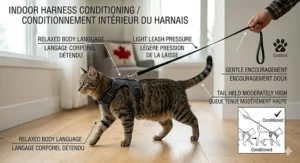
Step 3: Fasten and let them wear it indoors (Week 2). Fasten the harness fully and let your cat wander the house. Expect initial drama — flopping, freeze-walking, backward scrambling. This is normal and temporary. Keep sessions to 10 minutes and end on a positive note. The Toronto Wildlife Centre recommends multiple short sessions rather than one long one.
Step 4: Attach the leash indoors (Week 3). Clip the leash and let your cat drag it freely while supervised. This gets them used to the weight and resistance sensation before you hold the other end.
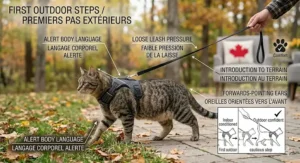
Step 5: First outdoor session — very short (Week 4). Choose a quiet spot: your backyard, a low-traffic side street, or a park early morning. Keep the first sessions under 10 minutes. Let your cat lead completely — don’t pull them in any direction. Bring high-value treats.
Canadian climate note: Avoid first outdoor sessions in temperatures below 5°C (41°F) or during heavy rain — cold stress and sensory overload don’t help a cat building outdoor confidence. Spring and early autumn are ideal in most Canadian provinces for starting leash training. 🇨🇦
Real Canadian Cat Owners: Who Needs Which Harness?
Let me paint three specific scenarios to help you match a harness to your situation.
Profile 1 — The Toronto Condo Dweller. You have a 3-year-old indoor tabby who’s never been outside. Your walk routes will be urban sidewalks and a nearby park. You want something affordable to test whether your cat takes to outdoor life at all. → Dooradar or rabbitgoo. Start low-investment, build confidence. If your cat becomes a committed walker, upgrade to a Halypet 4th-Gen for the buckle convenience.
Profile 2 — The Vancouver Island Outdoor Family. You have two cats, an adventurous 2-year-old Bengal and a calmer 5-year-old domestic shorthair. You want to take them on trails and camping trips in Pacific Rim National Park. Weather will include rain. → Sleepypod Martingale for the Bengal, Kitty Holster for the shorthair (who likely appreciates soft-contact comfort). The laminated Sleepypod mesh handles trail brush and rain; the Kitty Holster’s cotton is fine for campsite lounging where rain isn’t a constant.
Profile 3 — The Calgary Senior Cat Owner. Your 9-year-old Persian mix is gentle but has never worn a harness. You want gentle outdoor sessions in your quiet suburban neighbourhood. She’s texture-sensitive and doesn’t love being handled. → Kitty Holster without question. The minimal handling required for application and the soft cotton construction are exactly right for a senior cat being introduced to harness walking later in life.
How to Choose the Right Cat Harness in Canada: 6 Key Criteria
Choosing a cat harness for walking beginners involves more decision points than most product guides acknowledge. Here’s what actually matters — and what doesn’t.
1. Harness style vs. your cat’s personality. Vest-style harnesses (rabbitgoo, Halypet, Dooradar) are easiest for beginners because they require the least cat cooperation to apply. Step-in styles (Voyager) require more cooperation. Figure-H and martingale styles (PetSafe, Sleepypod) offer superior escape prevention for resistant cats but have a steeper learning curve for the human handler.
2. Sizing accuracy — the most critical factor. Harness sizing tips from every expert point to the same conclusion: measure your cat’s neck circumference and chest girth before ordering. Most beginners guess based on body weight alone, which is unreliable. A Bengal at 4.5 kg can have a narrower chest than a Persian at the same weight. Use a soft measuring tape and measure the widest point of the chest, just behind the front legs.
3. Escape-proofing mechanism. Not all “escape-proof” claims are equal. Passive escape prevention (tight fit with adjustable straps) differs meaningfully from active escape prevention (martingale loop that tightens on resistance). For beginners with cats who’ve never been outside, active prevention is worth prioritizing.
4. Breathability for Canadian summers. Mesh harnesses outperform cotton in warm weather for ventilation. If you’re in Southern Ontario or BC’s Lower Mainland where summers can reach 30–35°C, mesh is the practical choice from June to September.
5. Reflectivity for Canadian winters. Canada’s short winter daylight hours mean many cat walkers do their morning or evening walks in low light from October to March. Reflective strips aren’t a luxury feature in Canadian conditions — they’re a genuine safety consideration.
6. Price vs. commitment. The most expensive harness is not automatically the best choice for beginners. Start with mid-range and upgrade based on actual use. If your cat walks twice daily, a premium Sleepypod pays for itself in durability within a year.
Common Mistakes When Buying a Cat Harness for Walking Beginners
Even experienced pet owners make these errors — and in Canada, a few of them have an extra layer of relevance.
Mistake 1: Using a dog harness or scaling down a small dog harness. Cats have fundamentally different torso proportions and a unique escape mechanism (backing straight out of front-loaded harnesses). A harness engineered specifically for cats is non-negotiable — the Animal Behavior College notes this in their professional training guidelines.
Mistake 2: Buying based on weight alone. A harness sized for a “5 kg cat” from a generic chart may be completely wrong for your specific cat’s body shape. Always use actual measurements.
Mistake 3: Skipping the indoor desensitization period. Canadian cat owners are sometimes tempted to go straight from “harness arrived” to “first outdoor walk” — especially when spring finally arrives after a long winter and everyone wants to be outside immediately. This almost always backfires. The cat panics, tries to escape, and often develops a negative association with the harness that takes weeks to undo.
Mistake 4: Walking in cold or wet conditions too early. Your cat’s first few outdoor experiences should be as positive as possible. A 2°C March morning with sleet is not the ideal introduction to outdoor life, regardless of how excited you are about spring. Wait for a dry, mild day above 10°C for the first few outdoor sessions.
Mistake 5: Ignoring Canadian wildlife considerations. The Toronto Wildlife Centre explicitly recommends that leash-walked cats be kept under full control and supervision — cats on leashes can still stalk birds and small mammals if not monitored. Choose walking routes and times that minimize wildlife encounters, particularly during spring nesting season.
Mistake 6: Ignoring Amazon.ca vs. Amazon.com availability. Some harnesses with strong .com reviews (particularly US-only brands) don’t ship to Canada or carry significantly higher pricing when ordered cross-border. Always verify availability on Amazon.ca directly and note that Canadian pricing runs 10–20% higher than US equivalents due to exchange rate and import logistics — this is normal and the trade-off is avoiding customs delays and US-based warranty headaches.
Cat Harness vs. Cat Collar for Walking: What the Data Actually Shows
A comparison that many beginner guides skip entirely — but shouldn’t.
| Factor | Vest Harness | Figure-H Harness | Cat Walking Collar |
|---|---|---|---|
| Neck injury risk | ✅ None | ✅ Minimal | ❌ High if resistance occurs |
| Escape risk | ✅ Low (4-point) | ✅ Very low (martingale) | ❌ Very high |
| Comfort | ✅ High | ✅ Moderate | ⚠️ Acceptable at rest only |
| Best For | Beginners | Escape artists | ID only — not walking |
| Canadian climate suitability | ✅ Mesh versions ideal | ✅ Year-round | ❌ Not recommended for walks |
The data here is clear, and every Canadian veterinarian and animal welfare organization agrees: collars are for identification, not walking. 24 Petwatch Canada explicitly recommends against attaching a leash to a collar — a cat’s head is roughly the same circumference as their neck, meaning a startled cat can slip a collar with very little effort, and collar pressure during resistance can cause tracheal injury.
A vest harness distributes all leash tension across the chest and shoulders — the same principle used in front-clip dog harnesses. For walking beginners, this is the only sensible starting point. The martingale-style harness offers a step up in escape prevention for cats that learn to manipulate basic vest designs. The collar remains important for ID tags (and is legally required in many Canadian municipalities), but it should never double as walking hardware.
Harness Sizing Tips: The Complete Measurement Guide for Canadian Cat Owners
Getting the fit right is more important than getting the brand right — a poorly fitted premium harness will always lose to a well-fitted budget harness. Here’s how to measure correctly.
What you need: A flexible fabric measuring tape (the kind used for sewing). If you don’t have one, a piece of string and a ruler work fine.
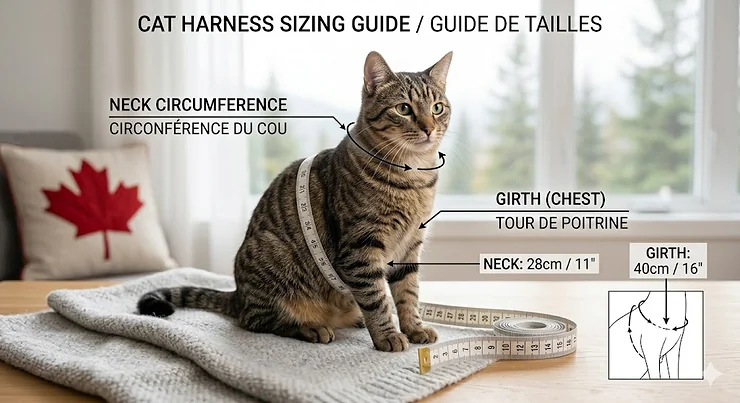
Measurement 1 — Neck circumference: Measure around the base of your cat’s neck, where a collar would sit. Add 2 cm (about 0.75 inches) for comfort. This measurement determines the neck strap adjustment range needed.
Measurement 2 — Chest girth: This is the critical measurement most guides underemphasise. Measure around the widest part of your cat’s chest, immediately behind the front legs. This is where most harnesses generate the most contact pressure and where escapes happen if the fit is wrong.
The two-finger rule: Once the harness is on, you should be able to slide two fingers under any strap — but not three. Two fingers = secure without restricting breathing. One finger = too tight (can cause discomfort or restrict movement). Three fingers = too loose (escape risk).
Size chart guidance for popular Amazon.ca harnesses:
- XS: Chest girth 22–28 cm (8.5–11 in) — small kittens, petite adults (Singapura, Devon Rex)
- S: Chest girth 28–36 cm (11–14 in) — average adult cats (most domestic shorthairs)
- M: Chest girth 36–44 cm (14–17 in) — larger adults (male Maine Coon, Ragdoll females)
- L: Chest girth 44–52 cm (17–20 in) — large/heavy breeds (large male Ragdoll, Norwegian Forest Cat)
Canadian note: If you’re purchasing from Amazon.ca, verify the size chart on the specific product listing rather than relying on a generic chart — sizing between brands like rabbitgoo and Halypet varies by up to one full size for equivalent measurements. When in doubt between two sizes, choose larger for vest harnesses and smaller for martingale harnesses.
FAQ: Cat Harness for Walking Beginners in Canada
❓ What is the best type of cat harness for walking beginners in Canada?
❓ How do I know what size harness to buy for my cat?
❓ Can I walk my cat in Canadian winter weather?
❓ Does Amazon.ca ship cat harnesses to all provinces, including remote areas?
❓ How long does it take to leash train a cat?
Conclusion: Your First Steps Toward an Adventure Cat Life in Canada
Starting your cat’s outdoor journey is genuinely one of the most rewarding things you can do for their quality of life — enrichment, exercise, and mental stimulation in one activity. But success depends entirely on starting with the right equipment and the right expectations.
For pure beginners testing the concept, the rabbitgoo Cat Harness and Leash Set is the smart starting point on Amazon.ca: well-engineered, affordable in CAD, and available Prime-eligible nationwide. For Canadian cat owners who want a more advanced escape-proof system with better long-term durability, the Halypet 4th-Gen and Sleepypod Martingale represent genuine upgrades worth the investment.
Above all: follow the gradual training approach. Rushing your cat from “unboxing the harness” to “first outdoor walk” is the most common beginner mistake in the leash training guide world, and it almost always results in a stressed cat and a discouraged owner. Take the three-to-six-week indoor training period seriously, use high-value treats, and let your cat set the pace. Canada’s outdoor spaces — from Montreal’s parks to BC’s trails to the quiet suburban streets of Saskatoon — are waiting for you both. 🐱🇨🇦
✨ Don’t Miss These Exclusive Deals!
🔍 Ready to start your cat’s outdoor adventure? Click on any highlighted product above to check current pricing and availability on Amazon.ca. Find the perfect cat harness and leash starter kit for your feline companion today!
Recommended for You
- 7 Best Escape Proof Cat Harnesses Canada 2026 | Vet Picks
- 7 Best AirTag Cat Collar Holders in Canada (2026)
- 7 Best GPS Cat Collars Real-Time Tracking Canada 2026
Disclaimer: This article contains affiliate links. As an Amazon Associate, I earn from qualifying purchases. If you purchase products through these links, we may earn a small commission at no additional cost to you.
✨ Found this helpful? Share it with your friends! 💬🤗
