
In This Article
Somewhere between “just cut a hole in the glass” and “call a professional glazier,” most Canadian cat owners hit a wall of confusing advice about how to install cat door in window openings without turning a Saturday afternoon into a home-insurance claim. It’s a fair worry. Windows are not doors — they’re often tempered or double-glazed, they’re load-bearing in a way most people don’t expect, and in a rented apartment, drilling into one without permission can cost you your damage deposit. The good news is that you almost never need to cut glass at all. Most window cat doors on the Canadian market today are designed to drop into an existing aluminum sash window, sit inside a screen frame, or clip onto a window-mounted adapter — no glazier, no caulking gun, no drama.

This guide walks through exactly how to install cat door in window frames, sash tracks, and glass panels, and it does so with seven real products you can actually buy in Canada, from budget sash inserts to microchip-activated flaps. We’ll cover the tools you’ll need, the mistakes that trip up first-timers, and how the process changes if you’re renting. Whether you’re chasing a true no drill cat door window setup or you’re comfortable having a glazier cut a clean circle into a single pane, there’s a path here that fits your window, your cat, and your toolbox.
Quick Comparison Table
| Product | Type | Best For | Price Range (CAD) |
|---|---|---|---|
| Ideal Pet Products Aluminum Sash Window Pet Door | No-drill sash insert | Best all-rounder for aluminum sliding windows | C$90–C$140 |
| VEVOR Cat Door for Window | No-drill sash insert | Best budget pick for apartments | C$100–C$140 |
| Ideal Pet Products Small Aluminum Sash Cat Flap | No-drill sash insert (small) | Best for kittens and small cats | C$80–C$120 |
| TRIXIE 4-Way Cat Flap for Glass Doors | Permanent glass cut-in | Best quiet flap for a fixed pane | C$60–C$100 |
| PetSafe Microchip Cat Door | Permanent glass/window cut-in | Best selective entry for a single-cat household | C$200–C$280 |
| Cat Mate Microchip Activated Cat Flap (360) | Wall/window with adapter kit | Best for multi-cat households | C$150–C$220 |
| TRIXIE Electromagnetic 4-Way Locking Cat Door | Wall/window with adapter kit | Best quiet collar-key alternative | C$110–C$160 |
Looking at this lineup, the split is really between doors you can pull out again (the sash inserts) and doors that become a permanent part of the glass (the cut-in flaps). If you rent, that distinction matters more than any spec sheet — a no-drill sash unit like the Ideal Pet Products Aluminum Sash Window Pet Door or VEVOR Cat Door for Window lets you take the whole thing with you when you move. If you own your home and want a flap that disappears into the glass itself, the TRIXIE 4-Way Cat Flap for Glass Doors or PetSafe Microchip Cat Door are built for that permanence.
💬 Just one click — help others make better buying decisions too!😊
Top 7 Cat Doors for Windows: Expert Analysis
1. Ideal Pet Products Aluminum Sash Window Pet Door — no-drill install in under an hour
The headline feature here is right in the name: this unit slides into the track of an existing aluminum sash window, so there’s no cutting, no drilling, and no permanent change to the window itself. The medium size (adjustable to fit window widths of roughly 58–71 cm / 23–28 in) uses a safety-glass panel with an aluminum frame and a floating threshold that seals against the sash when it’s lowered back down. In practice, that means the flap itself has a 6.25 in x 6.25 in (about 16 cm x 16 cm) opening, sized for cats up to roughly 12–15 lb, with adjustable end spacers that let it wedge snugly into slightly different window widths.
Based on the spec comparison across this category, the appeal of a sash-mounted unit is that it treats the window as a temporary host rather than a surface to modify — which is exactly why it dominates searches for cat flap sash window setups. It’s a strong fit for anyone in an older home with classic aluminum sliders, or for a first-time installer who wants a reversible option before committing to anything permanent. Reviewers on major retail sites consistently note that the vinyl draft seal supplied with the kit is essential for cutting down winter draughts, and that skipping it leads to a noticeably cold spot near the window in January. A recurring theme in aggregated feedback is that measuring the sash track width precisely before ordering avoids the single biggest headache: a unit that’s a few millimetres too wide or narrow for the track.
Pros:
- ✅ True no-drill installation that preserves the original window
- ✅ Reversible — remove it entirely if you move or sell
- ✅ Includes a foam bumper seal and vinyl draft seal for winter
Cons:
- ❌ Only fits vertically sliding aluminum sash windows, not casement styles
- ❌ Flap opening is fixed once you’ve chosen a size
At around C$90–C$140 depending on width and retailer promotions, this sits firmly in the budget-to-mid range, and for a renter or a first cat door, it’s hard to argue with the value: you get a genuine engineered product instead of a DIY hole saw project.
2. VEVOR Cat Door for Window — best budget pick built for apartment sash tracks
VEVOR Cat Door for Window takes the same basic sash-insert concept and undercuts it slightly on price while keeping the same core mechanics: an aluminum frame, a high-transparency glass panel, and a magnetic-closure flap with four lock modes (in-only, out-only, both ways, and fully locked). It’s adjustable to fit window widths of about 58–71 cm (23–28 in), which covers the vast majority of standard North American sash windows found in older apartment buildings and mid-century houses across Canada.
What most buyers overlook about this style of door is that the magnetic closure isn’t just a convenience feature — it’s doing real work reducing draught and noise compared with older gravity-hinge flaps, which is worth noting for anyone chasing energy efficiency in an older building envelope. The weatherproofing is adequate rather than exceptional; it’s designed for a covered or moderately exposed window rather than a rain-battered exterior wall, which is a fair trade-off at this price point. Aggregated buyer feedback on general retail marketplaces frequently highlights that assembly is quick — most people report having it installed and locked into the track within 30–45 minutes without additional tools beyond a tape measure. This is precisely the profile that makes it a go-to answer whenever someone searches cat door for apartment window: no permanent alteration, no landlord conversation required for the window itself, and a straightforward return if the cat refuses to use it (which, this being a cat, is always a possibility).
Pros:
- ✅ Genuinely no drill cat door window setup, ideal for rentals
- ✅ Four lock modes for real control over access
- ✅ Fast tool-free-ish assembly most users finish same-day
Cons:
- ❌ Lighter-duty weatherproofing than premium sash units
- ❌ Limited to the 23–28 in width range without a wider variant
Priced typically in the C$100–C$140 range in Canadian dollars, it’s a near-identical value proposition to the Ideal Pet unit above, so the deciding factor often comes down to which one is actually in stock, or which frame finish matches your window trim.
3. Ideal Pet Products Small Aluminum Sash Cat Flap — the right-sized pick for kittens and small breeds
Not every cat needs a 6-inch-plus opening, and that’s the standout advantage of the extra-small variant in the Ideal Pet Products sash lineup: a roughly 6.25 in x 6.25 in flap sized down specifically for kittens and small adult cats up to about 12 lb, mounted in the same no-cut aluminum sash frame as the medium and large versions. The width range is slightly narrower too, generally fitting window openings around 58–71 cm (23–28 in), so measuring twice before ordering still matters.
Here’s what to weigh with a smaller opening: a flap sized correctly for a kitten discourages larger neighbourhood cats or raccoons from squeezing through, which is a real consideration in suburban and rural Canadian settings where wildlife encounters at pet doors are a known nuisance. On paper this means less physical clearance for anything bigger than your own cat, and reviewers consistently frame the smaller size as the reason they chose it over a standard flap — it’s a soft form of size-based selective entry, even without any electronic locking. The trade-off, obviously, is that this door won’t grow with a kitten past a certain adult size, so anyone adopting a large breed like a Maine Coon should size up rather than assume “kitten-sized” is always safer.
Pros:
- ✅ Deters larger animals through opening size alone
- ✅ Same reversible, no-drill sash mounting as the medium unit
- ✅ Lightweight flap is easy for very young kittens to push open
Cons:
- ❌ Not suitable once a kitten grows into a large adult cat
- ❌ Narrower width adjustment range than the medium/large models
Expect to pay in the C$80–C$120 range, making it one of the more accessible entry points into this whole category, and a sensible starter purchase for anyone unsure whether their cat will even use a window door.
4. TRIXIE 4-Way Cat Flap for Glass Doors — quietest option for a true glass cut-in
Once you move past sash inserts into permanent installations, TRIXIE 4-Way Cat Flap for Glass Doors is one of the most established names in the category, and its standout trait is how quiet the transparent flap is in day-to-day use — TRIXIE’s own listing describes a roughly 27 cm x 26 cm frame with a 360-degree TPR rubber seal designed specifically to cut down on the clatter and draught that cheaper flaps let through. It’s built for single-pane glass with an installation depth of about 5–18 mm, and the twist-style four-way lock (in-only, out-only, both, or fully closed) is operated from a dial rather than a sliding tab.
The spec sheet won’t tell you this, but user reports suggest the TPR seal genuinely does reduce the “clack-clack” noise that some older cat flaps are notorious for, which matters if the flap is anywhere near a bedroom or home office. Installing this style requires a professional glazier to cut a circular opening in the glass before the frame goes in — this is not a DIY-with-a-drill job on tempered glass, and reputable installers won’t attempt it, since cutting or drilling tempered glass after manufacture causes it to shatter rather than form a clean hole. Reviewers who’ve used it in an actual glass door or fixed window pane note that once installed, it behaves and feels like a built-in fixture rather than an add-on, which is the whole appeal of committing to a permanent cut.
Pros:
- ✅ Noticeably quieter flap action than basic hinge designs
- ✅ Draught-resistant TPR seal for year-round comfort
- ✅ Compact footprint suits smaller window panes
Cons:
- ❌ Requires professional glass cutting — not a DIY hole job
- ❌ Permanent once installed; can’t be removed without a glass replacement
Budget roughly C$60–C$100 for the flap itself, though the glazier’s cutting fee is a separate cost that varies significantly by region and pane type — get a quote before committing to this route.
5. PetSafe Microchip Cat Door — premium selective entry for a single-cat household
At the top end of the category sits the PetSafe Microchip Cat Door, and its defining feature is selective entry: the flap reads your cat’s existing implanted microchip and only unlocks for that specific chip ID, which functionally eliminates the classic “strange cat wandering in through the flap” problem that plagues basic mechanical doors. PetSafe’s own installation documentation for glass and window applications specifies a circular cutout of roughly 260 mm in diameter when using the glass adapter kit, again requiring a professional glazier since tempered and double-pane glass cannot be safely cut after manufacture.
Based on the spec comparison, the practical draw here is programming flexibility — the unit can typically store multiple chip IDs, so a two-cat household can register both pets while still blocking the neighbour’s cat that keeps trying its luck. What most buyers overlook about microchip doors generally is that they still need a battery change on a predictable schedule, and reviewers aggregated across major retailers frequently mention setting a recurring reminder rather than waiting for the lock to start acting erratically as a low-battery signal. For anyone whose cat already has a microchip for identification purposes (a near-universal recommendation from Canadian veterinary clinics), this door effectively repurposes hardware your cat is already carrying, rather than adding a collar tag that can snag or fall off.
Pros:
- ✅ True selective entry using your cat’s existing microchip
- ✅ Blocks neighbourhood cats and strays automatically
- ✅ Supports multiple registered pets on one unit
Cons:
- ❌ Highest price point in this roundup
- ❌ Requires professional glass cutting for window/glass installs
Typical Canadian pricing lands around C$200–C$280 at the time of research, positioning it as a premium investment best justified by a genuine stray-cat or multi-cat access problem rather than a simple in-out convenience.
6. Cat Mate Microchip Activated Cat Flap (360) — the strongest pick for multi-cat households
Cat Mate Microchip Activated Cat Flap (360) takes a similar microchip-reading approach but is explicitly built around larger households, with the manufacturer stating compatibility for entry control of up to 30 registered cats or small dogs on a single unit — a figure aimed at catteries and multi-pet homes rather than the average family, but a useful ceiling to know exists. It reads standard 15-digit ISO microchips as well as AVID chips, and window or wall installation is achieved using the separate Cat Mate adapter kit and stackable wall liners, which extend the tunnel depth in 50 mm increments to suit different window and wall thicknesses.
Here’s what to weigh with a multi-cat setup: rather than a single locked/unlocked state, this flap’s real value is letting some registered cats through while automatically excluding anything unregistered — extremely useful in multi-cat rescues, foster situations, or homes near a colony of community cats. Aggregated reviewer sentiment consistently flags the liner system as the trickiest part of installation, since getting a weatherproof seal between stacked liners typically requires sealant between sections and duct tape on the exterior joint, a detail Cat Mate’s own instructions call out directly. Buyers who’ve used it in a window frame rather than a door tend to report that the liner-based approach, while fiddlier than a single-piece sash unit, ultimately gives a tighter, better-insulated fit than a simple drop-in insert.
Pros:
- ✅ Reads standard ISO and AVID microchips for true selective entry
- ✅ Scales to multi-cat households far better than basic locks
- ✅ Liner system adapts to different window/wall thicknesses
Cons:
- ❌ Liner installation is fiddlier than a single-piece sash insert
- ❌ Adapter kit and liners are often sold separately, adding to total cost
Pricing generally sits in the C$150–C$220 range for the flap alone, with the wall/window liner kit as an additional line item — worth budgeting for up front rather than discovering it’s a separate purchase after checkout.
7. TRIXIE Electromagnetic 4-Way Locking Cat Door — quiet, collar-key access without microchip programming
The standout hook for TRIXIE Electromagnetic 4-Way Locking Cat Door is that it splits the difference between a basic mechanical flap and a full microchip reader: your cat wears a small collar magnet (included), and an internal circuit unlocks the flap only when that specific magnet approaches, without any app pairing or chip programming required. TRIXIE positions this as a durable plastic-framed unit with a transparent flap and a 4-way security lock, and like the other permanent-mount options here, window installation is handled through an adapter kit rather than a raw hole in the glass.
Reviewers consistently note that the electromagnetic mechanism runs quietly compared with older battery-motor designs, and that battery life is respectable since the circuit only activates on approach rather than staying powered continuously. What the spec sheet won’t tell you is that a collar magnet can occasionally be lost the same way a collar tag can, so cat owners who’ve had a magnet go missing report simply ordering a spare rather than reprogramming anything — there’s nothing to reprogram, which some buyers find simpler than microchip-based systems, and others find less secure since a lost magnet (if picked up by another cat’s collar) could theoretically grant access. For most households this is a non-issue, but it’s worth knowing as an honest trade-off rather than glossing over it.
Pros:
- ✅ No microchip programming or app setup required
- ✅ Quiet electromagnetic mechanism with solid battery life
- ✅ Simple 4-way lock dial for full manual control
Cons:
- ❌ Relies on a physical collar magnet that can be lost
- ❌ Less secure against a picked-up magnet than true microchip reading
Expect a price range of roughly C$110–C$160, positioning it as a sensible middle ground between the basic sash inserts and the full microchip-reading units above.
Top 7 Products: Specs & Value Snapshot
| Product | Install Method | Flap Size (approx.) | Best For |
|---|---|---|---|
| Ideal Pet Products Aluminum Sash Window Pet Door | No-drill sash slide-in | 6.25 in x 6.25 in | Aluminum sliding windows |
| VEVOR Cat Door for Window | No-drill sash slide-in | Similar, adjustable frame | Apartments and rentals |
| Ideal Pet Products Small Aluminum Sash Cat Flap | No-drill sash slide-in | Smaller opening | Kittens & small cats |
| TRIXIE 4-Way Cat Flap for Glass Doors | Professional glass cut-in | 27 cm x 26 cm frame | Permanent, low-noise install |
| PetSafe Microchip Cat Door | Professional glass cut-in | ~260 mm cutout | Single-cat selective entry |
| Cat Mate Microchip Activated Cat Flap (360) | Wall/window adapter + liners | Standard microchip flap | Multi-cat households |
| TRIXIE Electromagnetic 4-Way Locking Cat Door | Wall/window adapter | Standard collar-key flap | Collar-key selective entry |
Reading across this table, the real fork in the road isn’t budget versus premium — it’s reversible versus permanent. The three sash-mounted doors (Ideal Pet Products Aluminum Sash Window Pet Door, VEVOR Cat Door for Window, and Ideal Pet Products Small Aluminum Sash Cat Flap) all trade a bit of flap-size flexibility for the ability to remove the entire unit without touching the glass, while the glass cut-in and adapter-mounted doors trade that reversibility for tighter seals and, in the case of PetSafe Microchip Cat Door and Cat Mate Microchip Activated Cat Flap (360), genuine selective entry. If a stray-cat problem is your main motivator, the microchip units justify their higher price; if you simply want your own cat to come and go, a sash insert does the job for less.
Practical Usage Guide: Installing Your Cat Door in a Window Step by Step
Whether you’ve picked a no-drill sash unit or committed to a permanent glass cut-in, the DIY cat door window installation process follows a broadly similar sequence. Start by measuring your cat, not just the window: measure shoulder width and the height from floor (or sill) to the top of the shoulder, then compare against the manufacturer’s flap dimensions with a couple of centimetres of clearance on each side. For sash units, measure your window track width at its narrowest point, since older aluminum frames can vary by a centimetre or two from what’s stamped on the box.
For a no drill cat door window install, the process is genuinely straightforward: raise the sash to its fully open position, set the pet door unit into the track, extend the adjustable end spacers until the frame sits snugly, then lower the sash down onto the unit’s top seal. Apply the supplied foam bumper seal along the contact edge before you do a final close, since skipping this step is the single most common reason owners report a draughty gap in month one. For a permanent glass cut-in, the sequence is different: a professional glazier measures and cuts the circular opening (never attempt this yourself on tempered glass), you or the installer insert the interior and exterior frame halves from opposite sides of the pane, and binder posts or bolts cinch the two halves together around the glass.
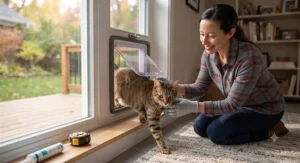
In the first 30 days, the most common mistake is skipping a supervised introduction — cats often need several short sessions with the flap propped open before they’ll push through a closed one on their own, and rushing this step is why some owners wrongly conclude “my cat won’t use it” within the first week.
Real-World Scenarios: Matching a Window Cat Door to Your Household
Picture three different homes, because the “best” cat door genuinely depends on which one you’re living in. First, the renter in a mid-rise apartment with an aluminum sliding window and a strict no-alterations clause in the lease: this is the textbook case for the VEVOR Cat Door for Window or Ideal Pet Products Aluminum Sash Window Pet Door, since both drop into the existing track and come back out again cleanly at move-out, with nothing to patch or explain to a landlord.
Second, the homeowner with a single indoor-outdoor cat and a recurring problem with a neighbourhood cat sneaking in through an older mechanical flap to steal food: this household gets disproportionate value from PetSafe Microchip Cat Door, since the selective-entry mechanism solves the actual problem — an unwanted visitor — rather than just providing an opening. Third, a foster-based multi-cat rescue home with five to eight cats cycling through at different times, some chipped, some not yet: Cat Mate Microchip Activated Cat Flap (360) and its higher registered-pet ceiling fits that scale far better than a basic mechanical door, even though it costs more up front, because the alternative — manually opening a door for each cat — doesn’t scale at all.
Problem → Solution: Common Cat Door Window Installation Issues
A handful of problems come up again and again once a window cat door is installed, and most have a straightforward fix. Draughts around the frame: this almost always traces back to a skipped or poorly seated foam bumper seal on a sash unit — reseat it along the full contact edge rather than just the centre. Cat refuses to use the flap: prop the flap fully open with tape for the first few days so the cat associates the opening with easy passage before reintroducing the closing mechanism, rather than expecting immediate confidence with a swinging panel.
Condensation building up on the interior glass panel near the unit: this is typically a sign of a poor seal between the frame and the window track rather than a fault with the flap itself, and it’s worth rechecking the adjustable end spacers for a snugger fit. Unwanted animals still getting through: if raccoons or neighbourhood cats are getting past a basic mechanical flap, that’s the clearest signal to upgrade to a microchip or electromagnetic model like PetSafe Microchip Cat Door or TRIXIE Electromagnetic 4-Way Locking Cat Door, since no amount of manual locking fully solves a determined intruder problem. Flap freezing shut in deep winter: on exterior-facing installs in colder Canadian regions, a light silicone-based lubricant on the hinge points before the first hard freeze prevents ice buildup from locking the flap in place.
What Is a Window Cat Door?
A window cat door is a small pet-access opening built into a window frame, sash track, or window-mounted adapter, letting a cat move in and out independently without a person opening a full window or door. Unlike a traditional door-mounted cat flap, it’s specifically engineered to work with glass, sash tracks, or window sills rather than a solid door panel — which changes both the installation method and the hardware involved.
Within this category, options split into three installation types: no-drill sash inserts that slide into an existing aluminum window track, permanent flaps cut directly into a glass pane by a professional glazier, and adapter-mounted units that attach via a separate frame kit rather than the raw glass. Each style suits a different combination of window type, tenancy situation, and how much permanence a homeowner is willing to commit to.
How to Choose a Cat Door for Your Window
- Measure your cat first, then your window. Shoulder width and height determine the minimum usable flap size — buying by price before checking these numbers is the most common regret buyers report.
- Identify your window type. Aluminum sliding sash, vinyl casement, and fixed single-pane glass all call for different installation methods, and not every product fits every window style.
- Decide how permanent you’re willing to go. Renters and anyone uncertain about long-term plans should lean toward no drill cat door window options; homeowners planning to stay put can consider a glass cut-in for a tighter seal.
- Weigh selective entry against basic access. If stray or neighbourhood animals are a known issue, a microchip or electromagnetic lock earns its higher price quickly; if it’s just your own cat, a mechanical 4-way lock is usually sufficient.
- Check your region’s winter severity. In colder parts of Canada, prioritize models with dedicated draught seals and consider a smaller flap size to limit heat loss.
- Confirm return and warranty policy before cutting anything permanent. Sash inserts are easy to return if they don’t fit; a glass cut-in cannot be undone without replacing the pane.
- Budget for installation, not just the unit. A glazier’s cutting fee for a permanent flap is a real cost that changes the total price comparison against a no-drill option.
Cat Flap Sash Window vs. Glass Cut-In Cat Door
The choice between a sash-mounted insert and a true glass cut-in comes down to permanence versus fit quality, and it’s worth spelling out plainly rather than leaving it as a vague trade-off. A cat flap sash window unit, like the Ideal Pet Products Aluminum Sash Window Pet Door, occupies the existing window track and can be removed in minutes — ideal for renters, but it does mean the window can no longer close fully flush while the unit is installed. A glass cut-in flap, like TRIXIE 4-Way Cat Flap for Glass Doors, becomes a permanent part of the pane with a tighter overall seal and no impact on how the rest of the window opens and closes, at the cost of needing a professional glazier and being effectively irreversible without a full pane replacement.
| Factor | Sash-Mounted Insert | Glass Cut-In |
|---|---|---|
| Reversible | Yes — slides out | No — permanent |
| Tools required | Tape measure, basic hand tools | Professional glazier |
| Renter-friendly | Yes | Rarely, without landlord sign-off |
| Seal quality | Good | Excellent |
| Upfront cost | Lower | Higher (unit + cutting fee) |
Looking at the comparison above, renters and anyone testing whether their cat will actually use a window door should default to a sash-mounted insert, while long-term homeowners chasing the tightest possible seal and lowest ongoing draught loss should budget for a glass cut-in. Neither is objectively “better” — they solve for different constraints, and the wrong choice mainly shows up as either wasted money on a permanent cut you later regret, or a slightly draughtier install than a permanent one would have delivered.
Common Mistakes When Installing a Cat Door in a Window
The single most common mistake is measuring the window opening but not the cat, leading to a flap that’s technically installed correctly but too small for a mature cat to use comfortably. A close second is skipping the manufacturer’s supplied seals and gaskets to save five minutes, which reliably shows up months later as a draught complaint or a small water leak during heavy rain. Renters frequently make the mistake of assuming any window modification is fine because “it’s not drilled” — even a no drill cat door window insert changes how the window closes, and checking the lease or getting quick written confirmation from a landlord protects a damage deposit far more cheaply than the cat door itself. As noted in Ontario’s Residential Tenancies Act framework, tenants generally need landlord consent before making changes beyond ordinary use of a rental unit, and window inserts can fall into that grey area depending on the building.
Another frequent error is attempting to cut or drill tempered or double-pane glass without a professional — tempered glass cannot be modified after manufacture without shattering, which is precisely why every glass-mounted product in this roundup explicitly requires a glazier. Finally, buyers sometimes skip the supervised introduction period entirely and assume a cat’s reluctance means the product is faulty, when in most cases it simply reflects normal feline caution around a new moving object.
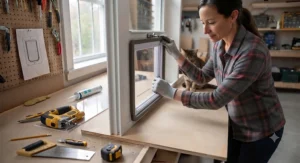
Cat Doors for Apartment Windows: Rental-Friendly Options
Apartment living adds a layer of constraints that a detached house doesn’t have, and it’s worth addressing head-on rather than assuming one-size-fits-all advice applies. The first constraint is reversibility: a cat door for apartment window use should, in almost every case, be a no-drill sash insert rather than a glass cut-in, simply because most leases prohibit permanent structural changes without written approval. The second constraint is building-specific window hardware — many apartment buildings use standardized aluminum sliders that happen to match the width ranges these sash inserts are designed for, which is a fortunate coincidence rather than a guarantee, so always measure your specific unit’s track before ordering.
The third, less obvious constraint is condo or building bylaws around exterior appearance; some buildings restrict anything visible from outside the unit, which rarely applies to an interior-facing sash insert but is worth a quick check with a property manager before installation. For apartment dwellers, VEVOR Cat Door for Window and Ideal Pet Products Aluminum Sash Window Pet Door remain the strongest picks precisely because they leave no lasting mark: remove the unit, and the window returns to its original state for move-out inspection.
🔍 Don’t Guess Your Window Fit — Check Before You Buy!
Take your window cat door project to the next level by measuring both your cat and your window track before checking current pricing and availability. A few minutes with a tape measure now saves a return shipment later and gets your cat using their new door faster.
Long-Term Cost & Maintenance of a Window Cat Door
The sticker price on a window cat door is only part of the real cost picture. No-drill sash units like the Ideal Pet Products Aluminum Sash Window Pet Door and VEVOR Cat Door for Window have effectively zero installation cost beyond the unit itself, but their foam and vinyl seals wear over time in high-traffic households and typically need replacing every couple of years to maintain draught resistance — a low-cost fix, but one that’s easy to forget. Glass cut-in units like TRIXIE 4-Way Cat Flap for Glass Doors and PetSafe Microchip Cat Door carry a one-time glazier’s cutting fee that can meaningfully change the total cost of ownership, sometimes doubling the effective price versus the flap alone, so it’s worth getting that quote before comparing sticker prices across products.
Microchip and electromagnetic units add a recurring, if modest, cost: battery replacements on a predictable schedule, generally every 6–12 months depending on usage, plus the eventual cost of a lost collar magnet on the TRIXIE Electromagnetic 4-Way Locking Cat Door if that route is chosen. Weighed against the ongoing cost of heat loss from a poorly sealed, cheaply made flap — a real expense in Canadian winters — spending a bit more upfront on quality seals and draught-resistant hardware tends to pay for itself over two or three heating seasons.
Safety, Regulations & Building Code Considerations
Cutting into glass is not a job to take lightly from a safety standpoint, and Canadian rules reflect that. Federally, the Glass Doors and Enclosures Regulations under the Canada Consumer Product Safety Act set out requirements for safety glass in doors and glazed panels near floor level, and the underlying safety-glass standard referenced there — tempered or laminated glazing — cannot be cut or drilled after it’s manufactured without the pane shattering. This is precisely why every permanent glass-mounted flap in this roundup, including TRIXIE 4-Way Cat Flap for Glass Doors and PetSafe Microchip Cat Door, explicitly calls for a professional glazier rather than a DIY cut: the glazier can confirm whether your specific pane is tempered, laminated, or standard float glass, and cut accordingly (or advise against cutting altogether).
Provincially and through industry bodies, CSA Group’s window and door certification standards provide the testing framework builders and manufacturers use for fenestration products sold in Canada, and it’s a reasonable due-diligence step to favour products and installers who reference these standards. Beyond the glass itself, it’s worth factoring in a broader animal-welfare question: a peer-reviewed assessment from the Ontario Veterinary College at the University of Guelph notes that uncontrolled outdoor access carries real risks for cats, including traffic injury and disease exposure — a useful reminder that a cat door’s lock modes (in-only, out-only, fully closed) aren’t just a security feature, but a genuine tool for managing how much unsupervised outdoor time a cat actually gets.
Cat Flap Installation Tools: What You’ll Actually Need
The cat flap installation tools required depend heavily on which installation route is chosen, and it’s worth laying out both lists clearly rather than assuming one toolkit covers everything. For a no-drill sash insert, the list is short: a metric and imperial tape measure, a flat-head screwdriver for adjusting end-spacer tension, a level to confirm the unit sits flush, and the foam and vinyl seals supplied in the box. Most owners report completing this install without buying a single additional tool.
For a permanent glass cut-in, the tool list shifts almost entirely to the glazier’s side: glass-cutting equipment, a template (usually supplied by the manufacturer, like PetSafe’s printable install templates), and appropriate screws sized to the window’s specific thickness, since screws that are too long will prevent the finishing plugs from seating properly. Homeowners handling their own portion of a glass-mounted install — inserting the interior and exterior frame halves and tightening the binder posts — typically need only a Phillips screwdriver and the hardware included with the unit; the actual glass cutting should always be left to a professional.
Frequently Asked Questions
❓ Can I install a cat door in a window myself without a professional?
❓ How much does it cost to install a cat door in a window in Canada?
❓ Will a window cat door let cold air into my house in winter?
❓ Do I need my landlord's permission to install a cat door in an apartment window?
❓ Can a cat door in a window keep other cats or wildlife out?
Conclusion
Learning how to install cat door in window openings really comes down to one early decision: reversible or permanent. If you’re renting, testing whether your cat will use the door at all, or simply want the simplest possible Saturday project, a no-drill sash insert like the Ideal Pet Products Aluminum Sash Window Pet Door or VEVOR Cat Door for Window gets the job done without touching the glass. If you own your home, want the tightest seal, and have a specific problem like stray cats or raccoons getting in, a professionally cut, microchip-enabled option like PetSafe Microchip Cat Door or Cat Mate Microchip Activated Cat Flap (360) earns its higher price by solving that exact problem.
Whichever route fits your window and your household, the process itself isn’t nearly as intimidating as it first appears — measure carefully, respect tempered glass, seal the gaps properly, and give your cat a few patient days to learn the new opening before judging whether it “works.”
✨ Ready to Give Your Cat Their Own Door?
🐾 Browse the picks above and check current pricing before you measure your window. A properly fitted cat door means fewer 3am meows at a closed door and one less thing standing between your cat and the sunny spot on the porch.
Recommended for You
- Window Cat Door: 7 Best Picks for Canadian Homes in 2026
- Magnetic vs Microchip Cat Door: 7 Picks Compared (2026)
- Best Magnetic Cat Flap in Canada 2026: 7 Top 4-Way Picks
Disclaimer: This article contains affiliate links. As an Amazon Associate, I earn from qualifying purchases. If you purchase products through these links, we may earn a small commission at no additional cost to you.
✨ Found this helpful? Share it with your friends! 💬🤗
