
In This Article
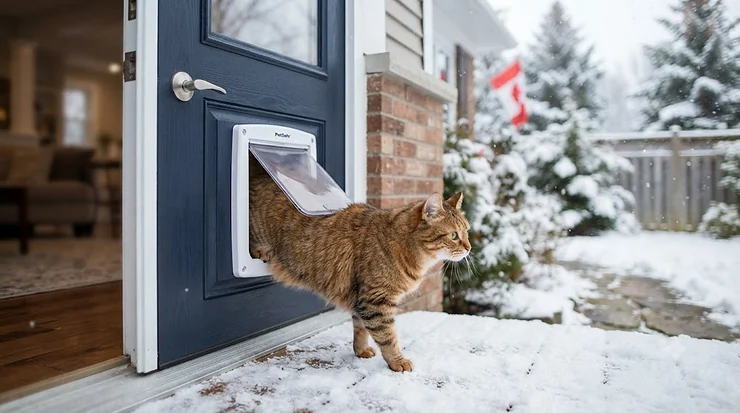
Your cat is sitting at the front door again, staring at the handle like she’s about to figure out how door hinges work. You’ve been there — coat half on, coffee going cold, playing doorman four times before breakfast. A cat door for exterior door use solves this specific problem: it’s a small, sealed opening installed into or beside a front, back, or garage entry door that lets your cat come and go on her own schedule, without turning your house into a wind tunnel every January
That’s the plain-language version. In practice, “exterior door” changes everything about what you should buy. Interior cat doors are built to separate rooms — they don’t need to fight −25°C wind chill, driving rain off Lake Ontario, or a raccoon trying its luck at 2 a.m. An exterior-rated flap needs weatherstripping, a locking mechanism, and a flap material that won’t go brittle the first hard frost. Canadian animal welfare organizations have increasingly made the case for keeping cats indoors or supervised outdoors, both to protect local wildlife and for the cat’s own safety — which is exactly why the locking and curfew features on several products below aren’t gimmicks; they’re the whole point.
We researched seven real, currently available products — from a C$45 manual flap to a C$300 app-controlled smart door — so you can match the right one to your door type, your climate, and your cat.
Quick Comparison Table: Cat Door Types at a Glance
Before diving into specific products, it helps to see how the four broad categories of cat door for exterior door installations stack up against each other.
| Door Type | Weather Protection | Security Level | Typical Price Range (CAD) | Best For |
|---|---|---|---|---|
| Basic manual flap (4-way lock) | Low-moderate | Manual only | C$40–C$70 | Hollow-core or storm doors, mild climates |
| Insulated multi-flap | High | Manual only | C$100–C$170 | Wooden or steel exterior doors, cold winters |
| Microchip-activated | Moderate-high | Automatic (pet-specific) | C$110–C$260 | Keeping strays and wildlife out |
| Exterior-grade heavy insulated | Very high | Manual + locking cover | C$220–C$340 | Extreme cold, high-traffic front doors |
A basic manual flap gets the job done on a budget, but it’s really a compromise product — fine for a mild coastal climate, less fine once the wind chill hits double digits below zero. The insulated multi-flap and exterior-grade categories exist specifically because a single thin vinyl flap on an exterior door behaves like a hole in your building envelope, and comprehensive air leakage control around doors and windows is considered by Natural Resources Canada to be one of the single most important places to focus when trying to keep a home comfortable and efficient. If you’ve got a determined neighbourhood tom trying to move in, the microchip category is worth the premium — it’s the only one of the four that tells the difference between your cat and every other cat in the postal code.
💬 Just one click — help others make better buying decisions too!😊
Top 7 Cat Doors for Exterior Doors: Expert Analysis
We looked at real, currently sold products spanning budget, mid-range, and premium tiers, across wooden doors, hollow-core doors, and heavy exterior-grade installations. Every product below is genuinely available — check the listing for current stock and exact pricing, since Amazon pricing shifts constantly.
1. Cat Mate 235 4-Way Locking Cat Flap — budget champion for hollow-core doors
The Cat Mate 235 solves a problem most budget flaps ignore completely: what do you do with a hollow-core door that’s mostly cardboard honeycomb and air on the inside? This flap is self-lining up to 50mm of panel thickness, meaning it frames itself out on both sides without needing a separate wooden liner kit.
The flap opening measures roughly 14.5cm x 14.5cm (5.7″ x 5.7″), rigid acrylic with a perimeter weather strip, and the housing offers four lock positions: in-and-out, in-only, out-only, and fully locked. That last setting matters more than it sounds — a cheap flap without a proper locked position is really just a hole with a flap taped over it. Based on the spec comparison against pricier options, what you’re sacrificing here is insulation depth, not build quality; the acrylic panel and lock mechanism are genuinely durable for the price point.
Who should buy this: anyone installing a cat door for wooden door panels that are hollow-core (the vast majority of interior-style doors used as side or garage entries), plus budget-conscious owners in milder Canadian climates like coastal BC or southern Ontario shoulder seasons. Reviewers consistently note that the tamper-proof lock mechanism takes a minute to figure out the first time, since you push down before sliding, but that it holds firm once set — exactly the kind of small learning curve worth mentioning rather than glossing over.
Pros:
- ✅ Self-lining design fits hollow-core doors with no extra kit
- ✅ True 4-way lock including a fully secured setting
- ✅ Compact footprint suits smaller and older cats
Cons:
- ❌ Minimal insulation compared to multi-flap designs
- ❌ Opening is too small for larger or fluffier cats
Price sits around C$45–C$60, and for a first-time buyer testing whether their cat will even use a flap, that’s a low-risk entry point rather than a compromise.
2. PetSafe Extreme Weather Pet Door — 3-flap insulation for brutal winters
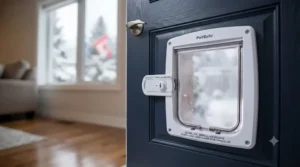
The PetSafe Extreme Weather Pet Door takes a different approach entirely: instead of one flap, it uses three, with a center insulated panel sandwiched between two outer flaps. PetSafe rates the design at roughly 3.5 times the energy efficiency of a single-flap door, and the whole unit is engineered to keep working in climates ranging from about −23°C to 38°C (−10°F to 100°F), which covers the overwhelming majority of what a Canadian winter throws at a door.
What that means in practice: the center insulated flap acts like a storm window for your pet door, trapping a still-air pocket that slows heat transfer the same way double glazing does. A snap-on closing panel lets you shut the whole thing off overnight or during a cold snap without uninstalling anything. The frame is paintable plastic, so it can be matched to your door’s existing colour rather than sitting there as an obvious white rectangle.
This is arguably the strongest all-round pick for anyone specifically shopping for an insulated door cat flap on a standard wood, metal, or PVC exterior door between about 4.1cm and 5.7cm (1 5/8″ to 2 1/4″) thick — which describes most Canadian front and back doors. What most buyers overlook about this model is that the three-flap system, while excellent for insulation, does add a small amount of resistance a nervous or elderly cat needs to learn to push through; most adapt within a week.
Pros:
- ✅ Three-flap design blocks far more cold air than single flaps
- ✅ Rated for genuinely wide temperature extremes
- ✅ Paintable frame blends into most door colours
Cons:
- ❌ Extra flap resistance takes some cats longer to learn
- ❌ Plastic frame less rugged than aluminum alternatives
Expect to pay in the C$110–C$160 range depending on size, with the medium size covering most full-grown cats comfortably.
3. SureFlap Microchip Cat Flap — keeps every stray and raccoon out
The SureFlap Microchip Cat Flap flips the whole conversation from “insulation” to “security.” Instead of a manual lock you set by hand, it reads your cat’s existing microchip and only unlocks for chips it recognizes — up to 32 registered pet identities stored in memory. Given how often microchips help shelters reunite lost pets with their families, having a door that already relies on the same microchip infrastructure feels less like a novelty and more like a natural extension of identification your cat probably already has.
The flap opening is sized for cats and comes with battery-powered locking (four C-cell batteries, roughly 12 months of life), a low-battery indicator, and a manual override for in-only mode when you want your cat home for the night without locking the door entirely. Installation works through wood, glass, or brick, which makes it flexible for the odd door construction some older Canadian homes have.
Here’s what the spec sheet won’t tell you, but reviewers note repeatedly: the microchip read range is short and directional, so cats with a habit of approaching sideways sometimes need a beat longer to register. It’s a minor training issue, not a design flaw, and most cats adjust within the first few days. For households near a colony of neighbourhood cats, or anyone who’s ever found a raccoon eating out of the cat bowl, this is the single most effective category upgrade available.
Pros:
- ✅ Reads existing microchips — no new tag or collar needed
- ✅ Stores up to 32 pet identities in memory
- ✅ Selective entry keeps strays and wildlife out entirely
Cons:
- ❌ Battery-dependent, needs periodic checks
- ❌ Learning curve for cats approaching at odd angles
Typical pricing runs C$110–C$150, positioning it as a mid-range option that punches well above its price in security value.
4. Ideal Pet Products Designer Series Ruff-Weather Pet Door — best fit for painted wooden doors
The Ideal Pet Products Ruff-Weather Pet Door was built around the reality that a lot of Canadian homes still have solid, paintable wood or panel doors as their main entry. Its structural foam frame fits doors from about 1.9cm to 4.4cm (3/4″ to 1-3/4″) thick, and — crucially for anyone specifically searching for a cat door for wooden door installs — the frame itself is paintable to match trim, siding, or door colour exactly.
Two flexible vinyl flaps create a roughly 7.6cm (3-inch) insulating air gap between them, which is a meaningfully different approach than PetSafe’s three-flap system but lands in a similar performance band. A lock-out slide built into the frame lets you close the opening entirely without extra parts. Installation ships complete with hardware, a paper template, and instructions clear enough that most reviewers describe it as a weekend project rather than a contractor call — though one detail worth flagging honestly: several owners installing this in steel doors report it takes noticeably longer than expected, since standard drill bits and jigsaw blades struggle with steel and need to be swapped for metal-rated ones.
Based on the spec comparison, this sits squarely in the mid-range tier: better insulation and a sturdier frame than the basic Cat Mate flap, but without the aluminum-and-acrylic toughness of the premium options further down this list. It’s the door I’d point a homeowner toward if their main entry is a painted wooden door and their winters are cold-but-not-brutal — think Ottawa or Halifax rather than Winnipeg.
Pros:
- ✅ Paintable frame matches wooden door finishes exactly
- ✅ 3-inch double-flap air gap adds real insulation
- ✅ Complete hardware kit with template included
Cons:
- ❌ Steel-door installs require different tools than expected
- ❌ Optional wall kit sold separately if needed later
Price generally falls in the C$160–C$220 range for the extra-large size, with smaller sizes available for lighter cats.
5. PlexiDor Performance Pet Door — nearly indestructible acrylic for big cats
The PlexiDor Performance Pet Door, small size, is built for cats up to roughly 11kg (24 lb) and takes a completely different construction approach than every flap-based product on this list: instead of vinyl, it uses saloon-style dual-pane acrylic panels that swing open from the center and are spring-loaded to snap shut. The frame is heavy-duty anodized aluminum, and the whole unit carries industrial-grade weatherstripping on all four edges.
Reviewers consistently report that rigid acrylic panels solve a problem vinyl flaps never fully do — they don’t flap loudly in wind, they don’t curl or crack after a few winters, and larger, more confident cats push through with almost no hesitation compared to a resistance-heavy multi-flap system. The 4-way lock (in-only, out-only, both, or fully locked) is a simple turn-knob rather than a slide, which several reviewers describe as easier to operate one-handed.
If you’re specifically shopping for a large cat door for front door installs — a Maine Coon, a big rescue tom, or a household with both a big cat and a small dog sharing one entry — this is one of the strongest picks here. On paper this means paying a premium for materials that essentially never need a flap replacement, which changes the long-term cost math meaningfully (more on that in the maintenance section below). The trade-off: at 1.75″ (4.4cm), it’s designed for standard US/Canadian exterior door thickness and doesn’t flex much beyond that without additional hardware.
Pros:
- ✅ Rigid acrylic panels never crack or curl like vinyl
- ✅ Anodized aluminum frame built for years of daily use
- ✅ Comfortably fits larger cats up to 24 lb
Cons:
- ❌ Premium price relative to flap-style competitors
- ❌ Limited flexibility for non-standard door thicknesses
Expect C$230–C$300 for the small size, which reviewers broadly agree is justified by the multi-year durability.
6. SureFlap Microchip Pet Door — app-controlled curfews for front-door access
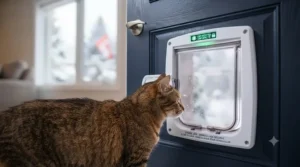
The SureFlap Microchip Pet Door is the large-format sibling to the microchip cat flap above, sized for large cats and small dogs, with a flap opening around 17.8cm x 17cm (7″ x 6 11/16″) — genuinely one of the better large cat door for front door options if your cat is on the bigger side or you also have a small dog sharing the entry. It runs on the same selective-entry microchip technology, but the Connect version adds Wi-Fi control through the Sure Petcare app.
That app connection is the real differentiator: it lets owners set a curfew that locks and unlocks the door automatically at specified times, share app access with other household members, and receive a notification whenever their pet comes or goes. For anyone who’s ever wondered whether the cat actually came in last night, that visibility is worth something real, not just a smart-home novelty.
Here’s what the spec sheet won’t tell you: setting up the curfew schedule the first time takes about ten minutes, and the Hub needs a spare port on your home router, which can be an obstacle in homes where the router lives in a basement far from the door. Battery life runs up to 12 months on 4 AA batteries even with the app layer active, since the app connects through a separate hub rather than draining the door unit itself. For households that want automatic scheduling on top of microchip security, this is currently the most capable option on this list.
Pros:
- ✅ App-based curfew scheduling locks the door automatically
- ✅ Notifications confirm when your pet comes or goes
- ✅ Sized generously for large cats and small dogs
Cons:
- ❌ Requires a Wi-Fi hub near a router
- ❌ Higher total cost once the hub is included
Combined door-plus-hub pricing typically runs C$220–C$280, positioning it as a premium, tech-forward choice rather than a budget one.
7. Endura Flap Door Mount Pet Door — the exterior-grade heavyweight
The Endura Flap Door Mount is the product to reach for when “weatherproof” needs to mean something specific and extreme. Made by Patio Pacific, it’s engineered to hold its seal down to −40°F and withstand wind gusts up to 50 mph, and the flap itself uses a dual-layer sealed construction that the manufacturer compares to the insulating performance of double-pane glass.
What sets this apart from every other product here is the three-sided magnetic seal — most flaps only seal along the bottom edge, letting wind push them open from the sides during a storm. The Endura Flap seals magnetically on all three edges, so it resists exactly the kind of sideways gusting that makes typical vinyl flaps flap and rattle all winter. It’s also explicitly built to install in solid core, hollow core, metal, and storm doors alike, which makes it one of the rare products genuinely marketed as an exterior grade pet flap regardless of what your door is made from.
Based on the spec comparison, this is the product for anyone in a genuinely harsh climate — the Prairies, northern Ontario, anywhere winter isn’t polite about it — or anyone who’s tried a cheaper flap and found it rattling and letting cold air whistle through by December. The included heavy-duty locking cover, rated comparable to 16-gauge steel, adds a real security layer most flap-style doors skip entirely. The trade-off is straightforward: this is the most expensive door on the list, and installation into a solid-core or steel door is more involved than a basic flap swap.
Pros:
- ✅ Three-sided magnetic seal resists wind-driven drafts
- ✅ Rated to remain flexible down to −40°F
- ✅ Works across hollow-core, solid-core, and metal doors
Cons:
- ❌ Highest price point of any door on this list
- ❌ Installation is more involved on solid-core doors
Pricing generally runs C$260–C$340 for the large single-flap version, reflecting genuinely different-tier materials rather than brand markup alone.
Full Product Comparison: Specs, Price Range & Best Use
| Product | Flap/Panel Type | Approx. Price Range (CAD) | Best For |
|---|---|---|---|
| Cat Mate 235 4-Way Locking Cat Flap | Rigid acrylic, single | C$45–C$60 | Hollow-core doors, mild climates |
| PetSafe Extreme Weather Pet Door | 3-flap vinyl, insulated | C$110–C$160 | Standard exterior doors, cold winters |
| SureFlap Microchip Cat Flap | Single flap, microchip lock | C$110–C$150 | Keeping strays and wildlife out |
| Ideal Pet Products Ruff-Weather | Double vinyl flap | C$160–C$220 | Painted wooden doors |
| PlexiDor Performance Pet Door | Dual acrylic panels | C$230–C$300 | Large cats, durability priority |
| SureFlap Microchip Pet Door | Single flap, app-controlled | C$220–C$280 | Large cat door for front door, smart curfews |
| Endura Flap Door Mount | Dual-layer sealed flap | C$260–C$340 | Extreme cold, any door material |
Looking at the table above, the Cat Mate 235 and SureFlap Microchip Cat Flap deliver the best value for households prioritizing budget and security respectively, while the Endura Flap Door Mount justifies its premium for anyone in a genuinely harsh winter climate. Buyers focused purely on avoiding drafts should note that the PetSafe Extreme Weather Pet Door offers nearly comparable insulation performance to the Endura Flap at roughly half the price, provided sideways wind isn’t a major factor at their specific entry point.
✨ Ready to stop playing doorman? Compare current prices on the models above and find the one that matches your door.
Practical Setup & First-30-Days Guide
Getting a cat door for exterior door installed right the first time saves a lot of frustration later, and the process is genuinely more approachable than most homeowners expect.
Start by measuring your cat, not the door. Measure from the top of the shoulders to the floor while your cat is standing normally, then add a couple of centimetres of clearance — an opening that’s too tight makes cats hesitant, while one that’s oversized just lets more cold air through than necessary. Next, confirm your door’s thickness with a tape measure at the edge; most exterior doors run between 3.5cm and 4.5cm (1 3/8″ to 1 3/4″), and every product above lists a compatible thickness range worth double-checking before you cut anything.
Installation day itself typically takes two to four hours for a flap-style door and closer to half a day for anything requiring cutting through steel. Use the supplied cardboard template, tape it in place, and triple-check placement with a level before drilling pilot holes — a crooked cutout is the single most common installation regret reported in reviews. For wood and hollow-core doors, a jigsaw handles the cutout fine; steel doors need metal-rated bits and blades specifically, since standard woodworking tools will overheat and dull almost immediately.
The first 30 days are about training, not hardware. Prop the flap open with tape for the first few days so your cat can walk through without pushing anything. Once she’s comfortable, remove the tape and let the flap fall closed on its own, using treats on the far side to build confidence. Most cats fully adopt a new door within one to two weeks. Check the seal around the frame monthly through the first winter — caulking settles, and a small gap here undoes a lot of the insulation you paid for.
Real-World Scenarios: Which Door Actually Fits Your Household
Spec sheets are useful, but most people make this decision based on their actual situation, so here are three composite scenarios built from the patterns above.
The condo-adjacent townhouse with a hollow-core side door. A young cat, a mild coastal climate, and a budget that doesn’t want to stretch past C$70. The Cat Mate 235 is the obvious fit here — its self-lining design solves the hollow-core problem directly, and the mild climate means the extra insulation of pricier options isn’t doing much practical work.
The century-old farmhouse with a solid wooden front door and a big orange tomcat. Cold Ontario winters, an entry that gets real wind exposure, and a cat too large for most “standard” flap openings. The PlexiDor Performance Pet Door or the Ideal Pet Products Ruff-Weather both make sense, with the Ideal Pet Products option winning if budget matters more, and the PlexiDor winning if the owner wants something that will genuinely never need a replacement flap.
The suburban household near a wooded ravine, with two indoor-outdoor cats and a raccoon problem. This is where security stops being optional. Either SureFlap model earns its price here — the standard Microchip Cat Flap for a straightforward setup, or the app-controlled SureFlap Microchip Pet Door if the owners want curfew scheduling and activity notifications on top of the stray-blocking benefit.
Problem → Solution: Fixing Common Exterior Cat Door Headaches
Even a well-chosen door runs into predictable snags. Here’s how to handle the ones that come up most often.
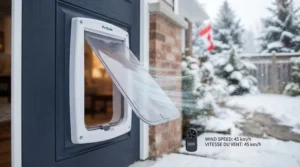
Problem: cold draft whistling through even with the flap closed. This is almost always a seal issue, not a design flaw — check the weatherstripping around the frame edges first, then confirm the flap itself is seated flush. Multi-flap products like the PetSafe Extreme Weather Pet Door or Endura Flap Door Mount solve this at the design level for anyone starting fresh.
Problem: raccoons or neighbourhood cats getting in. A manual-lock flap simply can’t distinguish animals. Upgrading to the SureFlap Microchip Cat Flap solves this directly, since the microchip reader sits on the exterior of the door and only recognizes registered pet identities.
Problem: the flap is too stiff and the cat won’t use it. Vinyl flaps stiffen in cold weather, especially cheaper single-layer designs. Warming the flap slightly with a hairdryer before first use, or switching to a rigid acrylic panel design like the PlexiDor, both address this.
Problem: door frame won’t accommodate a hollow-core panel. Use a self-lining product built for exactly this, like the Cat Mate 235, or add a wooden liner kit to bridge the gap on a heavier-duty product.
How to Choose a Cat Door for Exterior Door
Picking the right cat door for exterior door installs comes down to seven practical checks, roughly in order of importance:
- Measure your door’s material and thickness first. Wood, hollow-core, steel, and fiberglass all cut differently, and this single factor eliminates half the options immediately.
- Size the opening to your specific cat, not an “average” cat — a too-small opening is the top reason cats refuse to use a new door.
- Match insulation level to your actual winter, not the worst storm you can imagine — a mild-climate household doesn’t need the same door as a Prairie farmhouse.
- Decide how much security you actually need. If strays or wildlife are a real problem, a microchip lock isn’t a luxury, it’s the core feature.
- Check the locking mechanism type. Slide locks, turn-knob locks, and app-based curfews all work differently day-to-day; pick the one that matches how hands-on you want to be.
- Confirm installation difficulty against your own tools and comfort level. Steel doors in particular change the calculus significantly.
- Compare warranty length, since flap replacement frequency varies enormously between vinyl and acrylic designs.
Cat Door for Wooden Door vs. Hollow-Core Door vs. Metal Door
The single biggest factor in choosing a cat door for exterior door use isn’t brand — it’s what the door is actually made of, and this is where a lot of buyers get tripped up after purchase.
A cat door for wooden door installations is usually the most forgiving scenario. Solid wood and panel doors take a jigsaw cutout cleanly, hold screws securely, and accept paintable frames like the Ideal Pet Products Ruff-Weather without much fuss. The main risk is cutting into a structural rail or stile without checking first, which weakens the door — always confirm your cutout falls within a solid panel section.
A cat door for hollow core door installations is trickier, because there’s often nothing but air and cardboard honeycomb inside the panel where a standard frame would normally clamp down. This is exactly the gap the Cat Mate 235‘s self-lining design fills, and it’s also why the Endura Flap Door Mount explicitly lists hollow-core compatibility as a selling point rather than an afterthought — most premium doors need a wooden liner kit added separately to handle hollow-core panels safely.
Metal and steel doors sit at the opposite end: incredibly durable once installed, but genuinely harder to cut, requiring metal-rated jigsaw blades and drill bits, plus a mind for sharp edge burrs left behind by the cutting process. If your main entry is steel, budget extra installation time regardless of which product you choose, and consider a professional install if you’re not comfortable with a metal-cutting jigsaw.
Exterior Cat Door Weatherproof Features That Actually Matter
Not every feature marketed as “weatherproof” delivers equally, and this is worth unpacking honestly before you spend money on the wrong priority.
An exterior cat door weatherproof rating really comes down to three things: seal quality, flap layering, and frame material. Weatherstripping around the frame perimeter matters more than almost anything else — air leakage around frames and movable joints is consistently the most common source of drafts in door systems generally, and a cat door is just a smaller, pet-shaped version of that same problem. A single flap with good perimeter weatherstripping can outperform a poorly-sealed multi-flap door.
Flap layering is the second lever. A double or triple-flap design, like the PetSafe Extreme Weather Pet Door, traps a still-air pocket between layers the same way double-pane windows trap air between panes of glass. An exterior grade pet flap built around this principle, such as the Endura Flap Door Mount, takes it further with a sealed dual-layer flap and three-sided magnetic edges rather than just a bottom-weighted flap.
The third and most overlooked factor is frame material rigidity. A flimsy plastic frame can warp slightly over a few winters, breaking the seal even if the flap itself is fine. Aluminum frames, like those on the PlexiDor and Endura Flap, hold their shape through repeated freeze-thaw cycles far better than basic plastic housings — which is exactly why insulated door cat flap products in the premium tier lean almost universally toward aluminum construction.
Cat Door vs. Leaving the Door Ajar or Using a Sitter
It’s worth stepping back and comparing a proper cat door against the informal alternatives most people default to before they buy one.
| Approach | Energy Cost | Security | Convenience |
|---|---|---|---|
| Leaving door propped open | Very high | None | Poor — constant vigilance needed |
| Manual door-opening on demand | None (energy) | High (you decide) | Poor — ties you to a schedule |
| Cat door for exterior door | Low, if insulated well | Varies by lock type | Excellent — hands-off daily |
The math here is straightforward: propping a door open, even briefly and repeatedly, bleeds far more conditioned air out of a home over a winter than a well-sealed pet door ever will, since a proper flap only opens for the seconds it takes your cat to pass through. Manual, on-demand opening protects security completely but costs you real time and flexibility every single day. A quality insulated cat door for exterior door use lands in the middle ground that actually works long-term — modest, controlled energy loss in exchange for genuine independence for both you and your cat.
Common Mistakes When Buying a Cat Door for Exterior Door
A few buying mistakes show up again and again in reviews and installation forums, and most are easy to avoid once you know to look for them.
Buying based on price alone, without checking material compatibility, is the most frequent one — a beautiful C$50 flap that doesn’t actually fit a hollow-core panel properly ends up costing more once a liner kit gets added on. Skipping the measurement step is a close second; guessing at flap size instead of measuring your specific cat leads to openings that are either too tight or needlessly oversized. Ignoring climate mismatch is another — a basic single-flap door in a Winnipeg winter will underperform regardless of brand reputation. And overlooking security needs entirely is a mistake pet owners often only recognize after the first raccoon incident, at which point a manual-lock-only door suddenly looks underbuilt.
Long-Term Cost & Maintenance: What a Cat Door Really Costs Over 5 Years
The sticker price on a cat door for exterior door purchase is only part of the real cost, and this is where the cheaper options sometimes lose their advantage over time.
Vinyl flaps, found on budget and mid-range products like the Cat Mate 235 and PetSafe Extreme Weather Pet Door, typically need replacement every two to four years as the material stiffens and cracks with repeated cold exposure — replacement flaps generally run C$15–C$30 each. Over five years, that can add C$30–C$60 in ongoing cost on top of the original purchase. Rigid acrylic panels, like those on the PlexiDor, essentially never need this kind of replacement, which is exactly the trade-off behind their higher upfront price — the total cost of ownership narrows considerably by year three or four.
Battery-powered options like both SureFlap models add a small recurring cost too: roughly C$8–C$15 per year in batteries, though the 12-month battery life keeps that manageable. Weatherstripping on any door, regardless of price tier, benefits from a yearly inspection and occasional re-caulking around the frame — a five-minute task that preserves most of the insulation value you originally paid for.
Safety, Predators & Municipal Rules for Canadian Cat Owners
Installing a cat door for exterior door use raises a question worth answering honestly: is letting a cat come and go freely actually the right call in your neighbourhood?
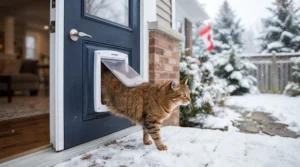
The research on this is fairly consistent. According to the Stewardship Centre for BC’s overview of outdoor cat risks, free-roaming owned cats are linked to a substantial share of Canadian bird deaths each year, and roaming cats also face constant risk of injury, disease, and death while outside unsupervised. That doesn’t mean a cat door is a bad idea — it means the locking and curfew features aren’t optional extras for anyone taking this seriously. A microchip-locked door with curfew scheduling, like the SureFlap Microchip Pet Door, lets you give a cat outdoor access during safe daylight hours while automatically locking overnight, which addresses both the predation-of-wildlife concern and the cat’s-own-safety concern at once.
Municipal rules vary considerably across Canada — some municipalities have introduced bylaws around free-roaming cats, so it’s worth a quick check with your local city or town before assuming unrestricted outdoor access is uncomplicated everywhere. Regardless of local bylaws, a cat door paired with proper identification remains a sound practice, and a microchip-locked door effectively uses that same identification technology twice — once for reuniting a lost cat, once for daily access control.
Frequently Asked Questions
❓ Can I install a cat door for exterior door use myself, or do I need a contractor?
❓ What size cat door do I need for a large cat?
❓ Do insulated cat doors really make a noticeable difference on energy bills?
❓ How do I stop other cats or raccoons from using my cat door?
❓ Can a cat door for hollow core door installs be made secure enough for winter?
Conclusion
A cat door for exterior door installation genuinely changes daily life — no more four-times-a-morning doorman duty, no more cold cat glaring at you through the glass. The right pick depends less on brand reputation than on three honest questions: what’s your door actually made of, how cold does your winter actually get, and how much security do you actually need against strays and wildlife. Budget-conscious hollow-core installs point toward the Cat Mate 235. Cold-climate wooden or steel doors point toward the PetSafe Extreme Weather Pet Door, Ideal Pet Products Ruff-Weather, or the heavyweight Endura Flap Door Mount. And anywhere security or smart scheduling matters, the two SureFlap models — along with the exceptionally durable PlexiDor — earn their higher price tags. Measure twice, match the product to your actual door and climate, and the whole household — cat included — gets its mornings back.
Recommended for You
- How to Install Cat Door in Window: 7 Best Picks for 2026
- Window Cat Door: 7 Best Picks for Canadian Homes in 2026
- Magnetic vs Microchip Cat Door: 7 Picks Compared (2026)
Disclaimer: This article contains affiliate links. As an Amazon Associate, I earn from qualifying purchases. If you purchase products through these links, we may earn a small commission at no additional cost to you.
✨ Found this helpful? Share it with your friends! 💬🤗
