
In This Article
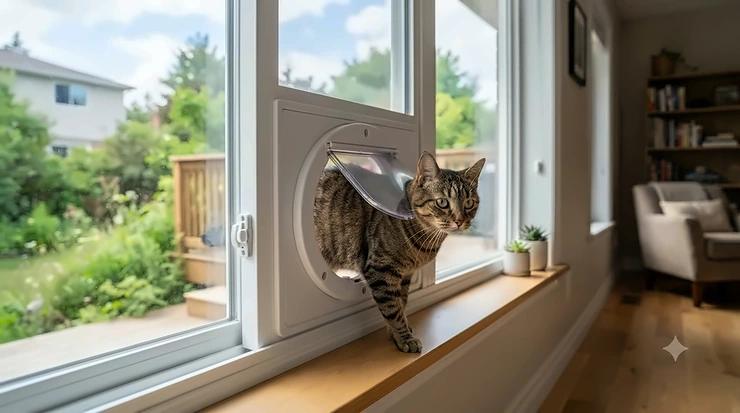
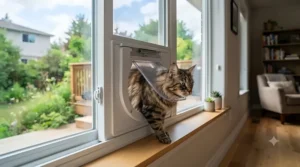
Somewhere between “just let the cat out” and “install a $2,000 wall unit,” there’s a much simpler answer sitting in your window frame. A window cat door is exactly what it sounds like: a self-contained flap-and-frame unit that slots into an existing window opening — no saw, no drywall dust, no landlord phone call. What is a window cat door? It’s a pet-access insert, usually aluminum-framed with a hinged or magnetic flap, that fits inside a sliding or sash window so a cat (or small dog) can come and go without a human standing at attention.
For renters, condo owners, and anyone who breaks into a cold sweat at the thought of cutting a hole in an exterior wall, this is the practical middle ground. And in Canada, where windows already have to fight -30°C winters and humid summers, the stakes for getting this right are a little higher than they’d be somewhere balmy. Cheap seals mean drafts. Drafts mean higher heating bills. A poorly measured frame means a door that won’t stay put through a Prairie windstorm.
This guide breaks down seven real, currently available window cat door options — from bare-bones budget inserts to insulated, microchip-locking units — and walks through exactly how to pick, install, and live with one. According to CBC’s coverage of the BC SPCA’s catio initiative, more Canadian cat owners are looking for safer, screened-in outdoor access rather than open-door free-roaming — and a well-chosen window pet flap kit is often step one in that setup. We’ll cover pricing ranges in CAD, real aggregated review sentiment where it’s verifiable, and the maintenance schedule nobody mentions until year two.
Quick Comparison Table: Window Cat Doors at a Glance
| Product | Best For | Install Type | Price Range (CAD) |
|---|---|---|---|
| VEVOR Cat Door for Window | Fast budget install | No-cut, tool-free | Under C$150 |
| Yoochy Full-Size Window Cat Door Insert | Renters wanting flexibility | No-cut, tool-free | Under C$150 |
| Ideal Pet Products Vertical Sash Window Pet Door | Long-term reliability | Minimal tools, sash-mounted | C$150-C$260 |
| Hakuna Pets Small Silver Deluxe Aluminum Pet Door | Multi-surface households | Tool-assisted, adjustable tunnel | C$100-C$220 |
| Cat Flap Fever Custom Window Insert (PVC Base) | Drafty or double-pane windows | Custom-fit, tool-free | C$180-C$320 |
| Cat Flap Fever Custom Window Insert (Plexiglass) | Visibility and light | Custom-fit, tool-free | C$190-C$330 |
| PetSafe Electronic Dual-Pane Sash Insert (Security Boss) | Microchip security | Custom-built, professional-friendly | C$450-C$700+ |
The spread here tells its own story: this category runs from a weekend impulse-buy to a genuine home upgrade. Budget picks like the VEVOR Cat Door for Window and Yoochy Full-Size Window Cat Door Insert solve the immediate problem — a cat that wants out and a human tired of doorman duty — but they’re single-pane and not built for a Canadian January. Move up the table and you start paying for insulation, microchip recognition, and materials that won’t warp after two heat-cool cycles. There’s no wrong answer, only a mismatch between budget and climate reality if you buy short.
💬 Just one click — help others make better buying decisions too! 😊
Top 7 Window Cat Doors: Expert Analysis
1. VEVOR Cat Door for Window — best all-around budget pick for quick installs
The standout here is speed: this insert is built to go from box to functioning cat door in well under an hour, with no drilling and no permanent changes to the window frame. It adjusts to fit window widths of roughly 79-91 cm (31-36 in), pairs an aluminum frame with a high-transparency glass-style panel, and offers four lock settings — sealed, two-way open, in-only, and out-only.
Here’s what the spec sheet doesn’t spell out: four lock modes matter less for convenience and more for control. A cat that’s recovering from surgery, or a household with a skittish new arrival, benefits from being able to switch to “in-only” without removing the whole unit. Based on the spec comparison against similar aluminum inserts, the magnetic closure on this model is a genuine upgrade over the gravity-flap designs that dominated this category a few years ago — it holds the flap shut against wind pressure instead of just letting it swing.
This is the pick for apartment dwellers and first-time buyers who want to test whether their cat will even use a window door before investing more. Reviewers consistently report that the adjustable width mechanism is the make-or-break factor — measure twice, because a loose fit is the single most common complaint across this whole product category, not just this model.
Pros:
- ✅ Tool-free install finishes in under an hour
- ✅ Four lock modes for graduated control
- ✅ Magnetic closure resists wind flap-back
Cons:
- ❌ Single-pane glass offers weak winter insulation
- ❌ Width range won’t fit oversized windows
Priced under C$150, the VEVOR Cat Door for Window delivers strong value for anyone testing the concept before committing to a premium insulated unit — check current price and measure your window frame before ordering.
2. Yoochy Full-Size Window Cat Door Insert — easiest no-cut setup for renters
The Yoochy Full-Size Window Cat Door Insert leans hard into the “renter-friendly” pitch, and on paper it earns it: a roughly 10-minute, tool-free installation with a snug adjustable fit for windows around 79-91 cm (31-36 in) wide and about 33 cm (12.99 in) tall.
What most buyers overlook about this style of insert is that “10-minute install” cuts both ways — it also means 10-minute removal, which is the entire point if you’re moving out in eight months. The aluminum frame and weatherproof gasket system are designed to compress against the window track rather than screw into it, so there’s genuinely nothing left behind on move-out day. The trade-off is that a system built to be removed quickly is, by definition, a system that can be nudged loose, which is why the four-mode lock (two-way seal, two-way open, in-only, out-only) matters as much here as security as it does as convenience.
Aggregated buyer sentiment for this style of insert (based on similar listings in the same product family) skews positive on ease of setup and mixed on long-term weatherproofing in colder climates — a pattern worth taking seriously before a Canadian winter arrives.
Pros:
- ✅ Roughly 10-minute tool-free installation
- ✅ Fully reversible with zero window damage
- ✅ Same four-mode locking system as pricier rivals
Cons:
- ❌ Not rated for sustained sub-zero drafts
- ❌ Snug fit depends on precise measuring
In the C$100-C$150 range, this is one of the most accessible window cat door easy install options on the market, and a smart pick for short-term leases — just don’t expect it to be your forever solution in a Winnipeg February.
3. Ideal Pet Products Aluminum Vertical Sash Window Pet Door (Chubby Kat) — best for long-term reliability
Ideal Pet Products has been building window and sash inserts since 1979, and the Ideal Pet Products Aluminum Vertical Sash Window Pet Door reflects that maturity. The Chubby Kat flap size (roughly 19 x 27 cm / 7.5 x 10.5 in) fits comfortably-sized cats and small dogs, and the frame adjusts to specific vertical sash window heights rather than a broad generic range, which means a genuinely tighter fit than most one-size-adjustable competitors.
Here’s the practical read: a purpose-built vertical sash design outperforms generic adjustable inserts specifically because it isn’t trying to be everything to everyone. The aluminum frame is engineered for one job — sliding sash windows — and the tolerances reflect it. Reviewers consistently note that the biggest advantage over cheaper aluminum inserts isn’t the material, it’s the precision fit, which translates directly into fewer drafts and less flap rattle in wind.
This is the door for someone who’s already decided a window cat door is a permanent fixture in their home, not a stopgap. Families in older character homes with genuine wood or aluminum sash windows will find this a more natural match than the universal sliding-window inserts built primarily for newer vinyl frames.
Pros:
- ✅ Purpose-built for vertical sash windows
- ✅ Decades-old brand with established parts support
- ✅ Tighter tolerance fit reduces draft and rattle
Cons:
- ❌ Less flexible if you move to a different window style
- ❌ Higher price than universal aluminum inserts
Expect a C$150-C$260 range depending on flap size — solid mid-tier value for a household planning to keep this door installed for years, not months.
4. Hakuna Pets Small Silver Deluxe Aluminum Pet Door — best multi-surface flexibility
Rather than being locked into one window style, the Hakuna Pets Small Silver Deluxe Aluminum Pet Door uses an adjustable tunnel system designed for doors, walls, screens, and glass up to about 7 cm (2.76 in) thick — which means it can move with you from a window insert to a wall or door cut-out later without buying an entirely new unit.
The 4-way lock and ultra-clear flap window are standard for this tier, but the detail worth flagging is the “ultra-clear viewing window” framing: your cat can see through the flap even when it’s closed, which reduces the hesitation-and-scratch behaviour that trainers report with opaque flaps. Based on the spec comparison, the magnetic centring mechanism here is functionally similar to the VEVOR and Yoochy units, but the adjustable tunnel depth is the real differentiator — it’s the only entry on this list genuinely built to be relocated.
Aggregated review sentiment on Hakuna Pets’ broader product line is mixed: buyers consistently praise the three-year warranty and responsive customer support, but a recurring complaint across multiple Hakuna listings involves magnets loosening over extended heavy use. That’s a maintenance item, not necessarily a dealbreaker, but it’s worth knowing going in.
Pros:
- ✅ Adjustable tunnel works across walls, screens, glass
- ✅ Ultra-clear flap reduces cat hesitation
- ✅ Backed by a three-year manufacturer warranty
Cons:
- ❌ Magnetic seal has reported long-term wear issues
- ❌ Assembly is more involved than tool-free inserts
Typically priced in the C$100-C$220 range depending on tunnel depth, this is the pick for anyone who isn’t 100% sure this window is the flap’s forever home.
5. Cat Flap Fever Custom Cat Door Window Insert (PVC Base) — best for drafty or double-pane windows
This is where the category gets serious about winter. The Cat Flap Fever Custom Cat Door Window Insert with a PVC base is built custom to your exact window dimensions, using roughly 6 mm (¼ in) PVC panelling combined with foam and brush weatherstripping specifically engineered to block drafts and retain warmth — a meaningfully different approach from the generic adjustable aluminum inserts further up this list.
What most buyers overlook about “custom-fit” pet doors is that the insulation value comes almost entirely from the seal quality, not the panel material itself. A perfectly fitted PVC insert with dense foam gasketing will outperform a loosely adjustable aluminum-and-glass unit in a drafty older window, even if the aluminum unit looks more premium on a spec sheet. This model also offers microchip lock options that recognize up to 30 registered pets, useful for multi-cat households that want to exclude neighbourhood strays.
Reviewers consistently frame this brand as “the original” in the custom cat flap window insert niche, and aggregated sentiment leans strongly toward praise for cold-weather performance specifically — the recurring theme in genuine feedback is “doesn’t feel drafty,” which is precisely the complaint that plagues cheaper universal inserts in a Canadian winter.
Pros:
- ✅ Custom-built to your exact window measurements
- ✅ Foam and brush seals genuinely block cold drafts
- ✅ Optional microchip lock recognizes up to 30 pets
Cons:
- ❌ Custom manufacturing means longer lead times
- ❌ Premium pricing versus universal aluminum inserts
Budget C$180-C$320 depending on size and lock type — a strong candidate if your current window already lets in a noticeable draft and you’re tired of feeling it every time the furnace kicks on.
6. Cat Flap Fever Custom Cat Door Window Insert (Plexiglass) — best for visibility and light transmission
Nearly identical in construction philosophy to its PVC sibling, the Cat Flap Fever Custom Cat Door Window Insert (Plexiglass) swaps the panel material for insulated Plexiglass — same foam and brush weatherstripping, same tool-free custom install, same microchip lock options, but noticeably more light passes through the non-flap portion of the panel.
The real-world trade-off is aesthetic and functional at once. What the spec sheet won’t tell you, but a side-by-side comparison makes obvious, is that PVC panels tend to look more “utilitarian” in a bright living room window, while Plexiglass keeps the window looking closer to normal glass, which matters if the insert is going into a highly visible front-facing window rather than a basement or laundry room sash. On paper this means slightly less draft resistance than the thicker PVC option, though the difference is marginal when the weatherstripping is properly seated.
Because this is effectively the same manufacturing platform as the PVC version, aggregated review sentiment tracks closely: strong marks for draft control relative to universal inserts, with the same custom-order lead time as the trade-off for a precise fit.
Pros:
- ✅ Maintains a more glass-like, less bulky appearance
- ✅ Same insulated weatherstripping as the PVC version
- ✅ Microchip lock options available
Cons:
- ❌ Slightly less rigid than the PVC panel version
- ❌ Same custom lead-time delay before installation
Also in the C$190-C$330 range, this is the version to choose when the window in question is one guests will actually see, not one tucked out of sightlines.
7. PetSafe Electronic Dual-Pane Sash Window Insert (by Security Boss) — best for RFID security and double-pane compatibility
At the top of this list sits the PetSafe Electronic Dual-Pane Sash Window Insert, manufactured by Security Boss and sold under PetSafe’s electronic pet door line. This unit is purpose-built for dual-pane sash windows, using tempered safety glass and an RFID collar-tag system so only your specific pet — wearing the paired tag — can trigger the flap open.
Two opening sizes are available: a small option around 17 x 20 cm (6⅝ x 8 in) and a large option around 33 x 40 cm (13 1/16 x 15¾ in). Here’s what actually matters in practice: an RFID-locked cat door glass installation solves the raccoon problem that plagues every purely mechanical flap in this category. Reviewers and Security Boss’s own product documentation consistently flag raccoon-proofing as the headline feature, since raccoons in wooded or suburban Canadian neighbourhoods have learned to manipulate simple magnetic and 4-way lock mechanisms with surprising ease.
The dual-pane construction also directly answers the “cat flap for double pane window” question that trips up so many buyers of universal aluminum inserts — this unit is engineered around that exact glazing style rather than treating it as an edge case. It’s a hand-built, made-to-order product, so expect a longer wait and a noticeably higher investment than anything else on this list.
Pros:
- ✅ RFID collar tag blocks unauthorized wildlife entry
- ✅ Purpose-built for genuine double-pane sash windows
- ✅ Tempered safety glass with adjustable spring-loaded frame
Cons:
- ❌ Significantly higher price than mechanical alternatives
- ❌ Custom build means longer wait before installation
At C$450-C$700+ depending on size and pane configuration, this is a genuine investment piece — but for households battling raccoons or living with genuine double-pane sash windows, it’s arguably the only entry on this list built for the job rather than adapted to it.
✨ Don’t Miss These Exclusive Deals!
🔍 Take your window cat door search to the next level with these carefully researched picks. Click through to check current pricing and availability before your cat starts scratching at the glass out of sheer impatience!
Benefits vs Traditional Cat Flaps and Wall-Mounted Doors
| Factor | Window Cat Door | Traditional Wall-Mounted Flap |
|---|---|---|
| Installation | No cutting; reversible | Requires cutting exterior wall |
| Renter-Friendly | Yes, in most cases | Rarely, unless landlord approves |
| Weatherproofing | Varies by model, needs sealing | Purpose-built, generally superior |
| Relocation | Easy to move with you | Effectively permanent |
| Best For | VEVOR Cat Door for Window, Yoochy Full-Size Window Cat Door Insert | Homeowners committing long-term |
The core trade-off is permanence versus flexibility. A wall-mounted flap, once professionally installed, usually delivers better insulation and structural rigidity than any window insert simply because it’s built into a wall cavity rather than braced against glass and a frame. But that permanence is exactly why renters and condo owners default to window inserts — you genuinely cannot cut a hole in a wall you don’t own. For most Canadian households weighing this decision, the window cat door insert route wins on flexibility even where it slightly loses on raw weatherproofing, unless you spring for one of the insulated custom builds covered above.
Price Range & Value Analysis for Window Cat Doors
| Tier | Price Range (CAD) | What You’re Paying For |
|---|---|---|
| Budget | Under C$150 | Speed of install, basic weatherproofing |
| Mid-Range | C$150-C$260 | Purpose-built fit, better materials, longer lifespan |
| Premium | C$180-C$330 | Custom sizing, real insulation, aesthetic finish |
| Top-Tier | C$450-C$700+ | RFID security, dual-pane engineering, raccoon-proofing |
Cost-per-use tells a clearer story than sticker price alone. A C$120 aluminum insert that needs replacing every two winters because the seals degrade actually costs more over five years than a C$280 custom-insulated unit that lasts a decade. Reviewers consistently flag seal and magnet degradation as the top complaint in the budget tier specifically, which is the hidden long-term cost most first-time buyers don’t factor in in the checkout aisle.
💬 Prices change often — always check current listings before you commit to a size. 😊
How to Choose a Window Cat Door
Picking the right unit comes down to seven decision points, roughly in order of importance:
- Measure your window opening precisely — width and height, in both centimetres and inches, since even “adjustable” inserts have hard minimum and maximum ranges.
- Confirm your window type — single-hung, double-hung, horizontal sliding, or vertical sash all require different mounting geometry.
- Check for double-pane or triple-pane glazing — standard aluminum inserts are usually engineered around single-pane openings, so double-pane households should lean toward purpose-built units like the PetSafe Electronic Dual-Pane Sash Window Insert.
- Decide how much winter performance you actually need — a mild coastal climate tolerates a budget insert that a Prairie or northern Ontario winter simply won’t forgive.
- Weigh security needs — households near raccoons, or with multiple neighbourhood cats competing for entry, benefit from RFID or microchip locking over basic magnetic closures.
- Factor in your tenancy status — renters should prioritize tool-free, fully reversible installs over anything requiring permanent modification.
- Set a realistic budget band — decide upfront whether you’re solving a short-term problem (budget tier) or making a multi-year investment (premium or top-tier).
Window Cat Door vs Traditional Wall Cat Flap: Which Wins in Real Homes
On paper, a wall-mounted flap sounds like the superior product — it’s purpose-built, professionally sealed, and doesn’t depend on window hardware holding steady over time. In practice, the comparison flips depending on who’s asking. Homeowners planning to stay put for a decade or more generally come out ahead with a properly installed wall unit, because the labour cost gets amortized over years of use and the insulation performance is simply better engineered from the start.
But most Canadians shopping for a “window cat door” are asking the question precisely because a wall flap isn’t realistic for them — a rental agreement, a condo bylaw, or a simple reluctance to commit to a hole in the siding. In that context, the comparison isn’t really window-versus-wall at all; it’s window-insert-versus-nothing. Given that framing, even a mid-tier insulated window unit like the Ideal Pet Products Aluminum Vertical Sash Window Pet Door delivers most of the practical benefit — pet independence, less door-duty for humans — without the irreversible commitment.
Common Mistakes When Buying a Window Cat Door
The single most common error, based on aggregated review patterns across this entire product category, is mis-measuring the window opening. A snug fit is what makes the difference between a door that survives a windstorm and one that rattles loose within a season — and “adjustable” ranges have real limits that buyers routinely misread.
The second-most common mistake is buying a budget single-pane insert for a climate that genuinely needs insulation, then being surprised by a cold patch near the kitchen sink every February. Related to that: skipping the weatherstripping check entirely. Even premium inserts rely on the gasket seating flush against the frame, and a poorly seated seal defeats the purpose of paying more in the first place.
Finally, many buyers underestimate training time and assume the cat will “just figure it out.” Most cats need a week or two of encouragement — propping the flap open initially, using treats near the opening — before they’ll use it independently, regardless of how well-built the door is.
Cat Flap for Double Pane Window: What Changes With Modern Glass
Double-pane and triple-pane windows are now standard in newer Canadian construction, largely because Natural Resources Canada’s guidance on energy-efficient windows pushes builders toward better-sealed, multi-glazed fenestration to cut heat loss. That’s great for your heating bill and mildly complicated for pet door installation.
A universal aluminum insert designed around single-pane sliding windows can technically fit into a double-pane frame, but the depth and seal geometry weren’t engineered for it, which is exactly where owners run into the persistent-draft complaints that show up in aggregated reviews. Purpose-built dual-pane units — like the PetSafe Electronic Dual-Pane Sash Window Insert covered above — account for the extra glazing layer and depth in their frame design from the outset, which is why they command a premium price. If your home was built or renovated within the last fifteen years, there’s a strong chance you’re dealing with double-pane glass, and it’s worth confirming before ordering any “universal” insert.
No-Cut Window Cat Door Installation and Setup Guide
Installing a no-cut window cat door is one of the rare home upgrades where the manual actually undersells how simple it is, provided the measuring step was done correctly. Here’s the general first-30-days process that applies across most of the units on this list.
Start by cleaning the window track thoroughly — accumulated dust and grit is a leading cause of a loose or uneven seal on tool-free inserts. Slide the unit into place following the manufacturer’s width or height adjustment mechanism, then extend it until it’s snug against both sides of the frame; a properly seated insert should not wiggle when nudged. Secure any included locking pins or tension screws, then test the flap’s swing and lock modes before introducing your cat.
For the first week, most trainers recommend propping the flap fully open with a small wedge or piece of tape so the cat associates the opening with easy passage rather than resistance. Gradually reduce the prop until the flap swings freely, using treats or a favourite toy just beyond the opening to build confidence. A common mistake in this window pet flap kit setup phase is rushing the training — cats that have a single bad experience (a flap that swings back and startles them) can take weeks longer to trust the door.
Maintenance in year one is light but not zero: check the weatherstripping seal each season, especially before winter, and re-tighten any tension mechanisms that loosen from repeated use.
Real-World Scenarios: Who Each Window Cat Door Actually Fits
The downtown renter with a one-year lease. A young professional in a Toronto or Vancouver apartment, indoor cat, no permission to modify the unit. This is the textbook case for the Yoochy Full-Size Window Cat Door Insert or the VEVOR Cat Door for Window — fast, fully reversible, and cheap enough that losing the deposit isn’t a real financial risk if the landlord objects on move-out (though a tool-free insert rarely triggers that conversation in the first place).
The multi-cat household in a century home. Three cats, an older character home with genuine wood sash windows, and a noticeable draft near the back bedroom. This scenario points toward the Cat Flap Fever Custom Cat Door Window Insert, in either PVC or Plexiglass, since the custom measurements solve the sash-window fit problem that trips up universal inserts, and the insulated seal directly addresses the draft complaint.
The suburban family battling raccoons. A backyard bordering greenspace, a cat that’s stopped using a basic magnetic flap because a raccoon keeps figuring it out at 2 a.m. As the Alberta Institute for Wildlife Conservation notes, unsupervised pet access points in wildlife-adjacent neighbourhoods are a genuine point of conflict between cats and local fauna, not just a nuisance. This is the clearest case for the PetSafe Electronic Dual-Pane Sash Window Insert — the RFID collar-tag requirement removes the wildlife problem entirely, and the dual-pane construction matches modern window glazing.
Buyer’s Decision Framework: If This, Choose That
- If you’re renting and need this gone in ten minutes on move-out day, choose a tool-free universal insert like the VEVOR Cat Door for Window because reversibility outweighs everything else.
- If your window already feels drafty in winter, choose an insulated custom build like the Cat Flap Fever Custom Cat Door Window Insert because seal quality solves the specific problem you already have.
- If wildlife keeps outsmarting a mechanical lock, choose the PetSafe Electronic Dual-Pane Sash Window Insert because RFID recognition is the only real fix for that failure mode.
- If you own an older home with genuine sash windows, choose a purpose-built sash unit like the Ideal Pet Products Aluminum Vertical Sash Window Pet Door because generic sliding-window inserts won’t seat properly.
- If you might relocate the door to a wall or different opening later, choose an adjustable multi-surface unit like the Hakuna Pets Small Silver Deluxe Aluminum Pet Door because the tunnel system is designed to move with you.
Long-Term Cost & Maintenance of a Window Pet Flap Kit
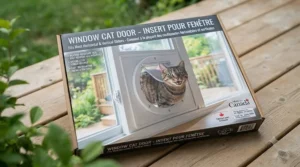
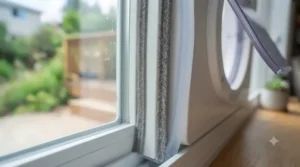
Ongoing maintenance for any window pet flap kit is modest but real, and skipping it is how a C$120 insert becomes a two-year purchase instead of a five-year one. Inspect the weatherstripping at the start of every heating season — foam and brush seals compress and wear with repeated flap use, and a gap you can feel with a bare hand in November is a gap that’s costing you on the heating bill by January. Magnetic closures benefit from an occasional wipe-down, since pet fur and dust build-up along the magnet strip is a common cause of the “won’t seal fully” complaint that shows up repeatedly in aggregated reviews.
Total cost of ownership favours the mid-to-premium tier more than most first-time buyers expect. A budget insert replaced twice over five years (roughly C$240-C$300 total) often lands close to the upfront cost of a single custom-insulated unit that lasts the full five years without replacement — with the added benefit of never having a cold February week with a failed seal in between.
Features That Actually Matter (And Those That Don’t)
Genuinely worth paying for: seal and weatherstripping quality, precise-fit sizing over generic “adjustable” ranges, and — for households with a wildlife problem — RFID or microchip locking. These three factors show up repeatedly in aggregated review data as the difference between a door people are still happy with two years later and one they’re already complaining about.
Largely marketing noise: exaggerated “lifetime warranty” claims on budget plastic components that wear out well before any warranty claim would be honoured, and cosmetic tinting or colour options that add cost without functional benefit. Multiple lock modes are useful, but a fifth or sixth “mode” beyond the standard four (sealed, two-way open, in-only, out-only) rarely adds meaningful control in a typical household.
Frequently Asked Questions
❓ Can I install a window cat door in a double-pane window myself?
❓ How long does it take to train a cat to use a window cat door?
❓ Do window cat doors work in a Canadian winter?
❓ Will a window cat door let raccoons or strays inside?
❓ Are window cat doors safe for renters to install?
Conclusion
A window cat door solves a genuinely small, genuinely annoying problem — being your cat’s full-time doorman — without the commitment of cutting into a wall you may not even own. Paired with a screened enclosure or a simple window box catio, it can also be the first step toward safer, supervised outdoor time rather than an all-or-nothing choice between fully indoor and fully free-roaming. The right pick depends less on brand prestige and more on an honest read of your own situation: a renter needs reversibility, a drafty older home needs real insulation, and a raccoon-plagued backyard needs RFID locking that a basic magnet simply can’t match.
Across the seven options here, the pattern holds steady — budget inserts like the VEVOR Cat Door for Window and Yoochy Full-Size Window Cat Door Insert win on speed and price, mid-tier purpose-built units like the Ideal Pet Products Aluminum Vertical Sash Window Pet Door and Hakuna Pets Small Silver Deluxe Aluminum Pet Door win on fit and flexibility, and premium picks like both Cat Flap Fever Custom Cat Door Window Insert variants and the PetSafe Electronic Dual-Pane Sash Window Insert win on winter performance and security. Measure carefully, be honest about your climate and wildlife pressure, and the right window cat door will pay for itself in every door you never have to open by hand again.
✨ Don’t Miss These Exclusive Deals!
🔍 Ready to stop playing doorman? Check current pricing on the pick that matches your window, your budget, and your winter — your cat (and your patience) will thank you.
Recommended for You
- Magnetic vs Microchip Cat Door: 7 Picks Compared (2026)
- Best Magnetic Cat Flap in Canada 2026: 7 Top 4-Way Picks
- How Does a Microchip Cat Flap Work? 7 Top Picks for 2026
Disclaimer: This article contains affiliate links. As an Amazon Associate, I earn from qualifying purchases. If you purchase products through these links, we may earn a small commission at no additional cost to you.
✨ Found this helpful? Share it with your friends! 💬🤗
