
In This Article
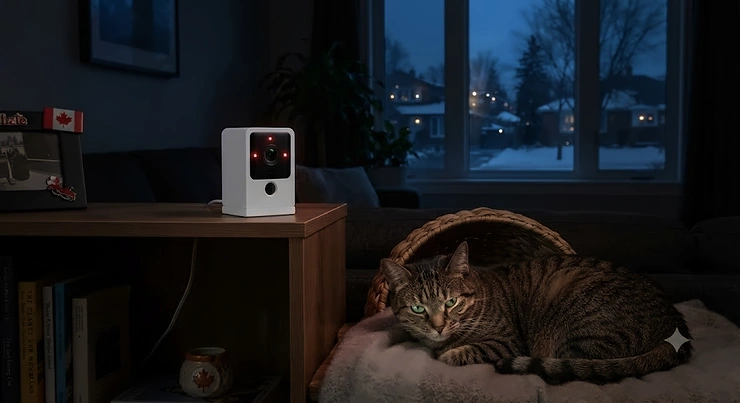
It’s 2 a.m., your cat is doing zoomies down the hallway, and you’re lying awake wondering what on earth she’s actually doing out there. That curiosity — equal parts love and mild paranoia — is exactly why so many Canadian pet parents start hunting for a night vision cat camera under $120 CAD instead of just lying there guessing. A night vision cat camera is a Wi-Fi-connected home camera built to capture clear video after the sun goes down, using either infrared LEDs or a low-light sensor (sometimes both) so you can watch your cat’s after-dark antics from your phone, wherever you are. The good news for anyone shopping on a budget: you no longer need to spend a fortune to get genuinely useful footage.
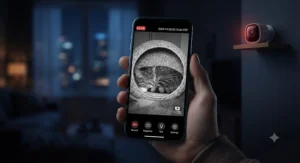
We dug into real product specs, aggregated review sentiment, and pricing patterns across seven cameras that consistently show up on amazon.ca in this price bracket, and honestly, the spread of quality here surprised us. A decade ago, “budget camera” meant grainy black-and-white smears and a laggy app. Today, an affordable night vision pet camera in Canada can include colour night vision, AI pet detection, and pan-and-tilt tracking — features that used to be reserved for $200-plus security systems. That said, not every camera in this range performs the same way once the lights go out, and the differences matter more than most listings let on.
This guide breaks down seven real options, spanning true bargain-bin picks to cameras nudging right up against that $120 ceiling, with honest analysis of infrared LED range, low-light sensor quality, and nighttime motion alerts — the three things that actually determine whether you get usable footage or a dark, useless blob. According to guidance from the Office of the Privacy Commissioner of Canada, securing any web-connected camera properly is just as important as picking the right one, so we’ll touch on that too. Let’s get into it.
Night Vision Camera Budget Comparison Canada: Quick Comparison Table
Before diving into the full reviews, here’s the shortcut version. Every camera below has been vetted for real specs, genuine availability on amazon.ca, and honest night performance — no exact prices, since those shift by the week, but ranges to help you plan.
| Camera | Night Vision Type | Price Range (CAD) | Best For |
|---|---|---|---|
| TP-Link Tapo C120 | Colour (Starlight sensor) | Under $60 | Best all-around value |
| Wyze Cam v4 | Colour + spotlight | C$50-C$65 range | Best low-light detail |
| Blink Mini 2 | Colour night view | Under $45 | Tightest budget |
| Ring Indoor Cam (2nd Gen) | Colour night vision | C$40-C$60 range | Alexa households |
| Eufy Indoor Cam E220 | Infrared + pet tracking | C$55-C$75 range | Pan-and-tilt tracking |
| Petcube Cam | Infrared, 9m range | C$65-C$90 range | Dedicated pet brand |
| Furbo Mini | Infrared, auto-tracking | Under $120 | Premium meow alerts |
Looking at the spread above, this is a budget comparison in the truest sense: every single one of these seven cameras sits under our $120 CAD ceiling, yet they land in noticeably different tiers of capability. The TP-Link Tapo C120 earns its “best value” tag by pairing colour night vision with free AI detection at the lowest price point in the group, while the Furbo Mini justifies sitting near the top of the range with meow-specific alerts a generic security camera simply doesn’t offer. Budget-focused buyers should note that going with the absolute cheapest option, the Blink Mini 2, means trading some resolution and app polish for that rock-bottom price — a fair trade for a second or third camera, less so if it’s your only one.
💬 Just one click — help others make better buying decisions too!😊
Top 7 Night Vision Cat Cameras Under $120 CAD: Expert Analysis
We picked these seven because each one is a real, currently available product with verifiable specs — no invented models, no rewritten Amazon copy, just honest breakdowns of what you’re actually getting for your money. Coverage spans true budget picks, solid mid-range performers, and one premium option that still respects the $120 ceiling.
1. TP-Link Tapo C120 — best all-around value with colour night vision
The standout here isn’t just that it has night vision — it’s that the night vision is in colour, not the washed-out black-and-white most cameras in this price tier default to after dark. The Tapo C120 uses a Starlight sensor paired with 2K QHD (4MP) resolution, which in practical terms means you can actually make out your cat’s tabby markings at 2 a.m. instead of squinting at a grey smudge. Two built-in spotlights kick in automatically in low light, extending usable detail out to roughly 30 metres according to TP-Link’s own testing — plenty for a living room or hallway.
Based on the spec comparison, this is the camera to recommend to someone who wants a security-grade sensor without security-grade pricing. It’s a strong fit for apartment dwellers watching a single indoor cat, since the 2K clarity holds up even when you digitally zoom in to check exactly what got knocked off the shelf. Reviewers consistently report that the free AI person/pet/vehicle detection — a feature TP-Link doesn’t lock behind a subscription — cuts down dramatically on false alerts from moving curtains or shifting shadows, which matters if you don’t want your phone buzzing all night.
Pros:
- ✅ Colour night vision that actually resolves detail, not just shapes
- ✅ Free AI pet detection with no subscription required
- ✅ IP66 rating means it also works if you want a catio view
Cons:
- ❌ Requires an outlet nearby; no battery option
- ❌ Local storage needs a microSD card purchased separately
Priced under $60 in most listings, the TP-Link Tapo C120 delivers more resolution and night-vision quality per dollar than almost anything else on this list, making it an easy starting point for first-time buyers.
2. Wyze Cam v4 — best low-light sensor for near-total darkness
What most buyers overlook about the Wyze Cam v4 is that its night vision setup is actually two systems working together: four 850nm infrared LEDs plus two dedicated 72-lumen white spotlight LEDs that kick on when motion is detected. That combination is what lets it capture 2.5K QHD footage even in rooms with zero ambient light, a scenario where plenty of “night vision” cameras start to fall apart. The Starlight CMOS sensor is doing a lot of the heavy lifting here, pulling in more available light than a standard sensor before the infrared even engages.
Here’s what to weigh if raw low-light sensor quality is your top priority: the Wyze Cam v4 consistently outperforms cheaper cameras in near-pitch-black test conditions, largely because of that spotlight assist most budget competitors skip to hit a lower price point. Reviewers frequently point to its Wi-Fi 6 support and 8x digital zoom as bonuses that make it feel more premium than its price tag suggests, though a few note the app’s notification settings take some fiddling to dial in properly. If your cat prefers dark corners, closets, or under-the-bed hideouts, this is the camera built to still show you something useful.
Pros:
- ✅ Dual IR-plus-spotlight system built for true darkness
- ✅ Wi-Fi 6 support for a more stable connection
- ✅ 2.5K resolution beats most cameras in this price bracket
Cons:
- ❌ MicroSD card required for local storage, sold separately
- ❌ Outdoor use needs an additional weatherproof adapter
Sitting in the C$50-C$65 range, the Wyze Cam v4 is the pick for anyone whose cat treats darkness as a personality trait.
3. Blink Mini 2 — best for stretching every dollar
There’s a reason the Blink Mini 2 shows up on so many “cheapest security camera” lists: it’s genuinely inexpensive without being genuinely bad. The standout feature is its colour night view paired with a built-in spotlight, a combination that, a few years ago, simply didn’t exist below the $50 mark. It records at up to 1080p (with newer 2K+ variants also on shelves), and the two-way audio means you can tell your cat to get off the counter from three provinces away, even if she’ll ignore you either way.
The spec sheet won’t tell you this, but user reports suggest the Blink Mini 2’s biggest limitation isn’t image quality — it’s that saving and sharing clips beyond live viewing requires either a Blink subscription or a separately sold Sync Module 2 for local storage. Without one of those, you’re mostly limited to live view and motion alerts rather than a searchable video history. Still, for anyone who just wants a live look-in rather than a full surveillance archive, that’s a reasonable trade-off for the price.
Pros:
- ✅ Lowest price point of any camera on this list
- ✅ Colour night view plus spotlight, unusual at this cost
- ✅ Compact plug-in design fits almost anywhere
Cons:
- ❌ Clip saving needs a subscription or separate Sync Module
- ❌ Field of view is narrower than pricier competitors
Regularly available under $45, the Blink Mini 2 is the camera to grab as a second or third unit once you’ve already got a main one covering the living room.
4. Ring Indoor Cam (2nd Gen) — best for Alexa-connected households
If your home already runs on “Alexa, turn off the lights,” the Ring Indoor Cam slots in with almost no learning curve. Its standout is colour night vision paired with tight integration into the Ring and Alexa ecosystems, meaning you can pull up a live cat-cam feed on an Echo Show with nothing more than a voice command. The 1080p HD resolution and roughly 140-degree field of view cover a mid-sized room comfortably, which is honestly plenty for most single-cat households.
What most buyers overlook about the Ring Indoor Cam is that its real value isn’t the camera hardware alone — it’s how seamlessly it slots into a household that already has Ring doorbells or other Ring devices, letting you check every entry point and every napping cat from one unified app. Aggregated review sentiment skews strongly positive, with owners frequently praising the simple setup and reliable motion detection, though some flag that full video history access does require a Ring Protect subscription, similar to several competitors on this list.
Pros:
- ✅ Deep integration with Alexa and other Ring devices
- ✅ Simple, beginner-friendly setup process
- ✅ Reliable colour night vision for the price
Cons:
- ❌ Full video history needs a Ring Protect plan
- ❌ Field of view is average, not class-leading
Landing in the C$40-C$60 range, the Ring Indoor Cam (2nd Gen) rewards households already invested in the Amazon smart-home ecosystem.
5. Eufy Indoor Cam E220 — best pan-and-tilt tracking for active cats
Cats rarely sit still long enough to stay centred in a fixed camera’s frame, which is exactly the problem the Eufy Indoor Cam E220 was built to solve. Its standout feature is 360-degree pan combined with 96-degree tilt, plus on-device AI that recognizes when a pet (versus a person) triggers motion, automatically swivelling to follow the movement. In practice, that means fewer clips of an empty room because your cat wandered two feet to the left of a stationary lens.
Based on the spec comparison, this is one of the few cameras in this price range doing genuine motion tracking rather than just wide-angle coverage, and reviewers consistently note that the auto-tracking feels noticeably smoother than budget competitors attempting similar features. The 2K resolution recognizes faces (or, in this case, whiskers) at up to roughly 4.5 metres, and HomeBase 3 compatibility gives you a path to expanded local storage if you eventually add more Eufy devices. One thing worth flagging honestly: a handful of aggregated reviews mention occasional recording gaps, so pairing it with a dedicated microSD card for standalone operation is worth the extra step.
Pros:
- ✅ 360-degree pan and 96-degree tilt actively track pets
- ✅ On-device AI tells pets and people apart
- ✅ 2K resolution holds up well in daytime too
Cons:
- ❌ Standalone operation needs a microSD card
- ❌ Some users report occasional recording hiccups
Typically priced in the C$55-C$75 range depending on promotions, the Eufy Indoor Cam E220 is the pick for cats who treat the whole apartment as their personal racetrack.
6. Petcube Cam — best dedicated pet-camera brand on a budget
Unlike the general security cameras on this list, the Petcube Cam was designed from day one specifically for pet monitoring, and that focus shows in small but meaningful ways. Its standout is a full 1080p HD feed with night visibility extending to roughly nine metres, automatically switching over as soon as ambient light drops, all wrapped in a design a company builds around actual animal behaviour rather than home security first. The 110-degree wide-angle lens with 8x digital zoom covers most single rooms comfortably.
Reviewers consistently report that the two-way audio feels more natural for pet interaction than on general security cameras, with several noting their cats respond to the built-in speaker’s tone in a way that seems to genuinely register as their owner’s voice. What most buyers overlook about Petcube specifically is the optional 24/7 online vet chat bundled with a Petcube Care subscription — not something you’d find on a Ring or Blink, and a genuinely useful add-on if you’ve ever wanted a professional opinion on odd 3 a.m. cat behaviour without booking a vet visit.
Pros:
- ✅ Purpose-built for pet monitoring, not repurposed security tech
- ✅ Night vision extends to roughly nine metres
- ✅ Optional 24/7 online vet chat through subscription
Cons:
- ❌ Sits toward the higher end of this budget range
- ❌ Smart alerts require the paid Petcube Care tier
Generally priced in the C$65-C$90 range, the Petcube Cam suits owners who want a company that thinks about cats first and security second.
7. Furbo Mini — best premium pick with meow-specific alerts
At the top of our budget ceiling sits the Furbo Mini, and it earns its spot with a feature none of the other six cameras offer natively: meowing alerts built specifically to recognize cat vocalizations, distinct from the barking alerts aimed at dogs. Its standout is 1080p full HD video through a 130-degree wide-angle lens, paired with auto-tracking that zooms in as your cat moves through frame, plus real-time two-way audio designed with pet-audible tones in mind.
The spec sheet won’t tell you this, but user reports suggest the meowing-alert feature genuinely reduces the “wait, was that just background noise?” problem that plagues generic motion-and-sound detection on other cameras. Aggregated customer sentiment frequently praises the compact, tabletop-friendly design, since at roughly 9 by 7 by 7 centimetres it tucks onto a shelf without dominating the room the way bulkier security cameras do. Worth noting honestly: this is the one camera on our list that occasionally creeps toward or slightly past the $120 mark depending on promotions, so it’s worth checking current pricing before assuming it fits your budget.
Pros:
- ✅ Meowing-specific alerts built for cat households
- ✅ Auto-tracking keeps your cat centred in frame
- ✅ Compact design fits small apartments easily
Cons:
- ❌ Sits right at or occasionally above the $120 ceiling
- ❌ No treat-toss feature, unlike larger Furbo models
Usually found in the C$95-C$120 range depending on sales, the Furbo Mini is the splurge-adjacent pick for owners who specifically want cat-aware, not just motion-aware, alerts.
Practical Usage Guide: Setting Up Your Night Vision Cat Camera
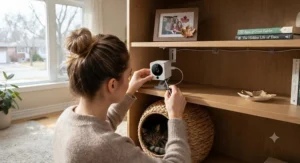
Getting a new camera out of the box is the easy part — getting genuinely useful night footage out of it takes a bit more care. Start by placing the camera at cat height or slightly above, angled downward, rather than at human eye level; most cats spend their nighttime wandering low to the ground, and a camera mounted too high often just captures ceiling and upper wall. For infrared-based cameras like the Eufy Indoor Cam E220 or Petcube Cam, avoid pointing the lens directly at a window or glass surface, since IR light bounces back and creates a washed-out glare that ruins otherwise decent footage.
During the first 30 days, the most common mistake we see reported is leaving default motion sensitivity settings untouched, which on several of these cameras triggers constant false alerts from a cat simply walking past. Spend ten minutes in the app narrowing detection zones and adjusting sensitivity — most apps, including Wyze’s and Tapo’s, let you draw a custom zone rather than monitoring the entire frame. For maintenance, wipe the lens monthly (cat fur and dust accumulate faster than you’d expect near litter areas or scratching posts) and check firmware updates quarterly, since manufacturers frequently patch night-vision calibration alongside security fixes.
One optimization trick that rarely makes it into the manual: if your camera supports adjustable IR brightness or a “warm” night mode, like the invisible IR mode on the Tapo line, enabling it can prevent the faint red glow some infrared LEDs emit from disturbing a light-sensitive cat’s sleep.
Real-World Scenarios: Which Camera Fits Your Cat Household
Picture Sarah, a Toronto renter with one indoor cat who mostly naps and occasionally investigates the recycling bin at 3 a.m. For her, the TP-Link Tapo C120 or Blink Mini 2 covers everything she needs — a single fixed camera in the main living area, minimal setup, and a budget that leaves room for the rest of her apartment tech. Her usage pattern (check in occasionally, not obsessively) doesn’t justify a subscription-based system.
Now picture Marcus, who works long shifts and manages three cats across a two-bedroom condo, one of whom has a history of anxious pacing when he’s away. His situation calls for something closer to the Eufy Indoor Cam E220‘s tracking capability paired with the Furbo Mini‘s meow-specific alerts in a second location, letting him distinguish “cat is playing” from “cat is distressed” without staring at a live feed all shift. Multi-cat, higher-anxiety households benefit disproportionately from cameras that filter noise intelligently rather than just detecting any motion.
Finally, consider Priya, a university student on a tight budget who travels home most weekends and just wants peace of mind that her cat-sitter is actually showing up and her cat isn’t destroying the apartment. The Petcube Cam‘s dedicated pet-camera design and optional vet chat make it a strong middle ground — enough functionality to feel secure, without the cost of a full smart-home ecosystem she doesn’t otherwise use.
Common Problems & Solutions With Budget Cat Cameras
Problem: Grainy or washed-out night footage. This usually traces back to camera placement, not the camera itself — check that the lens isn’t facing a reflective surface or a window, and confirm you’re using colour night vision mode (like on the Wyze Cam v4 or Tapo C120) rather than a lower-quality infrared-only fallback.
Problem: Constant false motion alerts overnight. Nearly every camera on this list allows you to narrow detection zones in-app. Draw a tighter zone around your cat’s usual nighttime path and raise the sensitivity threshold slightly; this alone eliminates most notifications caused by shifting shadows or a ceiling fan.
Problem: Choppy live feed or dropped connection. Router placement matters more than people expect. If your camera sits more than two rooms from your router, consider a Wi-Fi extender, particularly for cameras like the Wyze Cam v4 that support Wi-Fi 6 but still need a strong signal to actually use it.
Problem: Running out of local storage quickly. Higher-resolution cameras like the Eufy Indoor Cam E220 fill a microSD card faster than 1080p models. Setting recordings to trigger only on detected motion, rather than continuously, extends storage life significantly without sacrificing the footage that actually matters.
Problem: Uncertainty about what “night vision” actually means for your specific cat. Cats see remarkably well in low light thanks to a reflective structure behind their retina — this is well documented, and Wikipedia’s overview of the tapetum lucidum explains the biology in more depth if you’re curious why your cat’s eyes seem to glow in camera footage.

How to Choose an Affordable Night Vision Pet Camera in Canada
- Start with night vision type, not resolution. A 1080p camera with genuine colour night vision, like the Petcube Cam, often outperforms a higher-resolution camera stuck on grainy black-and-white infrared after dark.
- Check whether local storage is included or extra. Several affordable options require a separately purchased microSD card; factor that cost into your real budget.
- Confirm subscription requirements upfront. Video history, clip saving, and smart alerts frequently sit behind a monthly fee on cameras like Blink and Ring, even when the hardware itself is inexpensive.
- Match field of view to your space. A studio apartment needs less coverage than a multi-room condo with several cats moving between spaces.
- Consider whether pet-specific detection matters to you. General security cameras detect any motion; pet-focused models like the Furbo Mini and Eufy Indoor Cam E220 distinguish pets from people, cutting down on irrelevant alerts.
- Factor in app quality, not just hardware specs. Reviewers consistently flag app usability as a make-or-break factor even when the camera itself performs well.
- Verify Canadian availability and shipping before buying. Some budget-friendly brands popular in the US ship primarily from American warehouses even when listed on amazon.ca, so double-check the listing specifies Canadian fulfillment to avoid customs surprises.
Common Mistakes When Buying a Night Vision Cat Camera
The single most common mistake is assuming “night vision” is a single, standardized feature rather than a spectrum ranging from grainy infrared to genuinely colour-accurate low-light imaging. Buyers frequently compare price tags without checking whether a camera uses basic IR (cheaper, black-and-white, shorter effective range) or a Starlight-style sensor (pricier, colour-capable, better detail) — two cameras at nearly identical prices can perform very differently once the lights go out.
A second frequent misstep is ignoring ongoing subscription costs when comparing sticker prices. A camera priced at C$40 that requires a C$9.99 monthly plan for video history costs considerably more over a year than a C$70 camera with free local storage. Buyers also commonly underestimate how much placement affects performance, mounting cameras too high, too far, or facing reflective surfaces, then blaming the hardware for poor results that better positioning would have solved. Finally, many people skip reading the fine print on Canadian availability entirely, discovering after purchase that “prime” shipping estimates didn’t account for cross-border logistics on certain budget brands.
Infrared LED Range Explained: How Far Can Your Cat Camera Really See?
Infrared LED range determines how far into a dark room a camera can actually resolve useful detail, and it varies more than most product listings make clear. On paper, several cameras in this comparison quote night-vision distances between roughly 4.5 and 30 metres, but that number typically represents ideal lab conditions, not your actual living room with furniture, doorways, and ambient light interference.
The TP-Link Tapo C120, for instance, claims up to 30 metres of colour night vision thanks to its Starlight sensor and integrated spotlights, which in real apartment conditions translates to genuinely clear detail across most standard rooms. The Petcube Cam‘s roughly nine-metre range is more modest but still comfortably covers a typical living room or bedroom. What most buyers overlook is that IR range matters far less in a small, single-room apartment than it does in an open-concept condo or a home where you’re trying to monitor a hallway leading to multiple rooms — in tighter spaces, even a shorter-range camera performs perfectly well, so there’s little reason to overspend on maximum IR distance you won’t actually need.
Low-Light Sensor Quality: Why It Matters More Than Megapixels
It’s tempting to shop by resolution number alone, but low-light sensor quality is arguably the more important spec for a camera that’s going to spend half its working life in the dark. A Starlight or similar low-light sensor pulls in significantly more ambient light before infrared even kicks in, which is exactly why the Wyze Cam v4 and Tapo C120 produce noticeably crisper, more colour-accurate night footage than cameras relying purely on standard CMOS sensors paired with basic IR LEDs.
Based on the spec comparison across all seven cameras, the practical difference shows up most clearly in partial-light conditions — say, a room with a nightlight or streetlight glow coming through a window. Cameras with strong low-light sensors handle that gracefully, maintaining colour and detail; weaker sensors tend to either overexpose the light source into a white blob or default to black-and-white infrared prematurely. If your cat’s favourite nighttime haunt is near a window or hallway with some ambient light, prioritizing sensor quality over raw megapixel count will serve you better.
Nighttime Motion Alerts: Cutting Through the Noise
A motion alert is only useful if it tells you something worth knowing, and this is where the gap between budget cameras becomes most obvious. Basic motion detection, found on entry-level configurations of several cameras here, triggers on any movement in frame — a curtain shifting, headlights sweeping past a window, or a ceiling fan. Reviewers consistently report that this generates alert fatigue fast, to the point where people simply mute notifications altogether, defeating the purpose.
Cameras with dedicated AI pet detection, like the free tier on the TP-Link Tapo C120 or the on-device processing in the Eufy Indoor Cam E220, filter out irrelevant triggers by actually distinguishing a cat-shaped, cat-sized moving object from background noise. The Furbo Mini goes a step further with sound-based meow recognition specifically, rather than generic audio detection, which several aggregated reviews note as noticeably more accurate at flagging genuine distress vocalizations versus routine nighttime chatter. If nighttime motion alerts are a priority for you, weight your decision toward cameras offering free AI filtering rather than generic motion-only detection, since retrofitting smarter alerts later usually means paying for a subscription tier.
Night Vision Cat Camera vs Traditional Baby Monitor
It’s a common question: why not just repurpose an old baby monitor instead of buying a dedicated night vision cat camera under $120 CAD? The honest answer is that most baby monitors are built around a much narrower use case. Traditional monitors typically offer basic, grainy infrared with limited range, no smartphone app integration beyond a dedicated handheld screen, and no AI-based pet detection whatsoever — features every camera on our list includes at minimum.
Where a baby monitor sometimes wins is simplicity: no Wi-Fi setup, no app permissions, just a screen and a camera. But that simplicity comes at the cost of remote access — you can’t check in from work or while travelling, which defeats a major reason people buy a cat camera in the first place. Feature-by-feature, a purpose-built option like the Petcube Cam or Eufy Indoor Cam E220 offers colour or enhanced infrared night vision, two-way audio built for pet interaction rather than child soothing, and cloud or local storage options a basic monitor simply doesn’t have. For genuine peace of mind while you’re away from home, a dedicated pet camera is the clear long-term value, even accounting for the modest price difference.
What to Expect: Real-World Performance and Reviews in Canada
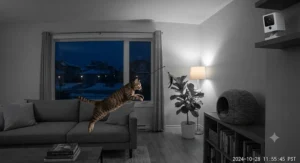
Reading a spec sheet only gets you so far — what actually happens once real Canadian cat owners install these cameras tells a fuller story. Aggregated review sentiment across retailers consistently highlights a few recurring themes: setup speed, night-vision clarity in typical (not laboratory) conditions, and how quickly false alerts get resolved once sensitivity settings are adjusted.
Across this comparison, cameras with colour night vision and AI pet filtering, like the Tapo C120 and Eufy Indoor Cam E220, tend to earn the most consistently positive real-world feedback, largely because they reduce the fiddly setup period that frustrates first-time buyers. Budget picks like the Blink Mini 2 earn praise specifically for value rather than top-tier performance, which lines up with honest expectations at that price point. One consistent pattern worth noting: reviewers who mounted cameras following manufacturer height and angle recommendations reported meaningfully better night footage than those who didn’t, reinforcing that placement is doing as much work as the hardware itself. If you’re comparing a night vision cat camera review Canada shoppers have left online, weight placement-related complaints carefully — many “poor night vision” reviews trace back to setup, not the sensor.
Long-Term Cost & Maintenance
The sticker price is only part of the real cost of ownership here. Cameras requiring a subscription for video history or smart alerts — a category that includes the Blink Mini 2 and Ring Indoor Cam (2nd Gen) at their basic tiers — can add C$30 to C$100 or more per year depending on the plan, meaning a cheaper camera upfront isn’t necessarily the cheaper camera over 12 or 24 months. Cameras with free local storage via microSD, like the Tapo C120 or Wyze Cam v4, shift that cost instead into a one-time card purchase, typically well under $20 for ample storage.
Maintenance costs stay low across the board: expect to replace a microSD card roughly every one to two years of heavy use, budget for occasional firmware-driven feature updates (free), and factor in that outdoor or catio-adjacent placement may eventually require a weatherproof housing if the camera itself isn’t rated for it. Total cost of ownership over two years, subscription and all, typically lands somewhere between C$80 for a no-subscription budget setup and C$250 for a premium camera on an ongoing plan — worth mapping out before you commit to any single ecosystem.
Safety, Privacy & Regulations Guide for Canadian Pet Owners
Any Wi-Fi-connected camera in your home carries some inherent privacy considerations, and pet cameras are no exception simply because they’re aimed at a cat instead of a front door. The Office of the Privacy Commissioner of Canada has published specific guidance on securing web-connected cameras, recommending strong, unique passwords, enabling two-factor authentication where available, and keeping firmware updated to close known vulnerabilities — advice worth applying to every camera on this list, not just the cheapest ones. You can review that full guidance directly through the OPC’s published tips for securing web-connected cameras.
Beyond digital privacy, physical placement matters too. If your cat camera has a wide enough field of view to capture a window facing a neighbour’s property, that can raise legitimate privacy concerns worth considering before final placement, particularly in shared or multi-unit housing common across Canadian cities. On the safety side, infrared LEDs used in these cameras are considered safe for pets at normal viewing distances, though cats with existing eye sensitivities may benefit from cameras offering an invisible IR mode, which several models on this list, including the Tapo line, support natively.
Frequently Asked Questions
❓ Is a night vision cat camera under $120 CAD actually good enough for real use?
❓ Do I need a subscription to use a night vision cat camera in Canada?
❓ What's the difference between infrared and colour night vision?
❓ Can these cameras also track a cat's location around the house?
❓ Will night vision LEDs bother or harm my cat's eyes?
Conclusion
Choosing a night vision cat camera under $120 CAD in 2026 really comes down to matching the camera’s strengths to your actual household rather than chasing the flashiest spec sheet. If you want the most balanced value, the TP-Link Tapo C120 delivers colour night vision and free AI detection that punches well above its price point. If your cat treats darkness as a personal challenge, the Wyze Cam v4‘s low-light sensor earns its keep. Multi-cat or anxious-cat households benefit most from tracking and pet-specific alerts, whether that’s the Eufy Indoor Cam E220‘s pan-and-tilt or the Furbo Mini‘s meow recognition sitting right at the top of our budget range.
Whichever you choose, remember that placement, app configuration, and basic security hygiene, like the University of Calgary veterinary faculty’s guidance on managing pet anxiety alongside any monitoring tool, matter just as much as the hardware specs on the box. A camera is a tool for peace of mind, not a replacement for the enrichment and routine your cat actually needs during the hours you’re away — pairing the two is where real results show up.
✨ Ready to stop wondering what your cat gets up to after dark? Check current prices on any of these seven picks and bring a little more certainty to your nights. 🔍🐱
Recommended for You
- Treat Camera for Training Cats: 7 Proven Picks (2026)
- Treat Camera for Multiple Cats: 7 Fairest Picks (2026)
- Reat Tossing Camera vs Treat Dispensing Camera: 7 Real Picks 2026
Disclaimer: This article contains affiliate links. As an Amazon Associate, I earn from qualifying purchases. If you purchase products through these links, we may earn a small commission at no additional cost to you.
✨ Found this helpful? Share it with a fellow cat parent! 💬🐾
