
In This Article
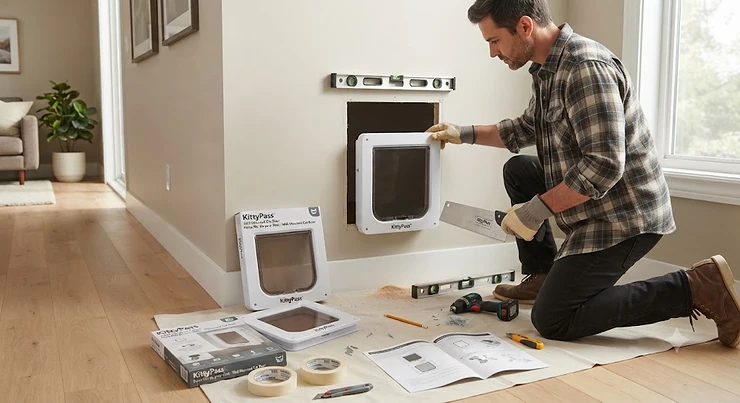
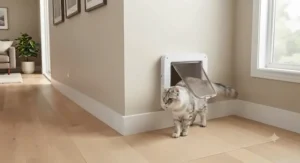
A wall mounted cat door is a small doorway, complete with its own tunnel, that’s cut directly into a wall rather than into an existing door — letting your cat come and go without you playing doorman five times a night. It’s the go-to fix when your entry door isn’t hollow-core (so a standard flap won’t fit), when you rent and can’t touch the front door, or when the litter box lives in the garage and Mittens needs her own commute route. For Canadian homeowners, the calculation is a bit different than it is south of the border: our walls tend to run thicker because of insulation requirements, our winters are harder on hardware, and a lot of us are working with brick, stucco, or vinyl siding rather than simple wood-frame doors.
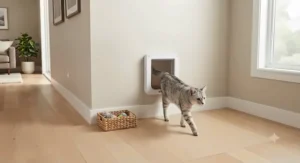
This guide digs into seven real, currently available options, breaks down what their specs actually mean once winter hits, and walks through installation — including the parts nobody tells you about until you’re standing in your basement with a hole saw. We looked at aggregated review sentiment, manufacturer documentation, and Canadian retailer listings to keep every recommendation grounded in reality rather than marketing copy. If you’ve been Googling “wall cat flap with tunnel” at 11 p.m. wondering whether this is even possible in a brick bungalow, it is — and we’ll show you exactly how.
Quick Comparison Table
| Product | Best For | Wall Thickness | Price Range (CAD) |
|---|---|---|---|
| PetSafe Wall Entry Pet Door (Small) | Budget cat-only households | 12 cm–18.5 cm (4.75″–7.25″) | C$60–C$90 |
| Cat Mate Lockable Cat Flap (234W) + Wall Liner | Renters, small stackable tunnel | Custom (2″ liners stack) | C$45–C$85 |
| Ideal Pet Products Wall Entry Double Flap | Mid-size households, added security | 11 cm–23 cm (4.25″–9.25″) | C$140–C$190 |
| PetSafe Wall Entry Aluminum Pet Door | Brick, stucco, or siding exteriors | 12 cm–18.5 cm (4.75″–7.25″) | C$150–C$210 |
| SureFlap Microchip Cat Flap + Tunnel Extender | Multi-cat homes needing selective entry | Custom (5 cm extenders) | C$130–C$260 |
| High Tech Pet Power Pet Wall Tunnel Kit | Automatic/electronic door owners | 31 cm (12.25″) fixed kit | C$300–C$420 |
| Kitty Pass Interior Cat Door (no-flap tunnel) | Interior walls, litter box access | Standard interior stud wall | C$70–C$110 |
Looking at the spread above, the honest takeaway is that “wall mounted” doesn’t mean one-size-fits-all — you’re really choosing between three different problems (exterior weatherproofing, interior litter-box privacy, and multi-cat security), and the right product depends on which one you actually have. Budget buyers gravitate toward the PetSafe Wall Entry Pet Door (Small) or the Cat Mate Lockable Cat Flap, but anyone dealing with a 23 cm brick-and-block wall will find those tunnels simply too short and need the extended range of the Ideal Pet Products Wall Entry Double Flap instead. Meanwhile, if the goal is just hiding a litter box behind a closet wall, paying for weatherproofing you’ll never use — like on the PetSafe Wall Entry Aluminum Pet Door — is money wasted on the wrong problem.
💬 Just one click — help others make better buying decisions too!😊
Top 7 Wall Mounted Cat Doors: Expert Analysis
1. PetSafe Wall Entry Pet Door (Small) — best budget pick built for cats specifically
The small size of the PetSafe Wall Entry Pet Door was sized with cats (and small dogs) in mind, not scaled down from a big-dog model as an afterthought. Its telescoping plastic tunnel adjusts to fit walls between roughly 12 cm and 18.5 cm thick, and the flap opening comes in around 20 cm wide — plenty for even a chunky rescue cat. Based on the spec comparison with pricier metal-framed options, the plastic frame trades some rigidity for being lighter, cheaper, and immune to rust, which matters in humid basements. This is the model we’d point a first-time installer toward: it’s genuinely the easiest DIY option on this list, with a paper cutting template and pre-drilled hardware that doesn’t require any specialty tools. Reviewers consistently report that the double-flap design keeps drafts down noticeably compared to single-flap dollar-store alternatives, though a handful mention the plastic slide-in closing panel can warp slightly after a few Canadian winters of freeze-thaw cycling. What most buyers overlook is that this door is only rated to about 15 kg — fine for cats, tight for a mixed cat-and-small-dog household.
Pros:
- ✅ Purpose-built cat-appropriate flap size, no oversizing
- ✅ Simplest DIY install of any option reviewed here
- ✅ Rust-proof plastic frame handles humid basements well
Cons:
- ❌ Closing panel can warp after repeated freeze-thaw seasons
- ❌ Not rated for mixed households with larger dogs
Priced in the C$60–C$90 range at the time of research, this is the door we’d recommend if your only goal is a straightforward, no-fuss cat door and your wall falls inside the standard thickness window.
2. Cat Mate Lockable Cat Flap (234W) with Wall Liner — best stackable tunnel for oddly thin or thick walls
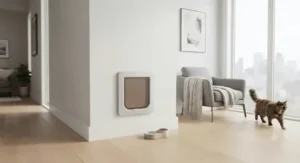
What sets the Cat Mate Lockable Cat Flap apart isn’t the flap itself — it’s the accessory system built around it. Instead of one fixed telescoping tunnel, Cat Mate sells 5 cm (2″) wall liner sections separately, and you snap together as many as your specific wall needs. Here’s what to weigh: that modularity means the Cat Mate Lockable Cat Flap is arguably the only door on this list that adapts gracefully to a non-standard wall, whether that’s a thin interior partition or a thick century-home exterior wall with lath and plaster. The base flap includes a 4-way lock (in-only, out-only, locked, or free access), which is a genuinely useful feature for households managing an indoor-only cat alongside one with outdoor privileges. A common theme in aggregated review sentiment is that the liner sections need a bead of sealant between joints to stay watertight — the manufacturer even recommends wrapping seams in duct tape for exterior installs, which feels a little low-tech for the price point.
Pros:
- ✅ Modular liners fit almost any wall thickness exactly
- ✅ 4-way lock gives real control over access
- ✅ Liners are paintable to match your wall colour
Cons:
- ❌ Requires manual sealing between liner joints
- ❌ Assembling multiple liners takes longer than a one-piece tunnel
At around C$45–C$85 depending on how many liner sections you need, this is the pick for anyone whose wall doesn’t match the “standard” thickness every other manufacturer assumes.
3. Ideal Pet Products Wall Entry Pet Door (Double Flap) — best all-rounder for mid-size Canadian homes
The Ideal Pet Products Wall Entry Pet Door covers a noticeably wider thickness range than the PetSafe options — its telescoping tunnel is rated for walls from roughly 11 cm up to 23 cm, which happens to line up well with a lot of Canadian exterior wall assemblies once you factor in exterior insulation and interior drywall. Based on the spec comparison, the extra flexibility comes from a longer built-in tunnel designed to drain water away from the wall rather than pooling at the threshold — a detail that matters more in a Canadian climate with spring melt than it does anywhere drier. The medium size fits cats and smaller dogs comfortably, and a lock-out slide panel lets you seal the opening completely overnight or during a cold snap. Reviewers consistently note that the double vinyl flap is noticeably better at cutting drafts than the single-flap dollar-store equivalents, though a few mention the white frame yellows slightly with UV exposure after a couple of summers on a south-facing wall.
Pros:
- ✅ Widest wall-thickness range of any budget-to-mid door here
- ✅ Built-in drainage design suited to snowmelt and rain
- ✅ Lock-out slide panel seals the opening completely
Cons:
- ❌ White frame can yellow with prolonged sun exposure
- ❌ Medium size may be tight for larger mixed-breed dogs
At a price range in the C$140–C$190 zone, this is the door that best splits the difference between “cheap and cheerful” and “built to last.”
4. PetSafe Wall Entry Aluminum Pet Door — best for brick, stucco, and siding exteriors
If your exterior is brick, stucco, or vinyl siding rather than a plain wood-frame door, the PetSafe Wall Entry Aluminum Pet Door is explicitly engineered for that scenario, and it shows in the details. The aluminum-reinforced frame resists the kind of impact and warping that a straight plastic frame can suffer over a rough Canadian winter, while the telescoping tunnel handles walls from about 12 cm to 18.5 cm, with optional extension kits stretching that up to roughly 30 cm for genuinely thick masonry walls. What the spec sheet won’t tell you, but reviewers note, is that installing into solid brick (rather than brick veneer over a wood frame) is a materially bigger job — you’re looking at a masonry bit and considerably more patience, and it’s often worth budgeting for a professional for that specific case. This model is rated up to roughly 45 kg, so it comfortably covers cats plus a medium dog if you’ve got a mixed household, without being wildly oversized for a cat-only home.
Pros:
- ✅ Aluminum frame holds up to brick and stucco installs
- ✅ Extension kits available for extra-thick masonry walls
- ✅ Handles mixed cat-and-dog households without oversizing badly
Cons:
- ❌ Solid brick installs are genuinely difficult DIY territory
- ❌ Aluminum frame conducts more cold than plastic in deep winter
Expect a price range around C$150–C$210, with extension kits sold separately if your wall runs on the thicker side.
5. SureFlap Microchip Cat Flap with Tunnel Extender — best for multi-cat households needing selective entry
The SureFlap Microchip Cat Flap solves a problem none of the mechanical doors above even attempt: keeping the neighbour’s cat (or a hungry raccoon) out while still letting your own cats through. It reads your cat’s existing microchip — no separate collar tag needed if your cat is already chipped, which most vets recommend anyway — and unlocks only for registered IDs, storing up to 32 pet profiles in memory. For wall installation, Sure Petcare sells tunnel extenders that stack in 5 cm increments onto the flap’s built-in 7 cm tunnel, a genuinely clever wall pet door tunnel extension system compared to buying an entirely separate wall kit. Based on the spec comparison, the trade-off for that smart security is battery dependency: it runs on four AA batteries with roughly a 12-month life, so it’s not a “set and forget forever” installation the way a purely mechanical flap is. Aggregated review sentiment is largely positive on the microchip reliability, though a subset of owners with older or damaged microchips report occasional missed reads requiring a chip re-scan and re-registration.
Pros:
- ✅ Selective microchip entry blocks strays and wildlife
- ✅ Stackable extenders build a custom wall tunnel length
- ✅ Stores up to 32 registered pet identities
Cons:
- ❌ Requires battery changes roughly once a year
- ❌ Occasional missed microchip reads reported by some owners
Priced around C$130–C$260 depending on extender count, this is the strongest pick if unwanted animal traffic is your actual problem, not just letting your own cat in and out.
6. High Tech Pet Power Pet Wall Tunnel Kit — best for owners already running an automatic electronic door
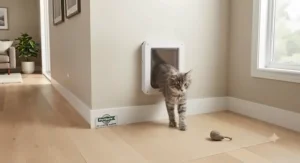
The High Tech Pet Power Pet Wall Tunnel Kit isn’t a door by itself — it’s the wall-installation tunnel built specifically for High Tech Pet’s Power Pet electronic sliding doors, and it’s worth including here because “automatic pet door in a wall” is a real, growing category that mechanical flaps can’t touch. The kit measures roughly 31 cm by 41 cm and is purpose-built to house the electronic door’s sliding panel and collar-key or RFID sensor inside a finished wall opening rather than a standard door slab. Here’s what to weigh: because the whole point of the Power Pet system is a motorized panel that only opens for your cat’s specific collar key or chip, pairing it with a wall tunnel effectively turns an entire exterior wall into a secured, weatherproof cat entrance — arguably the most “set it and forget it” option on this list once installed correctly. The honest catch is cost and complexity: you’re buying the electronic door and the wall kit separately, and the combined price sits well above every mechanical option here.
Pros:
- ✅ Pairs with motorized, key-activated electronic doors
- ✅ Purpose-built for finished wall openings, not retrofits
- ✅ Effectively automates entry security for one wall installation
Cons:
- ❌ Requires buying the electronic door and tunnel kit separately
- ❌ Highest combined cost of any option in this roundup
Budget C$300–C$420 for the tunnel kit alone, on top of the electronic door itself, putting this firmly in premium territory.
7. Kitty Pass Interior Cat Door (No-Flap Tunnel) — best for hiding a litter box behind an interior wall
Not every wall mounted cat door needs to face the outdoors, and the Kitty Pass Interior Cat Door is built entirely around that idea. It’s a flapless, open tunnel meant to be cut through an interior stud wall — say, between a bedroom closet and a spare room — so your cat can reach a litter box, feeder, or hideaway room without the door (or the litter box) being visible from the main living space. Based on the spec comparison against exterior-rated doors, there’s no weatherstripping or insulation here because there’s no weather to keep out, which keeps the price and installation complexity noticeably lower than every product above it. Reviewers consistently mention how effective the “concealed litter box” use case is for small condos and apartments, since it turns an awkward closet corner into functional cat infrastructure without a visible door cut into a wall. The trade-off is that, with no flap at all, it does nothing to contain smell or noise — it’s a passage, not a seal.
Pros:
- ✅ Purpose-built for interior litter-box concealment
- ✅ Simple installation with no weatherproofing needed
- ✅ Frees up floor space in small condos and apartments
Cons:
- ❌ No flap means no smell or draft containment
- ❌ Not suitable for any exterior-facing wall
At C$70–C$110, it’s an affordable, purpose-specific pick rather than a general-purpose wall mounted cat door — but for the litter-box-hiding use case specifically, nothing else on this list does the job as cleanly.
How to Install a Cat Door in a Wall: The Practical Guide
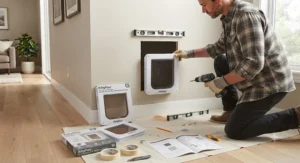
Knowing how to install a cat door in a wall starts well before the hole saw comes out. First, locate studs and any wiring or plumbing behind the target section using a stud finder — cutting blind into an exterior wall is how DIY projects turn into drywall repair projects. Second, measure your actual wall thickness from interior drywall to exterior cladding, including any insulation and sheathing, and compare it against the telescoping range of your chosen door; this single step prevents the single most common return reason cited across the products above. Third, use the manufacturer’s paper template to trace and cut the opening, working from the interior side outward wherever possible for a cleaner exterior cut line. Fourth, dry-fit the tunnel before applying any sealant, checking that both interior and exterior frames sit flush and level. Fifth, run a bead of exterior-grade sealant around the outside frame before final fastening — this is the step reviewers most often mention skipping, and the step most often blamed for winter drafts later. Sixth, for brick or masonry walls specifically, budget extra time for a masonry bit and consider a professional if the wall is solid brick rather than veneer over framing. Common first-30-day mistakes include forgetting to test the lock-out panel before the first cold night, and skipping a check of the flap’s magnetic or weighted closure once temperatures actually drop.
Real-World Scenarios: Which Door Fits Your Situation
Consider three common Canadian households. A condo owner in a mid-rise building with an indoor-only cat and a litter box tucked in a closet doesn’t need weatherproofing at all — the Kitty Pass Interior Cat Door solves exactly this, letting the cat reach the closet without a visible door interrupting the room. A family in a century-old brick two-storey with one outdoor-access cat and an active raccoon population nearby needs both masonry-friendly installation and selective entry, making the PetSafe Wall Entry Aluminum Pet Door paired with the SureFlap Microchip Cat Flap a reasonable combination depending on which wall is involved. A renter in a newer townhouse with a standard 15 cm insulated wall and a tight budget is squarely in PetSafe Wall Entry Pet Door (Small) or Cat Mate Lockable Cat Flap territory, since both install without major wall modification and can realistically be patched over at move-out. In each case, the “best” door isn’t the most expensive one — it’s the one matched to wall type, household risk, and how permanent the installation needs to be.
Problem → Solution: Fixing Common Wall Cat Door Issues
Drafts around the frame are the most reported complaint across nearly every mechanical flap here, and the fix is almost always a fresh bead of exterior sealant plus checking that the double-flap magnets still align — flaps do loosen over a few seasons of use. A tunnel that’s slightly too short for the wall is the second most common issue, solved by adding stackable liner sections (as with the Cat Mate Lockable Cat Flap) or a purpose-made extension kit rather than forcing an ill-fitting standard tunnel. Water pooling at the exterior threshold after heavy rain usually points to a door installed without the slight outward slope manufacturers recommend, which the Ideal Pet Products Wall Entry Pet Door‘s built-in drainage tunnel is specifically designed to prevent. Unwanted animals using the flap is a real nuisance-wildlife problem in many Canadian neighbourhoods, and it’s the one issue only a microchip-selective door like the SureFlap Microchip Cat Flap genuinely solves — a lock-out panel only helps if you remember to close it. Finally, a cat refusing to use any wall mounted cat door at all is rarely a hardware problem; propping the flap open with tape for the first week and using treats at the threshold resolves the vast majority of reluctance within a few days.
How to Choose a Wall Mounted Cat Door
- Measure your actual wall thickness first. Every product’s telescoping range is a hard limit, not a suggestion — get this number before comparing anything else.
- Identify your wall material. Brick, stucco, vinyl siding, and interior drywall all call for different tools and, in some cases, different products entirely.
- Decide whether security matters. If wildlife or stray cats are a local nuisance, a microchip-selective door earns its higher price quickly.
- Match the flap size to your cat, not the biggest option available. An oversized flap on a small cat lets in more cold air than necessary.
- Consider whether the wall faces the outdoors at all. Interior-only tunnels like the Kitty Pass Interior Cat Door skip weatherproofing costs entirely.
- Factor in installation difficulty honestly. A masonry wall is a different project than drywall, and it’s fine to budget for professional help.
- Check replacement flap availability. Vinyl and silicone flaps wear out; brands with easily sourced replacement parts save money long-term.
Wall Mounted Cat Door vs Traditional Door-Mounted Cat Flap
| Factor | Wall Mounted Cat Door | Door-Mounted Cat Flap |
|---|---|---|
| Best For | Renters, solid entry doors, litter-box access | Hollow-core interior/exterior doors |
| Installation | Cuts through wall material | Cuts through door slab |
| Wall/Door Damage on Move-Out | Patchable drywall hole | Visible cut in the door itself |
| Weatherproofing Needed | Yes, if exterior-facing | Yes, if exterior-facing |
The core difference comes down to what you’re willing to modify: a wall mounted cat door leaves your actual entry doors untouched, which matters a great deal if you’re renting or simply don’t want to cut a hole in an expensive exterior door. On the other hand, a door-mounted flap is usually the faster, cheaper install if your door is already hollow-core and suitable for cutting. For anyone choosing between the two purely on resale value, a patched drywall hole is generally easier — and cheaper — to make disappear than a visibly modified door.
What to Expect: Real-World Performance Through a Canadian Winter
On paper, every double-flap door promises “energy efficiency,” but what that actually feels like in a January cold snap is a faint draft near the threshold rather than a genuine cold spot in the room — noticeable if you stand right beside it, negligible from across the kitchen. Flap magnets and weighted closures do stiffen slightly in extreme cold, which is why several reviewers across these product lines mention their cat occasionally nudging the flap twice before it swings open on the coldest days. Aluminum-framed doors, like the PetSafe Wall Entry Aluminum Pet Door, transmit a bit more cold to the touch than plastic-framed equivalents, though the difference is more noticeable to a bare hand on the frame than to the room’s overall temperature. Electronic doors housed in a wall tunnel kit, such as the High Tech Pet Power Pet Wall Tunnel Kit, tend to seal more completely when closed than any purely mechanical flap, simply because a motorized panel closes flush rather than relying on gravity or magnets.
Wall Mounted Cat Doors for Different Home Types in Canada
Brick homes present the most involved cat door brick wall project on this list — full brick veneer typically runs at least 7.5 cm thick on its own, sitting in front of a wood-frame wall with an air gap, insulation, and interior drywall, which quickly adds up to the higher end of any telescoping tunnel’s range. Stucco exteriors are comparatively forgiving to cut but need careful sealing at the frame edge, since stucco’s texture makes a perfectly flush fit harder to achieve than with siding or drywall. Vinyl and wood siding homes are generally the easiest exterior installs, with the PetSafe Wall Entry Aluminum Pet Door and Ideal Pet Products Wall Entry Pet Door both explicitly rated for these materials. Interior partition walls, like the one behind a closet litter box, need none of the above considerations — just standard drywall cutting and stud-avoidance, making the Kitty Pass Interior Cat Door the simplest project of the seven by a wide margin.
✨ Ready to compare specific models side by side before you buy?
🔍 Don’t Miss These Top-Rated Picks! Take your cat’s daily routine to the next level with a door that actually matches your wall and your household. Click through to check current availability and pricing on the models above, and give your cat the independence they’ve been meowing about all winter.
Long-Term Cost & Maintenance
| Cost Factor | Budget Doors (e.g., PetSafe Wall Entry Pet Door (Small)) | Premium Doors (e.g., SureFlap Microchip Cat Flap, High Tech Pet Power Pet Wall Tunnel Kit) |
|---|---|---|
| Upfront Price | C$60–C$90 | C$130–C$420 |
| Replacement Flaps | Widely available, low cost | Model-specific, moderate cost |
| Ongoing Power Needs | None | Batteries (microchip) or mains power (electronic) |
| Expected Lifespan | 5–8 years with flap replacement | 6–10+ years with battery/part upkeep |
Looking at total cost of ownership rather than sticker price alone, a budget mechanical door like the PetSafe Wall Entry Pet Door (Small) stays cheap over its lifetime because replacement flaps are inexpensive and widely stocked. Premium options like the SureFlap Microchip Cat Flap cost more upfront and carry a small ongoing battery expense, but the security and convenience they add can be worth it in a household that’s genuinely dealing with unwanted animal traffic. For most single-cat, low-risk households, the cost-per-year math favours the simpler mechanical doors; the premium tier earns its keep specifically when the problem it solves — selective entry or full automation — actually exists in your home.
Features That Actually Matter (And Those That Don’t)
Wall thickness range and flap size matter enormously, because getting either wrong means the door simply won’t fit or will let in more draft than necessary — these are the two specs worth checking before anything else. A four-way lock matters if you have multiple cats with different access needs, but it’s largely decorative in a single-cat household that never needs to restrict access. Microchip selectivity matters a great deal if wildlife or neighbourhood cats are a real nuisance, and barely at all if your only concern is your own cat coming and going. On the other hand, colour options and decorative frame finishes are pure marketing dressing — reviewers rarely mention them, and they have zero bearing on how well the door performs. Similarly, marketed “weight capacity” numbers well above your cat’s actual size don’t add value; an oversized flap only means more cold air moving through with every use.
Permits, Bylaws, and Safety Considerations for Canadian Homes
Cutting into an exterior wall is generally considered minor home improvement rather than a structural renovation, but if your home has brick veneer or masonry cladding, it’s worth reviewing Construction Canada’s overview of masonry veneer construction before you start, since veneer walls include an air gap and drainage system that a poorly sealed cut can compromise. Most municipalities don’t require a permit for a small pet door opening, but it’s always worth a quick call to your local building department if you’re unsure, particularly in a heritage-designated brick property. Beyond the wall itself, there’s a broader safety conversation worth having: research from the University of Guelph’s Ontario Veterinary College found that a meaningful share of Canadian cat owners still allow uncontrolled outdoor access despite known risks to both cats and local wildlife, as detailed in a study on Canadian and American cat owners’ outdoor access attitudes. If full outdoor access isn’t right for your cat, a wall mounted cat door paired with a secured catio is a popular middle ground — CBC covered several Vancouver-area “catio” builds that use exactly this kind of wall or door opening to give cats supervised outdoor time without full free-roam risk.
Frequently Asked Questions
❓ Can you put a wall mounted cat door in a brick wall?
❓ What is the standard cat flap wall kit size?
❓ Do wall mounted cat doors let cold air in during winter?
❓ How much does it cost to install a wall cat flap with tunnel?
❓ Can I use a wall pet door tunnel extension on any brand?
Conclusion
Choosing the right wall mounted cat door really comes down to answering three questions honestly: how thick and what material is your wall, how much security do you actually need, and is this opening facing the outdoors at all. Budget-conscious, cat-only households do perfectly well with the PetSafe Wall Entry Pet Door (Small) or the endlessly adjustable Cat Mate Lockable Cat Flap, while brick and masonry homes are better served by the PetSafe Wall Entry Aluminum Pet Door and its available extension kits. If unwanted animal traffic is a genuine problem in your neighbourhood, the SureFlap Microchip Cat Flap earns its higher price, and anyone hiding a litter box behind an interior wall should look straight at the Kitty Pass Interior Cat Door rather than paying for weatherproofing they’ll never use. Whichever you choose, measure twice, seal properly, and give your cat a week to trust the new opening before assuming it’s the wrong product.
Recommended for You
- Cat Door for Interior Door: 7 Top Picks for Canadian Homes 2026
- Cat Door for Exterior Door: 7 Best Picks for Canadian Homes (2026)
- How to Install Cat Door in Window: 7 Best Picks for 2026
Disclaimer: This article contains affiliate links. As an Amazon Associate, I earn from qualifying purchases. If you purchase products through these links, we may earn a small commission at no additional cost to you.
✨ Found this helpful? Share it with your friends! 💬🤗
